
Canterbury & Kent
Expert Witness Surveys in Property Disputes: When and Why UK Courts Need a Chartered Surveyor
Nearly one in three boundary disputes that reach the First-tier Tribunal (Property Chamber) turns on technical surveying evidence that the judge alone cannot assess without specialist help. That single fact explains why expert witness surveys in property disputes have become a cornerstone of UK property litigation, and why understanding them matters to anyone facing a valuation challenge, a defects claim, a boundary conflict, or a party wall disagreement.
This article introduces non-lawyer property owners, landlords, and legal professionals to the concept of expert witness property surveys: what they are, when courts require them, what types of dispute they cover, and how a CPR-compliant expert report differs fundamentally from the building survey a buyer commissions before exchanging contracts.
Key Takeaways
- UK courts rely on chartered surveyors as expert witnesses whenever a property dispute turns on technical questions, such as market value, defect causation, boundary location, or party wall damage, that fall outside judicial expertise.
- Expert witness surveys must comply with Civil Procedure Rules Part 35, the RICS professional standard “Surveyors acting as expert witnesses,” and (from 30 November 2026) the new 5th edition of that standard.
- The surveyor’s primary duty is to the court, not to the instructing party, a fundamental difference from a standard building survey or valuation report.
- Courts may appoint a Single Joint Expert (SJE) to avoid duplication and control costs, or allow each party to instruct their own expert.
- A standard building survey or defects report cannot simply be repurposed as expert evidence without significant restructuring to meet CPR requirements.
What Expert Witness Surveys in Property Disputes Actually Are
An expert witness survey is a formal investigation and written report produced by a chartered surveyor specifically for use as evidence before a court, tribunal, or arbitration panel. It is not the same as a pre-purchase building survey, a mortgage valuation, or a landlord’s schedule of condition. Its purpose is to place specialist technical knowledge before a decision-maker who lacks that knowledge, enabling the court to resolve a factual dispute it could not determine on its own.
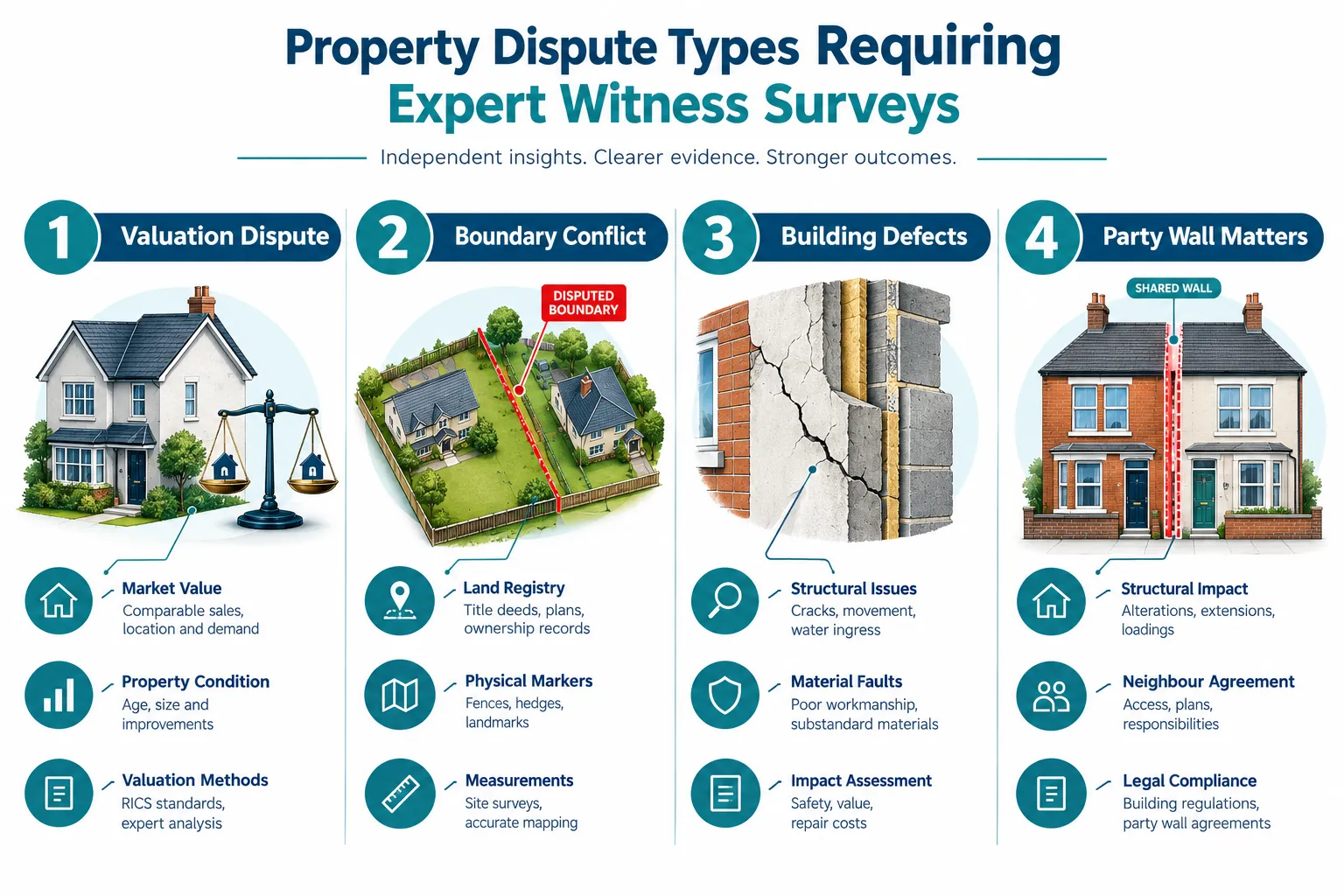
The legal framework governing this work is the Civil Procedure Rules (CPR), particularly Part 35, which sets out the duties of experts and the rules for expert evidence in civil proceedings. Alongside CPR, RICS members must comply with the RICS professional standard “Surveyors acting as expert witnesses.” The current operative version is the 4th edition (effective April 2014, last amended February 2023), which remains in force until 30 November 2026 [4]. From that date, the newly published 5th edition, released in July 2026, takes effect, consolidating and tightening expectations on independence, documentation, and methodological transparency [2].
The overriding principle is simple but demanding: the expert’s duty is to the court, not to the client who is paying the fee. This obligation of independence and impartiality is non-negotiable. A surveyor who allows their opinion to be shaped by the interests of the instructing party risks having their evidence rejected and may face regulatory consequences from RICS [3].
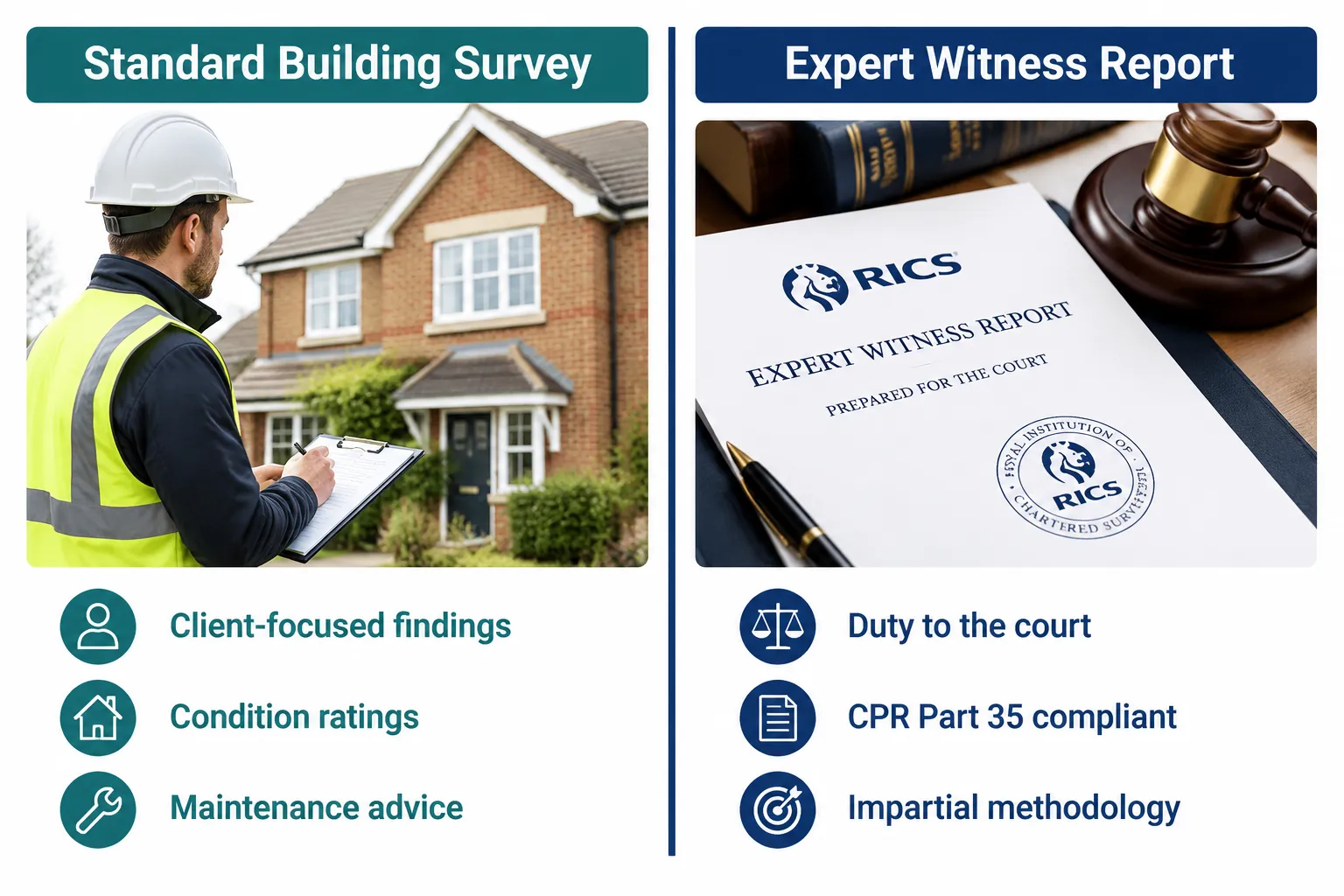
How an Expert Witness Report Differs from a Standard Survey
A standard building survey is written for a property buyer or owner. It describes condition, flags risks, and recommends action. It is client-focused, commercially oriented, and written in plain language to help someone make a decision.
An expert witness report, by contrast, must:
- Contain a statement of truth in the prescribed form required by CPR Part 35 and the RICS standard [4]
- State the expert’s qualifications and the scope of their instructions
- Set out the methodology used, including how comparables were selected or how defects were diagnosed
- Identify any facts or matters that might affect the opinion
- Be addressed to the court, not to the instructing solicitor or client
- Comply with any court directions on format, length, and exchange timetable
The article “From Surveyor to Expert Witness: Turning a Standard Defects Report into CPR-Compliant Evidence Without Starting Again” explores in detail how surveyors must restructure existing reports to meet these requirements, it is not a cosmetic exercise.
The Four Main Dispute Types That Require Expert Witness Surveys in Property Disputes
Courts and tribunals encounter property disputes across a wide spectrum. The following four categories account for the majority of instructions to chartered surveyors acting as expert witnesses.
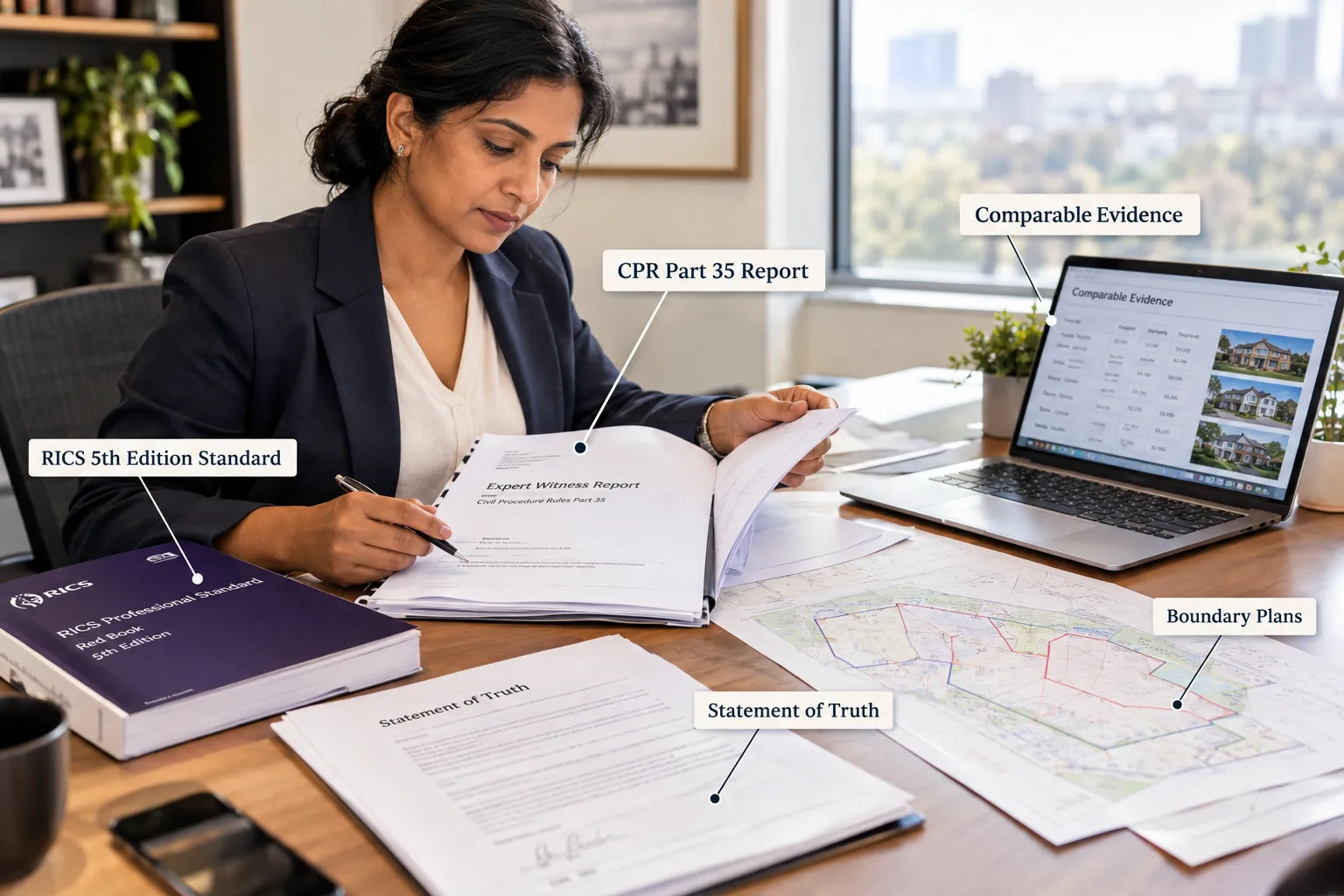
1. Valuation Disputes
Valuation disputes arise when parties disagree about the market value of a property at a specific date, for example, in professional negligence claims against a surveyor or lender, matrimonial proceedings, probate, compulsory purchase, or Leasehold Valuation Tribunal rent review cases.
The 2025 case Bratt v Jones is instructive here. The court clarified that a claimant alleging negligent valuation must demonstrate two things: first, that the valuation fell outside the permissible margin of error (typically 5-15% depending on property type and market conditions); and second, that the valuer failed to exercise reasonable care and skill, for example, by relying on inappropriate comparables or making false assumptions [9]. This ruling underscores why courts need rigorous, independently prepared expert valuation evidence from chartered surveyors: without it, the margin-of-error question simply cannot be answered.
For further context on how expert evidence functions in valuation litigation, see expert witness roles in mortgage valuation disputes and RICS standards and expert witness valuations in mortgage rate disputes.
2. Building Defects and Dilapidations
Disputes about construction defects, dampness, structural failure, or dilapidations at lease end require a surveyor who can diagnose the cause of a problem, attribute responsibility, and quantify the cost of remedy. These cases often turn on questions such as:
- Was the defect present before the purchase?
- Did the contractor deviate from specification?
- Is the landlord or the tenant responsible for the deterioration?
A chartered surveyor with expertise in building pathology is uniquely placed to answer these questions. Courts will not accept a generalist opinion; the expert must be a genuine subject-matter specialist [5]. Damp surveys and specific defect reports form the investigative foundation for this category of expert evidence.
3. Boundary Disputes
Boundary disputes are among the most contentious, and expensive, property conflicts in England and Wales. They often involve ambiguous title deeds, historical maps, and physical features on the ground that do not match the paper record.
The RICS Dispute Resolution toolkit for boundary disputes sets out a clear process: a chartered surveyor may be appointed either as a Single Joint Expert (SJE) by court order or as a party-appointed expert witness. The surveyor prepares either a full expert witness report or an advisory opinion to help clients assess whether to pursue or settle the claim [8]. Detailed boundary surveys provide the physical measurement and mapping evidence that underpins this expert opinion.
4. Party Wall Disputes
The Party Wall etc. Act 1996 creates a statutory framework for resolving disputes between adjoining owners. When the statutory process breaks down, or when damage is alleged following notifiable works, a chartered surveyor may be called upon to provide expert evidence about the condition of the party wall before and after works, the cause of any damage, and the appropriate remedy.
This category overlaps with building defects work but has its own procedural nuances. Understanding the statutory context is essential, as explored in detail in the article on party wall surveys for basement excavations and deep foundation works.
How UK Courts Manage Expert Witness Surveys in Property Disputes
Understanding court procedure helps property owners and their advisers make better decisions about when and how to instruct a surveyor.
Single Joint Expert vs. Party-Appointed Expert
Under CPR Part 35, courts actively manage expert evidence to avoid duplication and control costs. In many lower-value property disputes, the court will direct that a Single Joint Expert (SJE) be appointed, a single surveyor instructed by both parties jointly. The SJE’s report is addressed to the court and both parties may put written questions to the expert after the report is served.
Where the dispute is sufficiently complex or the parties’ positions sufficiently divergent, each side may be permitted to instruct their own expert. If both experts are instructed, the court will typically order them to meet without the parties or lawyers present, to produce a joint statement identifying the issues on which they agree and disagree and the reasons for any disagreement.
A party will only be allowed to replace or supplement an expert’s report if the original report is significantly deficient in a way that cannot be addressed through questions, a high threshold that reinforces the importance of instructing the right expert from the outset [13].
The RICS Standards Framework in 2026
The regulatory landscape for expert witnesses is evolving. The RICS Practice Alert on Expert Witnesses (first issued February 2024 and updated in 2025) reminds all RICS members that they must comply with the current edition of “Surveyors acting as expert witnesses” and with CPR at all times [1]. The 4th edition practice statement, which sets mandatory duties including the prescribed statement of truth, conflict-of-interest management, and report structure, remains operative until 30 November 2026 [4].
The 5th edition, published in July 2026, is described as a global standard applying to surveyors giving oral or written expert evidence before UK courts and tribunals [2]. Industry analysis suggests it tightens, rather than relaxes, expectations on independence, documentation, and methodological transparency [6].
Key obligations under both editions include:
| Obligation | What It Means in Practice |
|---|---|
| Duty to the court | Opinion must be objective and uninfluenced by the instructing party |
| Conflicts of interest | Must be identified and managed before accepting instructions |
| Statement of truth | Prescribed wording required in every report |
| Methodology | Assumptions, comparables, and reasoning must be explicit |
| Fee arrangements | Fees must not be contingent on the outcome of the case |
| Distinction from advocacy | The expert advises the court; the lawyer argues the case |
Sources: [4][7][2]
“Courts will only rely on chartered surveyors where they possess specialised expertise in fields such as valuation, building pathology or boundary matters relevant to the dispute.”, RICS, December 2023 [5]
When Should a Party Instruct an Expert Surveyor?
The earlier, the better. A surveyor instructed at the pre-litigation stage can:
- Provide an advisory opinion to help the client assess the strength of their case
- Identify evidence that needs to be preserved before it is altered or lost
- Advise on proportionality, whether the cost of litigation is justified by the likely outcome
- Prepare a report that is already structured to meet CPR requirements if proceedings are issued
Waiting until proceedings are underway risks missing court-imposed deadlines for expert evidence and limits the surveyor’s ability to inspect the property in its original condition.
Qualifications, Independence, and Practical Considerations
Not every chartered surveyor is qualified to act as an expert witness. RICS is explicit that the expert must be a genuine subject-matter specialist, someone whose expertise is directly relevant to the technical question the court needs to answer [5]. A residential valuer is not automatically qualified to give expert evidence on construction defects, and a building surveyor is not automatically qualified to give evidence on rent review methodology.
Practical checklist for instructing parties:
- Confirm the surveyor holds MRICS or FRICS status and has current RICS membership
- Verify that their area of specialism matches the technical issue in dispute
- Confirm they have experience of CPR Part 35 compliance and have previously produced expert witness reports
- Check for any conflicts of interest, prior instructions from the opposing party, previous involvement with the property, or financial relationships
- Agree terms of engagement in writing, including scope, timetable, and fee arrangements that are not contingent on the outcome [7]
Chartered surveyors across London and the South East, including those practising as chartered surveyors in North London, chartered surveyors in East London, and chartered surveyors in Sussex, regularly handle the full range of property dispute types described in this article.
The Cost of Getting It Wrong
The consequences of a poorly prepared expert report are significant. A report that does not comply with CPR Part 35 may be excluded from evidence entirely. A surveyor who gives partisan evidence risks a finding of bias, which can destroy the credibility of the entire technical case. In the worst cases, a surveyor who knowingly misleads the court may face criminal liability for contempt as well as RICS disciplinary proceedings.
The 2025 Bratt v Jones decision is a reminder that courts scrutinise expert valuation evidence carefully, examining the choice of comparables, the assumptions made, and the reasoning applied [9]. Robust, well-structured expert evidence from a qualified chartered surveyor is not a luxury; in many property disputes, it is the difference between winning and losing.
Conclusion
Expert witness surveys in property disputes occupy a distinct and demanding space between surveying practice and legal procedure. Whether the dispute concerns a negligent valuation, a structural defect, a contested boundary, or party wall damage, UK courts depend on chartered surveyors to translate complex technical questions into clear, impartial evidence.
Actionable next steps for anyone facing a property dispute:
- Identify the technical question at the heart of the dispute, valuation, defects, boundary, or party wall, and seek a surveyor whose specialism matches that question precisely.
- Instruct early. Pre-litigation advisory opinions are often more cost-effective than waiting for court directions on expert evidence.
- Verify CPR compliance. Confirm that any surveyor instructed as an expert witness has experience of producing reports that comply with CPR Part 35 and the current RICS standard.
- Check the regulatory position. From 30 November 2026, the new RICS 5th edition professional standard applies. Ensure any surveyor instructed after that date is familiar with its updated requirements.
- Consider proportionality. An expert surveyor can provide an advisory opinion before proceedings are issued, helping parties assess whether litigation is worth pursuing or whether an early settlement is more sensible.
The role of the chartered surveyor as expert witness is only growing in importance. As property values remain significant and disputes more complex, the courts’ need for rigorous, independent, and well-structured expert surveying evidence will continue to define outcomes in property litigation across England and Wales.
References
[1] Practice Alert Expert Witnesses February 2024 – rics.org
[2] Surveyors Acting As Expert Witnesses – rics.org
[3] Expert Witness Duties Responsibilities – ww3.rics.org
[4] Surveyors acting as expert witnesses Feb2023amend – rics.org
[5] Surveyors As Expert Witnesses – rics.org
[6] RICS 2026 Expert Witness Guidance Key Changes For Surveyors – rimkus.com
[7] Residential And Commercial Dispute Resolution – isurv.com
[8] RICS Boundary Disputes Dispute Resolution – img1.wsimg.com
[9] Bratt V Jones 2025 Clarifies Professional Negligence Claims Against Property Valuers – aaronandpartners.com
[10] August 2020 Surveyors Acting As Expert Witnesses 4th Edition – rics.org
Related services from Canterbury Surveyors
- Party wall surveyors in Canterbury & Kent
- Boundary surveys
- Building expert witness surveyors
- Dilapidations surveyors
Get a fixed-fee quote or call 0204 579 8270.