
Canterbury & Kent
Defects Found in Building Surveys: What Surveyors Look For and What Should Worry You
Only 31% of homes surveyed show no faults at all. That single statistic, drawn from UK building defect data compiled in 2026, reframes the entire homebuying process [6]. For the remaining 69% of properties, a building survey will uncover something, and the real question is not whether defects exist, but which ones demand urgent action and which ones are simply part of owning an older building.
Understanding the defects found in building surveys, what surveyors look for and what should worry you, is essential knowledge for any buyer, owner, or investor. This guide breaks down the most common findings across Level 2 and Level 3 surveys, explains the rating system surveyors use to signal severity, and draws a clear line between routine maintenance items and genuine red flags that can affect safety, value, and long-term costs.
Key Takeaways
- The vast majority of properties have at least one defect; only around a third are entirely fault-free, making building surveys a near-universal necessity rather than an optional extra.
- Roof coverings, damp, structural movement, and defective services are the most frequently flagged issues and the most likely to carry serious financial and safety consequences.
- RICS Condition Rating 3 items, those needing urgent repair or investigation, are the non-negotiable priorities in any survey report.
- New builds are not immune: paintwork, doors, windows, plumbing, and electrical faults appear in the vast majority of newly completed homes, and some snagging issues cross into safety-critical territory.
- Fire-safety defects, waterproofing failures, and structural instability are the three categories that should trigger immediate specialist follow-up, not just a note on a maintenance list.
What Surveyors Actually Examine: The Scope of a Building Survey
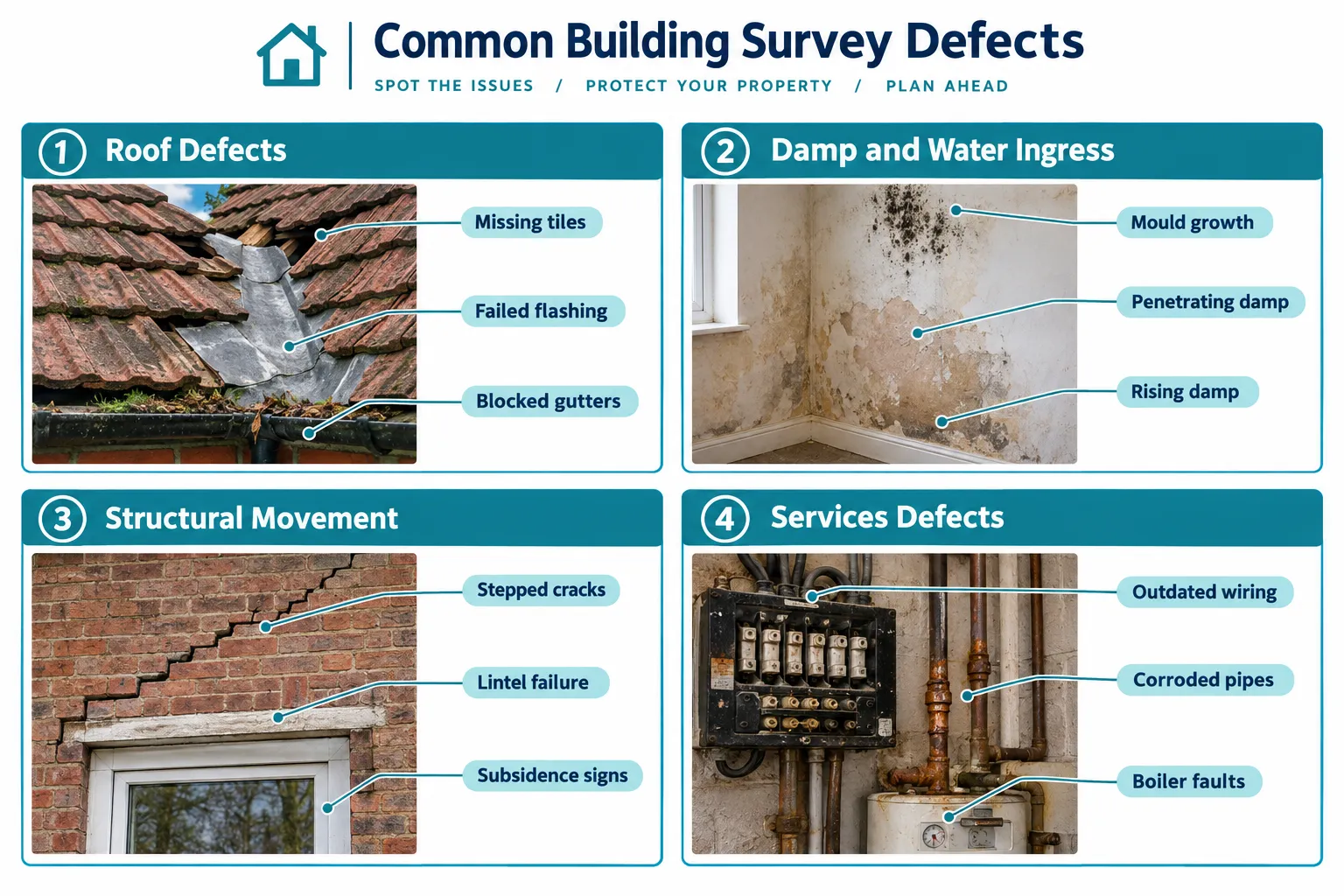
A building survey is a systematic, element-by-element inspection of a property’s condition. The scope differs between survey levels: a Level 2 HomeBuyer Report covers accessible and visible elements in a standardised format, while a Level 3 Building Survey provides a more detailed narrative assessment suited to older, larger, or significantly altered properties. Both use the same RICS Condition Rating system to communicate severity.
The three condition ratings work as follows:
| Rating | Meaning | Action Required |
|---|---|---|
| Condition 1 | No repair needed; normal maintenance only | Monitor |
| Condition 2 | Defects that need repairing or replacing but are not considered serious | Plan and budget |
| Condition 3 | Serious defects requiring urgent repair, replacement, or investigation | Act immediately |
Condition Rating 3 is the one that should command a buyer’s full attention. RICS guidance is explicit: failure to act on a Condition 3 item risks “serious safety issues or severe long-term damage” to the property [8][9]. In practice, surveyors assign this rating to significant structural movement, widespread damp, failing roofs, serious timber decay, and unsafe services.
For a detailed breakdown of what different survey types cover and how to choose between them, see this guide to choosing the right property survey.
The Elements Surveyors Inspect
A thorough survey covers the following elements, among others:
- External envelope: Roof coverings, chimneys, flashings, rainwater goods, external walls, windows, and doors
- Internal structure: Ceilings, floors, internal walls, and staircases
- Services: Electrical installations, gas and heating systems, plumbing and drainage
- Roof space: Structural timbers, insulation, ventilation, and signs of water ingress
- Grounds: Drainage, boundary structures, and outbuildings
Research consistently shows that defects are not evenly distributed across these elements. A 2026 synthesis of building defects research found that approximately 40% of recorded defects related to building fabric and cladding, 8.58% to roof and rainwater disposal, and 7.25% to structural elements [4]. This profile explains why surveyors spend disproportionate time on the building envelope.
The Most Common Defects Found in Building Surveys: What Surveyors Look For and What Should Worry You
Roof Defects
Roof problems are among the most consistently reported findings in UK building surveys [1][6][10]. The consequences of a failing roof are severe: water ingress leads to hidden damp in roof spaces and wall cavities, timber decay, mould growth, and elevated heating costs [1][6][10].
Common roof defects include:
- Missing, slipped, or cracked tiles and slates
- Damaged or failed lead flashing around chimneys and abutments
- Deteriorating mortar bedding on ridge tiles and verges
- Blocked or leaking gutters and downpipes
- Poor or absent loft ventilation
- Inadequate insulation
Rainwater goods deserve particular attention. External faults concentrated in roof features and rainwater goods account for 34% of cases where a property is judged to have exterior defects [6]. A blocked gutter may appear trivial, but over time it drives water back into the wall structure, causing penetrating damp that is expensive to trace and remedy.
What should worry you: Any sign of active water ingress in the roof space, failed flashing, or widespread tile displacement. These are typically Condition 3 findings. A surveyor who flags the roof covering with a rating 3 is signalling that repair costs could run into thousands of pounds and that structural timbers may already be at risk.
For buyers looking at properties where roof defects may interact with wider structural issues, this resource on defect diagnosis in older properties and building pathology essentials provides useful context.
Damp
Damp is one of the most frequent findings in building surveys and one of the easiest problems for buyers to miss at a viewing, because it can be concealed behind furniture, carpets, or within wall cavities [1]. There are three main types:
- Rising damp, groundwater drawn up through masonry where the damp-proof course has failed or is absent. Common in properties built before 1900.
- Penetrating damp, water entering through defective external elements: failed pointing, cracked render, leaking windows, or defective rainwater goods.
- Condensation, moisture from internal air condensing on cold surfaces, often caused by poor ventilation and inadequate insulation.
Each type has different causes, different remedies, and different cost implications. Rising damp remediation can involve injecting a new chemical DPC and replastering affected walls. Penetrating damp requires identifying and fixing the source. Condensation-related damp may be resolved with improved ventilation and heating, but if it has led to mould growth, there are health implications for occupants.
Disrepair is the single most common reason a dwelling is judged unfit, accounting for around 46% of unfitness cases [6]. Damp is a primary driver of that disrepair.
What should worry you: Widespread damp affecting multiple rooms or walls, evidence of long-standing water ingress, or damp in combination with timber decay. A specialist damp survey is often recommended following a Level 2 or Level 3 report that flags significant moisture issues.
Structural Movement and Cracking
Cracking in walls and ceilings is extremely common, but not all cracks are equal. Surveyors assess cracking by width, pattern, location, and whether it is active or historic.
A practical guide to crack severity:
| Crack Width | Category | Typical Concern Level |
|---|---|---|
| Hairline (under 0.1mm) | Category 0 | Negligible |
| Up to 1mm | Category 1 | Very slight |
| 1-5mm | Category 2 | Slight to moderate |
| 5-15mm | Category 3 | Moderate |
| 15-25mm | Category 4 | Severe |
| Over 25mm | Category 5 | Very severe |
Evidence of structural cracking and building movement appears in approximately 25% of homes inspected [12][13]. Diagonal stepped cracking in brickwork above windows, cracks that widen at one end, or cracking accompanied by sloping floors or sticking doors can indicate subsidence, heave, or differential settlement.
What should worry you: Category 3 or above cracking, particularly if it is diagonal, recent, or accompanied by other signs of movement such as out-of-plumb walls or distorted door frames. Surveyors will typically recommend a structural engineer’s report in these cases. For properties with a history of movement, the guidance on valuing homes with historic subsidence or previous structural movement is directly relevant.
Timber Defects: Rot and Infestation
Timber is used throughout most UK residential properties, in roof structures, floors, windows, and joinery. It is vulnerable to two main problems:
- Wet rot, caused by persistently damp timber; the wood becomes soft and loses structural integrity
- Dry rot (Serpula lacrymans), a fungal infection that can spread through masonry and destroy large areas of timber even in relatively dry conditions
- Wood-boring insect infestation, evidence of active or past infestation by woodworm or death-watch beetle
Dry rot is the most serious of these. It spreads rapidly, is difficult to eradicate completely, and remediation involves removing and replacing affected timber, treating surrounding masonry, and improving ventilation to prevent recurrence.
What should worry you: Any evidence of dry rot, active wet rot in structural timbers (floor joists, roof rafters, wall plates), or widespread woodworm infestation. These are Condition 3 findings and require specialist investigation before proceeding with a purchase.
Services: Electrics, Gas, and Plumbing
Surveyors are not qualified to test electrical or gas installations in detail, but they do visually assess the condition of visible elements and flag obvious concerns. Unsafe services can be life-threatening, and this is an area where survey findings should never be dismissed as minor.
Common service defects found in surveys include:
- Outdated consumer units (fuse boards) with no residual current device (RCD) protection
- Visible signs of DIY or non-compliant electrical work
- Old rubber-insulated wiring (pre-1960s)
- Corroded or lead pipework
- Boilers beyond their expected service life or showing signs of poor maintenance
- Inadequate drainage or slow-draining waste pipes
For new-build properties, snagging data from 2026 show electrical faults in approximately 60% of units and plumbing defects in around 65% [2]. Even in brand-new homes, services are rarely defect-free.
What should worry you: Any recommendation in the survey report to commission an Electrical Installation Condition Report (EICR) or gas safety inspection should be acted on before exchange of contracts. Unsafe electrics or gas installations are Condition 3 findings with direct safety implications.
Condition Rating 3: The Red Flags That Should Worry You Most
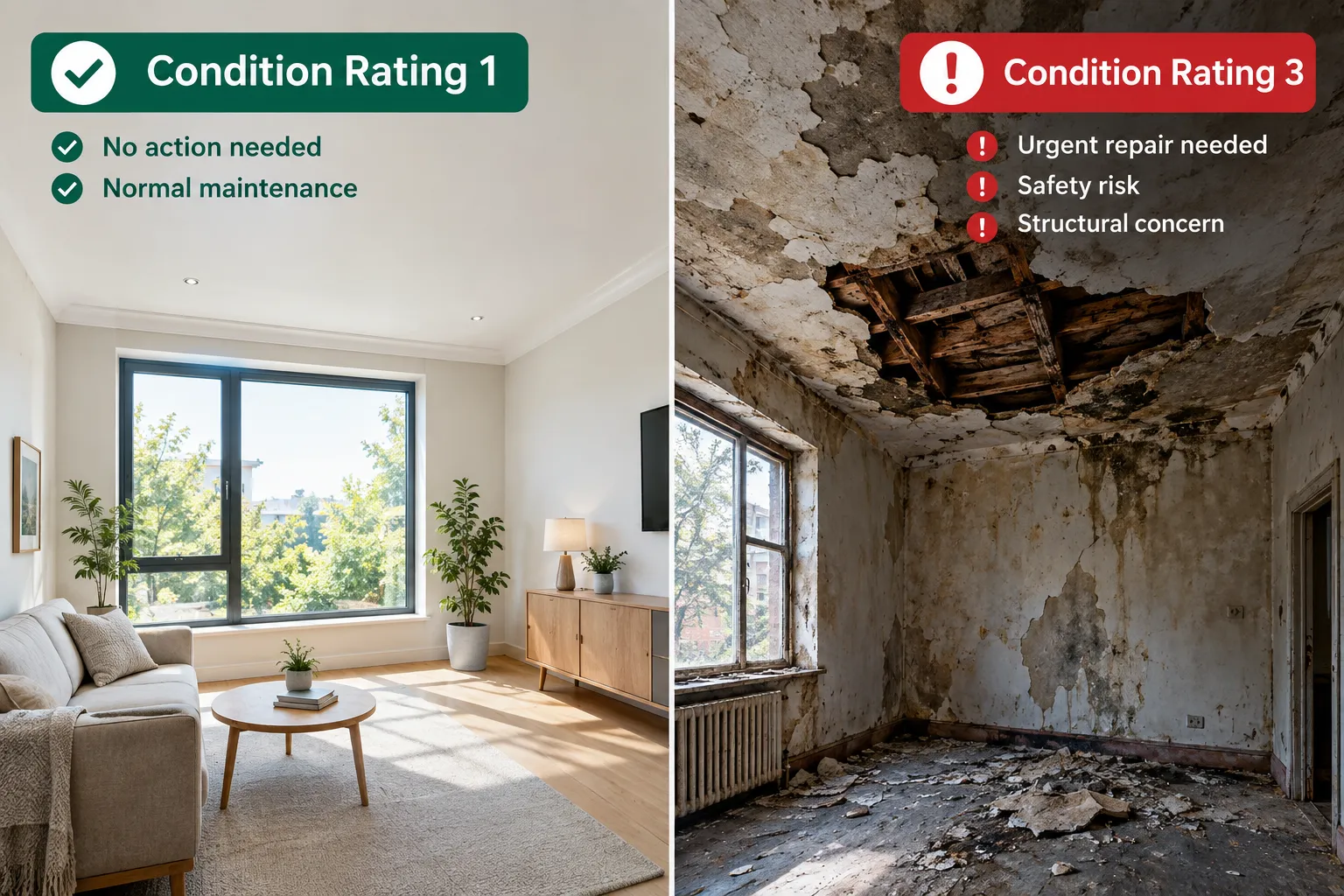
Not all defects found in building surveys carry equal weight. The distinction between what is routine and what is genuinely worrying comes down largely to the RICS Condition Rating system [8][9]. A Condition Rating 3 is not a suggestion, it is a formal signal that a defect is serious enough to require urgent action, specialist investigation, or both.
“Condition Rating 3 defects are those where there are serious defects that need to be repaired, replaced, or investigated urgently. Failure to do so could risk serious safety issues or severe long-term damage to the property.”, RICS HomeBuyer Report guidance [8]
The defect categories most commonly assigned Condition Rating 3:
- Significant structural movement (active subsidence, heave, or settlement)
- Widespread or penetrating damp with associated timber decay
- Failing roof coverings with evidence of water ingress
- Serious timber decay (dry rot, extensive wet rot)
- Unsafe electrical installations or gas appliances
- Fire-safety non-compliance (particularly in flats and converted buildings)
Fire Safety: An Increasingly Critical Area
Fire-safety defects deserve special mention. UK government data for 2026 estimate that between 2,800 and 3,700 mid-rise residential buildings in England have or had unsafe external wall systems requiring remediation [5]. From April 2026, developers are required to report progress on cladding and non-cladding defects separately, reflecting regulatory recognition that serious issues now extend beyond external wall fire risk to include internal fire-protection and structural defects [5].
For buyers of flats, particularly in buildings constructed or converted between 1980 and 2010, fire-stopping, compartmentation, and external wall system compliance are critical survey considerations. A Level 3 survey for a flat in a multi-storey building should always include commentary on fire-safety elements. Buyers considering Level 3 building surveys for buy-to-let investments will find this particularly relevant.
New Builds Are Not Exempt
A common misconception is that new-build properties are defect-free. Snagging data from 2026 tell a different story: paintwork and decorating problems appear in approximately 90% of new builds, doors and windows issues in 75%, plumbing defects in 65%, electrical faults in 60%, and flooring problems in 55% [2]. While many of these are cosmetic, surveys also regularly uncover roof and structural issues, services faults, and damp or insulation defects in brand-new homes [2][7].
Academic research on new-build dwellings reports a mean average of 9.8 defects per home [15]. The subset involving services, drainage, leakage, and structural performance should be treated as higher-risk items that may justify withholding completion or extending warranty claims [7][15].
Industry guidance in 2026 strongly recommends commissioning an independent snagging survey before legal completion wherever possible, or within the first two weeks of occupation if pre-completion access is refused [7]. The building survey defect patterns in 2026 recovery properties resource provides additional context on what surveyors are encountering in the current market.
What to Do After Receiving a Survey Report With Defects
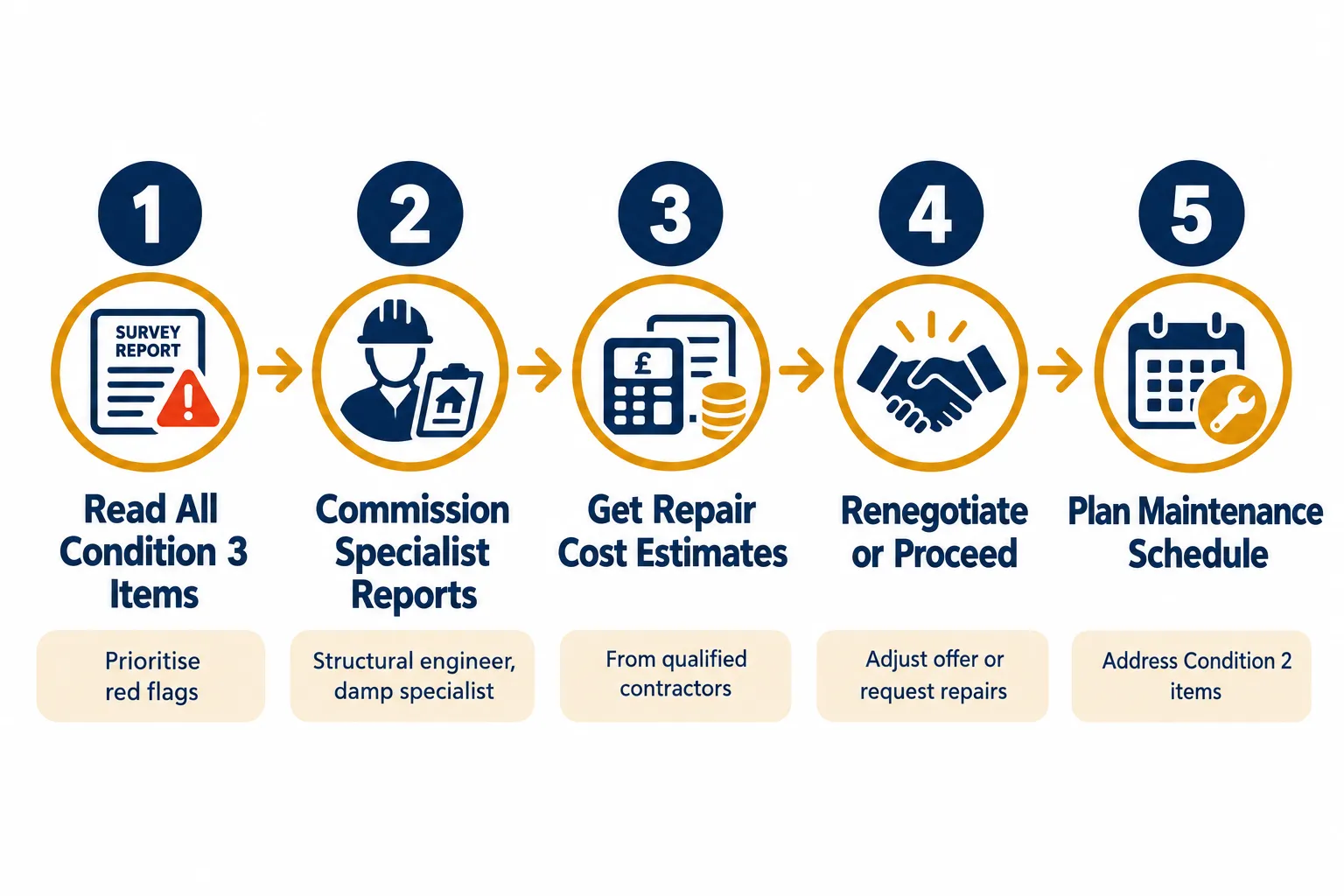
Receiving a survey report with multiple defects is normal. The task is not to panic but to triage, separating the urgent from the manageable and the cosmetic from the structural.
A Practical Action Framework
Step 1: Identify all Condition Rating 3 items These are the non-negotiable priorities. List every element rated 3 and note the surveyor’s specific recommendations, whether that is a specialist report, an urgent repair, or further investigation.
Step 2: Commission specialist reports where recommended A structural engineer’s report for suspected subsidence, an EICR for electrical concerns, a specialist damp report for widespread moisture, these are not optional extras when a surveyor has flagged them. They provide the cost certainty needed to make an informed decision.
Step 3: Obtain repair cost estimates Before renegotiating or proceeding, get at least two contractor quotes for the Condition 3 items. This converts a vague concern into a specific number that can be used in price negotiations.
Step 4: Renegotiate the purchase price or request remediation Armed with specialist reports and cost estimates, buyers are in a strong position to request a price reduction, ask the vendor to carry out repairs before completion, or, in serious cases, withdraw from the purchase.
Step 5: Plan a maintenance schedule for Condition 2 items These are not urgent but they will need attention. A maintenance plan with a realistic budget prevents Condition 2 items from deteriorating into Condition 3 problems after purchase.
For properties where defects have legal or litigation implications, the resource on building survey expertise in construction defect litigation covers how survey findings translate into expert reports and quantum valuations.
Choosing the Right Survey Level
The level of survey commissioned should match the property’s age, complexity, and condition:
- Level 2 HomeBuyer Report, suitable for conventional properties in reasonable condition, typically post-1930 construction with no significant alterations. See the Level 2 HomeBuyer Survey guide for full details.
- Level 3 Building Survey, recommended for properties built before 1900, those with significant alterations or extensions, listed buildings, or any property where the Level 2 scope is insufficient to assess visible concerns.
- Specific Defect Report, targeted investigation of a single identified issue, such as a crack or suspected damp. See the Specific Defect Report service for more information.
For a side-by-side comparison of all survey types, the different types of survey comparison page sets out the key differences clearly.
Conclusion
The defects found in building surveys, what surveyors look for and what should worry you, span a wide spectrum from hairline cracks requiring only monitoring to fire-safety non-compliances demanding immediate specialist action. The data are clear: most properties have defects, and the minority that are genuinely worrying share common characteristics, they affect the building envelope, structural integrity, fire safety, or the safety of services.
Actionable next steps for buyers and owners in 2026:
- Always commission a survey appropriate to the property’s age and complexity, a Level 3 Building Survey for older or complex properties, a Level 2 for conventional post-war homes.
- Treat every Condition Rating 3 item as a mandatory action point, not a negotiating chip to be dismissed.
- Commission specialist reports for structural movement, damp, and services where the surveyor recommends them, these are the areas where survey findings translate directly into safety and financial risk.
- For new-build purchases, arrange an independent snagging survey before legal completion to capture defects while the developer retains responsibility.
- Use the survey report as a living document: Condition 2 items that are deferred today can become Condition 3 problems within a few years if left unaddressed.
A building survey is not a reason to walk away from a purchase, it is the tool that ensures any purchase is made with clear eyes, accurate cost expectations, and a plan for what comes next.
References
[1] Most Common House Survey Problems – surveyorlocal.co.uk
[2] New Build Snagging Guide – housesurveys.co.uk
[4] Examining Building Defects Research Report – mopresearchhub.org
[5] Building Safety Remediation Technical Note June 2026 – gov.uk
[6] Prevalent Building Defects – archifact.co.uk
[7] New Build Snagging And Building Surveys Protecting Off Plan Buyers In The 2026 Construction Uptick – princesurveyors.co.uk
[8] RICS Homebuyer Report Survey Valuation Professional Statement 5th Edition – samconveyancing.co.uk
[9] New Level 3 Report – homesurvuk.com
[10] 10 Common Home Defects Found In Property Surveys And How To Fix Them – lmsurveyors.co.uk
Related services from Canterbury Surveyors
- Boundary surveys
- Building expert witness surveyors
- RICS property valuations
- RICS Homebuyer Surveys (Level 2)
Get a fixed-fee quote or call 0204 579 8270.