
Canterbury & Kent
Compass Use in UK Property Valuation: How Surveyors Turn ‘Compass’ Readings into Real-World Price Adjustments
A south-facing garden can add tens of thousands of pounds to a property’s asking price in the UK, yet the compass bearing that determines that orientation rarely appears as a named line item in a valuation report. Understanding the mechanics behind compass use in UK property valuation, and precisely how surveyors turn ‘compass’ readings into real-world price adjustments, reveals one of the most nuanced and underappreciated skills in the RICS professional toolkit.
This article unpacks the full process: from the moment a surveyor steps onto a site with a compass in hand, through the analysis of sun path, prevailing winds and microclimate, to the final adjustment figure entered into a Red Book valuation. It also examines how automated valuation models (AVMs) are beginning to formalise what was once a matter of professional judgement.
Key Takeaways
- Compass orientation, particularly the direction a garden, main facade or principal windows face, is a recognised property characteristic that influences comparable selection and price adjustment in RICS-compliant valuations.
- RICS Red Book standards require valuers to consider all relevant physical characteristics of a property; orientation is one such characteristic, assessed through inspection and observation [1][2].
- South-facing aspects typically command a measurable premium in the UK residential market, while north-facing or wind-exposed elevations can attract discounts, both of which must be evidenced through comparable transaction data [5].
- AVMs and AI-driven analytics platforms are increasingly encoding orientation as a structured data input, moving compass readings from informal observation to explicit, auditable adjustment factors.
- The weight given to orientation varies significantly by property type, location, and competing valuation factors such as tenure, condition, and legal risk.
What ‘Compass Readings’ Actually Mean in a Valuation Context
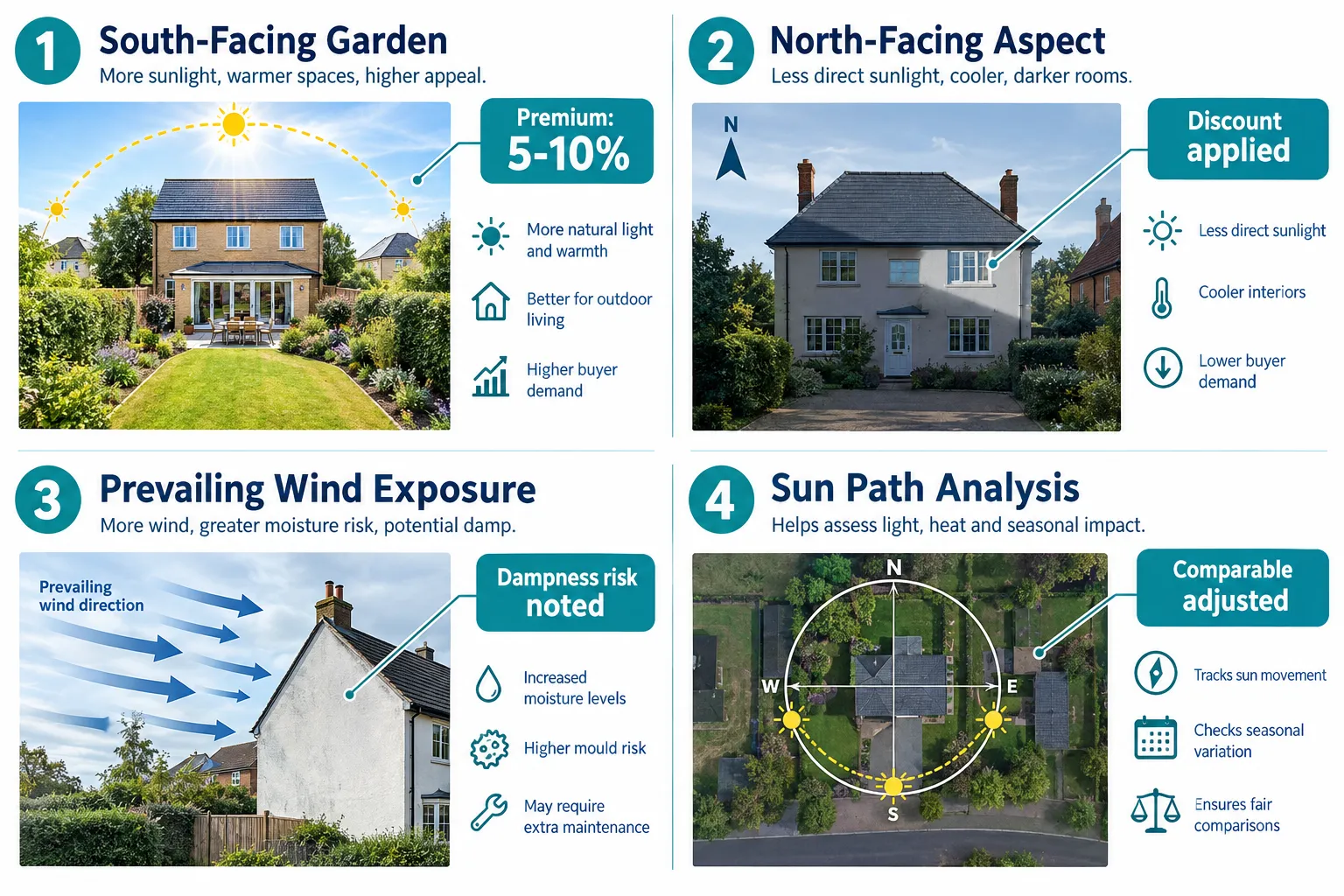
When surveyors and property professionals refer to “compass use in UK property valuation,” they are not describing a mystical or proprietary system. The term covers the practical process of determining a property’s cardinal orientation, which direction its principal elevation, rear garden, or main habitable rooms face, and then assessing how that orientation influences value relative to comparable properties.
In the UK, the sun travels across the southern sky. A rear garden facing south receives direct sunlight for the longest part of the day. A north-facing garden sits in shade for much of the year. This simple solar geometry has real consequences for how buyers perceive and bid on properties, and therefore for how valuers must account for orientation when selecting and adjusting comparable evidence.
The key orientations and their typical market implications are:
| Orientation | Solar Gain | Typical Market Perception | Valuation Effect |
|---|---|---|---|
| South-facing garden | High throughout day | Strongly preferred | Premium, often 5-10% |
| East-facing garden | Morning sun | Moderately preferred | Modest premium |
| West-facing garden | Afternoon/evening sun | Popular with working households | Modest premium |
| North-facing garden | Minimal direct sun | Least preferred | Discount or neutral |
Beyond solar gain, compass readings inform assessments of prevailing wind exposure. In the UK, the dominant wind direction is south-westerly. Properties with exposed south-west or west-facing elevations in coastal or upland areas may face increased weathering, damp penetration risk, and higher maintenance costs, all of which a competent surveyor must factor into their valuation opinion.
“A valuer who ignores orientation is ignoring buyer behaviour. The market has already priced it in; the valuer’s job is to read that pricing accurately.”
The RICS Red Book, formally the RICS Valuation Global Standards, sets the overarching framework within which all UK Red Book valuations must be conducted [2]. It does not prescribe a fixed “compass adjustment percentage.” Instead, it requires valuers to consider all relevant physical characteristics of a property and to support their opinion of value with adequate comparable evidence [8]. Orientation is one such characteristic, and its weight in any given valuation depends on the evidence available in that specific market.
How Surveyors Apply Compass Use in UK Property Valuation on Site

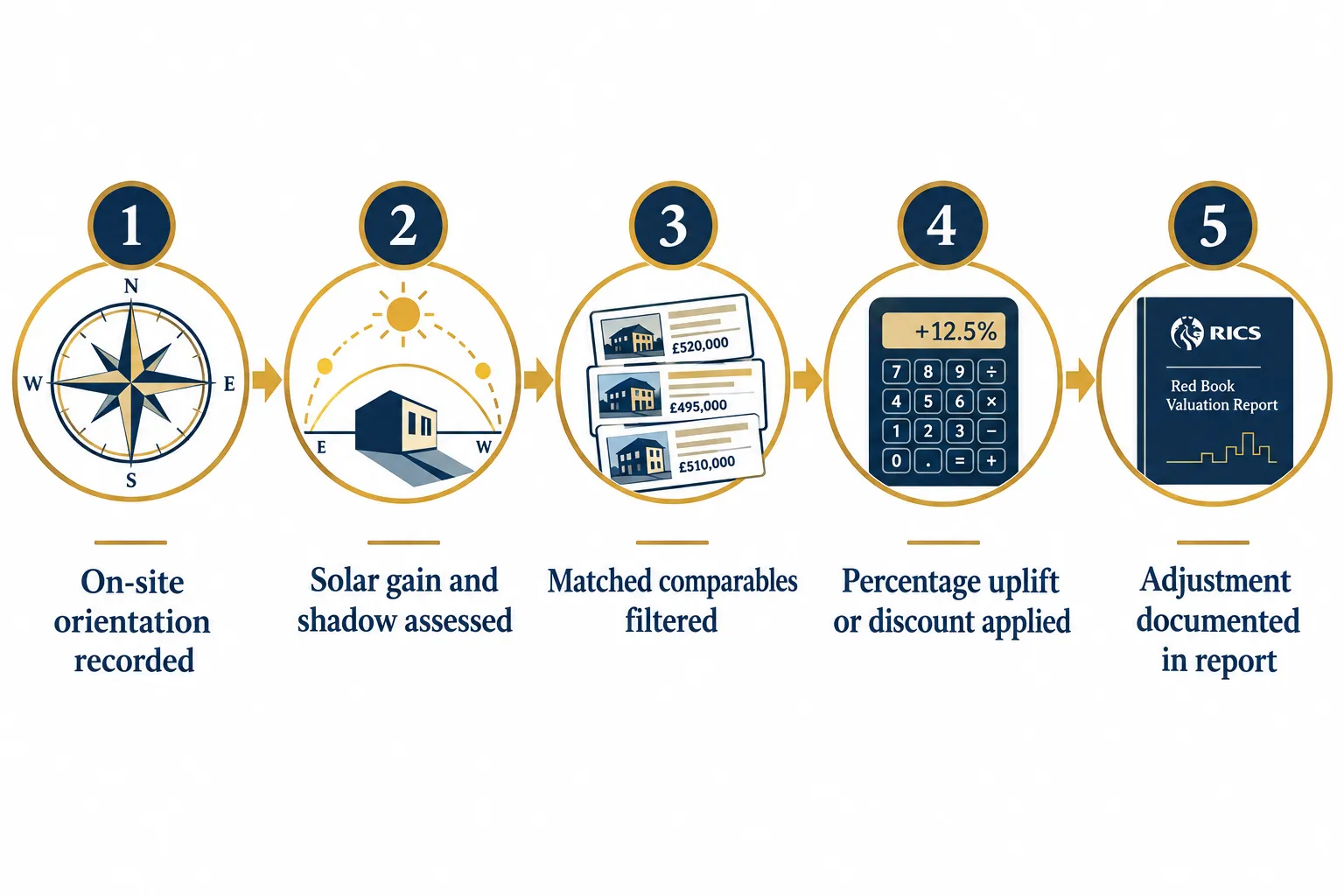
The practical application of compass use in UK property valuation begins during the physical inspection. RICS guidance on residential valuation emphasises that the inspection is the foundation of the valuation process [3][4]. A surveyor arriving at a property will typically note orientation as part of a structured observation checklist that covers:
- The cardinal direction of the principal elevation and rear garden
- The position and size of windows on each elevation
- Evidence of solar gain or shading (sun bleaching on carpets, condensation patterns, plant growth in the garden)
- Wind exposure indicators (weathering on the south-west elevation, condition of pointing and render)
- Proximity to neighbouring structures that create overshadowing
This information is recorded in the inspection notes and feeds directly into the comparable analysis stage. The RICS UK National Supplement, reissued in January 2025, reinforces the requirement for valuers to document the physical characteristics observed during inspection and to explain how those characteristics have influenced the valuation opinion [9].
Translating Observations into Comparable Adjustments
The compass reading itself is only the starting point. The real analytical work lies in finding comparable sales where orientation was a differentiating factor and then measuring the price differential those sales reveal.
A surveyor valuing a semi-detached house with a south-facing garden in a suburban street will search for recent sales of comparable properties on the same street or in the same neighbourhood. Where two otherwise similar properties have sold at different prices and the primary distinguishing feature is garden orientation, that price gap becomes the evidential basis for the orientation adjustment.
This process aligns with the sales comparison approach described in RICS guidance on valuation approaches, methods and models [6]. The approach requires:
- Identification of comparable transactions, ideally within the same street or immediate neighbourhood, within the last six to twelve months.
- Analysis of differences, systematically identifying how each comparable differs from the subject property, including orientation.
- Quantification of adjustments, using market evidence to assign a value to each difference.
- Reconciliation, weighting the adjusted comparables to arrive at a final opinion of value.
HM Land Registry transaction data provides the backbone of this comparable search, giving surveyors access to actual sale prices rather than asking prices. Where orientation-related price differentials are consistent across multiple transactions, the adjustment gains evidential weight. Where the data is thin or contradictory, the surveyor must exercise professional judgement and document the reasoning clearly.
For those interested in how methods of valuation interact with physical property characteristics, the sales comparison method is the most directly relevant to orientation adjustments in residential work.
Real-World Price Adjustments: Quantifying the Compass Effect
Translating compass use in UK property valuation into concrete price adjustments requires discipline. There is no universal tariff, no official RICS table that says “south-facing garden = +7%.” The adjustment must always be market-derived and property-specific. However, research and professional practice point to consistent patterns.
Factors that amplify the orientation premium or discount:
- Property type: Detached and semi-detached houses with private gardens show the strongest orientation effect. Flats with communal gardens or no outdoor space show a weaker effect, though aspect of principal rooms still matters.
- Location: In dense urban areas, overshadowing by neighbouring buildings can neutralise a nominally south-facing aspect. In rural or suburban settings, the orientation premium is more pronounced.
- Price band: Premium properties in sought-after areas tend to show larger absolute orientation adjustments, though the percentage effect may be similar across price bands.
- Competing factors: Tenure complexity, cladding issues, structural defects, and legal encumbrances can dwarf orientation as a valuation driver. A leasehold flat with a short lease and a south-facing balcony will not command an orientation premium that overrides the leasehold discount.
Orientation in Rental Valuations
Orientation also influences rental value, though the effect is somewhat less pronounced than in sales valuations. Tenants value natural light and warmth, but rental decisions are often driven more strongly by location, transport links, and affordability. Nonetheless, a surveyor preparing a rental valuation should still note orientation as a relevant characteristic. For a detailed treatment of how physical property characteristics feed into rental market assessments, see the guidance on rental market valuations in 2026.
Orientation in Commercial Valuations
In commercial property, compass orientation plays a different role. For retail premises, frontage direction affects footfall and display lighting. For office buildings, solar gain influences energy performance ratings and occupier comfort, both of which have become increasingly material to value as EPC requirements tighten. Industrial and logistics properties are less sensitive to orientation, though roof-mounted solar panel potential is now a factor in some assessments. Commercial property surveyors working on mixed-use or energy-sensitive assets are increasingly expected to factor orientation into their sustainability assessments.
RICS Standards, Red Book Compliance, and Documenting Orientation Adjustments
Compass use in UK property valuation does not exist in a regulatory vacuum. Every adjustment a RICS-registered valuer makes must be capable of withstanding scrutiny, from the client, from the lender, and potentially from a court or professional negligence tribunal.
The RICS Red Book requires that valuation reports be transparent, reasoned, and supported by evidence [2][8]. Where orientation has influenced the valuation, the report should:
- Note the orientation as an observed physical characteristic
- Identify the comparable transactions used to quantify the adjustment
- State the adjustment applied and the reasoning behind it
- Flag any limitations in the comparable evidence (for example, where the market is thin and orientation differentials are not clearly evidenced)
The forthcoming RICS Residential Property Valuation standard, currently in consultation, is expected to bring greater consistency to how physical characteristics, including orientation, are reported in residential valuations [3][4]. This is part of a broader drive toward transparency and consumer protection in the valuation profession.
For valuers seeking to understand how Red Book valuation standards for 2026 apply to physical characteristic adjustments, the updated RICS guidance provides the most current framework.
Professional Negligence Implications
Failing to account for a material orientation factor, particularly where comparable evidence clearly supports an adjustment, can expose a valuer to professional negligence claims. If a lender suffers a loss on a mortgage secured against a property that was overvalued because the surveyor ignored a significant north-facing aspect or wind exposure issue, the valuer’s reasoning will be examined in detail. The expert witness roles in mortgage valuation disputes are increasingly focused on whether all relevant physical characteristics were properly identified and adjusted for.
AVMs, AI Tools, and the Future of Compass Data in Valuations
Automated valuation models are transforming how orientation data is processed. Where a human surveyor historically made an orientation adjustment based on inspection notes and professional experience, modern AVMs are beginning to encode orientation as a structured data field, pulling compass bearing data from Ordnance Survey mapping, satellite imagery analysis, and energy performance certificate records.
Platforms such as Property Compass and similar investor-facing analytics tools already present orientation alongside other location metrics, allowing investors and advisers to screen properties by aspect and model expected price premiums. As these tools mature and their datasets grow, orientation adjustments are shifting from implicit professional judgement to explicit, auditable model inputs.
This development has significant implications for the profession. RICS guidance on valuation approaches, methods and models acknowledges the growing role of AVMs and the importance of understanding their inputs and limitations [6]. A valuer reviewing or overriding an AVM output must be able to explain why their human assessment of orientation differs from the model’s encoded assumption.
The integration of GNSS and GPS enhancements achieving centimetre-level accuracy in real-time property measurements is accelerating this trend, enabling surveyors to record precise site orientation data that feeds directly into digital valuation platforms.
Key developments to watch in 2026 and beyond:
- EPC integration: As energy performance becomes more central to mortgage lending decisions, orientation data embedded in EPCs will increasingly cross-reference with valuation models.
- Satellite-derived aspect data: Automated extraction of garden orientation from aerial imagery is already technically feasible and is being piloted by several PropTech firms.
- AVM transparency requirements: Regulatory pressure for greater AVM explainability may require lenders to disclose how orientation has been factored into automated valuations.
- Climate risk overlays: As flood, overheating, and wind exposure risks become more material to value, compass-derived microclimate data will gain further prominence in risk-adjusted valuations.
Practical Guidance for Surveyors and Property Owners
For practising surveyors, the discipline of compass use in UK property valuation comes down to three habits: observe systematically, evidence rigorously, and document transparently.
For surveyors:
- Always record compass orientation as a standard inspection data point, even where it appears unlikely to be material. The market can surprise.
- Build a local database of orientation-differentiated comparable pairs. Over time, this evidence base makes adjustments faster and more defensible.
- When orientation is a significant factor, note it explicitly in the report and explain the comparable evidence used to quantify the adjustment.
- Stay current with RICS guidance updates, particularly the forthcoming residential valuation standard, which is expected to formalise physical characteristic reporting [3].
- Review valuation factors guidance to ensure orientation is considered alongside all other relevant characteristics in a structured way.
For property owners and buyers:
- When commissioning a Red Book valuation, ask the surveyor how orientation has been treated in the comparable analysis. A competent valuer should be able to explain this clearly.
- Do not assume that a south-facing garden automatically guarantees a premium in every market. The adjustment depends on local comparable evidence, not on a fixed rule.
- Be aware that orientation premiums can be eroded by overshadowing, planning restrictions on extensions, or the presence of competing value factors such as tenure or condition issues.
Conclusion
Compass use in UK property valuation is not a peripheral technicality. It is a concrete, evidence-based process through which RICS-registered surveyors translate a physical observation, the direction a property faces, into a defensible, market-evidenced price adjustment. The compass bearing recorded on site feeds into comparable analysis, informs the weight given to competing sales evidence, and ultimately shapes the final opinion of value entered into a Red Book report.
As AVMs and AI tools encode orientation as a structured data input, the profession is moving toward greater consistency and auditability in how compass readings are converted into price adjustments. Surveyors who build robust local evidence bases, document their orientation assessments clearly, and stay current with evolving RICS standards will be best placed to produce valuations that are both accurate and professionally defensible.
Actionable next steps:
- Review your current inspection checklist to confirm orientation is recorded as a standard data point on every residential and commercial instruction.
- Audit recent comparable databases to identify orientation-differentiated pairs that can anchor future adjustments.
- Read the updated RICS UK National Supplement and monitor the forthcoming residential valuation standard consultation for guidance on physical characteristic reporting.
- Consider how AVM outputs in your practice encode orientation, and whether your professional override reasoning is adequately documented.
- Engage with registered RICS valuers for complex instructions where orientation interacts with other significant valuation factors.
References
[1] Valuation Standards – rics.org
[2] Red Book – rics.org
[3] Residential Property Valuation – community.rics.org
[4] Residential Valuations – rics.org
[5] Valuation And Sale Price – rics.org
[6] Valuation Approaches Methods Models – ww3.rics.org
[8] 2021 11 25 Rics Valuation Global Standards Effective 2022 – rics.org
[9] Uk National Supplement Reissuedjan25 – rics.org
Related services from Canterbury Surveyors
- Building expert witness surveyors
- RICS property valuations
- Structural engineers in Canterbury & Kent
- Lease extensions & freehold purchase
Get a fixed-fee quote or call 0204 579 8270.