
Canterbury & Kent
Party Wall Agreements: What Happens If Your Neighbour Refuses Consent?
Roughly one in three party wall notices served in England and Wales results in a dissent or no response, meaning thousands of homeowners every year face the same uncomfortable question: can a neighbour actually block a building project by refusing to sign? The short answer is no, but the process that follows refusal has real cost, timeline, and legal implications that every building owner should understand before breaking ground.
This article explains every step of what happens when a neighbour refuses consent under the Party Wall etc. Act 1996, from the moment the 14-day window closes to the production of a legally binding Party Wall Award, and beyond, if an appeal becomes necessary.
Key Takeaways
- A neighbour’s refusal to consent does not stop lawful works; it triggers the statutory dispute resolution process under the Party Wall etc. Act 1996.
- Once a dispute is deemed to have arisen, surveyor(s) must be appointed and a Party Wall Award produced before notifiable works can begin.
- The building owner typically bears surveyor fees of £700,£1,500 before an Award is made, and the process adds roughly 3-6 weeks to the project timetable.
- A Party Wall Award is legally binding on both parties; appeals must be lodged at the county court within 14 days of receiving the Award.
- Early dialogue, shared drawings, and transparent communication remain the most effective ways to avoid formal dispute proceedings altogether.
Understanding the Legal Framework Behind Party Wall Agreements
Before examining what happens when a neighbour refuses consent, it helps to understand what the Party Wall etc. Act 1996 actually requires. The Act governs three categories of work: works to an existing party wall or structure, the construction of a new wall at or astride the boundary line, and excavations within three or six metres of a neighbouring building. If you are unsure whether your project falls within any of these categories, the guidance on whether you need a party wall agreement is a useful starting point.
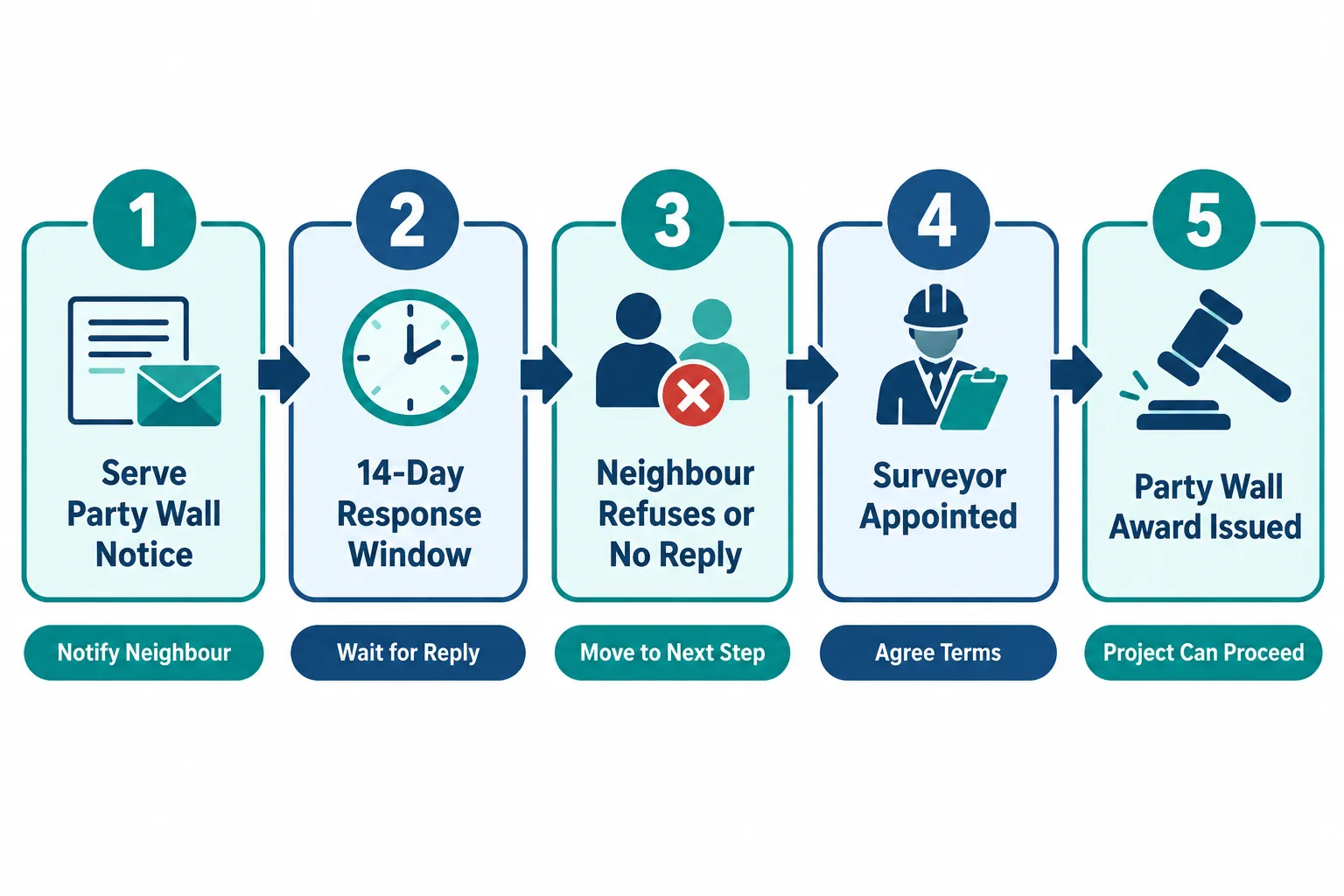
Once a notifiable project is identified, the building owner must serve a formal party wall notice on every adjoining owner. The notice must be served at least one month before works begin for party wall works, or two months before for new walls on the boundary. The adjoining owner then has 14 days to respond. That response can take one of three forms:
| Response | Legal Effect |
|---|---|
| Written consent | Works may proceed; no Award required |
| Written dissent (refusal) | Dispute deemed to have arisen; surveyors must be appointed |
| No response within 14 days | Treated as dissent; same surveyor process triggered |
The critical point, confirmed by GOV.UK guidance updated in May 2026, is that silence is legally equivalent to refusal [5][6]. Many building owners are caught off guard by this, assuming that no reply means tacit approval.
For a deeper look at how notice timelines interact with residential project planning, the article on party wall notices for residential extensions and loft conversions covers the practical scheduling challenges in detail.
Party Wall Agreements: What Happens If Your Neighbour Refuses Consent, The Dispute Process Explained
When a neighbour refuses consent or fails to respond, a dispute is formally deemed to have arisen under section 10 of the Act. At this point, the building owner cannot simply proceed. A Party Wall Award must be in place before notifiable works begin [5][8].
Step 1, Appointing a Surveyor
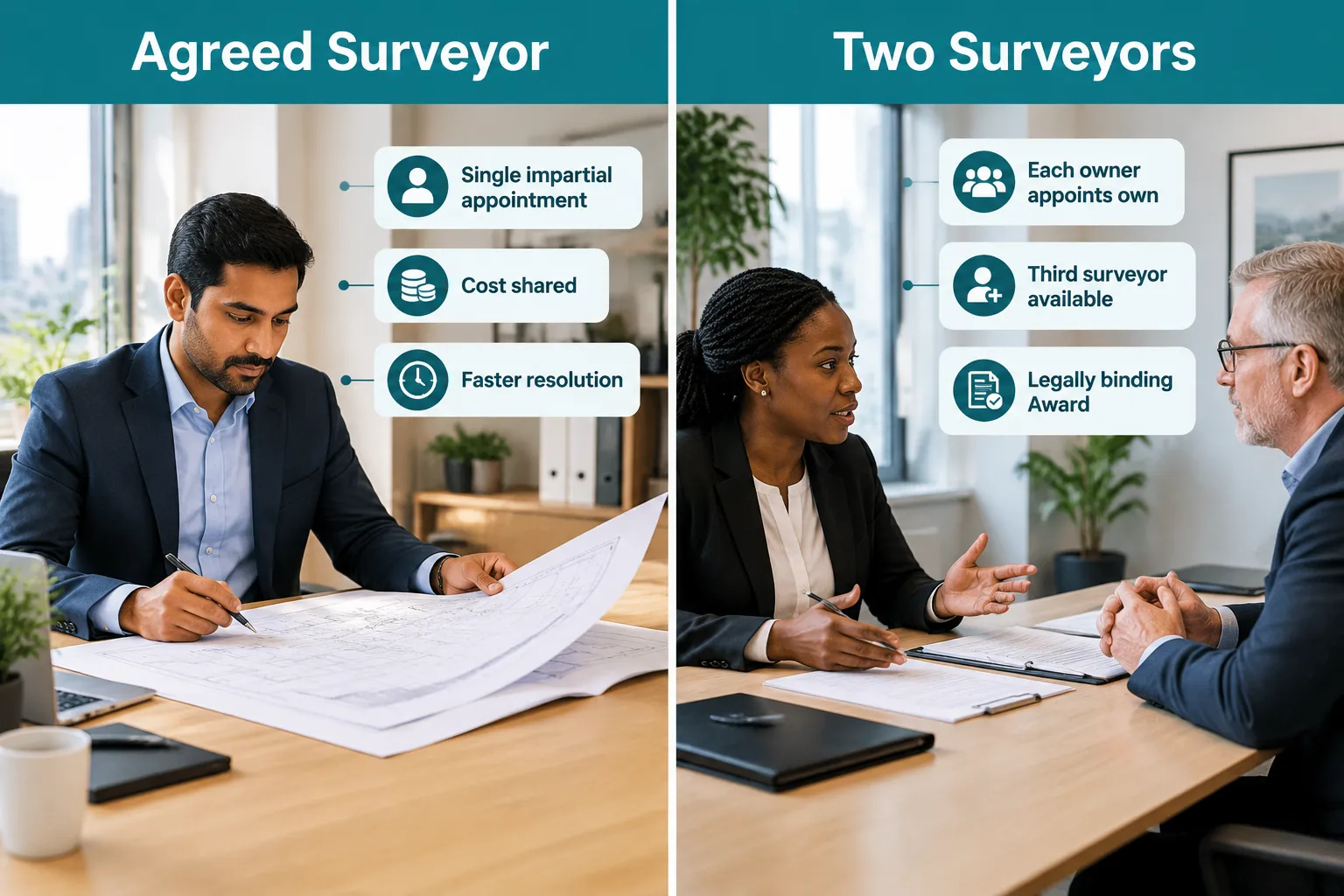
Both parties must now appoint a surveyor. There are two routes:
Option A: A single “agreed surveyor” Both the building owner and the adjoining owner jointly appoint one impartial surveyor. This is faster and cheaper, but requires both parties to trust the same professional. The agreed surveyor acts in the interests of both parties, not just the person who instructs them.
Option B: Two separate surveyors Each party appoints their own surveyor. If those two surveyors cannot agree on the terms of the Award, they appoint a third surveyor whose decision is binding. This route costs more and takes longer, but gives each party independent professional representation [2][8].
“The neighbour’s refusal cannot stop a compliant project, it simply moves the matter into the statutory dispute procedure under the 1996 Act.” [2]
The RICS consumer-facing guidance updated in August 2026 confirms that before starting any notifiable works, the building owner must have either written consent or a Party Wall Award in place [8]. Proceeding without either exposes the building owner to injunctions and potential liability for any damage caused.
Step 2, Preparing the Schedule of Condition
Before the Award is finalised, the surveyor(s) will typically inspect the adjoining property and prepare a Schedule of Condition, a detailed photographic and written record of the existing state of the neighbour’s property. This document is essential: it provides the baseline against which any damage claims after the works are assessed [4][10].
Step 3, Producing the Party Wall Award
The Party Wall Award (sometimes called a “determination”) is a legally binding document that sets out:
- What works are permitted
- How and when they may be carried out (working hours, access arrangements)
- How the adjoining owner’s property will be protected
- Who is responsible for making good any damage
- Any security for expenses, if required
The Award is served on both parties. Once received, either party has 14 days to appeal to the county court if they disagree with its terms [5][6]. Outside that window, the Award stands and works may begin.
For projects in areas where construction activity is particularly high, the article on party wall surveys in high-growth northern markets explores how surveyor demand and timetables are affected by development surges.
What the Neighbour’s Refusal Can and Cannot Achieve
This is where many homeowners, on both sides of the boundary, hold misconceptions. Understanding the limits of a neighbour’s dissent is central to managing the process calmly and effectively.
What a Refusal Cannot Do
- Permanently block lawful works. If the proposed works are authorised by the Act and the correct procedure is followed, the neighbour cannot veto them outright [1][4].
- Prevent access for the surveyor. The surveyor has a statutory right to access the adjoining property to carry out inspections relevant to the Award [7].
- Nullify a correctly served notice. A refusal does not invalidate the notice; it simply moves the process to the next stage [6].
What a Refusal Can Achieve
- Delay the project. The surveyor appointment and Award preparation process typically adds 3-6 weeks to the timetable [3].
- Increase costs. The building owner can expect to pay approximately £700,£1,500 in surveyor fees before the Award is made, depending on complexity and whether one or two surveyors are appointed [3].
- Secure protective conditions. Through the Award, the adjoining owner can insist on specific working hours, access protocols, and damage safeguards that would not exist under a simple written consent [4][10].
- Require the wall to be built entirely on the building owner’s land. If consent for a new wall astride the boundary is refused, the RICS 7th-edition guidance confirms the wall must be built wholly within the building owner’s land [7].
If you are concerned about a project proceeding without the correct paperwork, the page on what happens when no party wall agreement is in place explains the risks and remedies.
Practical Steps to Avoid or Resolve a Refusal
The formal dispute process is a safety net, not a first resort. Most experienced surveyors and practitioners advise that early, transparent communication significantly reduces the likelihood of a neighbour refusing consent [1][2][9].
Before Serving the Notice
- Talk to the neighbour first. Explain the project informally, share drawings, and address concerns before any formal paperwork is served.
- Provide structural information. Many neighbours refuse consent simply because they do not understand what the works involve. A clear explanation, ideally with engineer’s drawings, can resolve anxiety quickly [14].
- Choose the right timing. Serving a notice when a neighbour is already stressed or in dispute with the building owner is likely to produce a dissent. Where possible, build goodwill first.
After a Refusal
- Do not proceed with works. This cannot be overstated. Beginning notifiable works without a consent or Award in place is unlawful and can result in an injunction to stop the works immediately [5][9].
- Appoint a surveyor promptly. Delays in appointing a surveyor after a dissent simply extend the overall project delay.
- Keep communication open. Even after the formal process begins, informal dialogue can help. If the neighbour’s concerns are addressed, they may withdraw their dissent and give written consent, removing the need for an Award entirely [1][2].
- Consider sharing the surveyor appointment. An agreed surveyor is faster and cheaper than two separate surveyors. If the relationship with the neighbour is not actively hostile, proposing a jointly appointed surveyor is worth exploring.
For projects involving shared chimney stacks or other specific structural features, specialist guidance on shared chimneys and shared chimney stacks covers the additional considerations that apply.
Appealing a Party Wall Award and the Role of Expert Witnesses
Party Wall Agreements: What Happens If Your Neighbour Refuses Consent? does not always end with the Award. In a small number of cases, one party disagrees with the Award’s terms and exercises the right to appeal.
The 14-Day Appeal Window
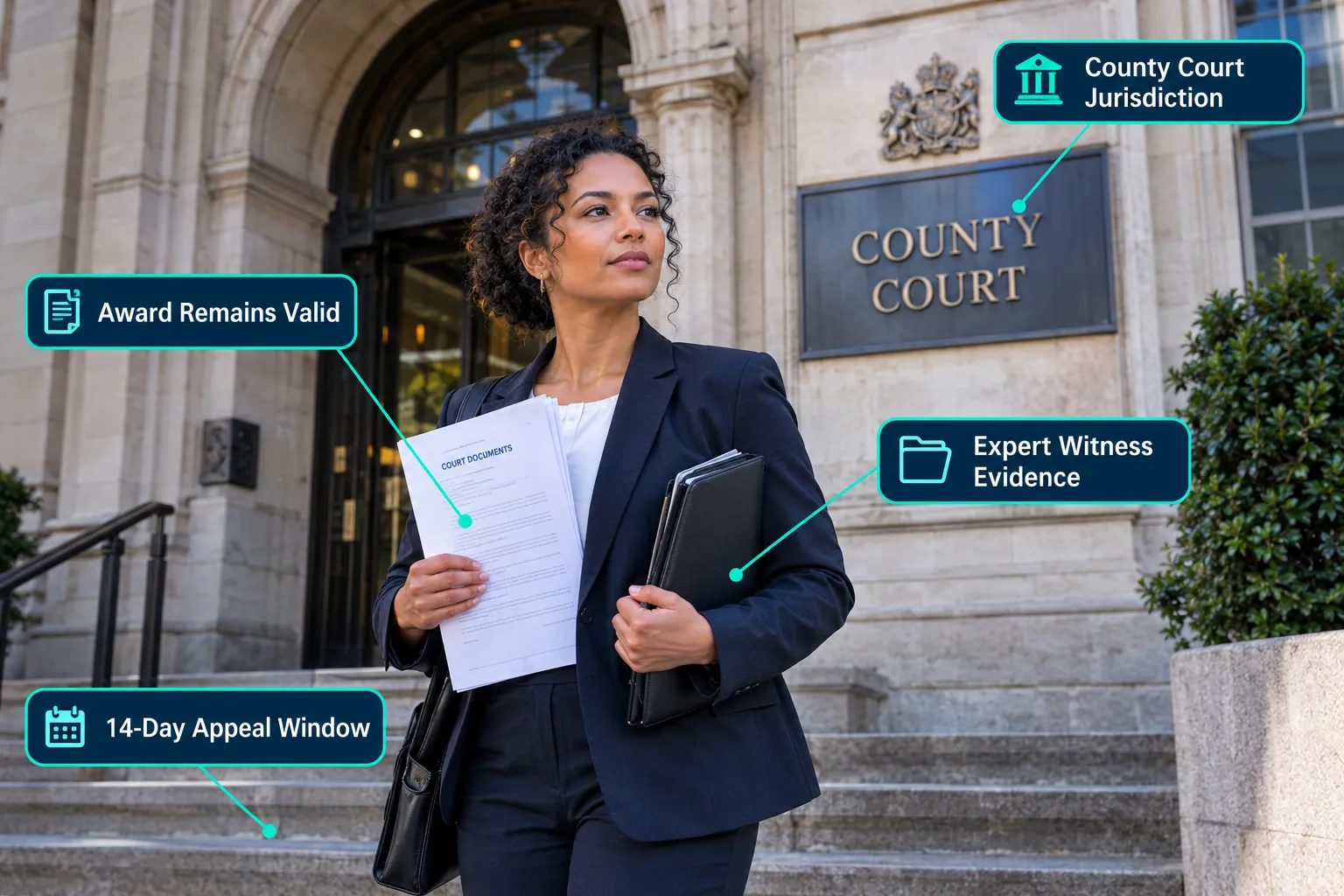
Either party may appeal the Award to the county court within 14 days of receiving it [5][6]. Appeals are relatively rare in practice, most Awards are accepted, but they do occur, particularly where:
- The Award permits works the adjoining owner believes are unnecessarily intrusive
- The building owner believes the Award imposes conditions that go beyond what the Act permits
- There is a dispute about costs or the surveyor’s fees
The court has broad powers on appeal: it can confirm, vary, or rescind the Award. Importantly, the existence of an appeal does not automatically suspend the works unless the court grants a stay [7].
When Expert Witness Input Is Needed
In contested cases, particularly those involving allegations of structural damage, disputed boundaries, or complex engineering questions, expert witness evidence becomes important. A surveyor instructed as an expert witness can provide the court with independent technical analysis of the works, the damage claimed, and whether the Award’s terms were appropriate.
The article on building your expert witness practice in party wall defects and valuations explores how surveyors approach this specialist role and what courts expect from expert evidence in party wall disputes.
For guidance on what a properly constituted Award should contain, the guidance for party wall awards page provides a practical breakdown.
Common Questions About Neighbour Refusals
Can a neighbour refuse to appoint a surveyor? If the adjoining owner refuses to appoint a surveyor within 10 days of being asked, the building owner may appoint a surveyor on their behalf [5][7]. The process cannot be indefinitely stalled by inaction.
Does the neighbour have to pay any costs? In most cases, the building owner pays the surveyor fees, since the works are for the building owner’s benefit. However, if the adjoining owner requests additional works through a counter-notice, they may bear the cost of those additions [6].
What if the party wall notice was never served? If works have already begun without a notice being served, the adjoining owner has legal remedies including seeking an injunction. The page on party wall notice not served explains the options available in that situation.
Can the neighbour demand the works stop once they have started? If a valid Award is in place and the building owner is complying with its terms, the neighbour cannot demand a halt. If the building owner is breaching the Award’s conditions, the neighbour can apply to the court for enforcement [5][7].
Conclusion
A neighbour’s refusal to consent under the Party Wall etc. Act 1996 is not a dead end, it is the start of a well-defined statutory process that ultimately protects both parties. The building owner retains the right to carry out lawful works; the adjoining owner gains formal protections through the Party Wall Award that would not otherwise exist.
Actionable next steps for building owners facing a refusal:
- Stop all notifiable works immediately and do not restart until a consent or Award is in place.
- Attempt informal dialogue to understand and address the neighbour’s specific concerns.
- Instruct a qualified party wall surveyor without delay, the sooner the process begins, the sooner the Award can be produced.
- Discuss with the neighbour whether a single agreed surveyor is acceptable to both parties, as this is the fastest and most cost-effective route.
- Once the Award is served, review it carefully within the 14-day window and seek legal or surveyor advice if any term appears unreasonable.
- Keep detailed records of all communications, notices, and responses throughout the process.
The party wall surveyor route exists precisely because neighbour disputes over building works are common and often emotionally charged. Used correctly, it provides a structured, legally sound path through what can otherwise become a protracted and costly conflict.
References
[1] Can A Neighbour Refuse A Party Wall Agreement – hoa.org.uk
[2] Can Neighbours Refuse A Party Wall Agreement – peterbarry.co.uk
[3] Party Wall Agreement Neighbour Refuses – trackeveryday.com
[4] Refuse Party Wall Agreement – ansteyhorne.co.uk
[5] If You Cant Agree – gov.uk
[6] Reaching Agreement With Neighbours – gov.uk
[7] Jan 22 Party Wall Legislation And Procedure 7th Edition – rics.org
[8] Party Walls – rics.org
[9] Party Wall Agreements What If Neighbor Refuses – iconsurveyors.co.uk
[10] Party Wall Guidance – collier-stevens.co.uk
Related services from Canterbury Surveyors
- Party wall surveyors in Canterbury & Kent
- Boundary surveys
- Building expert witness surveyors
- RICS property valuations
Get a fixed-fee quote or call 0204 579 8270.