
Canterbury & Kent
Building Survey Price Negotiation: Using Survey Results to Renegotiate the Property Price
Around two-thirds of UK buyers who commission a building survey use the findings to renegotiate the purchase price, and the majority of them succeed in securing a reduction or having repairs completed before exchange [9]. Yet many buyers still receive their survey report, feel overwhelmed by the technical language, and either accept the original price or walk away entirely. Neither outcome is necessary. Understanding how building survey price negotiation works, and how to use survey results to renegotiate the property price systematically, can save buyers thousands of pounds and prevent costly surprises after completion.
Key Takeaways
- Roughly two-thirds of buyers use survey findings to renegotiate, with most successful reductions falling in the 1-5% range [9][6].
- In England and Wales, no agreed price is legally binding until exchange of contracts, so buyers can revise their offer based on survey evidence [5].
- Defects should be categorised by severity before negotiation, structural and safety issues carry far more weight than cosmetic problems [1][11].
- A written negotiation proposal supported by contractor quotes is far more effective than a verbal or unsupported request for a reduction [7][15].
- Buyers should define a clear walk-away threshold before entering negotiations to avoid emotional decision-making under pressure [7].
Why Building Survey Price Negotiation Is Now Standard Practice
The UK property market in 2026 has made post-survey renegotiation a routine part of the buying process rather than an exceptional tactic. Approximately 75% of prospective buyers attempt some form of late-stage price reduction, and around two-thirds specifically cite survey problems as the basis for their request [2][9]. This trend reflects a straightforward reality: a survey often reveals defects that were not visible or disclosed during the initial viewing, meaning the agreed price was based on incomplete information.
From a legal standpoint, buyers in England and Wales are fully entitled to revise their offer at any point before exchange of contracts. The “subject to contract” status that governs pre-exchange negotiations explicitly permits renegotiation based on new information, including findings from a RICS home survey or a full Level 3 building survey [5][7]. Sellers are equally free to decline any reduction, but the legal framework clearly supports the buyer’s right to respond to newly discovered evidence.
It is important to distinguish legitimate, evidence-based renegotiation from opportunistic “gazundering”, the practice of reducing an offer without documented justification simply to extract a lower price [2][3]. Sellers and their agents are increasingly alert to the difference. A renegotiation backed by a professional survey report and itemised contractor quotes is treated seriously; a vague request for “money off” without evidence is likely to be refused or to damage the relationship between buyer and seller [3][8].
“The survey is not an official revaluation of the property, it is evidence that the buyer can use to demonstrate a discrepancy between the agreed price and the property’s actual condition.” [3]
How to Interpret Your Survey Report Before Negotiating
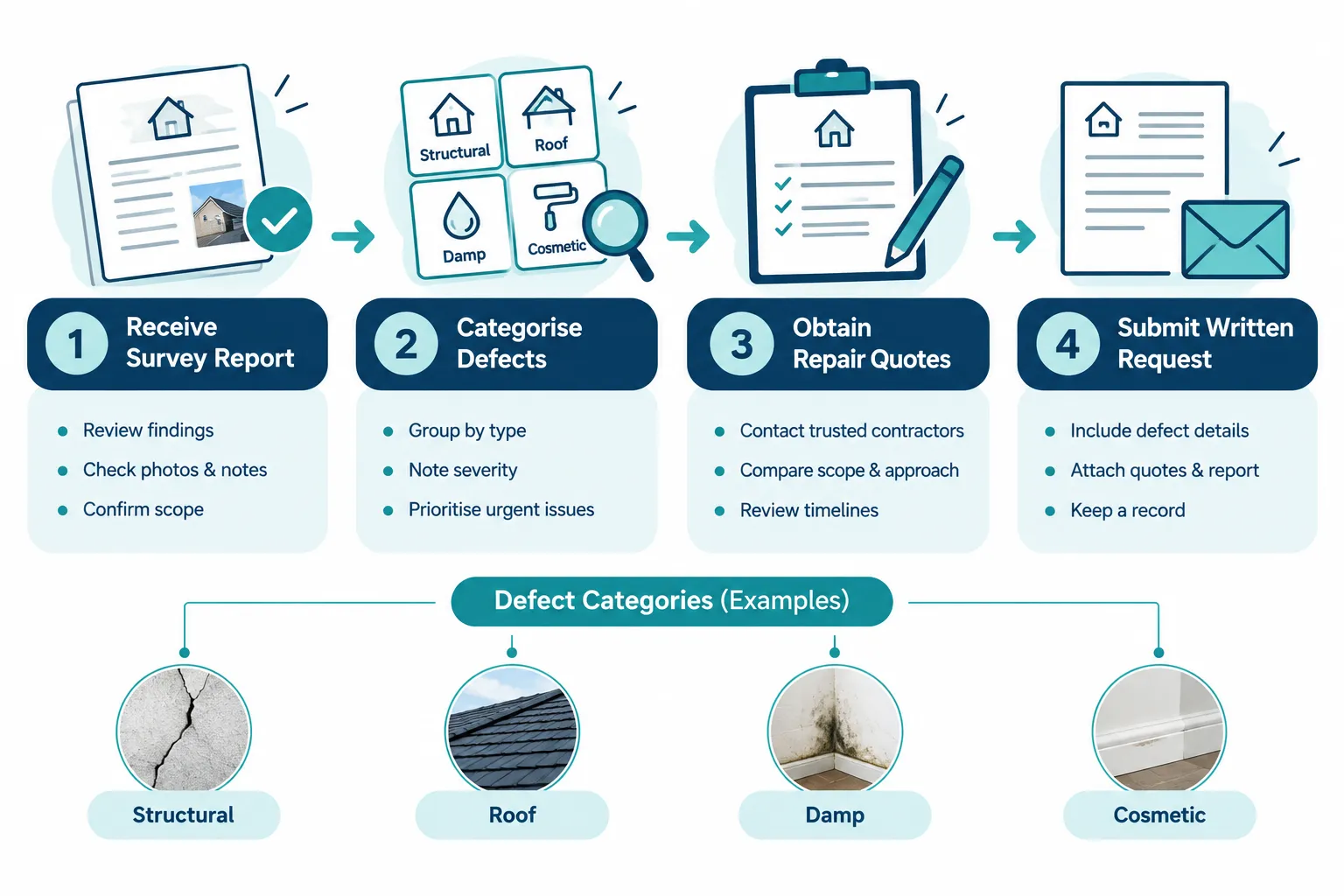
Before any building survey price negotiation can begin, the buyer must understand what the report is actually saying. RICS surveys use a condition rating system: Condition Rating 1 (no repair needed), Condition Rating 2 (defects that need attention but are not urgent), and Condition Rating 3 (serious defects requiring immediate attention or further investigation) [1]. The negotiation case rests almost entirely on Condition Rating 3 items and any significant Condition Rating 2 items with quantifiable repair costs.
For a detailed comparison of survey types and what each covers, see the guide on the difference between Level 2 and Level 3 surveys.
Categorising Defects by Severity and Impact
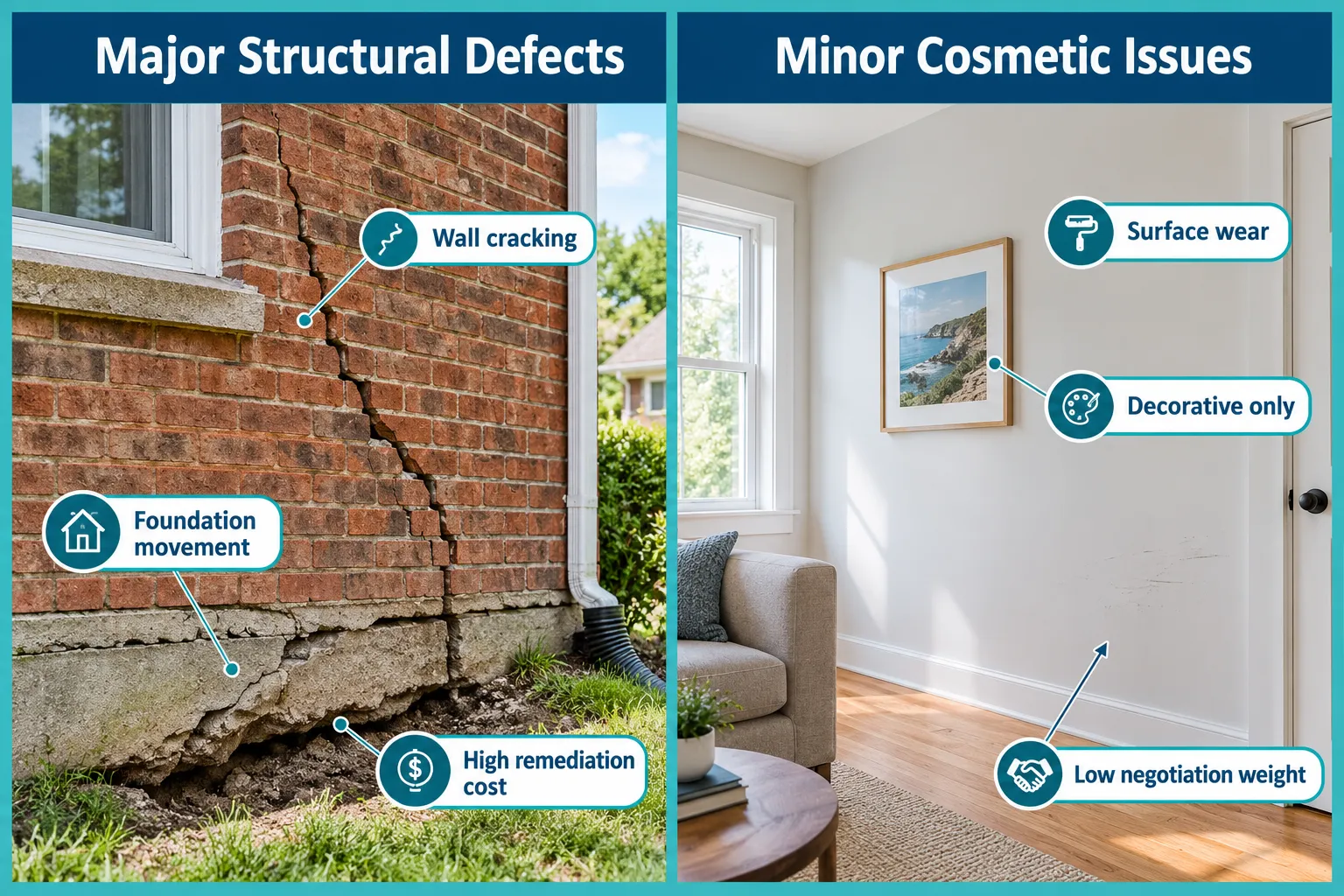
Not all defects carry equal negotiating weight. Experienced surveyors and negotiation advisors recommend sorting findings into three categories before approaching the seller [11]:
| Category | Examples | Typical Remediation Cost | Negotiation Weight |
|---|---|---|---|
| Critical / Structural | Subsidence, foundation failure, major roof failure | £10,000 – £50,000+ | Very high |
| Significant | Roof repairs, damp penetration, rewiring, boiler replacement | £5,000 – £20,000 | High |
| Minor / Cosmetic | Decorating, minor cracking, worn fixtures | £500 – £3,000 | Low |
Structural issues such as subsidence or foundation movement are the strongest basis for renegotiation. Remediation costs for these problems typically range from £10,000 to over £50,000, and lenders may refuse to release mortgage funds until they are resolved [11]. For properties in high-risk areas, a specialist survey for subsidence may be recommended as a follow-up.
Roof defects are another high-priority category. A failing roof covering or structural roof timbers can cost £5,000 to £20,000 to remedy and will almost certainly be flagged by a mortgage valuer as well as the building surveyor [11].
Damp issues require careful interpretation. Rising damp, penetrating damp, and condensation are treated very differently in terms of cost and urgency. A damp survey can provide the specific diagnosis needed to obtain accurate repair quotes.
Cosmetic defects, peeling paintwork, worn carpets, minor surface cracks, rarely justify significant price reductions on their own. Advisors consistently warn that cosmetic items alone will not support a large renegotiation and may undermine the buyer’s credibility if presented as the primary basis for a reduction [1][11].
A Step-by-Step Framework for Building Survey Price Negotiation: Using Survey Results to Renegotiate the Property Price
Once defects have been categorised, the negotiation process follows a clear sequence. Buyers who follow this framework are significantly more likely to achieve a meaningful reduction than those who approach the seller without preparation [7][15].
Step 1: Act Quickly
Respond to the survey within 24 to 48 hours of receiving the report [7]. Delays signal uncertainty and give the seller time to find another buyer. A prompt response demonstrates that the buyer is committed but has legitimate concerns that need addressing.
Step 2: Obtain Multiple Contractor Quotes
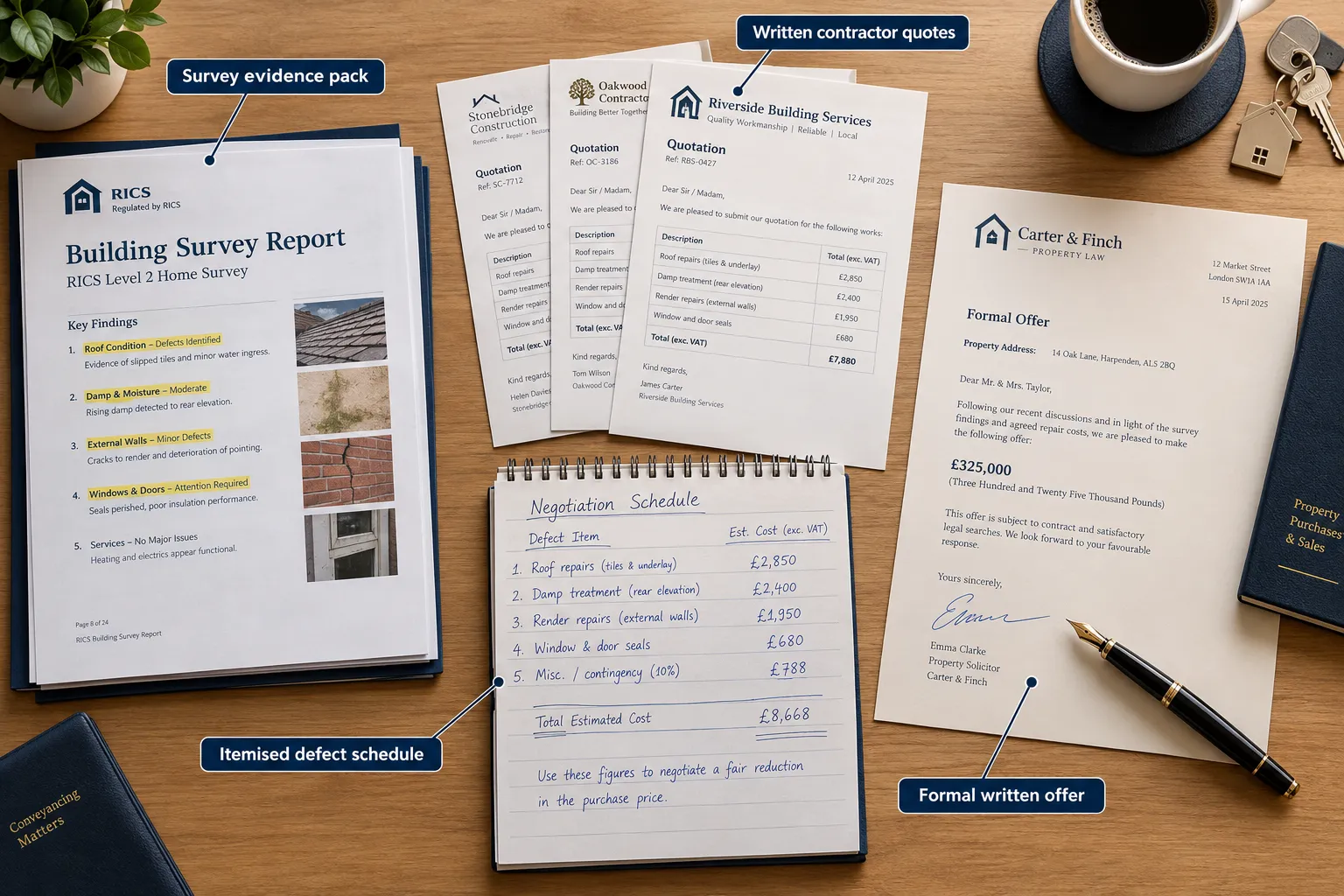
For every significant defect, obtain two to three written quotes from qualified contractors [7][15]. This serves two purposes: it provides an accurate cost estimate to underpin the negotiation, and it demonstrates to the seller that the buyer has done proper due diligence rather than guessing at figures. Quotes should be itemised and on headed paper where possible.
Step 3: Calculate the Total Remediation Cost
Add up the cost of all critical and significant repairs. This total becomes the basis for the negotiation target. Expert guides recommend aiming for close to 100% of the cost of truly critical repairs (those affecting safety, structure, or mortgageability) and approximately 50% to 75% of the cost of medium-priority issues [11][13]. Asking for the full cost of every defect, including cosmetic items, is rarely realistic and can damage the negotiation.
For context, most successful post-survey renegotiations in 2026 fall in the 1% to 5% range. On the current UK average house price of approximately £271,900, that equates to roughly £2,700 to £13,600 off the agreed price [6]. Larger reductions are achievable where structural or safety defects are documented, but they require proportionately stronger evidence.
Step 4: Define a Walk-Away Threshold
Before contacting the seller, decide on the minimum acceptable outcome, whether that is a specific price reduction, a commitment to carry out certain repairs before completion, or a combination of both [7]. Having a clear threshold prevents the buyer from accepting an inadequate compromise under pressure.
Step 5: Submit a Written Negotiation Proposal
A verbal request is easy to dismiss. A written schedule listing each defect, the relevant condition rating from the survey, the contractor quotes, and the requested reduction is far harder to ignore [7][15][1]. The proposal should be factual and professional in tone, framing the request as a response to documented evidence rather than a personal criticism of the seller’s property.
Key elements of an effective written negotiation proposal:
- Reference the specific section and condition rating in the survey report
- Attach or summarise contractor quotes for each item
- State the total requested reduction clearly
- Offer a realistic alternative (e.g., seller arranges repairs in lieu of price cut)
- Set a reasonable response deadline (typically five to seven working days)
Step 6: Be Prepared to Compromise
Sellers are not obligated to accept any reduction [3][8]. Many will counter-offer, accept part of the request, or offer to carry out specific repairs themselves. Buyers should assess any counter-offer against their walk-away threshold and be willing to accept a reasonable compromise. Insisting on the full requested amount when the seller has made a genuine concession can collapse a transaction unnecessarily.
What Sellers Need to Know About Post-Survey Renegotiation
Building survey price negotiation is not a one-sided process. Sellers who understand the framework are better placed to respond constructively rather than reactively.
The survey report belongs to the buyer and does not constitute an official revaluation of the property [3]. A seller is under no obligation to reduce the price simply because a survey has been carried out. However, refusing to engage with a well-evidenced request, particularly where the defects are genuine and the repair costs are documented, risks the transaction falling through entirely [8][10].
Sellers are advised to:
- Request itemised evidence, accept only reductions tied to specific defects with written contractor quotes, not broad unsupported demands [3]
- Get an independent opinion, commission their own quotes for disputed items to verify the buyer’s figures
- Consider repairs in lieu of price cuts, in some cases, having a trusted contractor carry out the work before completion is more cost-effective than reducing the price
- Treat late, unsupported demands with caution, a request that arrives without survey evidence or contractor quotes close to exchange may be opportunistic gazundering rather than legitimate renegotiation [2][8]
For commercial property transactions, the same principles apply but with additional complexity around lease obligations and regulatory compliance. The RICS commercial building survey process follows a similar evidence-based framework.
Using Building Survey Price Negotiation: Using Survey Results to Renegotiate the Property Price Effectively in 2026
The 2026 market context strengthens the case for systematic, evidence-based renegotiation. Persistent repair backlogs, rising construction costs, and heightened buyer focus on affordability mean that sellers increasingly expect some form of post-survey discussion [1][7]. Buyers who approach this process professionally, with a structured report, documented quotes, and a clear written proposal, are more likely to be taken seriously and to achieve a satisfactory outcome.
Several factors increase the leverage available to buyers in 2026:
- Mortgageability concerns, if a defect is likely to affect the lender’s valuation or result in a mortgage retention, the seller has a strong incentive to address it, since a new buyer would face the same issue [5]
- Fire safety and regulatory compliance, updated fire safety regulations in 2026 mean that certain defects in older properties carry both remediation costs and compliance obligations. See the fire safety regulation updates in building surveys resource for detail on how these affect valuations
- Energy performance, poor EPC ratings and the cost of bringing a property up to minimum standards are increasingly factored into post-survey negotiations, particularly for buy-to-let purchases
- Defect diagnosis in older properties, period properties often reveal hidden defects that were not visible during viewing. The defect diagnosis in older properties guide covers the most common issues and how surveyors assess them
It is also worth understanding the cost of the survey itself in the context of the overall transaction. The structural survey pricing guide explains what determines survey fees and why a Level 3 survey on an older or complex property represents a sound investment when it uncovers defects that support a five-figure price reduction.
When to Walk Away
Not every survey finding leads to a successful renegotiation. If the seller refuses to engage with a well-evidenced request and the defects are genuinely serious, particularly where they affect structural integrity, safety, or the ability to obtain a mortgage, walking away may be the correct decision [7][10]. The cost of completing a purchase on a property with undisclosed major defects almost always exceeds the cost of restarting the search.
Conclusion
Building survey price negotiation, when approached systematically, is one of the most effective tools available to UK property buyers. The process works because it is grounded in evidence: a professional survey report, contractor quotes, and a written proposal that links specific defects to specific costs. Buyers who follow this framework are far more likely to achieve a meaningful reduction or secure repairs before exchange than those who rely on informal requests or emotional appeals.
Actionable next steps for buyers:
- Commission a Level 2 or Level 3 survey from a qualified RICS surveyor before exchange, the type of survey should match the age and complexity of the property
- Read the full report carefully, noting every Condition Rating 3 item and any significant Condition Rating 2 findings
- Obtain two to three written contractor quotes for each significant defect within 48 hours of receiving the report
- Calculate the total remediation cost and set a realistic negotiation target (typically 50-100% of critical repair costs)
- Define a walk-away threshold before contacting the seller
- Submit a written, itemised negotiation proposal with the survey evidence and contractor quotes attached
- Be prepared to accept repairs in lieu of a price reduction, or to compromise on the total amount requested
For buyers and sellers who want professional guidance on survey findings and their valuation implications, speaking with a local chartered surveyor is the most reliable starting point.
References
[1] Negotiating After Survey – housesurveys.co.uk [2] Gazundering Tactics Rise Renegotiating Offer 115226262 – uk.news.yahoo.com [3] Buyer Wants Money Off After Survey Uk 2026 – valuq.co.uk [5] Negotiating The House Price After A Survey – mortgageadvicebureau.com [6] How Much Can You Negotiate Off House Price After Survey – chattoyourbuilder.co.uk [7] Negotiating After Survey – moneysavingadvisors.co.uk [8] Renegotiation After Survey – getpine.co.uk [9] Two Thirds Use Problems Revealed By House Surveys To Renegotiate – which.co.uk [10] How To Renegotiate An Offer After A Home Survey – cjbloor.co.uk
Related services from Canterbury Surveyors
- RICS property valuations
- RICS Homebuyer Surveys (Level 2)
- Building Surveys (Level 3)
- Structural engineers in Canterbury & Kent
Get a fixed-fee quote or call 0204 579 8270.