
Canterbury & Kent
Independent Property Valuation in a Volatile UK Market: When to Go Beyond Your Lender’s Figure
Rightmove recorded the steepest August asking-price drop in eight years in 2026, cutting its full-year house-price forecast from +2% to a range of 0% to -2% [9]. At the same time, different mainstream indices now report “average” UK house prices that vary by more than £26,000 from each other [1][2][8]. In a market this fragmented and fast-moving, relying solely on a lender’s automated valuation is not just inconvenient, it can be financially costly. This article explains the case for independent property valuation in a volatile UK market: when to go beyond your lender’s figure, what triggers should prompt action, and how a formal RICS report can protect buyers, sellers, and investors from decisions built on outdated or misaligned numbers.
Key Takeaways
- UK house price indices diverge by more than £26,000 in mid-2026, meaning a lender’s figure may not reflect the most current or locally relevant data.
- Lender valuations are designed to protect the lender, not the borrower; an independent RICS valuation serves your interests directly.
- Down-valuations, high-LTV thresholds, atypical properties, and legal or tax requirements are the most common triggers for commissioning an independent report.
- In a softening market, even a £5,000-£10,000 valuation gap can shift you into a worse LTV band and materially increase your borrowing costs.
- Independent valuations are most powerful when backed by recent comparable sales, property condition evidence, and a qualified RICS surveyor’s professional judgment.
Why the 2026 UK Market Makes Lender Valuations Unreliable
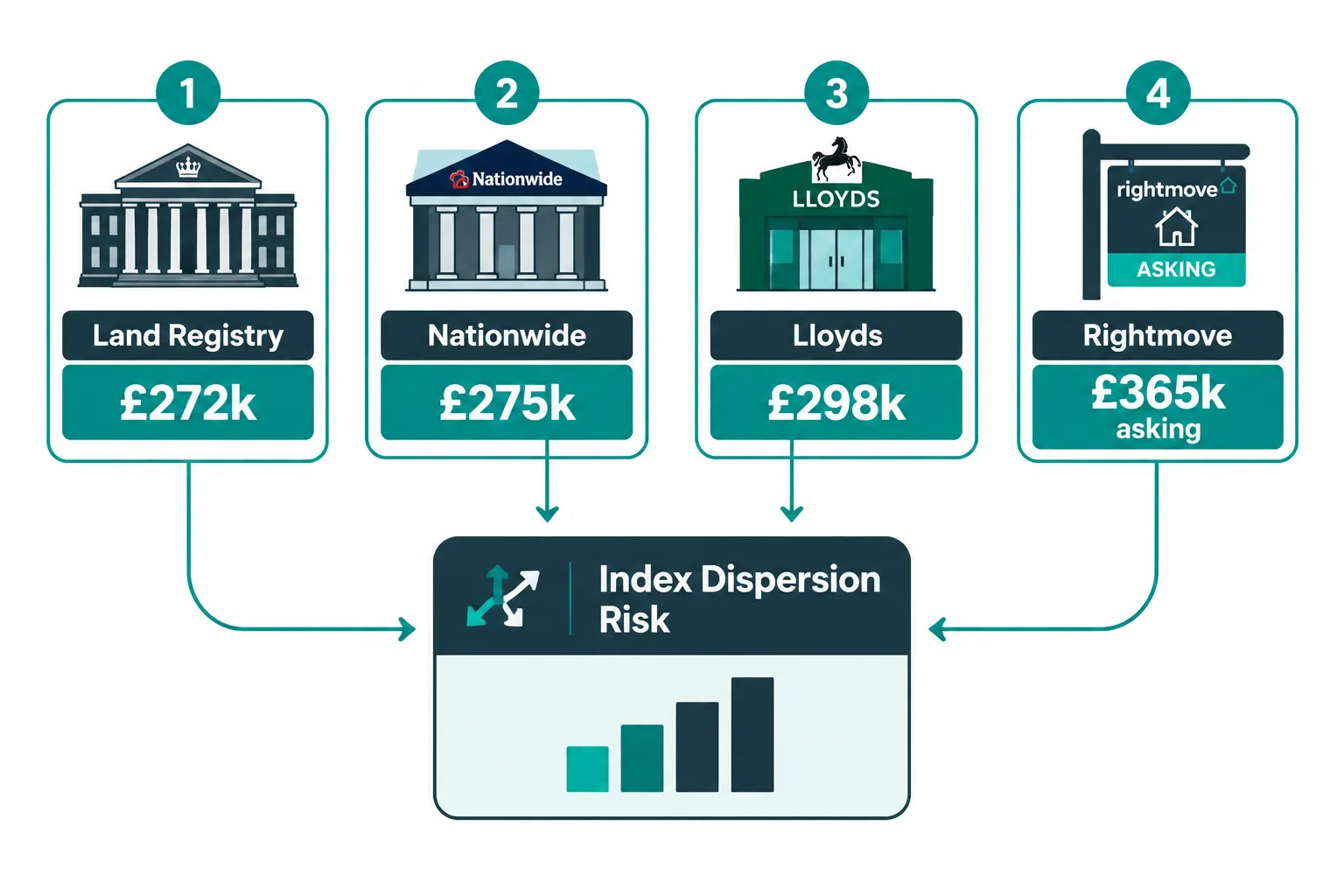
The UK housing market in 2026 is not simply “slow”, it is diverging in ways that make any single valuation figure harder to trust. Official Land Registry data put the average UK house price at approximately £272,000 for June 2026, representing annual growth of just 2% and a near-flat month-on-month rise of 0.1%, down sharply from 3% annual growth recorded in May 2026 [1][3]. The January 2026 House Price Index had already flagged the trend, with an average price of £268,000, only £3,000 higher than a year earlier [1].
Meanwhile, lender-based indices tell a different story. Lloyds reported an average property price of £298,468 in August 2026, down 0.2% month-on-month and 0.4% year-on-year, the first annual fall recorded since November 2023 [2][4][6]. Nationwide’s August figure came in at £275,465, with annual growth of 1.6% and a monthly rise of 0.2%, though the building society described conditions as “subdued” amid economic uncertainty [2]. Rightmove’s asking-price data added a further layer of complexity, reporting a 2% fall in average asking prices to around £364,999 in August 2026 [5][9].
This growing dispersion between official completed-sale indices, lender indices, and listing-price data is not a statistical curiosity. It reflects genuinely different methodologies, data lags, and buyer-mix assumptions. For anyone transacting property in 2026, it raises an immediate practical question: which figure is your lender actually using, and does it reflect the current reality of your specific property in your specific location?
For context on how different methodologies produce different outcomes, the guide to methods of valuation explains the main approaches RICS surveyors use and how they differ from automated lender models.
The Index Dispersion Problem
The table below illustrates how far apart the major benchmarks have moved by mid-to-late 2026:
| Source | Period | Average UK Price | Annual Change |
|---|---|---|---|
| Land Registry / ONS | June 2026 | £272,000 | +2.0% |
| Nationwide | August 2026 | £275,465 | +1.6% |
| Zoopla | July 2026 | £272,800 | approx. +1.8% |
| Lloyds (Halifax) | August 2026 | £298,468 | -0.4% |
| Rightmove (asking) | August 2026 | £364,999 | -2.0% |
Sources: [1][2][5][8][9]
When the spread between completed-sale indices and asking prices exceeds £90,000, and even completed-sale indices diverge by more than £26,000, a lender’s automated valuation model (AVM) is working from a contested baseline. That is precisely the environment where independent property valuation in a volatile UK market becomes a strategic safeguard rather than an optional extra.
The Scenarios That Demand an Independent Valuation

Not every property transaction requires a separate RICS valuation. But several specific scenarios make one not just useful but arguably essential. Understanding these triggers can save buyers, sellers, and investors from decisions that cost far more than the fee for an independent report.
Down-Valuations That Threaten Your Purchase
A lender down-valuation occurs when the mortgage provider’s surveyor values the property below the agreed purchase price. In a softening market, this is becoming more common. When asking prices are falling faster than completed-sale indices, as they are in August 2026 [5][9], lenders applying caution may value a property at a level that reflects earlier, stronger comparables rather than the current negotiated price.
The practical consequences are serious: the lender will only advance a mortgage based on their valuation, not the purchase price. If the gap is £15,000, the buyer must either find additional funds, renegotiate the price, or walk away. An independent RICS valuation, based on the most recent local comparables and a physical inspection, can provide robust evidence to challenge the lender’s figure or support a price renegotiation with the seller.
High-LTV Thresholds and Small Valuation Gaps
In a market where the Land Registry recorded average annual price growth of just £3,000 between January 2025 and January 2026 [1], even modest valuation errors carry outsized consequences. A £5,000-£10,000 difference in a property’s assessed value can push a borrower across a loan-to-value (LTV) threshold, from 85% LTV to 90% LTV, for example, triggering a materially higher interest rate or requiring additional deposit funds.
This is the arithmetic that makes independent valuations most valuable in flat or declining markets. When prices are rising strongly, a small valuation gap is easily absorbed. When prices are broadly flat, the same gap can determine whether a mortgage is affordable.
Atypical and Non-Standard Properties
Automated valuation models work well for standard properties in active markets with plentiful recent comparables. They work poorly for:
- Properties with significant extensions or conversions
- Non-standard construction (timber frame, prefabricated, thatched)
- Short leasehold flats (particularly those with fewer than 80 years remaining)
- Properties with condition issues that affect value materially
- High-value or unique homes with limited comparable sales
SAM Conveyancing’s June 2026 data highlight that buyer segments value properties very differently: first-time buyers paid an average of £241,257 while owner-occupiers paid £350,491, a gap of over £109,000 [8]. A lender’s model that applies the wrong buyer-mix assumption to a property can produce a figure that is structurally wrong, not just marginally off.
For leasehold properties specifically, the valuing shared ownership properties resource explains how complex tenure structures affect assessed value in ways that automated models often fail to capture.
Legal, Tax, and Regulatory Requirements
Several situations require a formal RICS Red Book valuation rather than a lender’s figure as a matter of law or professional obligation:
- Probate: HM Revenue & Customs requires a defensible market valuation of property in an estate. See probate valuation for how this works in practice.
- Divorce proceedings: Courts require an independent, impartial valuation to achieve a fair financial settlement. A lender’s figure, produced to protect the lender’s security, does not meet this standard. More detail is available on divorce valuation.
- Capital gains tax calculations: HMRC may challenge valuations used to establish base cost or disposal value if they are not supported by a qualified surveyor’s report.
- Compulsory purchase: Where a property is subject to a compulsory purchase order, a robust independent valuation is essential to securing full compensation.
For a clear explanation of the difference between a formal RICS Red Book valuation and a lender’s mortgage valuation, the comparison of RICS Red Book valuations vs market appraisals sets out what each type of report covers and when each is appropriate.
How Independent Valuations Work and What They Deliver
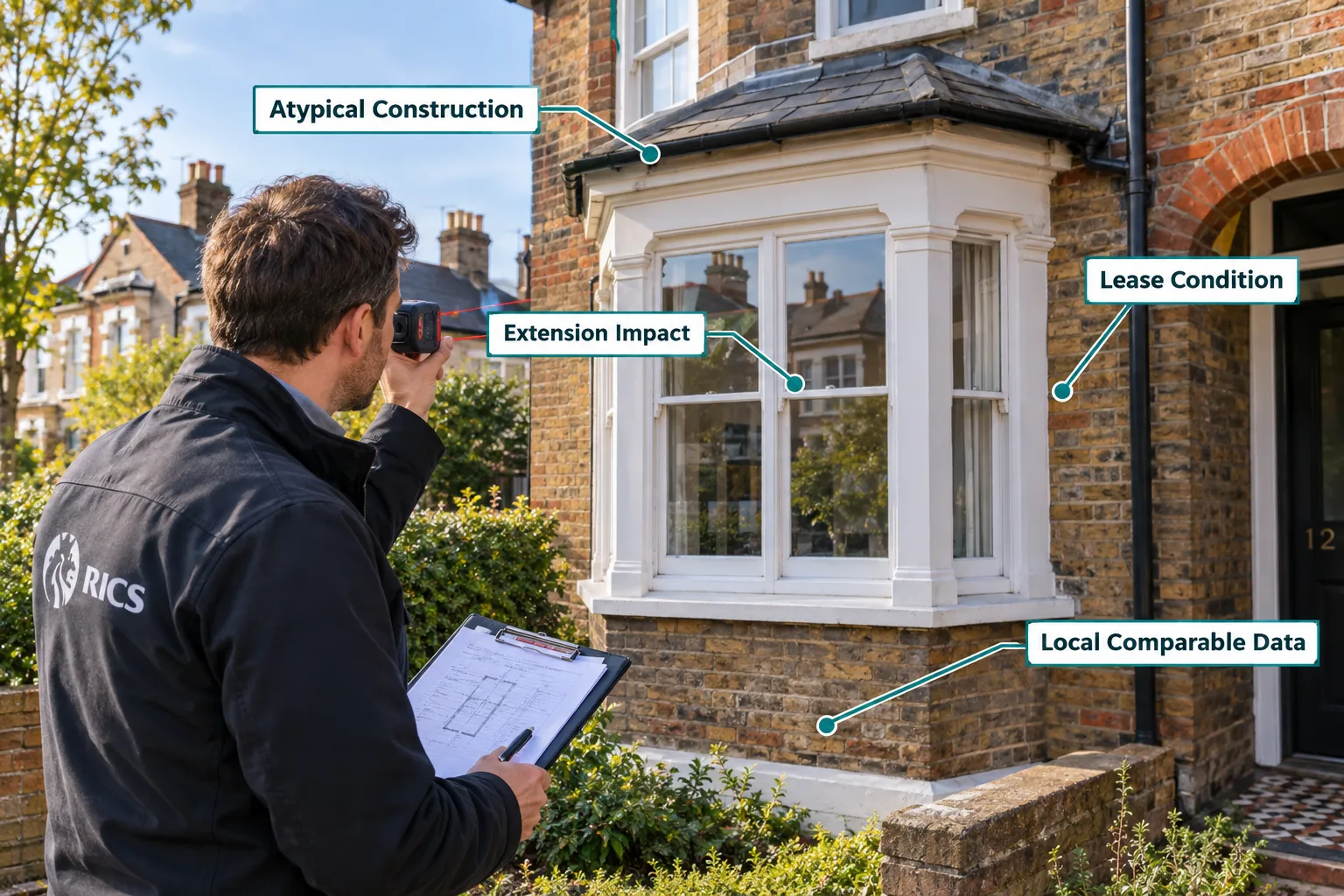
An independent property valuation carried out by a registered RICS valuer follows the RICS Red Book Global Standards, which set out the methodology, assumptions, and reporting requirements that give the valuation its legal and professional weight. This is fundamentally different from a lender’s mortgage valuation, which is a brief desktop or drive-by assessment designed to confirm that the property provides adequate security for the loan, not to establish the most accurate possible market value for the buyer or seller.
What a RICS Valuation Includes
A formal independent valuation typically involves:
- Physical inspection of the property, including internal and external condition
- Analysis of recent comparable sales in the immediate locality, weighted by recency and similarity
- Assessment of property-specific factors, tenure, lease length, construction type, planning history, condition
- Market commentary on local supply, demand, and price trends
- A written report meeting RICS Red Book standards, signed by a qualified RICS member
This level of analysis is particularly valuable in 2026’s fragmented market. Nationwide describes national growth as “subdued” with macro uncertainty [2], but market conditions vary sharply at a local level. The article on valuation accuracy in stabilising markets explains how qualified surveyors adjust their assessments when price momentum and market sentiment are moving in different directions, a challenge that is directly relevant to the current environment.
Challenging a Lender’s Figure
When a lender’s valuation is disputed, an independent RICS report provides the evidence base for a formal challenge. Most lenders have an internal appeals process, and some will commission a second valuation if the borrower provides compelling evidence of comparable sales that support a higher figure.
In cases where a dispute escalates to litigation or regulatory complaint, the independent valuation takes on additional weight. The role of expert witness valuations in mortgage disputes is increasingly relevant in 2026, as stabilising but uneven prices create more situations where lender and borrower valuations diverge materially.
Regional Divergence Makes Local Expertise Essential
One of the most important limitations of any national index, and of many lender AVMs, is that they smooth over significant regional variation. Rightmove’s August 2026 data show asking prices softening most sharply in parts of the south of England, while some northern markets have maintained stronger momentum [5][8]. A lender applying national assumptions to a property in a locally outperforming or underperforming area will produce a figure that may be systematically wrong.
The analysis of regional housing recovery trends and valuation adjustments illustrates how pronounced these regional differences have become in 2026 and why local comparable evidence matters more than national averages when valuing individual properties.
Making the Decision: A Practical Framework
The decision to commission an independent valuation does not need to be complex. The following framework covers the most common situations:
Commission an independent valuation if:
- Your lender has down-valued the property by any amount that affects your LTV band or deposit requirement
- You are within 5% of an LTV threshold and the market is moving against you
- The property has atypical features, non-standard construction, or a short lease
- You need the valuation for legal, tax, probate, or divorce purposes
- You are buying or selling in a micro-market where recent asking-price cuts are steeper than national averages [5][9]
- You are arranging equity release or a remortgage and the lender’s figure seems inconsistent with recent local sales
- You are an investor assessing a portfolio property where a small valuation error compounds across multiple assets
A desktop valuation may be sufficient if:
- The property is standard construction in an active market with plentiful recent comparables
- The lender’s figure aligns with recent local sales evidence and agent appraisals
- No legal, tax, or regulatory requirement mandates a formal RICS report
For straightforward cases, a desktop house valuation can provide a rapid sense-check against a lender’s figure before deciding whether a full physical inspection is warranted.
Cost vs. Risk Calculation
The fee for an independent RICS valuation typically ranges from a few hundred pounds for a standard residential property to higher amounts for complex or high-value assets. Set against the potential cost of being locked into a worse LTV band, which can add thousands of pounds to mortgage costs over a two- or five-year fixed term, the arithmetic almost always favours commissioning the report when any of the triggers above apply.
Conclusion
The 2026 UK housing market has entered a phase where headline stability conceals significant volatility beneath the surface. Asking prices are falling at their fastest August rate in eight years [9], lender indices have begun recording annual price falls [4][6], and the spread between different benchmarks now exceeds £26,000 [1][2][8]. In this environment, a lender’s valuation, produced quickly, using broad assumptions, and designed to protect the lender’s security, is an inadequate basis for major financial decisions.
Independent property valuation in a volatile UK market: when to go beyond your lender’s figure is not a niche concern for complex cases. It is a practical safeguard for any buyer, seller, or investor who faces a down-valuation, sits close to an LTV threshold, owns an atypical property, or needs a defensible figure for legal or tax purposes.
Actionable next steps:
- Compare your lender’s valuation against recent sold prices on Land Registry and local agent evidence before accepting it.
- If the figure looks low, request the comparable sales the lender used and identify any that are outdated or geographically mismatched.
- Contact a registered RICS valuer for an independent report, particularly if you are within 5% of an LTV threshold or the property has non-standard features.
- For legal or tax requirements, ensure the report meets RICS Red Book standards; a lender’s mortgage valuation will not satisfy HMRC or a court.
- In regions where asking prices are being cut aggressively, use an independent valuation as leverage in price negotiations, a robust third-party figure strengthens your position materially.
The cost of an independent valuation is modest. The cost of proceeding without one, in a market this uncertain, can be significant.
References
[1] UK House Price Index for June 2026 – gov.uk
[2] House Prices – moneyweek.com
[3] UK House Price Index Summary May 2026 – gov.uk
[4] UK House Prices Fall August Interest Rates Lloyds – theguardian.com
[5] British House Prices Fall Burnham Interest Rates Oil Bank Taxes Stock Markets Live Updates – theguardian.com
[6] August House Price Fall Signals More Than A Normal Summer Slowdown – mortgagesolutions.co.uk
[7] August 2026 – ons.gov.uk
[8] August – samconveyancing.co.uk
[9] Asking Prices UK Homes Show Biggest August Fall 8 Years 2026 – reuters.com
[10] August 2026 UK Property Market Update Forecasts Cut Rents – linkedin.com
Related services from Canterbury Surveyors
- Building expert witness surveyors
- RICS property valuations
- Structural engineers in Canterbury & Kent
- Lease extensions & freehold purchase
Get a fixed-fee quote or call 0204 579 8270.