
Canterbury & Kent
Asbestos in Party Walls: Survey, Identification and Removal Obligations for UK Homeowners
}
Roughly half of all UK homes were built before 1980, and a significant proportion of those contain asbestos-containing materials (ACMs) somewhere in their fabric, including in the walls that separate one property from the next. For homeowners planning renovation work in 2026, understanding the specific risks posed by Asbestos in Party Walls: Survey, Identification and Removal Obligations for UK Homeowners is not a box-ticking exercise. It is a practical safety and legal matter that can affect project timelines, costs, neighbour relations, and, in the worst cases, long-term health outcomes. This guide explains where asbestos may be found in party walls, how building and asbestos surveys interact, and what legal duties apply before and after works begin.
Key Takeaways
- Pre-2000 party walls and partition walls can contain asbestos insulating board (AIB) and other higher-risk ACMs requiring licensed removal.
- Owner-occupiers have no automatic legal duty to commission an asbestos survey in their own home, but any intrusive work should not begin until asbestos risk has been assessed.
- The Control of Asbestos Regulations 2012 (CAR 2012) remains the core legal framework; the duty to manage applies to non-domestic premises and the common parts of multi-occupancy residential buildings.
- DIY removal of asbestos is strongly discouraged; damaged or deteriorating ACMs in party walls must be handled by competent, appropriately licensed contractors.
- Asbestos surveys for pre-1990s properties typically cost £200,£450, while party wall surveyor fees can range from £700 to over £4,000 in complex cases, making early identification essential for budget planning.
Why Party Walls Are a Particular Concern for Asbestos
Party walls occupy a unique position in building law and building fabric. They are shared structural elements, often incorporating fire-separation requirements, and they were frequently constructed using materials that were later found to be hazardous.
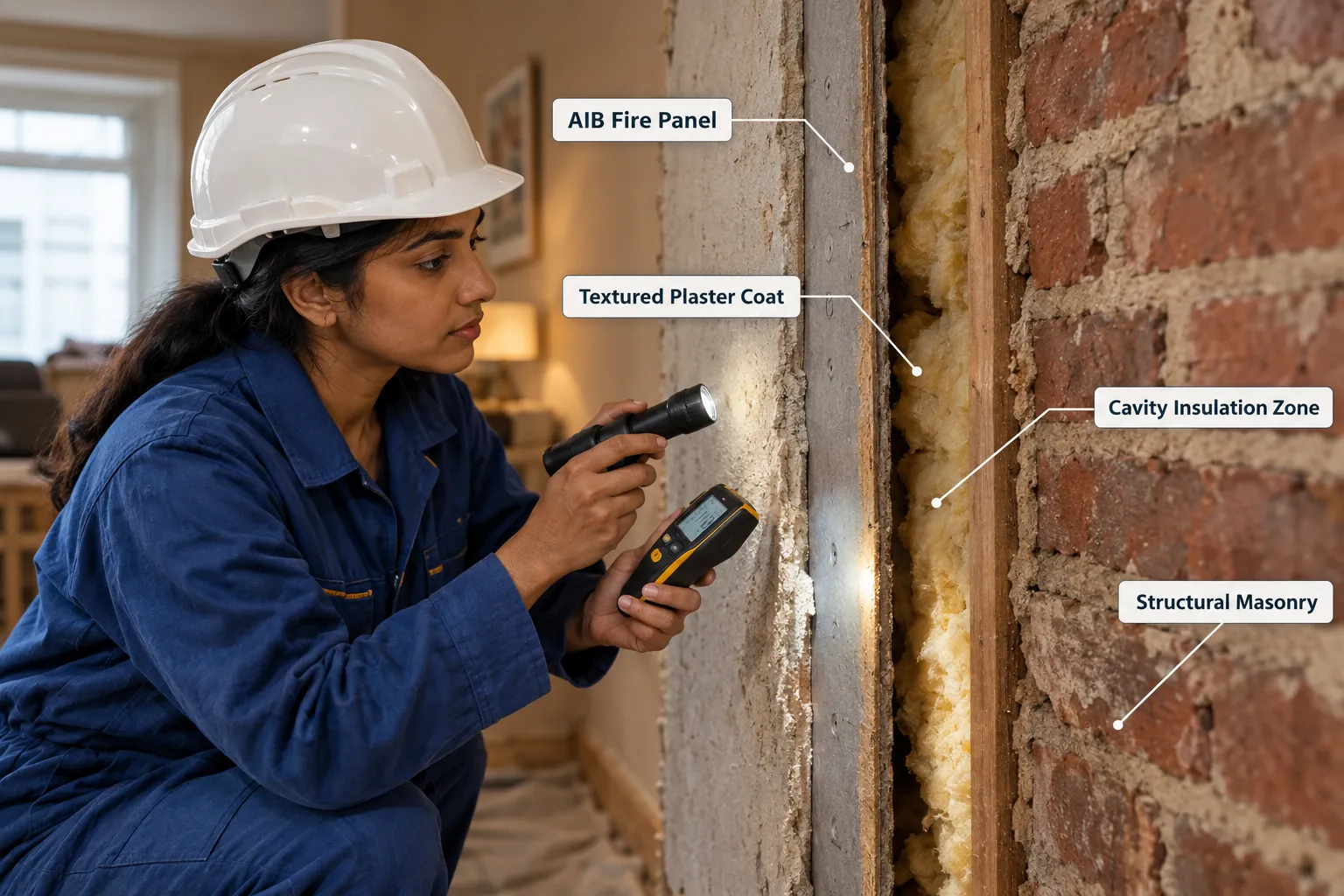
Asbestos insulating board (AIB) was widely used in internal partition walls and fire-check panels throughout the mid-to-late twentieth century. HSE’s building location diagrams confirm that AIB panels and similar ACMs were routinely installed in internal partition walls, which include the fire-separating walls between adjoining dwellings [10]. This means that in a typical pre-2000 terraced or semi-detached house, the party wall itself, or the board and plaster finishes applied to it, may contain asbestos.
The risk is not merely theoretical. AIB is classified as a higher-risk ACM because its fibres can be released more readily than those in, for example, asbestos cement. Any work that involves cutting, drilling, chasing, or removing sections of a party wall in a pre-2000 property therefore carries a real potential for fibre release if the presence of asbestos has not been established first [4].
Common locations where asbestos may be found in or around party walls include:
| Location | Typical ACM Type | Risk Level |
|---|---|---|
| Fire-check panels between dwellings | Asbestos insulating board (AIB) | Higher risk |
| Textured coatings on wall surfaces | Artex or similar coatings | Moderate risk |
| Pipe lagging in wall cavities | Amosite or chrysotile insulation | Higher risk |
| Partition wall infill boards | AIB or asbestos cement board | Higher risk |
| Masonry mortar (rare, pre-1970s) | Chrysotile fibres | Lower risk |
“Pre-2000 party walls and partition walls can contain higher-risk materials that require licensed removal rather than simple DIY.” [10]
For anyone planning a loft conversion, rear extension, or any work that involves opening up or cutting into a shared wall, understanding this risk is the essential starting point. Detailed guidance on the surveying process for such projects is available through resources covering party wall loft conversions and the broader implications of insulation in a party wall.
The Legal Framework: What Asbestos in Party Walls Means for UK Homeowners
Understanding the legal position is essential before commissioning any work. The rules differ significantly depending on whether the property is owner-occupied, rented, or a multi-occupancy building.
Control of Asbestos Regulations 2012
The Control of Asbestos Regulations 2012 (CAR 2012) is the primary piece of legislation governing asbestos management in Great Britain. The duty to manage asbestos under Regulation 4 applies to all non-domestic premises and to the common parts of multi-occupancy domestic buildings, for example, the shared stairwells, corridors, and roof spaces of a block of flats [4]. It does not extend to individually owner-occupied houses.
This means that a homeowner living in their own terraced house has no automatic legal duty to commission an asbestos survey or maintain a formal asbestos register [4]. However, the absence of a legal duty does not mean the absence of risk, and the practical obligations change the moment tradespeople are brought in to carry out work.
What Changes When Work Begins
Once a homeowner engages contractors to carry out intrusive work, drilling, cutting, or removing sections of a party wall, the obligations under CAR 2012 become directly relevant to those contractors. Tradespeople have a duty not to disturb materials until asbestos has been ruled out or safely managed [4]. Homeowners are strongly advised to inform any contractor of known or suspected asbestos before work starts.
In 2026, HSE has maintained its position that the Great Britain asbestos control limit remains at 0.1 fibres per millilitre (f/ml) as a 4-hour time-weighted average [5][8]. Work on a party wall that is likely to exceed this limit, or that is not sporadic and of low intensity, cannot be classified as non-notifiable non-licensed work (NNLW). It will instead fall into notifiable non-licensed work (NNLW) or fully licensed categories, with corresponding requirements for method statements, air monitoring, and waste disposal [8].
Landlords and Multi-Occupancy Buildings
For landlords, the position is more demanding. Shelter’s legal guidance confirms that a party wall is part of the structure of a dwelling, and therefore falls under Section 11 of the Landlord and Tenant Act 1985 for landlords’ repair duties [3]. Where asbestos in a party wall is in a deteriorating condition that could cause exposure, a landlord is required to address it, the mere presence of asbestos is not illegal, but deterioration that creates a risk of exposure is a structural defect that triggers the repair obligation [3].
In multi-occupancy buildings, the duty to manage under CAR 2012 also applies to the common parts, which may include party walls that form part of shared structural elements [4]. Dutyholders in such buildings must identify ACMs, keep a register, and maintain a management plan.
The 2025/2026 Regulatory Consultation
HSE opened a consultation in November 2025 (closed January 2026) on improving how CAR 2012 is applied and how asbestos management guidance is framed. Legal commentary confirms that the consultation is aimed at tightening management and guidance rather than imposing blanket removal duties, and that the current regulations continue to focus primarily on non-domestic premises and common parts [4]. Homeowners should monitor any resulting guidance updates, as changes could affect obligations in multi-occupancy settings.
For a fuller picture of how party wall obligations interact with survey requirements, the guidance for party wall award sets out the procedural framework within which asbestos findings must be managed.
Survey, Identification and Removal Obligations for UK Homeowners: A Practical Guide
The question most homeowners ask is straightforward: what do they actually need to do? The answer depends on the nature of the property, the work planned, and the condition of any materials found.
Step 1: Establish Whether the Property Is at Risk
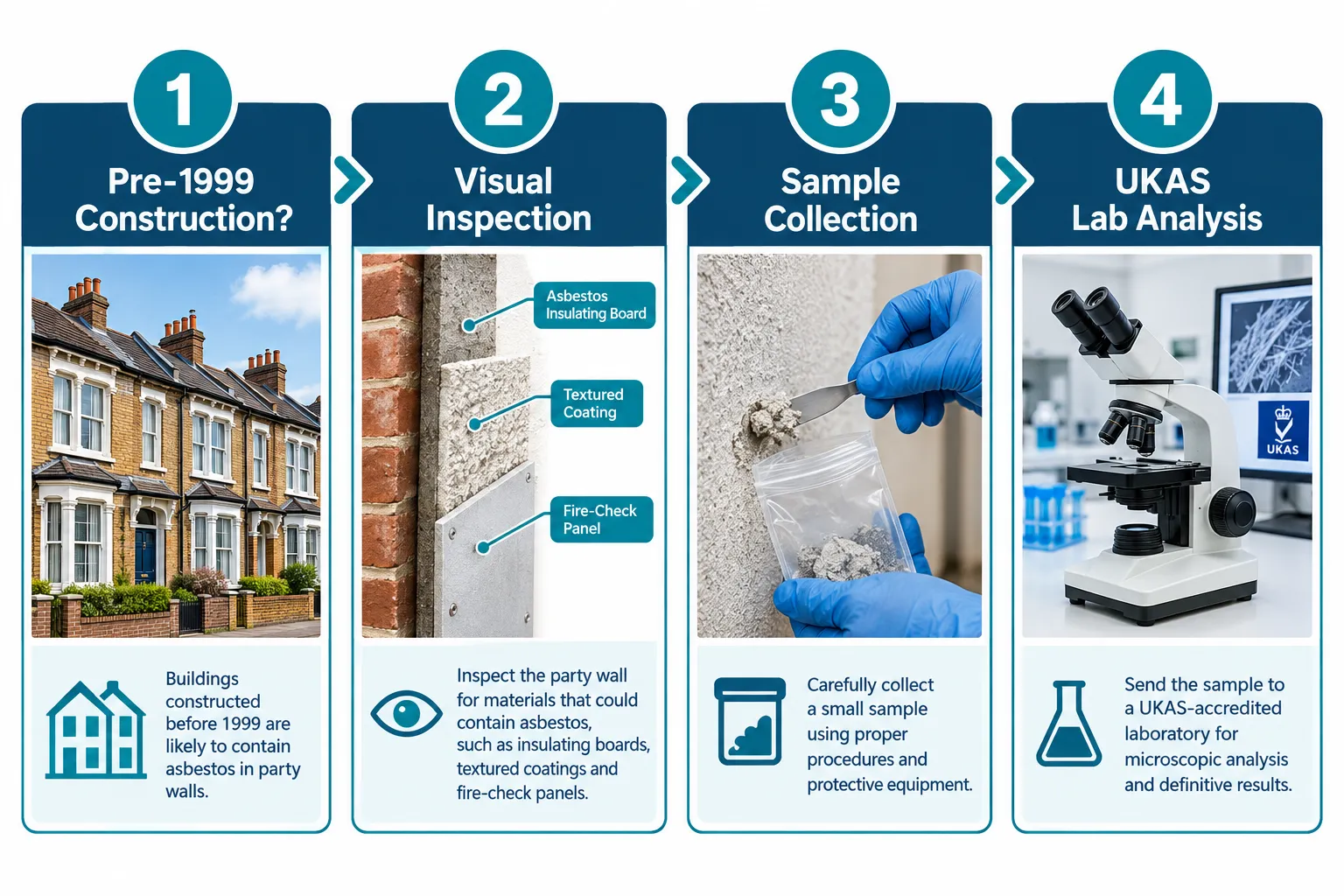
Any property built or refurbished before 2000 should be treated as potentially containing asbestos until confirmed otherwise. The risk is highest in properties built between 1950 and 1980, when AIB and other ACMs were most widely used. Properties built after 2000 are unlikely to contain asbestos, though they may incorporate older materials in extensions or refurbishments.
Key questions to ask before any party wall work:
- Was the property built or significantly refurbished before 2000?
- Are there existing asbestos survey records or an asbestos register for the building?
- Does the planned work involve cutting, drilling, or removing sections of the party wall?
- Are there visible signs of deterioration, crumbling boards, damaged textured coatings, or exposed pipe lagging?
Step 2: Commission the Right Type of Survey
There is no single “asbestos survey.” The type required depends on the scope of work planned.
Management surveys are appropriate for routine occupation and minor maintenance. They identify ACMs that could be disturbed during normal use and are suitable for establishing a baseline register.
Refurbishment and demolition surveys are required before any intrusive work, including party wall alterations, loft conversions, or extensions. These surveys involve destructive inspection to locate all ACMs that may be disturbed during the planned work [4].
For pre-1990s properties, a typical refurbishment survey starts at around £400 + VAT for a house, and from £300 + VAT for a flat [2]. Broader cost estimates place asbestos surveys in the £200,£450 range, while party wall surveyor fees typically run from £700 to £1,500 per neighbour, rising to £2,000,£4,000 or more in complex disputes [7].
Surveyors carrying out these assessments should follow HSG264 (HSE’s guidance on asbestos surveys), and any laboratory analysis of samples should be carried out by a UKAS-accredited laboratory [6]. A surveys for asbestos specialist can advise on the appropriate survey type and scope for a specific project.
It is also worth noting that a standard RICS Home Survey will flag suspected ACMs but is not a substitute for a dedicated asbestos survey, the two serve different purposes and should be treated as complementary.
Step 3: Interpret the Findings and Decide on Action
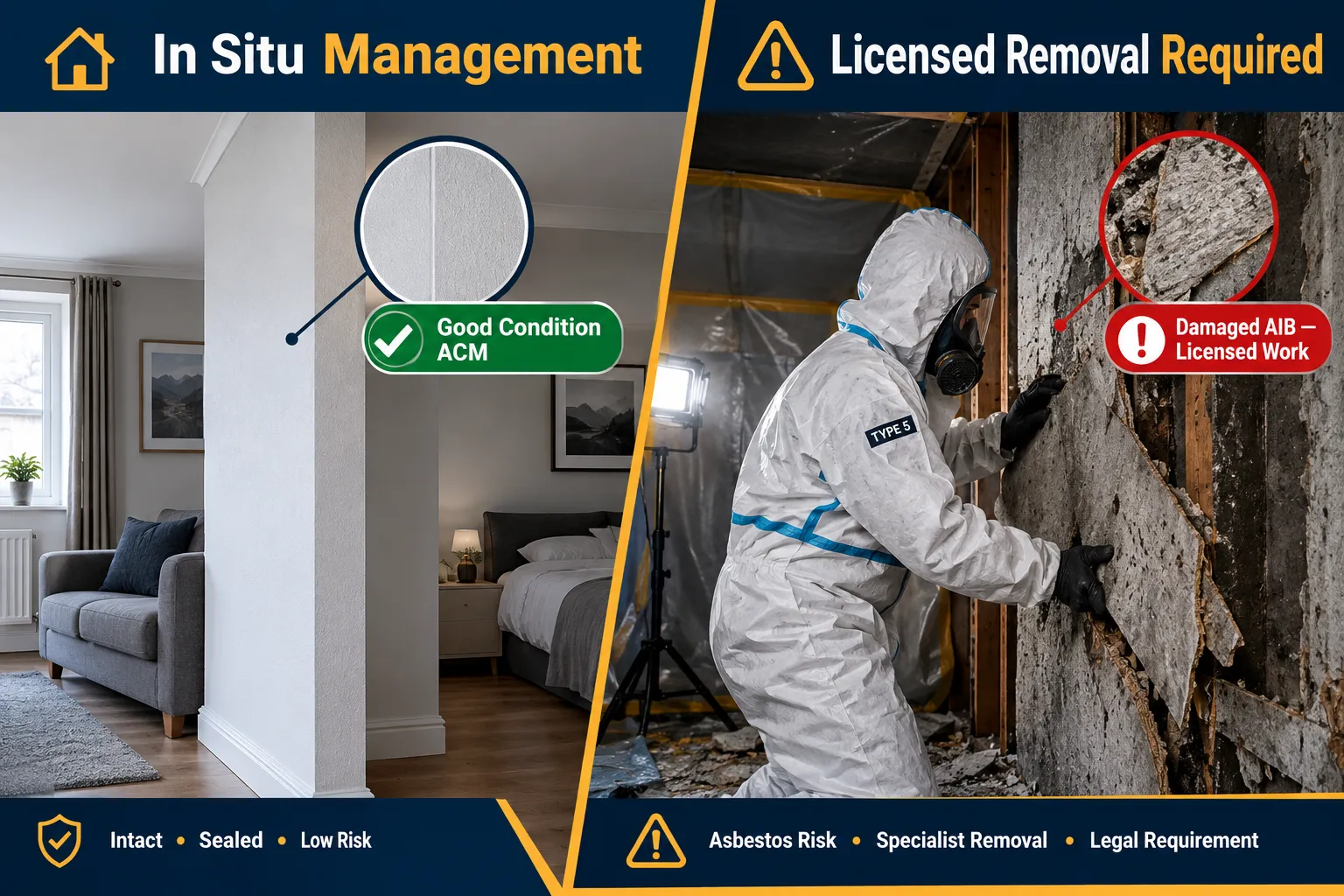
Not all asbestos found in a party wall needs to be removed. The prevailing regulatory position, confirmed by HSE and supported by industry guidance, is that ACMs in good condition and unlikely to be disturbed may be managed in situ [4][6]. Removal is reserved for:
- Materials that are damaged or deteriorating
- Areas where planned refurbishment work will disturb the ACM
- Situations where the material cannot be adequately enclosed or sealed
Decision framework for ACMs found in party walls:
- Good condition, not to be disturbed, Monitor and record; update the asbestos register; no immediate action required.
- Good condition, but planned work will disturb, Arrange licensed or non-licensed removal (depending on ACM type) before work proceeds.
- Damaged or deteriorating, Arrange prompt remediation; consider encapsulation or removal depending on severity.
- Immediate risk of fibre release, Stop work; secure the area; engage a licensed contractor without delay.
Step 4: Manage Removal Safely and Legally
DIY removal of asbestos is strongly discouraged by HSE, UKHSA, and GOV.UK guidance [4]. For higher-risk ACMs such as AIB, which is frequently found in party wall fire-check panels, removal must be carried out by a licensed asbestos contractor. Licensed removal requires:
- A detailed method statement and risk assessment
- Appropriate enclosure and negative pressure units
- Personal protective equipment (PPE) including Type 5 coveralls and FFP3 respirators
- Air monitoring during and after removal
- Four-stage clearance inspection before re-occupation
- Correct disposal at a licensed waste facility [6]
For lower-risk ACMs (such as asbestos cement in good condition), non-licensed or notifiable non-licensed work may be appropriate, but the classification must be made by a competent person, not assumed by the homeowner or general contractor [4][8].
Where party wall works are being carried out under the Party Wall etc. Act 1996, the presence of asbestos adds a layer of complexity to the schedule of condition and the agreed works. A schedule of condition party wall report prepared before work begins provides a documented baseline that protects both the building owner and the adjoining owner if disputes arise later. For further context on what can go wrong when procedures are not followed, the guide on damage to property in party wall situations is a useful reference.
Financial Implications and Budget Planning in 2026
The cost of managing asbestos in party walls is a material consideration for any renovation project budget. In 2026, homeowners and property investors should factor in the following:
- Refurbishment asbestos survey: £200,£450 for a standard house; from £300 + VAT for a flat [2][7]
- Licensed asbestos removal (AIB panels): Costs vary significantly by quantity and access; typically £500,£3,000+ for a party wall section
- Party wall surveyor fees: £700,£1,500 per neighbour for straightforward agreements; £2,000,£4,000+ for complex disputes [7]
- Air monitoring and clearance testing: £300,£600 per clearance event
- Waste disposal at a licensed facility: Variable; typically included in contractor quotes but should be confirmed
These figures underscore why early identification of asbestos in party walls is so important. Discovering ACMs mid-project, after party wall notices have been served, neighbours have agreed to works, and contractors are on site, can cause significant delays and cost overruns. Commissioning a refurbishment survey before serving a party wall notice is best practice, not an optional extra.
For a broader view of how survey costs interact with renovation budgets, the party wall cost guide provides a detailed breakdown of the fees involved in the party wall process.
HSE Enforcement and Industry Standards in 2026
HSE has signalled a clear direction of travel in 2026. The regulator has announced targeted inspections of asbestos management across a range of premises types and is running active campaigns, “Asbestos and You” and “Asbestos: Your Duty”, aimed at trades and dutyholders [9]. The WorkRight campaign’s Global Asbestos Awareness Week update in March 2026 reiterated that there is a legal duty to manage asbestos in non-domestic and multi-occupancy domestic premises, including arranging surveys, registers, and management plans [9].
For homeowners and their contractors, the practical message is clear: the regulatory environment is tightening, not relaxing. Best-practice guidance for 2026 emphasises:
- Using competent surveyors who follow HSG264
- Maintaining up-to-date asbestos registers and management plans for relevant premises
- Employing UKAS-accredited laboratories for sample analysis
- Using licensed contractors for higher-risk ACM removal, with detailed method statements and dust monitoring [6]
HSE’s enforcement activity also highlights the importance of not assuming that a material is safe simply because it looks intact. The only reliable way to confirm the absence of asbestos is through laboratory analysis of a sample taken by a competent person [4][6].
Conclusion: Actionable Next Steps for UK Homeowners
Asbestos in party walls is a manageable risk, but only when it is identified early and handled correctly. The core obligations for UK homeowners in 2026 can be summarised in five practical steps:
Assume risk in any pre-2000 property. Treat all pre-2000 party walls and partition walls as potentially containing ACMs until a competent survey confirms otherwise.
Commission a refurbishment survey before intrusive work. Do not begin drilling, cutting, or removing sections of a party wall without first establishing the asbestos status of the materials involved. This applies regardless of whether a party wall notice has been served.
Inform contractors of known or suspected asbestos. Even though owner-occupiers have no formal duty to manage asbestos under CAR 2012, they have a practical and ethical obligation to share known information with tradespeople before work starts.
Use licensed contractors for higher-risk ACMs. AIB and similar materials found in fire-separating party walls require licensed removal. Do not attempt DIY removal or engage contractors who are not appropriately licensed.
Integrate asbestos findings into the party wall process. Where works are governed by the Party Wall etc. Act 1996, ensure that asbestos survey results are shared with the party wall surveyor and reflected in the agreed method of works and schedule of condition.
Early action on all five points will protect health, manage legal exposure, and keep renovation projects on track. For properties in South East England and London, specialist support is available from chartered surveyors in South East London and across the wider region.
References
[2] Party Wall And Asbestos Surveys – prp.uk.com
[3] Asbestos In Housing – england.shelter.org.uk
[4] Asbestos – hse.gov.uk
[5] Hses Policy Position On Great Britains Asbestos Control Limit – press.hse.gov.uk
[6] Asbestos Management In 2026 Best Practices For Uk Buildings – summitenvironmental.co.uk
[7] Hidden Costs Home Renovations – mybuildally.co.uk
[8] Asbestos Control Limit Review Published – press.hse.gov.uk
[9] Hse Inspectors Checking Asbestos Management – press.hse.gov.uk
[10] Diagrams – hse.gov.uk
Related services from Canterbury Surveyors
- Party wall surveyors in Canterbury & Kent
- Structural engineers in Canterbury & Kent
- Asbestos surveys & testing
Get a fixed-fee quote or call 0204 579 8270.