
Canterbury & Kent
ESG and Sustainability in UK Property Valuation: What Buyers and Lenders Need to Know in 2026
Adding detailed flood and subsidence data to UK property assessments has been shown to reduce projected values by an average of 21.6%, and by up to 31% in parts of London [8]. That single statistic captures the scale of the shift now reshaping how properties are bought, financed, and valued across the country. ESG and Sustainability in UK Property Valuation: What Buyers and Lenders Need to Know in 2026 is no longer a niche professional concern; it is a mainstream financial reality that touches every transaction, every mortgage application, and every valuation report.
From 30 April 2026, RICS made its fourth edition of the global professional standard on ESG and sustainability in commercial property valuation mandatory, integrating it fully into the Red Book Global Standards [1][4]. The implications extend well beyond commercial property. Lenders are embedding climate risk into loan-to-value calculations. Buyers face value adjustments tied to energy performance. And valuers who fail to address sustainability factors now risk producing non-compliant reports [5].
Key Takeaways
- From April 2026, RICS mandates ESG integration at every stage of commercial property valuation under the updated Red Book Global Standards.
- Valuers must assess energy performance, carbon data, flood risk, biodiversity, and stranded asset exposure, not just EPC ratings.
- Climate risk is already reducing UK property values, with flood and subsidence data cutting projected values by up to 31% in some areas.
- 82% of mortgage lenders say physical climate risk influenced their lending decisions or policy in the past year.
- A clear “green premium / brown discount” dynamic is now measurable in UK markets, affecting rents, yields, and liquidity.
The New RICS Mandatory Standard: What Changed in 2026
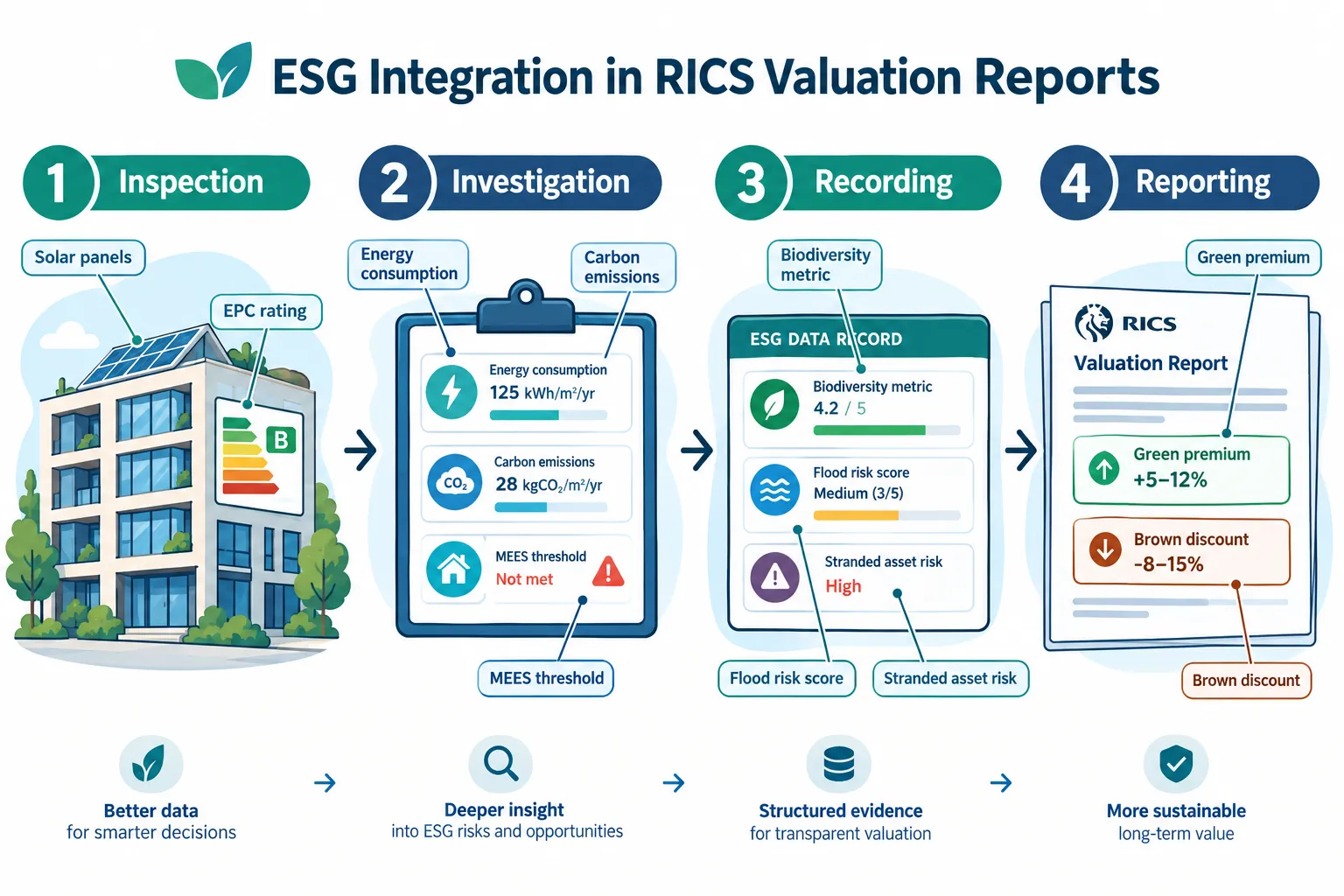
The updated RICS Red Book, effective from April 2026, represents the most significant revision to UK valuation standards in a generation. The fourth edition of “ESG and sustainability in commercial property valuation” is no longer guidance, it is a mandatory professional standard integrated directly into the Red Book Global Standards, with dedicated provisions for the UK, EU, and Australia [1][4].
The core change is structural. ESG factors must now be considered at every stage of the valuation process: inspection, investigation, recording, and reporting [3][4]. This is a departure from previous practice, where sustainability considerations were often appended as a brief commentary or omitted entirely.
VPGA 8, the section on real-property valuation, has been expanded to explicitly cover:
- Net-zero transition risk
- Stranded asset risk
- Physical climate vulnerability
- Operational energy performance
- Social and governance factors at asset level
Valuers accredited by RICS who fail to address these factors adequately now produce non-compliant reports. Such reports are already a primary source of valuation disputes [5]. For those involved in contested valuations, understanding the expert witness roles in mortgage valuation disputes under 2026 RICS standards has become essential reading.
What Valuers Must Now Assess
The standard requires valuers to go far beyond a simple EPC check. A compliant valuation in 2026 must include [2][11]:
| Data Category | Required Evidence |
|---|---|
| Energy consumption | Asset-level kWh data, not just ratings |
| Carbon emissions | Operational carbon figures, retrofit outcomes |
| EPC rating | Current certificate with supporting performance data |
| MEES exposure | Assessment against tightening thresholds |
| Flood risk | Property-specific flood modelling data |
| Stranded asset risk | Explicit uncertainty discount where data is incomplete |
| Biodiversity | Net gain obligations and site-level assessments |
| Whole-life carbon | Embodied and operational carbon across asset lifecycle |
Blanket ESG assessments are no longer acceptable. Each environmental, social, and governance factor must be individually assessed and, where possible, linked to measurable value effects, rents, yields, capital expenditure requirements, and liquidity [5][2]. RICS has also published a dedicated ESG data list for real estate valuations, setting out specific data types, units, and performance measures that valuers and their financial clients should hold [11][1].
For buyers and owners considering retrofit works to meet these standards, the detailed guidance on building surveys for EPC retrofits in 2026 provides a practical framework for understanding compliance pathways and buyer incentives.
Green Premium, Brown Discount: How ESG Affects Property Values

The phrase “green premium / brown discount” has moved from academic theory to market reality. UK real estate market reports for 2026 confirm that environmental performance is now a direct valuation driver [10]. The effects are measurable across multiple dimensions.
Compliant, high-performing assets, those with strong EPC ratings, verified low carbon emissions, and demonstrable resilience to climate risk, attract:
- Stronger institutional tenant demand
- Lower void rates and more competitive rents
- Greater investor interest and improved liquidity
- More favourable lender terms and LTV ratios
Non-compliant or low-performing stock faces the opposite dynamic [10][14]:
- Growing obsolescence risk as MEES thresholds tighten
- Higher operating costs passed through to occupiers
- Reduced transaction liquidity as buyers discount uncertainty
- Potential stranded asset status if retrofit costs are prohibitive
“Environmental performance is no longer a soft factor in valuation, it is a direct input into cash-flow assumptions, yield selection, and risk-adjusted return calculations.”
This shift is particularly visible in the commercial sector, but it is increasingly relevant to residential property too. Buyers seeking a freehold valuation or a Red Book valuation for any purpose, from purchase to lending to dispute resolution, will find that sustainability factors are now material inputs rather than optional commentary.
Energy Performance and MEES: The Regulatory Floor
The Minimum Energy Efficiency Standards (MEES) regime continues to tighten. For commercial landlords, the trajectory toward higher minimum EPC ratings is well established. For residential buyers, the direction of travel is equally clear, even if the residential timeline remains subject to policy confirmation.
Valuers are now required to assess a property’s regulatory position explicitly, identifying not just the current EPC rating but the gap between current performance and likely future thresholds, and the estimated capital expenditure required to close that gap [2][11]. Where that gap is large and retrofit costs are high, the valuation must reflect the risk through adjusted cash-flow assumptions or explicit uncertainty discounts.
This has practical consequences for buyers at every price point. Understanding valuation factors that now include energy and carbon performance is essential for anyone making a purchase decision or seeking finance in 2026.
ESG and Sustainability in UK Property Valuation: What Lenders Need to Know in 2026

The lender perspective on ESG and sustainability in UK property valuation has shifted dramatically. Climate risk is no longer a reputational concern managed by sustainability teams, it is a prudential risk managed by credit committees and risk officers.
A mid-2026 study found that 82% of mortgage lenders say physical climate risk influenced their lending decisions or policy in the previous year, and 90% are concerned about climate-related exposure across their mortgage portfolios [6]. These are not marginal concerns. They represent a fundamental reassessment of collateral risk.
Climate Risk Is Already Moving Numbers
The most striking evidence of this shift comes from the data. One 2026 study found that incorporating property-specific flood and subsidence data reduced projected property values across the UK by an average of 21.6%, and by up to 31% in parts of London [8][15]. These are not theoretical future adjustments, they reflect the gap between current valuations and what values would be if climate risk were fully priced.
Lenders are responding by investing in climate-risk analytics platforms that combine:
- Portfolio-level data aggregation
- Granular property intelligence
- Forward-looking climate models
- Property-level risk scores
- “Supervisory-ready” reporting formats [6][13]
The regulatory direction is clear. The Prudential Regulation Authority and the Financial Conduct Authority have both signalled expectations that lenders integrate climate risk into their underwriting and collateral assessment frameworks. Lenders who cannot demonstrate this integration face growing supervisory scrutiny.
Carbon Performance in Loan-to-Value Assessment
Major UK lenders are now disclosing climate-related metrics tied directly to their mortgage books. Nationwide’s 2026 climate-related financial disclosures, for example, include measures such as “economic LTV weighted carbon intensity”, a metric that directly links the carbon performance of collateral to loan-to-value and portfolio risk assessment [12].
This represents a structural change in how mortgage lending works. A property’s carbon intensity is no longer relevant only to its occupier’s energy bills. It is relevant to the lender’s assessment of collateral quality, portfolio risk concentration, and regulatory capital requirements.
For buyers, this means that the sustainability profile of a property can affect:
- Mortgage availability, some lenders are beginning to restrict lending on the lowest-performing stock
- Loan-to-value ratios, higher climate risk may attract lower maximum LTVs
- Interest rates, green mortgage products offer preferential rates for high-performing assets
- Remortgage risk, a property that deteriorates in EPC terms may face tighter terms at remortgage
Understanding the price of valuation and what a compliant RICS valuation now covers is therefore directly relevant to anyone planning a purchase or refinancing in 2026.
What Lenders Should Require from Valuers
Under the 2026 mandatory RICS standard, lenders commissioning valuations should expect, and require, reports that explicitly address [1][5][9]:
- Current EPC rating with supporting performance data
- Asset-level energy consumption and carbon emissions
- MEES compliance status and gap analysis
- Flood risk assessment using property-specific data
- Stranded asset risk assessment with explicit uncertainty treatment
- Retrofit cost estimates where compliance gaps exist
- Biodiversity net gain obligations where applicable
- Explicit linkage between ESG factors and value conclusions
Lenders who accept valuations that omit these elements are accepting collateral assessments that may materially misstate risk. The registered RICS valuers who produce these reports are now professionally accountable for their ESG coverage under the mandatory standard.
Practical Implications for Buyers in 2026
For individual buyers, the integration of ESG factors into UK property valuation creates both risks and opportunities.
The risks are real. A property that looks attractively priced may carry hidden sustainability liabilities, a poor EPC rating that will require expensive retrofit, a flood risk profile that affects insurability and future value, or a stranded asset trajectory that limits future buyer demand. These risks are now material to value, and a compliant valuation will surface them.
The opportunities are equally real. Buyers who understand ESG factors can make better-informed decisions, negotiate more effectively on properties with sustainability liabilities, and identify assets where retrofit investment will generate measurable value uplift.
Key questions buyers should ask before proceeding with any purchase in 2026:
- What is the current EPC rating, and what is the cost to reach the likely future minimum standard?
- Has a property-specific flood risk assessment been carried out?
- What are the asset-level energy consumption and carbon emission figures?
- Has the valuer explicitly addressed MEES exposure and stranded asset risk?
- Does the valuation report comply with the 2026 RICS mandatory ESG standard?
For buyers of older or more complex properties, commissioning a Level 3 building survey alongside a valuation provides the most comprehensive picture of both physical condition and sustainability performance.
Conclusion: Actionable Next Steps for Buyers and Lenders
ESG and sustainability in UK property valuation in 2026 is not a future consideration, it is the present standard. The mandatory RICS framework, the measurable impact of climate risk on property values, and the integration of carbon performance into lender underwriting all point in the same direction: sustainability factors are now core to value, not peripheral to it.
For buyers:
- Commission valuations only from registered RICS valuers who explicitly confirm compliance with the 2026 mandatory ESG standard.
- Request that the valuation report addresses energy performance, flood risk, MEES exposure, and stranded asset risk as distinct line items.
- Factor retrofit costs into purchase price negotiations where sustainability gaps are identified.
- Consider a building survey alongside any valuation to capture physical condition alongside sustainability performance.
For lenders:
- Update valuation instructions to require explicit ESG coverage consistent with the 2026 RICS mandatory standard.
- Invest in climate-risk analytics that enable property-level risk scoring, not just portfolio-level estimates.
- Develop clear policy positions on lending against low-EPC stock, including maximum LTV adjustments and timeline for review.
- Ensure climate-related financial disclosures reflect the carbon intensity of the mortgage book at asset level.
The green premium is real. The brown discount is accelerating. The regulatory and prudential frameworks that enforce ESG integration into valuation are now in place. Buyers and lenders who act on this information in 2026 will be better positioned than those who treat it as a compliance formality.
References
[1] Esg And Sustainability In Commercial Property Valuation – rics.org
[2] Carbon Performance Property Valuation Surveyors Data – sustainifyai.co.uk
[3] Global Red Book Updates – ww3.rics.org
[4] Rics Publishes Updated Global Standard Esg Sustainability Commercial Property Valuation – rics.org
[5] Expert Witness Preparation For Rics Sustainability Report 2025 Disputes Evidence Standards In Green Valuation Challenges – princesurveyors.co.uk
[6] Climate Risk And Lending From Portfolio Concern To Valuation Reality – landmark.co.uk
[7] Valuation Standards – rics.org
[8] Climate Risk Is Cutting Uk Property Values Faster Than Lenders Realise – insurancebusinessmag.com
[9] Valuing Tech Enabled Rentals For Institutional Investors Surveyor Insights From Q1 2026 Rics Data – princesurveyors.co.uk
[10] Evergreen Guide To Rics Valuation Standards In Volatile Markets Timeless Principles For 2026 Practitioners – princesurveyors.co.uk
Related services from Canterbury Surveyors
- Building expert witness surveyors
- RICS property valuations
- Building Surveys (Level 3)
- Structural engineers in Canterbury & Kent
Get a fixed-fee quote or call 0204 579 8270.