
Canterbury & Kent
Subsidence and Party Wall Claims: How Surveyors Assess Liability, Damage and Insurance in the UK
UK insurers paid out a record £72 million in subsidence claims in Q2 2026 alone, with the average individual claim reaching an unprecedented £20,000, a figure that has shocked both the insurance industry and homeowners who assumed modest cracking was a minor cosmetic issue [1][5]. When subsidence strikes a terraced or semi-detached property, the damage rarely respects boundaries. Shared walls, interlinked foundations, and adjacent excavations mean that Subsidence and Party Wall Claims: How Surveyors Assess Liability, Damage and Insurance in the UK have become one of the most technically and legally demanding areas a chartered surveyor can navigate in 2026.
This article explains how surveyors identify and apportion liability when subsidence affects party wall structures, what evidence insurers and courts require, and how the Party Wall etc. Act 1996 intersects with insurance obligations.
Key Takeaways
- Average subsidence claims in the UK reached a record £20,000 in Q2 2026, driven by prolonged drought and clay soil shrinkage.
- When subsidence affects a shared wall, liability must be apportioned between building owners and adjoining owners using documented evidence.
- A pre-works Schedule of Condition is the single most important document in any subsequent party wall or insurance dispute.
- Rebuild cost inflation is outpacing sums insured, creating a dangerous underinsurance gap that complicates damage assessments.
- Surveyors acting under the Party Wall etc. Act 1996 hold a quasi-judicial role and can face personal liability if they act negligently or outside their statutory authority.
Why Subsidence and Party Wall Structures Are Inseparable
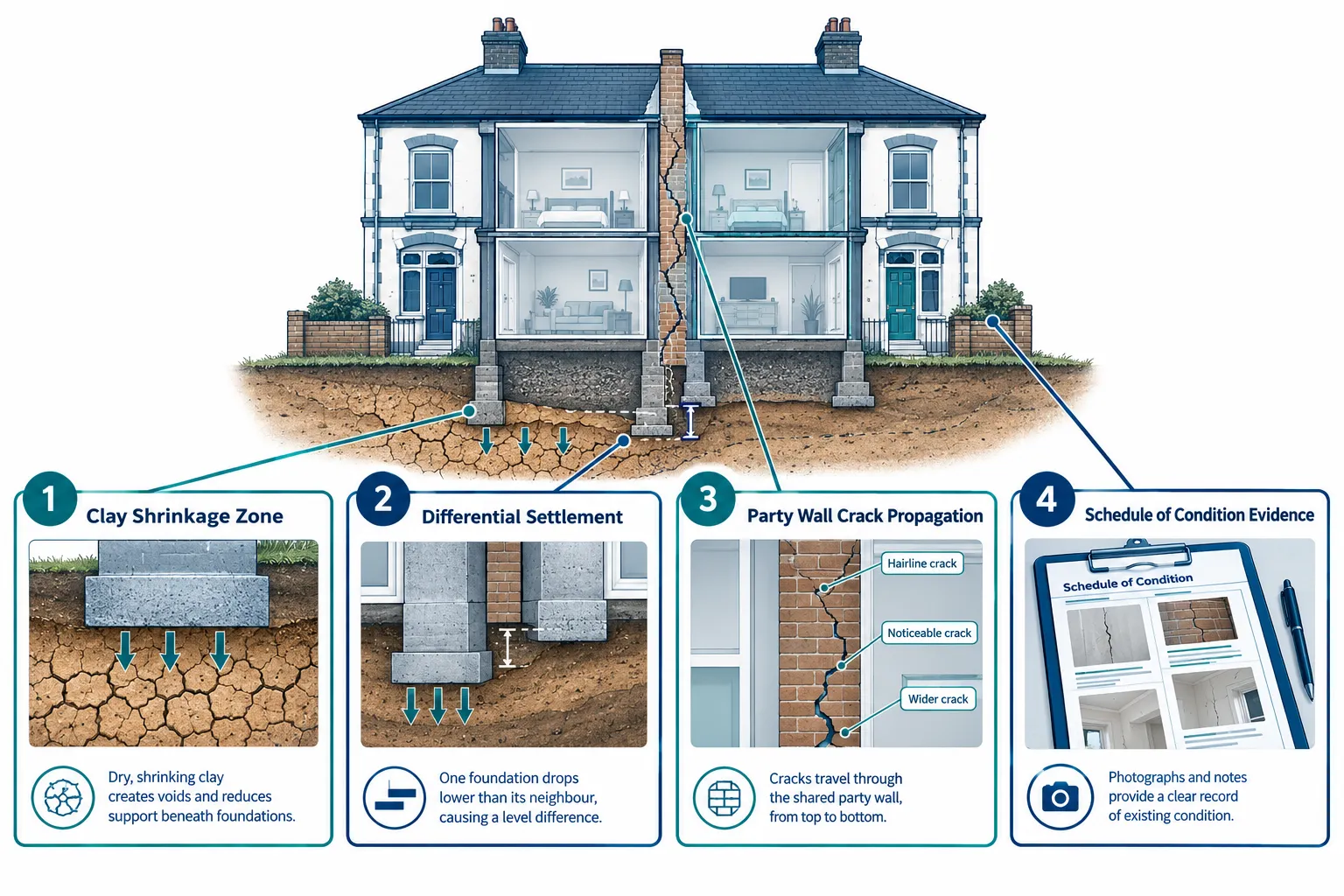
Subsidence occurs when the ground beneath a building moves downward, causing foundations to sink unevenly. In the UK, the primary driver is shrinkable clay soil, which loses volume during prolonged dry spells and expands when moisture returns. The summers of 2025 and 2026 have accelerated this cycle dramatically. According to data from the Association of British Insurers (ABI), subsidence claim volumes in H1 2026 were running at double the long-run average, with the hottest recorded summer on record cited as the primary cause [6][10].
For properties sharing a party wall, the legal structure dividing terraced houses, semi-detached pairs, and flats, subsidence creates a specific and complicated problem. The party wall sits on foundations that belong, in part, to both neighbours. When one side of that wall settles at a different rate from the other, diagonal cracking, door and window distortion, and structural separation can follow. Understanding surveys for subsidence in this context requires surveyors to think simultaneously about structural engineering, statutory law, and insurance liability.
The Role of Clay Soil and Tree Roots
The UK’s London Clay and similar shrinkable deposits underlie vast swathes of the South East, East Anglia, and parts of the Midlands. Tree roots, particularly from willows, oaks, and poplars, extract moisture from clay at depth, accelerating shrinkage in dry conditions. When a tree sits close to a party wall boundary, establishing which side bears responsibility for root-induced subsidence becomes a central question in both party wall proceedings and insurance claims.
Milliman’s 2026 analysis of the UK property insurance subsidence event noted that the combination of record temperatures, low rainfall, and high tree density in suburban areas created a “perfect storm” for claim frequency and severity [4]. Claim severity, the average cost per claim, is now outpacing general construction cost inflation, partly because underpinning and foundation repair work requires specialist contractors whose capacity is currently stretched [8].
How Surveyors Apportion Liability in Party Wall Subsidence Disputes
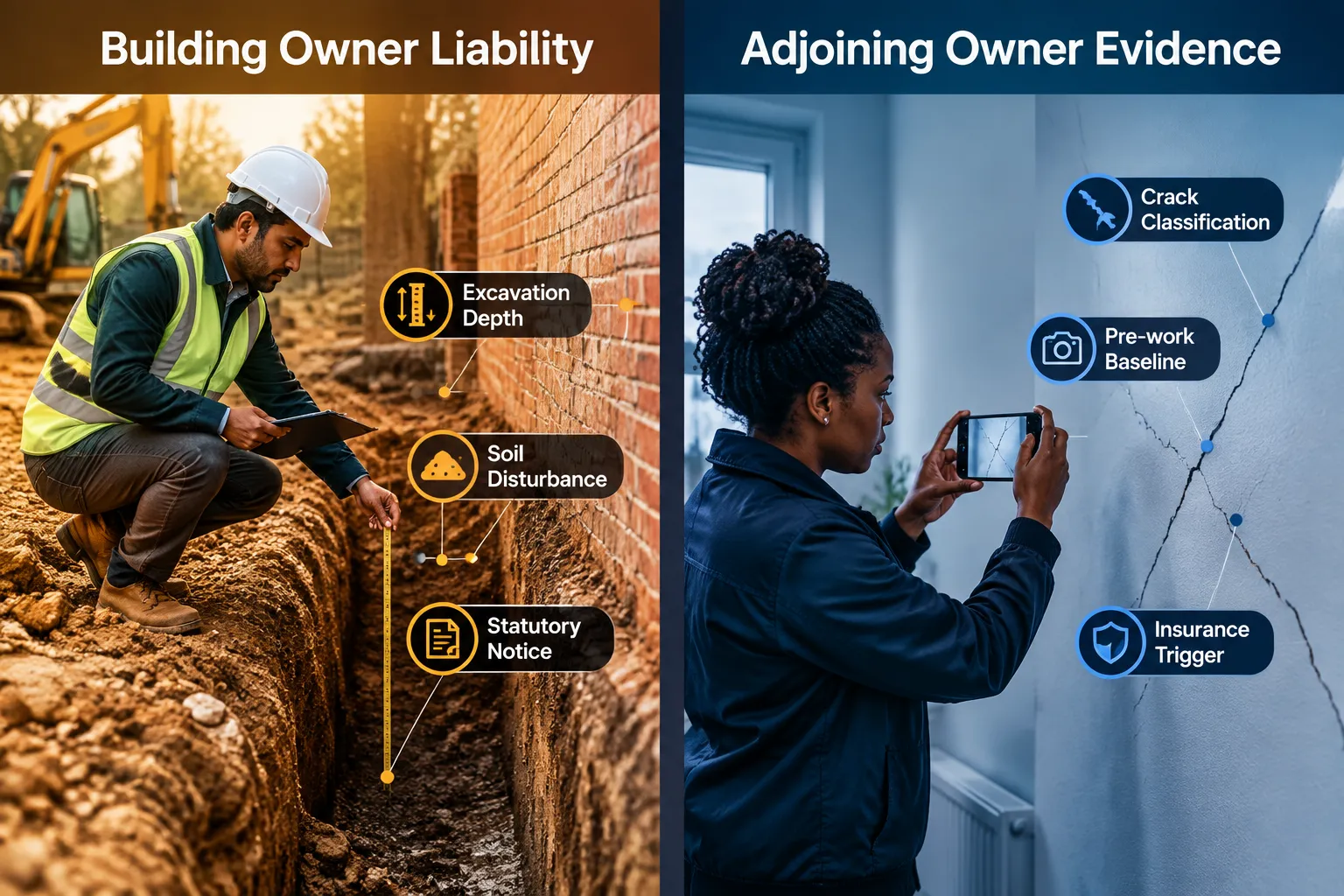
When subsidence damage appears at or near a party wall, the first question every insurer, solicitor, and surveyor asks is: who caused it, and who must pay? The answer is rarely simple. Liability in Subsidence and Party Wall Claims: How Surveyors Assess Liability, Damage and Insurance in the UK typically falls into one of three categories:
| Scenario | Likely Liable Party | Key Evidence Required |
|---|---|---|
| Natural clay shrinkage affecting both properties equally | Each owner’s insurer independently | Soil reports, crack pattern analysis |
| Excavation by one owner destabilising shared foundations | Building owner who excavated | Schedule of Condition, structural engineer’s report |
| Tree root ingress from one owner’s garden | Owner of the tree | Arborist report, root mapping |
| Pre-existing defect worsened by adjacent works | Shared or disputed | Historical surveys, photographic baseline |
The Schedule of Condition: The Surveyor’s Primary Tool
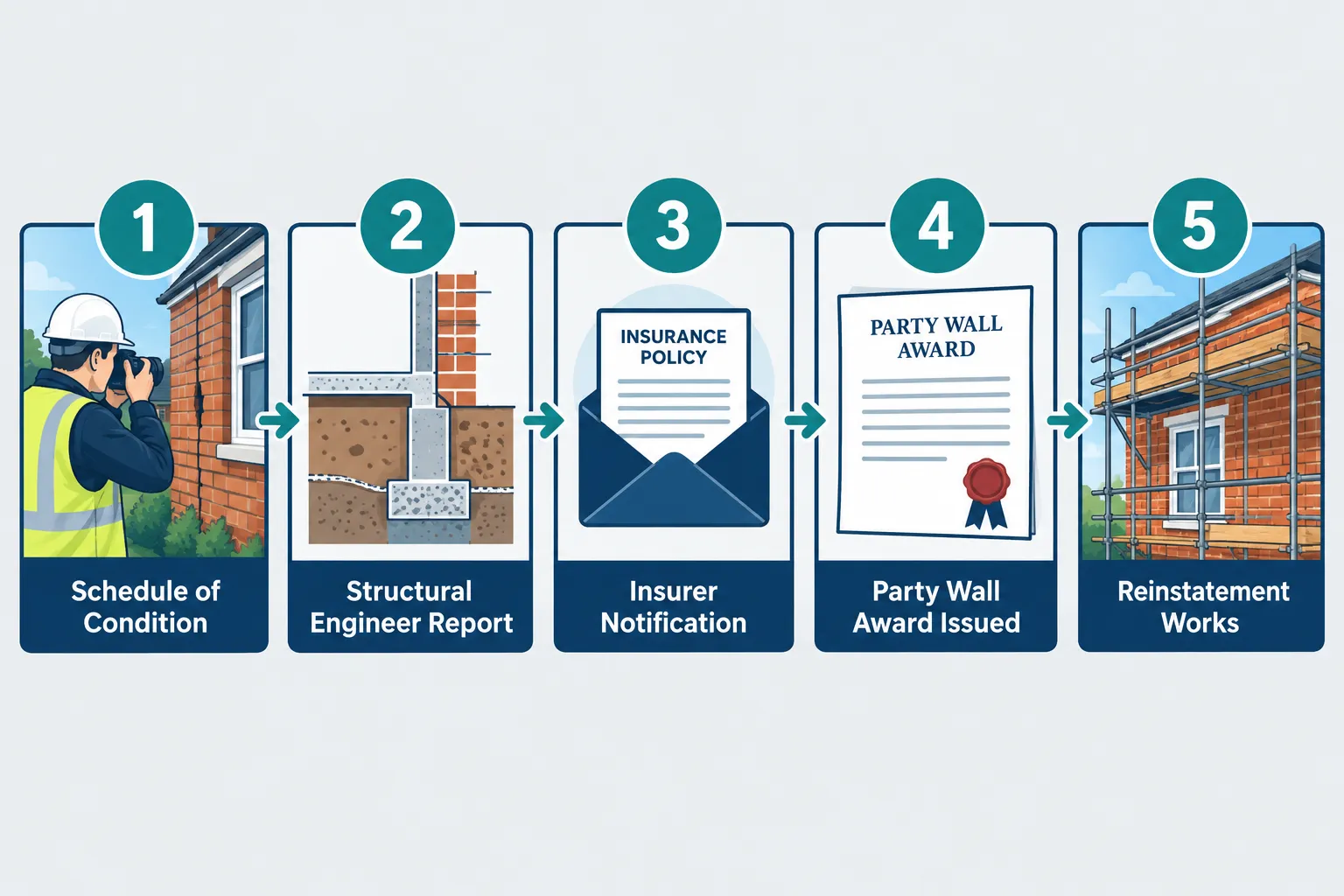
A Schedule of Condition is a detailed photographic and written record of a property’s state before any notifiable works begin. Under the Party Wall etc. Act 1996, a building owner proposing works that affect a party wall must serve notice on the adjoining owner. If the adjoining owner dissents, surveyors are appointed and a Party Wall Award is issued, a legally binding document that governs how works proceed and how damage is assessed afterward.
The Schedule of Condition sits at the heart of this process. Without it, a surveyor cannot objectively determine whether a crack existed before works commenced or was caused by them. In the current claims environment, where cracks in walls are increasingly common due to subsidence, this baseline record is the difference between a successful claim and a protracted dispute.
“The absence of a pre-works Schedule of Condition is the single most common reason party wall subsidence claims become contested and expensive.”, A recurring observation in FOIL’s 2026 subsidence update [3].
FOIL (the Forum of Insurance Lawyers) highlighted in its 2026 update that disputed causation, particularly where subsidence and construction works occur simultaneously, is generating a significant increase in litigation referrals [3]. Surveyors who have not documented baseline conditions face the prospect of claims being decided on inference rather than evidence.
Crack Classification and Damage Categories
Surveyors use the BRE Digest 251 classification system to categorise crack severity. This runs from Category 0 (hairline, less than 0.1mm) to Category 5 (very severe, requiring partial or complete rebuilding). In party wall subsidence cases, the category of damage directly influences:
- Whether the adjoining owner’s insurer accepts the claim
- The quantum of repair costs included in the Party Wall Award
- Whether underpinning is required or whether crack injection and monitoring suffice
Category 3 and above (crack widths exceeding 5mm) typically trigger insurer involvement and may require a structural engineer’s report before any repair schedule is agreed. For guidance on how a Party Wall Award is structured around damage evidence, the statutory framework provides clear but often misunderstood obligations.
Insurance, Rebuild Costs, and the Underinsurance Problem
Subsidence and Party Wall Claims: How Surveyors Assess Liability, Damage and Insurance in the UK are increasingly complicated by a structural problem in the insurance market: rebuild costs are rising faster than insured sums. The Building Cost Information Service (BCIS) reported in 2026 that rebuild cost inflation, driven by labour shortages, material costs, and specialist contractor demand, is outpacing the sums insured on many residential policies [2]. This creates an underinsurance gap that leaves homeowners exposed even when their claim is valid.
For party wall subsidence claims specifically, this gap matters in two ways:
- The building owner’s insurer may find that the cost of underpinning or structural repair exceeds the policy limit, leaving the owner personally liable for the shortfall.
- The adjoining owner’s insurer may dispute the quantum of the surveyor’s damage assessment if it reflects current market rates rather than the insured rebuild value.
An insurance reinstatement valuation, a formal assessment of the cost to rebuild a property to its pre-damage condition at current rates, is therefore an essential component of any subsidence claim involving a party wall. Surveyors who conflate market value with reinstatement value risk producing assessments that insurers will challenge.
How Insurers Reserve and Price Subsidence Risk
ABI data published in August 2026 showed that UK subsidence payouts reached £72 million in Q2 2026 alone [1]. Insurance Age reported that the average subsidence claim has now hit a record £20,000 [9], a figure driven by the increasing depth of underpinning required on shrinkable clay sites and the specialist nature of the repair work. Milliman’s actuarial modelling suggests that if current climate trends continue, annual subsidence losses could stabilise at two to three times their pre-2022 baseline [4].
For insurers, this means:
- Higher reserving on open subsidence files, particularly where party wall disputes delay the commencement of repair works
- Premium increases for properties on shrinkable clay soils, especially those with mature trees within 5 metres of foundations
- Greater scrutiny of causation evidence before settlement, with insurers increasingly instructing their own structural engineers to verify surveyor assessments
What Insurers and Courts Expect as Evidence
Whether a subsidence claim involving a party wall ends in a negotiated settlement or litigation, the quality of the surveyor’s evidence package is decisive. Courts and insurers expect:
- A dated, photographic Schedule of Condition taken before any works commenced
- A structural engineer’s report identifying the mechanism of subsidence (clay shrinkage, root ingress, leaking drain, or construction vibration)
- Crack monitoring data over a minimum period (typically 12 months for natural subsidence)
- A clear apportionment analysis distinguishing pre-existing damage from works-related damage
- A reinstatement cost schedule prepared to BCIS standards
Where works were carried out without proper notice, the absence of a Party Wall Award significantly weakens the building owner’s position. The consequences of no party wall agreement in a subsidence context can include injunctions, mandatory underpinning at the building owner’s sole cost, and damages awards that exceed the original construction budget.
The Surveyor’s Quasi-Judicial Role and Personal Liability
Party wall surveyors occupy an unusual legal position. When appointed under the Party Wall etc. Act 1996, they act not as agents of the party who appointed them but as quasi-judicial officers with a duty to act impartially. This distinction has significant consequences in subsidence disputes.
A surveyor who issues a Party Wall Award that fails to adequately address subsidence risk, for example, by approving excavation works without requiring monitoring or a Schedule of Condition, can face a claim in negligence from the adjoining owner if damage subsequently occurs. The courts have confirmed that the quasi-judicial immunity that protects surveyors from claims relating to the exercise of their judgment does not extend to procedural failures or acts outside their statutory authority.
For party wall advice on notifiable works and pre-dispute resolution, RICS-trained surveyors are expected to identify subsidence risk at the outset of the party wall process, not after damage has occurred. This means reviewing soil type, proximity of trees, depth of proposed excavation, and the condition of existing foundations before drafting the Award.
Excavation Works: The Highest-Risk Scenario
Basement excavations and deep foundation works represent the highest-risk category for party wall subsidence claims. Excavating below the level of an adjoining owner’s foundations, even by a small margin, can trigger differential settlement in clay soils within weeks. Party wall surveys for basement excavations and deep foundation works require surveyors to specify precise monitoring requirements, temporary propping schedules, and drainage protection measures as conditions of the Award.
Under Section 6 of the Party Wall etc. Act 1996, a building owner who excavates within 3 metres of a neighbour’s structure (or within 6 metres if the excavation goes below a 45-degree line from the bottom of the neighbour’s foundations) must serve a notice for excavation near a neighbour. Failure to serve this notice does not prevent the works from being unlawful, it simply removes the statutory protection that the Party Wall Act would otherwise provide to both parties.
Practical Steps for Surveyors, Homeowners, and Insurers
Whether acting for a building owner, an adjoining owner, or an insurer, the following framework applies to most subsidence and party wall claims in 2026:
Before works begin:
- Commission a thorough Schedule of Condition covering all rooms adjacent to the party wall, external elevations, and any outbuildings
- Obtain a soil investigation report identifying clay type and shrinkage potential
- Identify all trees within 10 metres of the shared boundary and assess root influence
- Serve the correct statutory notices and allow the prescribed response periods
During works:
- Install crack monitors and settlement gauges at agreed intervals
- Maintain a photographic site diary updated at each stage of excavation
- Report any unexpected ground conditions to the appointed surveyors immediately
After damage is identified:
- Instruct a structural engineer to determine causation before any repair works begin
- Notify the relevant insurer promptly, late notification can prejudice a claim
- Obtain a reinstatement cost assessment at current BCIS rates
- Engage the party wall surveyor to issue a supplementary Award if the original Award did not anticipate the extent of damage
Conclusion
The convergence of record subsidence claim volumes, rising rebuild costs, and increasingly complex party wall disputes has made 2026 a defining year for how the UK property industry manages shared structural risk. Average claims of £20,000 [5] and quarterly industry payouts of £72 million [1] are not statistical outliers, they reflect a structural shift in climate, construction activity, and legal exposure.
For surveyors, the message is clear: a rigorous Schedule of Condition, a well-drafted Party Wall Award that anticipates subsidence risk, and a reinstatement valuation prepared to current BCIS standards are no longer optional best practice. They are the minimum standard that insurers, courts, and clients will expect.
Actionable next steps:
- If works are planned near a shared boundary, seek consent for party wall work at the earliest opportunity and commission a Schedule of Condition before any ground is broken.
- If subsidence cracking has appeared near a party wall, instruct a chartered surveyor experienced in both structural assessment and party wall law before contacting your insurer.
- Verify that your buildings insurance sum insured reflects current reinstatement costs, not the purchase price or an outdated valuation.
- If a neighbour has carried out works without serving notice, understand the implications of a party wall notice not being served before deciding how to proceed.
The intersection of subsidence, party wall law, and insurance liability is one of the most consequential areas of property practice in the UK today. Getting the evidence right from the outset is the only reliable way to protect all parties involved.
References
[1] UK Subsidence Payouts Rise To 72 Million In Q2 ABI Says – theinsurer.com
[2] Rebuild Costs Are Outpacing Sums Insured BCIS Says Drought Is Making It Worse – insurancebusinessmag.com
[3] FOIL Update Subsidence – foil.org.uk
[4] UK Property Insurance Subsidence Event 2026 – milliman.com
[5] Average Subsidence Claims Reach Record 20000 – iloveclaims.com
[6] Subsidence UK Insurers Double Surge Claims Hot Summers – theguardian.com
[8] UK Subsidence Claims Hit Record As Hottest Summer Leaves Lasting Damage – insurancebusinessmag.com
[9] ABI Data Reveals Average Subsidence Claim Hits Record £20,000 – insuranceage.co.uk
[10] UK Insurers Surge Subsidence Claims Hottest Summer On Record – theguardian.com
Related services from Canterbury Surveyors
- Party wall surveyors in Canterbury & Kent
- Boundary surveys
- Building expert witness surveyors
- RICS property valuations
Get a fixed-fee quote or call 0204 579 8270.