
Canterbury & Kent
Leasehold Valuation and Remaining Term: How Lease Length Affects Property Worth in the UK
A flat with 74 years remaining on its lease can be worth tens of thousands of pounds less than an identical flat next door with 125 years, not because of condition, location, or size, but purely because of a number on a legal document. That single figure, the remaining term, sits at the heart of leasehold valuation and remaining term analysis across the UK, and in 2026 it is more consequential than ever as sweeping legislative reforms reshape the economics of leasehold ownership.
Understanding leasehold valuation and remaining term: how lease length affects property worth in the UK is essential for buyers, sellers, lenders, and surveyors alike. This article explains the mechanisms behind lease-length discounts, the critical threshold points that trigger lender caution and buyer hesitation, how surveyors model marriage value and future worth, and what the latest reforms mean for valuations going forward.
Key Takeaways
- Lease length is a primary driver of leasehold property value; a term falling below 80 years triggers the marriage value calculation, significantly increasing extension costs.
- Most mortgage lenders require a minimum of 70-85 years remaining at the time of application, with many preferring 90 years or more.
- The Leasehold and Freehold Reform Act 2024 and the 2026 draft Commonhold and Leasehold Reform Bill are abolishing marriage value and adjusting capitalisation rates, making short-lease extensions cheaper.
- Reforms are not yet fully priced into the market, creating both risk and opportunity for buyers and sellers of short-lease properties in 2026.
- Instructing a registered RICS valuer is the critical first step before buying, selling, or extending any leasehold property.
Why Lease Length Is the Invisible Price Tag on Every Leasehold Property
Every leasehold property in England and Wales carries a countdown. When that countdown drops below certain thresholds, the property’s value, mortgageability, and saleability all begin to deteriorate in ways that are predictable, quantifiable, and, for the unprepared, deeply costly.
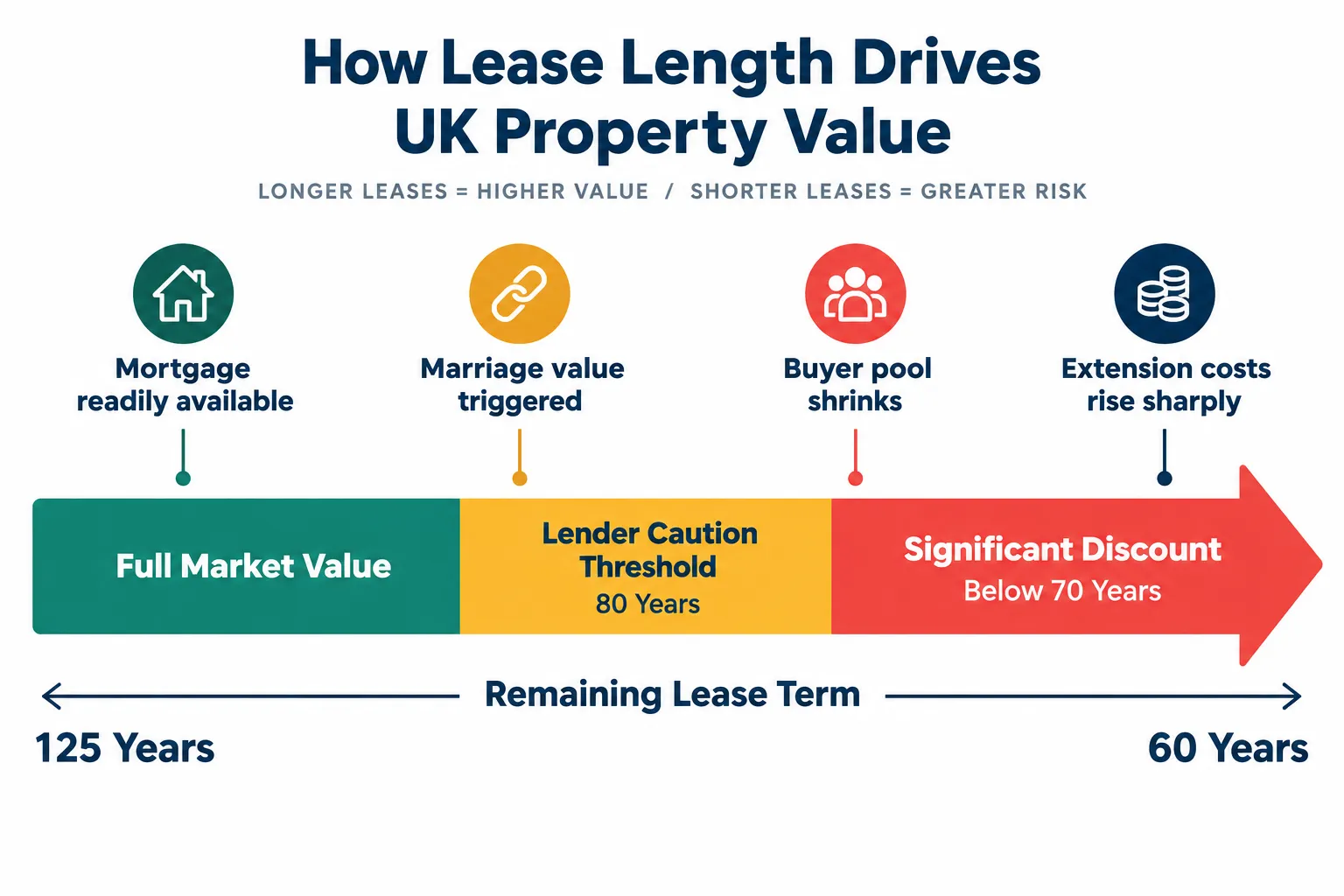
The relationship between remaining term and value is not linear. It follows a curve that steepens sharply as the lease shortens. A property with 120 years remaining trades at close to its freehold equivalent. The same property at 85 years still attracts most buyers and lenders, though a slight discount may apply. Drop below 80 years and the dynamics change fundamentally. Below 70 years, the property enters territory that many mainstream lenders will not touch at all, and the buyer pool narrows to cash purchasers and specialist investors.
Three key threshold bands define the market:
| Remaining Term | Lender Appetite | Valuation Impact |
|---|---|---|
| 90+ years | Unrestricted | Minimal or no discount |
| 80-90 years | Generally acceptable | Small discount; extension advisable |
| 70-80 years | Cautious; some lenders decline | Moderate discount; marriage value applies |
| Below 70 years | Most lenders decline | Significant discount; urgent extension needed |
| Below 60 years | Specialist lenders only | Severe discount; cash buyers primarily |
This table is a general guide. Individual lender policies vary, and a professional Canterbury property valuation will always reflect the specific circumstances of the property and the current lending environment.
The 80-Year Threshold and the Marriage Value Mechanism
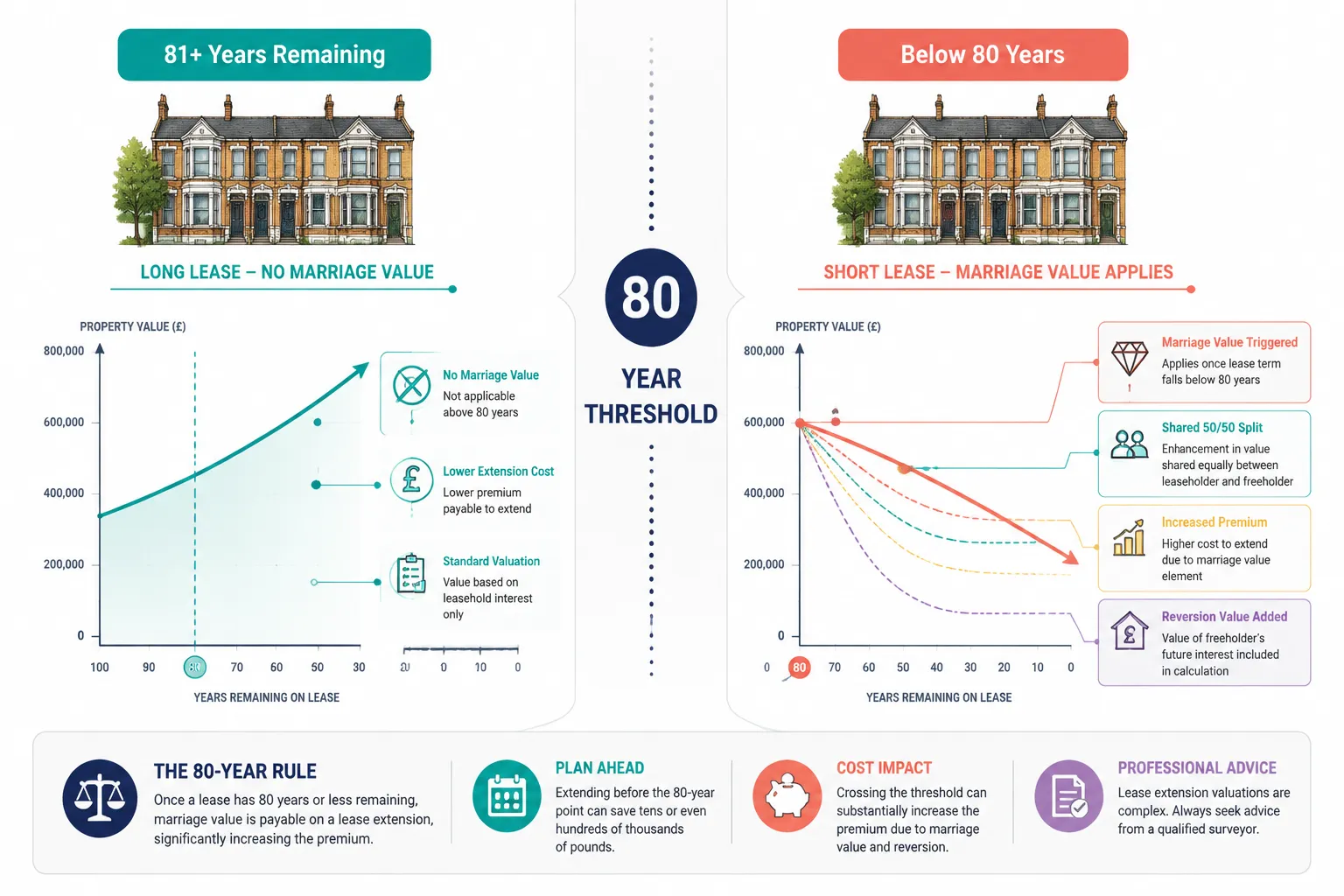
The figure of 80 years is not arbitrary. It is embedded in the Leasehold Reform, Housing and Urban Development Act 1993 and has governed enfranchisement valuations for decades. When a lease falls below 80 years, the concept of marriage value comes into play, and it is this mechanism that makes short-lease extensions disproportionately expensive.
What Is Marriage Value?
Marriage value is the additional value created when a short lease is extended to a long one. The logic runs as follows: a flat with 65 years remaining is worth less than its freehold equivalent. The act of extending the lease to 990 years (the standard term under statutory extension rights) creates a value uplift. Under the pre-reform law, the freeholder was entitled to 50% of that uplift as part of the extension premium. This 50% share is the marriage value payment.
For a flat worth £300,000 with a full lease but only £240,000 with 65 years remaining, the marriage value is £60,000. The freeholder’s 50% share is therefore £30,000, added on top of the ground rent capitalisation and reversion calculations. The total premium can easily exceed £40,000,£60,000 for a modest London flat with a short lease [8].
How Surveyors Model the Premium
A qualified RICS valuer calculates the extension premium using three components:
- Ground rent capitalisation, the present value of future ground rent payments the freeholder will lose.
- Reversion value, the present value of the freeholder’s right to reclaim the property at lease expiry, discounted to today.
- Marriage value, 50% of the value uplift created by the extension (only applicable below 80 years).
The discount rates used in steps one and two, known as the capitalisation rate and the deferment rate, have historically been set by case law (the Sportelli rates: 6% capitalisation, 5% deferment). These rates are now subject to reform, as discussed below.
For a deeper look at how different valuation methodologies interact, the methods of valuation guide provides useful context on the frameworks surveyors apply across different property types.
How Lenders Assess Leasehold Risk in 2026
Mortgage lenders apply their own internal policies to leasehold properties, and those policies are often stricter than the statutory minimums. Most high-street lenders require that the lease has at least 70 years remaining at the point of mortgage application, and that it will not fall below a minimum term (often 30 years) during the mortgage period. In practice, this means a 25-year mortgage requires roughly 95 years remaining to satisfy the most conservative lenders.
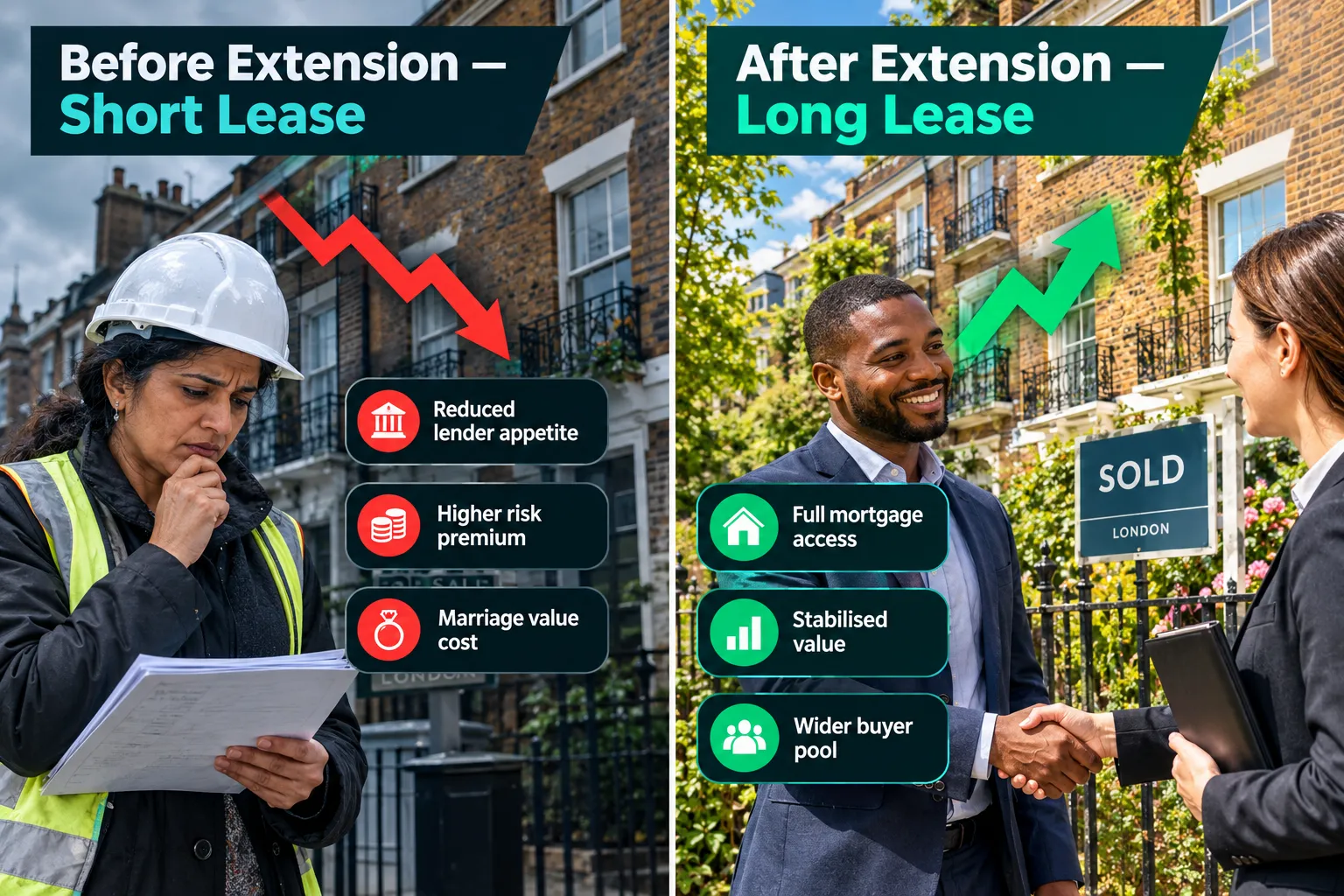
The UK Finance Mortgage Lenders’ Handbook, which governs conveyancing solicitors acting for lenders, specifies that the unexpired term must be sufficient to protect the lender’s security. With a 25-year mortgage term, many lenders effectively require 85-90 years remaining at the outset.
Key lender concerns include:
- Resale risk, if the borrower defaults, the lender needs to be able to sell the property. A short lease makes that harder.
- Value erosion, lease length depreciation accelerates as the term shortens, eroding the security over the mortgage period.
- Extension cost risk, a borrower facing a large extension premium may default rather than pay it.
These concerns directly affect the valuation reports in Canterbury and across the UK that surveyors prepare for mortgage purposes. A valuer must flag any lease below 85 years and may apply a specific discount to reflect lender risk.
“The remaining term is not just a legal technicality, it is a live financial variable that affects every stakeholder in a leasehold transaction.”
Leasehold Valuation and Remaining Term Under the 2024 and 2026 Reforms
The legislative landscape governing leasehold valuation and remaining term: how lease length affects property worth in the UK has shifted dramatically. Two pieces of legislation are central to understanding the current position.
The Leasehold and Freehold Reform Act 2024
Enacted in May 2024, this Act made several immediate and significant changes [7]:
- Extended the standard lease extension term from 90 years to 990 years for both flats and houses.
- Removed the requirement for a leaseholder to have owned the property for two years before claiming extension rights.
- Capped ground rents for new leases at a peppercorn (zero), eliminating a major source of onerous lease valuations.
The abolition of the two-year ownership requirement is particularly significant for buyers of short-lease properties, who can now serve a lease extension notice immediately after purchase.
The Draft Commonhold and Leasehold Reform Bill 2026
Published in March 2026, this draft Bill goes further [1][2]. Its most consequential valuation provision is the abolition of marriage value in enfranchisement calculations. Under the Bill, leaseholders extending their lease or purchasing their freehold will no longer pay the freeholder 50% of the value uplift created by the transaction [8].
The government’s plain English explainer describes this as making it “cheaper and easier” for leaseholders to extend, with the savings most pronounced for properties with fewer than 80 years remaining [8]. The Bill also proposes adjusting the capitalisation and deferment rates used in premium calculations, moving away from the Sportelli rates toward a statutory formula, a change that will affect how surveyors model extension costs across the board [9].
The Bill also sets out a pathway toward commonhold as the default tenure for new residential flats, with a ban on new leasehold flats expected to take effect from around 2029 [4][6]. This has long-term valuation implications: as commonhold stock grows, existing leasehold flats will face a relative value disadvantage unless converted.
For a detailed timeline of where the government’s reforms currently stand, the summer 2026 update on the roadmap to commonhold from Charles Russell Speechlys provides authoritative commentary [9].
Practical Implications for Buyers, Sellers, and Investors in 2026
Understanding the reform timeline matters because the market has not yet uniformly priced in the changes. The abolition of marriage value, for example, is proposed in the draft Bill but not yet enacted. This creates a gap between current statutory valuations and the future position, a gap that informed buyers can exploit and that uninformed sellers may suffer from [10].
For Buyers
- Short-lease properties (below 80 years) may be underpriced relative to their post-reform extension cost. Once marriage value is abolished, the premium to extend will fall, increasing the net value of the flat. Buyers who can tolerate the current uncertainty may find genuine value.
- Always commission a valuation report before exchanging contracts on any leasehold property with fewer than 85 years remaining.
- Check whether the seller has already served a Section 42 notice (the formal notice triggering statutory extension rights). If so, the notice can be assigned to the buyer, saving the two-year wait that no longer applies under the 2024 Act.
For Sellers
- A lease below 80 years will deter mortgage buyers and reduce the achievable price. Extending before marketing is almost always the right strategy if the remaining term is approaching or below 80 years.
- Ground rent provisions in the existing lease still affect value even after the 2024 Act’s peppercorn cap, because the cap applies to new leases and extensions, not to existing terms. Onerous ground rent clauses (doubling every 10 years, for example) remain a significant valuation negative until the lease is extended [5].
- Transparency is increasingly expected. The government’s Leasehold Toolkit for England provides guidance on disclosure obligations, and buyers’ solicitors will scrutinise lease terms closely [3].
For Investors
- The shift toward commonhold will gradually create a two-tier market: commonhold flats and leasehold flats. Long-term investors should model the cost of commonhold conversion and factor it into acquisition pricing.
- Yield-based valuations for leasehold investment properties must account for the lease depreciation curve. A flat generating a 5% gross yield on a 70-year lease is not the same investment as one on a 120-year lease. The yield vs comparable valuation methods framework is a useful starting point for stress-testing these assumptions.
- Tax implications also interact with lease length. When a short-lease property is extended and then sold, the capital gain calculation can be complex. A capital gains tax valuation from a registered RICS valuer ensures the correct base value is established.
The Role of Registered RICS Valuers in Lease Valuation
The complexity of leasehold valuation, combining ground rent capitalisation, reversion modelling, marriage value, and the evolving statutory framework, means that accurate figures cannot be produced by automated tools or desktop estimates alone. A registered RICS valuer brings professional indemnity, methodological rigour, and current market knowledge to the calculation.
RICS members are bound by the Red Book (RICS Valuation, Global Standards), which sets out the basis of value, assumptions, and reporting requirements for all formal valuations. For leasehold extension purposes, the valuer must produce a figure that can withstand scrutiny at the First-tier Tribunal (Property Chamber) if negotiations break down.
Working with registered RICS valuers also provides the professional accountability that lenders, courts, and counterparties require. This is not a context where informal estimates carry weight.
The schedule of condition for leasehold is a related document that records the physical state of a leasehold property at a specific point in time, important for managing dilapidations liability at lease end, another area where lease length and remaining obligations intersect.
Conclusion
Lease length is one of the most powerful, and most misunderstood, drivers of property value in the UK. The relationship between remaining term and worth is not merely academic: it determines whether a property can be mortgaged, how quickly it will sell, and how much it will cost to fix. The 80-year threshold remains the critical inflection point in 2026, triggering marriage value calculations that can add tens of thousands of pounds to extension premiums under the current statutory framework.
The legislative reforms underway, the Leasehold and Freehold Reform Act 2024 and the draft Commonhold and Leasehold Reform Bill 2026, will reshape these economics significantly, most notably through the abolition of marriage value and the long-term transition to commonhold. However, these reforms are not yet fully enacted or uniformly priced into the market, meaning that both risk and opportunity exist for those who understand the mechanics.
Actionable next steps for anyone involved in a leasehold transaction in 2026:
- Check the remaining lease term immediately, if it is below 85 years, treat it as a priority issue.
- Instruct a registered RICS valuer to model the current extension premium and the post-reform position.
- If buying, ensure your solicitor checks for onerous ground rent clauses and any existing Section 42 notices.
- If selling with a short lease, obtain a valuation and consider extending before marketing.
- If investing, model the lease depreciation curve and the cost of future commonhold conversion into your acquisition price.
The numbers on a lease document are not just legal formalities. In 2026, they are live financial variables, and understanding them is the foundation of sound leasehold decision-making.
References
[1] United Kingdom Publishes Commonhold And Leasehold Reform Bill – jonesday.com
[2] Draft Commonhold And Leasehold Reform Bill – gov.uk
[3] Leasehold Toolkit England – gov.uk
[4] Housing Minister Speech On Leasehold And Commonhold Reform – gov.uk
[5] Leasehold Reform – hoa.org.uk
[6] BBC News: Commonhold and Leasehold Reform – bbc.com
[7] Commonhold And Leasehold Reform Steps Up A Pace – traverssmith.com
[8] Plain English Explainer: Extending Your Lease Or Buying Your Freehold – gov.uk
[9] Summer 2026 Update: Where Are We On The Government’s Roadmap To Commonhold – charlesrussellspeechlys.com
[10] Leasehold Reform 2026: What Flat Sellers Need To Know – valuq.co.uk
Related services from Canterbury Surveyors
- Building expert witness surveyors
- Dilapidations surveyors
- RICS property valuations
- Lease extensions & freehold purchase
Get a fixed-fee quote or call 0204 579 8270.