
Canterbury & Kent
Non‑Standard Construction and Mortgage Lender Requirements: What UK Building Surveyors Look For
Roughly one in five UK properties falls outside what mainstream mortgage lenders define as “standard construction”, yet many buyers discover this only after a survey flags concerns that put their finance at risk [1]. Understanding how non‑standard construction and mortgage lender requirements intersect, and what UK building surveyors look for during an inspection, can mean the difference between a smooth purchase and a collapsed transaction.
Key Takeaways
- Non‑standard construction covers a wide range of property types, from PRC concrete frames to timber-frame and modern methods of construction, each carrying distinct structural and lending risks.
- UK building surveyors assess construction type, condition, and documentation before lenders will confirm a mortgage offer on an unusual property.
- Lenders typically require higher deposits (often 15-25%) and specialist valuations for non‑standard homes, and some high-street lenders will decline entirely.
- Certificates of repair, fire-safety documentation, and planning compliance records are critical evidence that surveyors and lenders scrutinise.
- Buyers should commission a full Level 3 building survey and seek a specialist broker early to avoid costly delays.
What Counts as Non‑Standard Construction?
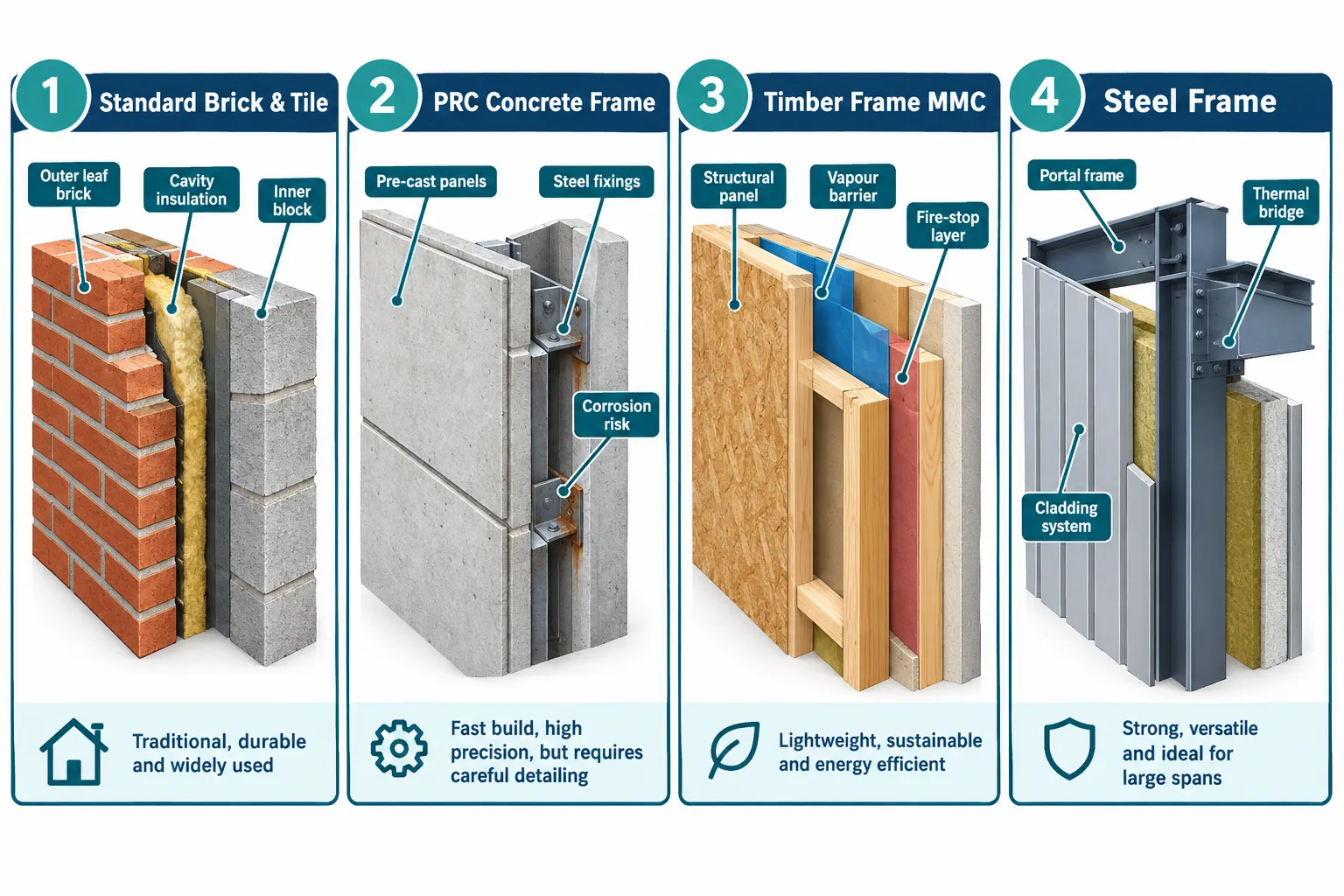
“Standard construction” in mortgage lending terms means a property built with brick or stone outer walls and a pitched roof covered in slate or tile. Anything outside this definition is broadly classified as non‑standard [1]. In practice, that covers a remarkably diverse range of properties:
- Prefabricated reinforced concrete (PRC), post-war system-built homes such as Airey, Reema, and Wimpey No-Fines types
- Timber frame, both traditional and modern engineered panel systems
- Steel frame, including BISF (British Iron and Steel Federation) houses common from the 1940s
- Concrete block or in-situ concrete, poured or block construction without a brick outer leaf
- Modern methods of construction (MMC), including structural insulated panels (SIPs), cross-laminated timber (CLT), and volumetric modular units
- Flat or low-pitch roofs, particularly where they cover the majority of the dwelling
- Thatched roofs, attractive but presenting distinct fire and maintenance risks
- Properties with non-standard cladding, especially relevant post-Grenfell
The distinction matters because lenders use construction type as a proxy for durability, saleability, and risk [7]. A property that is harder to sell in a distressed market represents greater collateral risk, and that risk is reflected in lending appetite.
Key point: Non‑standard construction is not automatically unmortgageable, but it does require a surveyor’s report that gives lenders the specific evidence they need to make a lending decision [2].
How Non‑Standard Construction and Mortgage Lender Requirements Shape the Surveyor’s Role
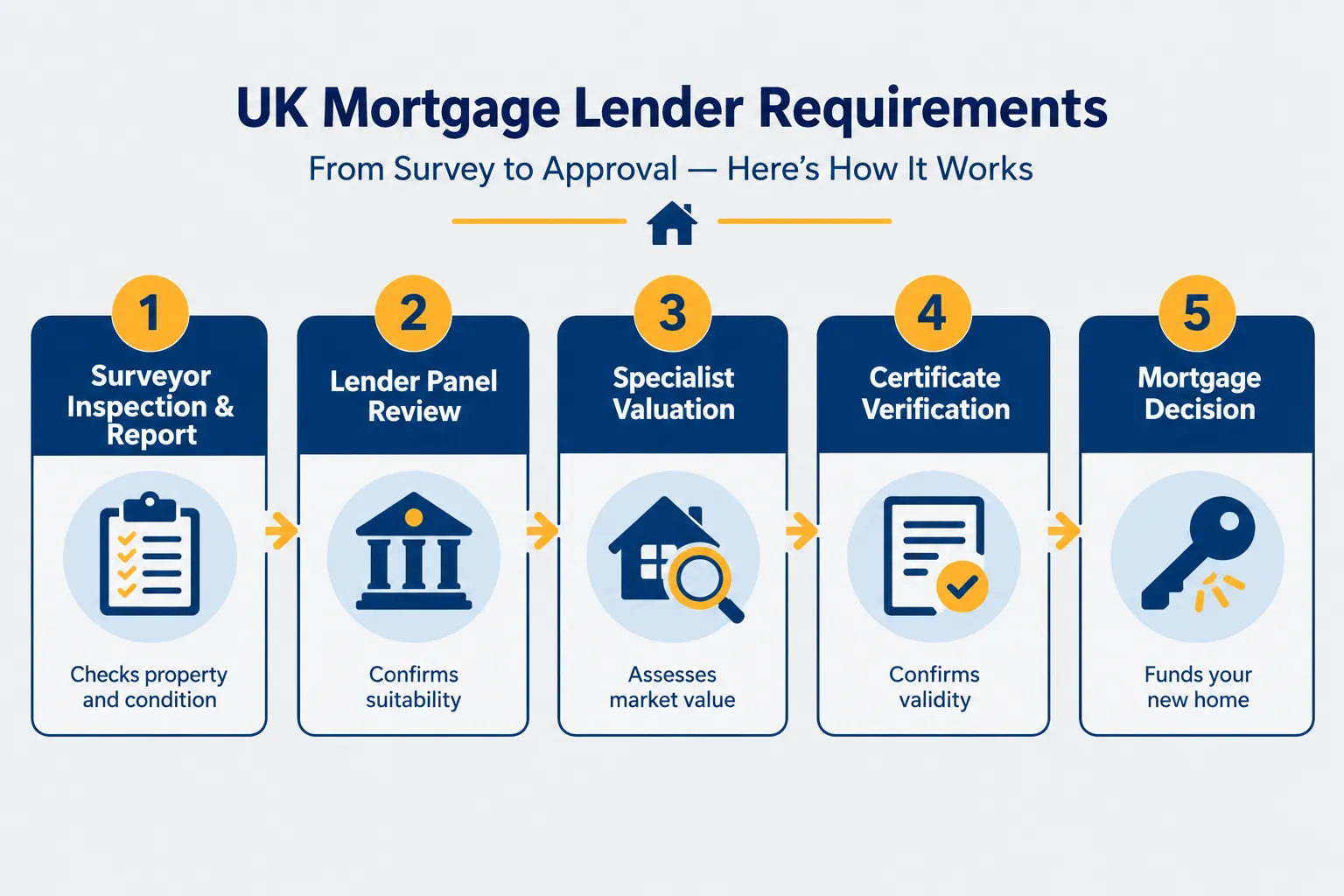
The surveyor sits at the centre of the mortgage lending process for any unusual property. When a lender instructs a valuation, or when a buyer commissions a RICS building survey, the professional’s findings directly influence whether a mortgage offer is made, at what loan-to-value (LTV), and subject to what conditions.
What Surveyors Assess First
On arrival at a non‑standard property, a building surveyor’s initial priorities are:
- Confirm the construction type, visual inspection of external walls, roof, and any exposed structure
- Identify the specific system, for PRC homes, this means recognising the particular designation (Airey, Unity, Cornish, etc.) because repair certificates are system-specific
- Check for defects associated with that construction type, carbonation in concrete, corrosion of steel fixings, interstitial condensation in timber panels
- Review available documentation, PRC certificates, structural warranties, fire-safety reports, building regulations completion certificates
This process aligns with the updated protocols set out in the Home Survey Standard 2nd Edition, which strengthens the requirement for surveyors to identify construction type and flag material risks to both clients and lenders.
Lender Panel Instructions and Reporting
Most lenders issue panel surveyors with specific instructions for non‑standard properties. These typically require:
- Explicit identification of the construction system
- Comment on structural condition and remaining life
- Confirmation of any repair or warranty certificates
- An opinion on marketability and comparable evidence
- A recommendation on whether the property is suitable security
Where a surveyor cannot confirm adequate condition or documentation, lenders will commonly either decline to lend, reduce the LTV, or require specialist reports before proceeding [4].
PRC Concrete, Defective Designations, and the Certificate Requirement
The most complex category for surveyors and lenders alike is prefabricated reinforced concrete. Following the Housing Defects Act 1984, a range of system-built house types were designated as defective due to structural deterioration caused by carbonation of the concrete and corrosion of the embedded steel reinforcement [3].
The PRC Homes Ltd Certificate
For a PRC property to be mortgageable with mainstream lenders, it generally needs to have been repaired under a scheme licensed by PRC Homes Ltd, with a certificate issued to confirm the repair meets the required standard. Surveyors are expected to:
- Confirm whether a valid PRC certificate exists
- Inspect the repair visually for signs of failure
- Note whether the certificate covers the full property or only part of it
- Flag any subsequent alterations that may have compromised the repair
Without a valid certificate, most high-street lenders will decline. Specialist lenders may consider the property, but typically at a lower LTV and with a higher interest rate [2].
BISF and Steel-Frame Houses
Steel-frame properties present similar challenges. The BISF house, widely built between 1945 and 1955, is recognisable by its distinctive upper-storey steel cladding panels. Surveyors look for:
- Corrosion of the steel frame, particularly at ground-floor junctions
- Condition of the external cladding and any subsequent over-cladding
- Evidence of condensation and moisture ingress at panel joints
- Any structural modifications that may have compromised frame integrity
Lender appetite for BISF houses varies considerably. Some building societies will lend on well-maintained examples with a positive surveyor’s report; others exclude them entirely [9].
Timber Frame, MMC, and Modern Construction Survey Expectations
Timber-frame construction has a long history in the UK, particularly in Scotland, and modern engineered timber systems are increasingly common in new-build developments. However, the survey requirements differ significantly between traditional and modern timber-frame.
Traditional Timber Frame
Older timber-frame properties, particularly those built before the 1970s, may have been constructed without adequate vapour barriers or fire-stopping. Surveyors assess:
- Evidence of rot, insect infestation, or structural movement in the frame
- Condition of any infill panels or external render
- Adequacy of fire compartmentation
- Whether any alterations have compromised the structural frame
Modern Methods of Construction
MMC properties, including SIPs, CLT, and modular volumetric units, present a different set of challenges. The primary concern for lenders is longevity and repairability [2]. Surveyors are expected to comment on:
- Whether the system has a recognised structural warranty (e.g., NHBC Buildmark, LABC, or Premier Guarantee)
- The track record of the specific system in the UK market
- Evidence of any defects common to that system
- Whether the property can be repaired using standard materials and contractors
The building survey standards developed following the RICS Retrofit Summit have placed additional emphasis on energy performance and fabric condition in MMC properties, reflecting growing lender and regulatory interest in long-term performance.
Surveyor’s note:For MMC properties built after 2000, always request the structural warranty documentation before the survey. A missing or expired warranty is a common reason for lender retention or decline, and it is far easier to resolve before exchange than after.
Flat Roofs, Cladding, and Fire-Safety Documentation
Flat Roofs
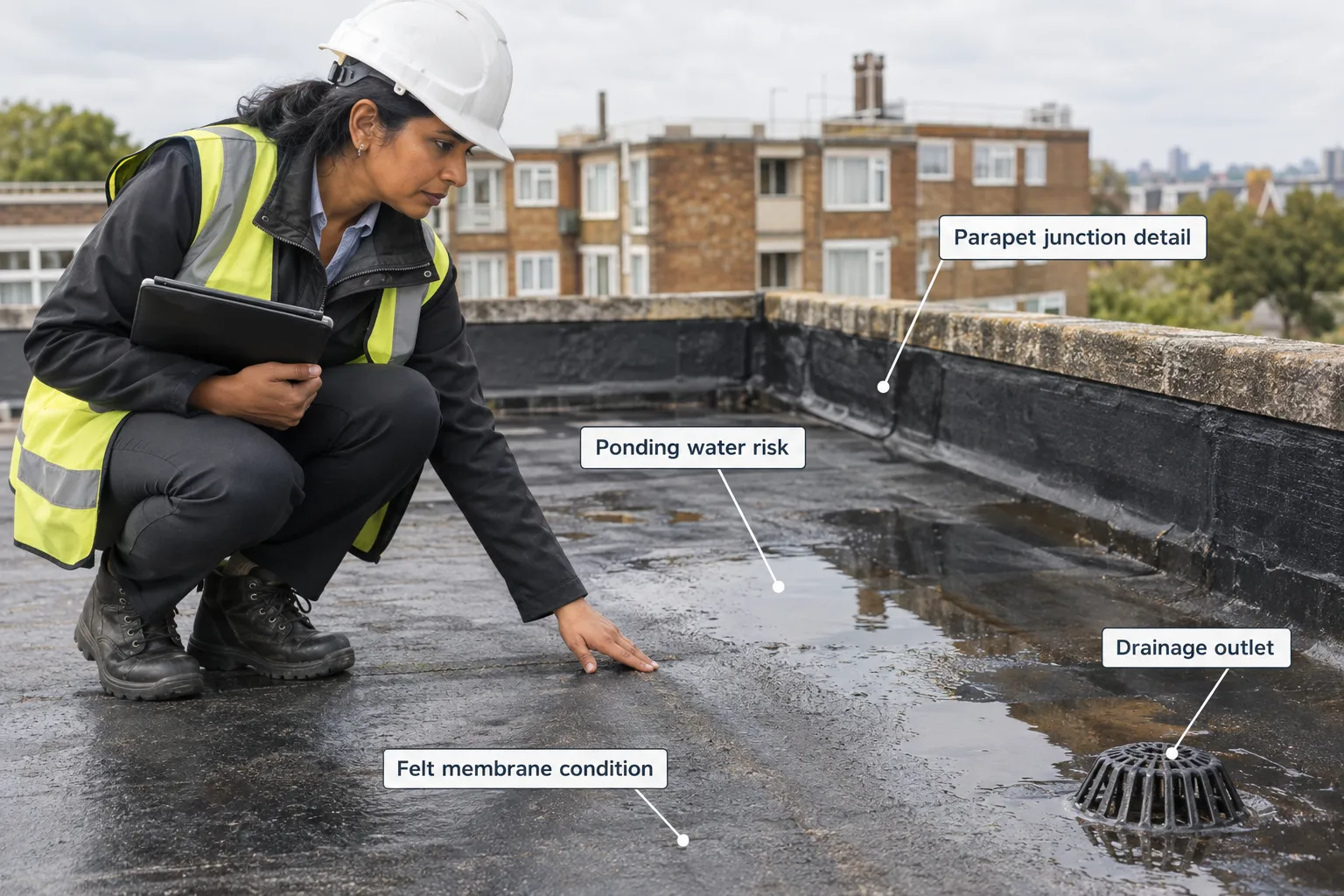
A flat roof covering more than 30% of the dwelling’s footprint is typically flagged as non-standard by lenders [1]. Surveyors assess:
- Roof covering type, felt, asphalt, GRP, EPDM rubber, or liquid-applied membrane
- Age and condition, felt roofs have an expected life of 10-15 years; GRP and EPDM can last 25-50 years with correct installation
- Drainage, evidence of ponding water, blocked outlets, or inadequate falls
- Upstand and parapet details, common failure points where water can penetrate
Where a flat roof is approaching or beyond its expected life, lenders may require retention of part of the mortgage advance until replacement works are completed and confirmed by a surveyor.
Cladding and Fire Safety
Post-Grenfell, cladding has become one of the most scrutinised elements in any survey of flats or mixed-use buildings. Surveyors are required to identify:
- The type of external cladding system
- Whether an EWS1 (External Wall System) form has been completed by a qualified professional
- Any outstanding remediation works or building safety fund applications
- The status of the building’s fire risk assessment
For buildings over 11 metres, an EWS1 form is typically required before a lender will proceed [7]. The absence of this documentation, or a B2 or C rating, effectively makes the property unmortgageable with most mainstream lenders until remediation is complete. This is an area where defect detection and building pathology expertise is particularly valuable for buyers.
Lender Appetite, LTV, and the Specialist Lender Market
Understanding non‑standard construction and mortgage lender requirements means recognising that lenders are not a monolithic group. Their appetite for unusual properties varies considerably.
High-Street Lenders
Major high-street banks apply the strictest criteria. Most will only lend on properties that meet their standard construction definition, with limited exceptions for well-documented cases. Where they do lend on non-standard properties, they typically:
- Require a minimum 15-25% deposit (75-85% LTV maximum) [2]
- Insist on a full structural survey rather than a basic valuation
- Apply additional conditions based on surveyor recommendations
Building Societies
Many regional building societies have more flexible criteria than high-street banks, particularly for property types common in their lending area. A building society in a region with a high proportion of 1950s system-built homes may have developed specific policies and panel surveyors with relevant expertise [4].
Specialist Lenders
For properties that mainstream lenders decline, specialist lenders and bridging finance providers offer an alternative, but at a cost. LTV ratios are typically lower (60-70%), rates are higher, and arrangement fees more significant [3]. The surveyor’s report remains critical: specialist lenders still require professional evidence of condition and value, and a negative report will result in decline regardless of the lender’s general appetite for non-standard properties.
| Lender Type | Typical Max LTV | Survey Requirement | Key Condition |
|---|---|---|---|
| High-street bank | 75-85% | Full structural survey | Valid certificates required |
| Building society | 80-85% | Level 3 survey | Regional policy variations |
| Specialist lender | 60-75% | Specialist valuation | Higher rates apply |
| Bridging finance | 60-70% | Desktop or drive-by | Short-term only |
For buyers of investment properties, the picture is further complicated by buy-to-let lending criteria. Level 3 building surveys for buy-to-let investments have become increasingly important as lenders apply additional risk loading to non-standard rental properties.
Conversions, Planning Compliance, and Change-of-Use Properties
Converted properties, former offices, barns, churches, or industrial buildings, present a distinct set of challenges that overlap with non-standard construction and mortgage lender requirements [6].
Surveyors assessing converted properties look for:
- Planning permission and building regulations approval, was the conversion lawful, and was a completion certificate issued?
- Structural adequacy for residential use, particularly floor loading, insulation, and fire compartmentation
- Services and drainage, many conversions involve complex drainage arrangements that require specialist assessment
- Habitable space compliance, ceiling heights, natural light, and ventilation must meet building regulations for residential use
Where planning or building regulations documentation is missing, lenders will typically require indemnity insurance as a minimum, and some will decline entirely. The surveyor’s report must clearly identify any compliance gaps and their potential impact on value and saleability [6].
Marketability, Comparables, and Valuation Impact
A central element of the surveyor’s role in any non-standard construction case is assessing marketability, the ability to sell the property at open market value within a reasonable timeframe [7].
For unusual properties, this requires:
- Identifying genuine comparable sales, not just nearby properties, but properties of the same construction type in similar condition
- Applying a marketability discount where the construction type limits the pool of potential buyers or lenders
- Commenting on demand, some non-standard types (e.g., well-maintained timber-frame cottages) command a premium; others (e.g., unrepaired PRC homes) suffer significant discounts
The valuation challenges in the 2026 property market have made comparable evidence more important than ever, particularly in markets where non-standard properties represent a significant proportion of lower-priced stock.
RICS Standards and the Regulatory Framework in 2026
The regulatory context for surveyors assessing non-standard construction has continued to evolve. The RICS Home Survey Standard and the Building Safety Act 2022 both impose specific obligations [8].
Key regulatory requirements in 2026 include:
- Mandatory identification of construction type in all Level 2 and Level 3 reports
- Fire safety reporting obligations for buildings over 11 metres
- Disclosure requirements for known defective designations (PRC, BISF, etc.)
- Competence requirements, surveyors must only accept instructions for property types within their competence
The RICS specialist defect survey remains the most appropriate instruction type for complex non-standard properties where a standard Level 3 survey may not provide sufficient depth of investigation.
Conclusion
Non‑standard construction and mortgage lender requirements represent one of the most technically demanding areas of UK building surveying. For buyers, the key actions are clear:
Before making an offer:
- Use a construction checker or specialist broker to confirm whether the property type is likely to be mortgageable with your preferred lender [9]
- Establish whether any required certificates (PRC, EWS1, structural warranty) exist and are valid
At survey stage:
- Commission a full Level 3 building survey from a surveyor with demonstrable experience in the specific construction type
- Request that the surveyor explicitly addresses lender requirements, documentation gaps, and any conditions likely to be imposed
After the survey:
- Act on any recommendations for specialist reports promptly, delays at this stage are a common cause of transaction failure
- Use the surveyor’s findings to negotiate on price or require the seller to obtain missing documentation before exchange
Non-standard does not mean unmortgageable. With the right professional advice, thorough documentation, and a realistic understanding of lender appetite, buyers can navigate even the most complex construction types successfully. The surveyor’s report is the foundation on which every lending decision rests, investing in a thorough, expert assessment is rarely money wasted.
References
[1] Non Standard Construction – mortgageaffordability.co.uk
[2] How To Finance Property With Non Standard Construction In 2025 – willowprivatefinance.co.uk
[3] Non Standard Construction Mortgage – propertypassport.uk
[4] Non Standard Construction Mortgage – mortgageonefinance.co.uk
[5] Property Types Accepted – mortgageaffordability.co.uk
[6] Can You Get A Mortgage On A Converted Property In 2025 – willowprivatefinance.co.uk
[7] Mortgages For A Property Of Unusual Construction – moneyfactscompare.co.uk
[8] Developing A Construction Procurement Strategy – rics.org
[9] Construction Checker – unmortgageable.co.uk
[10] Rics Cost Prediction Professional Statement Global 1st Edition – rics.org
Related services from Canterbury Surveyors
- RICS property valuations
- RICS Homebuyer Surveys (Level 2)
- Building Surveys (Level 3)
- Structural engineers in Canterbury & Kent
Get a fixed-fee quote or call 0204 579 8270.