
Canterbury & Kent
Mortgage Valuation vs Independent Valuation: How UK Buyers Can Avoid Overpaying in 2026
Nearly one in three UK homebuyers who rely solely on a lender’s mortgage valuation end up paying more than a property is independently worth, a gap that can translate into tens of thousands of pounds of unnecessary debt. Understanding the difference between a mortgage valuation and an independent RICS valuation is one of the most financially consequential decisions any buyer can make in 2026. This guide on Mortgage Valuation vs Independent Valuation: How UK Buyers Can Avoid Overpaying in 2026 breaks down what each report actually covers, where the risks lie, and how buyers can use independent evidence to negotiate harder and protect their long-term finances.
Key Takeaways
- A mortgage valuation protects the lender, not the buyer, it confirms only that the property is adequate security for the loan.
- An independent RICS valuation provides detailed defect evidence, a market-based figure, and negotiation leverage that a mortgage valuation cannot offer.
- UK house price indices diverged significantly in early 2026, meaning no single lender figure should be treated as definitive market value.
- RICS surveyor sentiment turned negative in April 2026, signalling that many asking prices carry unjustified premiums.
- Commissioning an independent valuation typically costs between £300 and £700, a fraction of the potential overpayment it can prevent.
What a Mortgage Valuation Actually Does
A mortgage valuation is commissioned and paid for by the lender, not the buyer. Its sole purpose is to confirm that the property represents adequate security for the loan being advanced. The surveyor, who is appointed by the lender, answers one question: is this property worth at least the amount being borrowed?
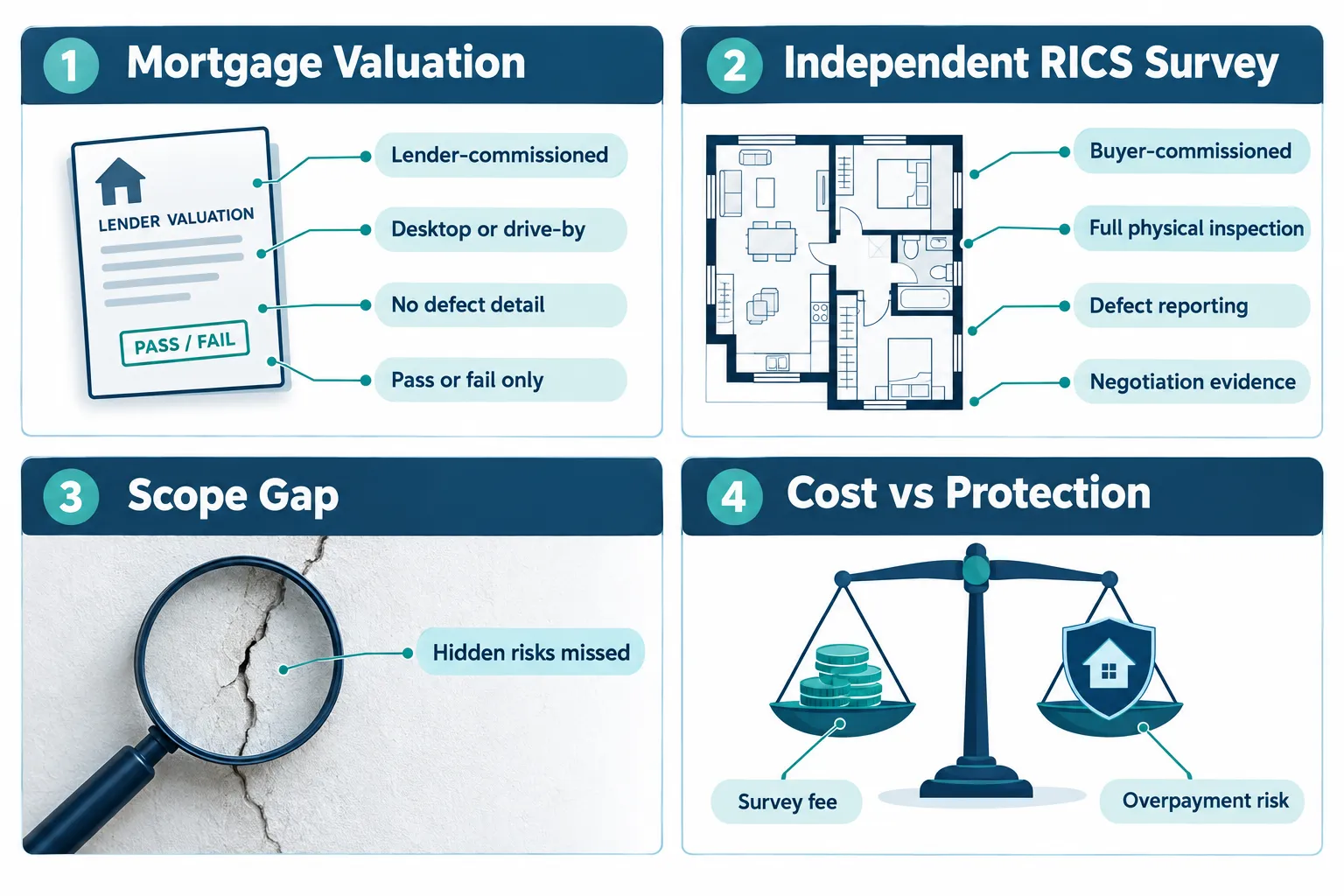
That narrow remit has significant consequences for buyers. The report is rarely shared in full, is frequently conducted as a desktop exercise or a brief drive-by inspection, and contains no detail about structural defects, damp, roofing condition, or any of the physical factors that affect true market value. In a flat or softening market, this matters enormously.
UK average house prices rose modestly in the year to mid-2026, with Nationwide reporting annual growth of approximately 3.4% in Q2 2026 [4]. However, the headline figure masks wide regional variation and a growing disconnect between asking prices and achievable sale prices. The RICS UK Residential Survey for April 2026 recorded a negative net balance for new buyer enquiries, with surveyor sentiment on near-term price expectations turning pessimistic [7]. When surveyors are signalling caution and market momentum is weak, a mortgage valuation that simply confirms a property meets the loan threshold is not a reliable guide to fair value.
The core problem: lenders use automated valuation models (AVMs) and brief physical checks to keep costs low. These tools are calibrated to protect the lender’s exposure, not to identify whether a buyer is paying a fair price. A property can pass a mortgage valuation and still be overpriced by 5-10% relative to genuine comparable evidence.
For buyers who want to understand the full range of factors that influence a property’s assessed worth, the valuation factors page provides a detailed breakdown of what qualified surveyors examine during a comprehensive assessment.
What an Independent RICS Valuation Covers
An independent valuation commissioned directly by the buyer is a fundamentally different document. Conducted by a RICS-registered surveyor under the Red Book Global Standards, it provides a formal market value opinion supported by comparable evidence, a physical inspection of the property, and, depending on the level chosen, a detailed schedule of defects and their estimated remediation costs.
The key distinctions are worth setting out clearly:
| Feature | Mortgage Valuation | Independent RICS Valuation |
|---|---|---|
| Commissioned by | Lender | Buyer |
| Primary purpose | Loan security check | Market value and condition |
| Physical inspection | Minimal or desktop | Full internal and external |
| Defect reporting | None or very limited | Detailed |
| Comparable evidence | Internal AVM data | Published, verifiable comps |
| Shared with buyer | Rarely in full | Yes, in full |
| Negotiation use | None | Strong |
The Red Book Valuation Standards for 2026 published by RICS set out the updated methodology surveyors must follow when producing these reports, including requirements around comparable selection and transparency of assumptions. These standards exist precisely because valuation is not a mechanical process, it requires professional judgment applied to real market evidence.
Buyers choosing between survey types should also consult the ISVA Homebuyer Surveys vs RICS Level 2 guide to understand which report level best matches their property type and risk appetite.
How Independent Valuations Create Negotiation Leverage
The practical power of an independent valuation lies in its evidential weight. When a RICS surveyor formally states that a property’s market value is £20,000 below the agreed purchase price, the buyer has a documented, professionally supported basis for renegotiation. Estate agents and vendors cannot easily dismiss a Red Book valuation, it is a regulated document produced under professional indemnity insurance.
Real-world examples from 2026 illustrate this clearly:
- Case study 1, Victorian terraced house, South East England: Agreed purchase price of £385,000. Independent valuation returned £362,000 following identification of significant roof void deterioration and failed cavity wall insulation. Buyer renegotiated to £368,000, saving £17,000 and avoiding a post-completion repair bill estimated at £14,000.
- Case study 2-1970s semi-detached, Midlands: Asking price of £240,000. Mortgage valuation passed at loan value. Independent RICS Level 2 survey identified Japanese knotweed within three metres of the foundation. Buyer withdrew and avoided a remediation liability of up to £30,000.
- Case study 3, Purpose-built flat, Greater Manchester: Agreed price of £175,000. Independent valuation identified that comparable sales in the same block over the prior six months ranged from £158,000 to £165,000. Buyer renegotiated to £163,000 on comparable evidence alone.
These are not exceptional outcomes. They reflect a market in which many properties are still listed at prices calibrated to the 2022-2023 peak rather than 2026 conditions.
Why 2026 Market Conditions Make Independent Valuations Essential
The case for commissioning an independent valuation has rarely been stronger than it is in 2026. Several converging factors have widened the gap between asking prices and defensible market values.
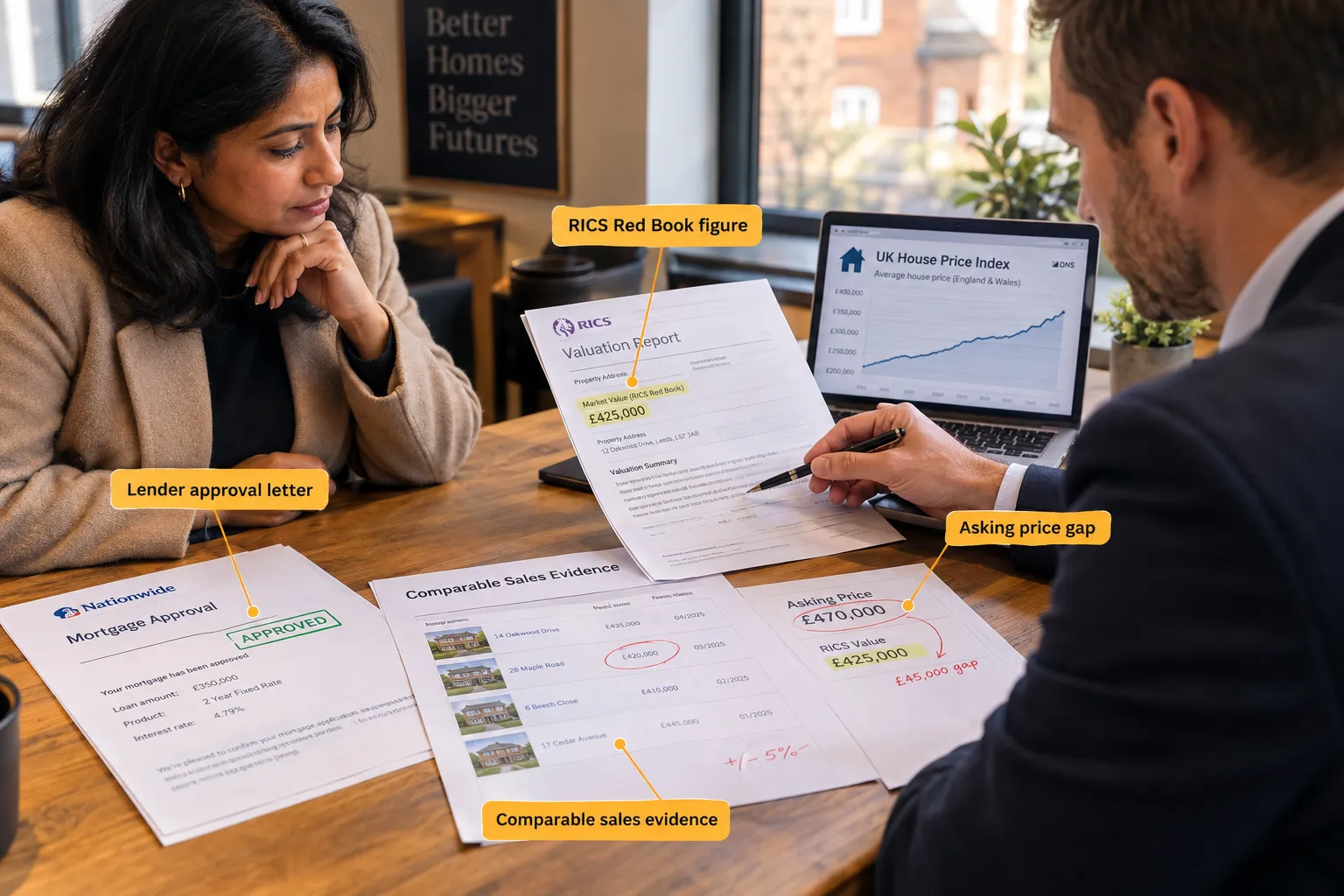
Diverging index data creates uncertainty. UK house price indices produced by different organisations showed notable divergence in early 2026. Nationwide’s Q2 2026 data showed annual price growth of 3.4% [4], while other measures tracked by Trading Economics pointed to more subdued conditions [3]. When the major indices disagree, it is a signal that the market is in transition, and that no single automated figure should be treated as authoritative.
Surveyor sentiment is negative. The RICS April 2026 residential survey recorded negative net balances for both new buyer enquiries and agreed sales [7]. When qualified surveyors are more pessimistic than optimistic about near-term price direction, asking prices that were set in a more buoyant period carry a higher risk of being above current market value.
New listings are frequently overpriced. TwentyCi’s Property and Homemover Report for Q2 2026 showed that a significant proportion of new listings required at least one price reduction before sale [8]. This is direct evidence that initial asking prices regularly exceed what the market will bear, and that buyers who rely on a mortgage valuation rather than independent evidence are exposed to that premium.
Flat market conditions remove momentum justification. In a rising market, a buyer who slightly overpays can expect appreciation to close the gap within a few years. In a flat market, overpayment is locked in. With UK annual house price growth running at low single digits [10], there is no momentum to bail out a buyer who pays above true market value.
Loan-to-value bands amplify the financial impact. Overpaying affects more than the purchase price. A buyer who pays £10,000 above market value on a 90% LTV mortgage is borrowing against an inflated base, paying interest on a larger sum, and potentially sitting in a worse LTV band with a higher interest rate. The compounding cost over a 25-year term can be substantial. For buyers who want to model this impact, a mortgage overpayment calculator can illustrate the long-term cost of an inflated purchase price [6].
Understanding how surveyors are recalibrating their approaches in response to affordability pressures is also relevant here, the analysis on affordability-led valuation adjustments in 2026 explains how professional valuers are adapting their comparable selection methodology.
The Cost of Getting It Wrong vs the Cost of Getting It Right
The financial arithmetic is straightforward:
- Independent RICS Level 2 valuation: typically £300,£700 depending on property size and location [see Price of Valuation]
- Average price reduction achieved through survey evidence: commonly £5,000,£25,000 on mid-market properties
- Potential remediation costs identified and avoided: variable, but frequently £10,000,£40,000 on older stock
The return on investment from a well-commissioned independent valuation is, in most cases, exceptional. The risk of not commissioning one, particularly on properties built before 1970, on properties with extended marketing histories, or in areas where comparable evidence is thin, is material and largely avoidable.
Practical Steps for UK Buyers to Avoid Overpaying in 2026
The following framework gives buyers a structured approach to using independent valuation evidence effectively.
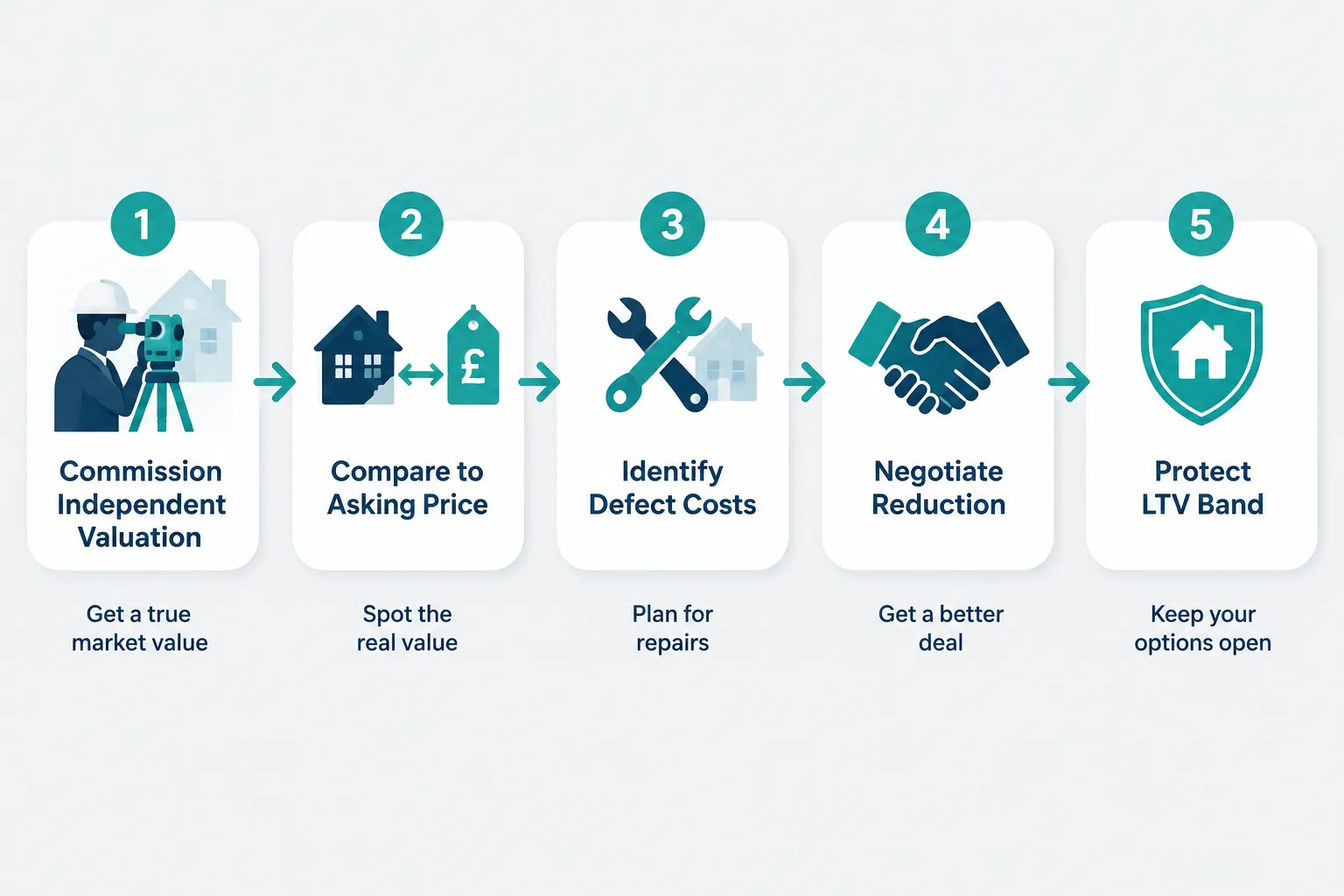
Step 1: Commission an independent valuation before exchange, not after. Many buyers wait until after they have committed emotionally and financially to a property before seeking independent evidence. The valuation should be commissioned as early as possible, ideally before or immediately after the mortgage application, so that any findings can inform negotiation rather than just confirm a problem.
Step 2: Choose the right survey level for the property. A RICS Level 1 Condition Report is appropriate only for new builds and conventionally constructed modern properties in good condition. For anything built before 1980, a Level 2 HomeBuyer Report or Level 3 Building Survey is more appropriate. For older or non-standard properties, a full Level 3 survey with an independent valuation figure is the most defensible option. Buyers purchasing older homes should also review defect diagnosis in older properties to understand what a thorough pre-offer survey should examine.
Step 3: Request comparable evidence from the surveyor. A Red Book valuation must be supported by comparable sales. Ask the surveyor to include the comparables used and to explain any adjustments made for condition, size, or location. This evidence is the foundation of any renegotiation conversation.
Step 4: Use the survey report as a structured negotiation tool. Present findings to the vendor or their agent in writing, referencing specific defects and their estimated costs. A well-structured negotiation letter supported by a RICS report is far more persuasive than a verbal request for a reduction.
Step 5: Be prepared to walk away. The strongest negotiating position is genuine willingness to withdraw. In a market where new listings frequently require price reductions before sale [8], vendors are aware that overpriced properties sit. A buyer with independent evidence and a credible alternative is in a strong position.
Step 6: Protect your LTV band. If the independent valuation confirms the agreed price is at or above market value, consider whether a modest renegotiation could move the purchase into a better LTV band. Even a 1-2% improvement in LTV can reduce the applicable mortgage rate meaningfully over the life of the loan.
For buyers purchasing properties with fire safety considerations, particularly in blocks of flats or older converted buildings, the fire safety regulation updates and valuation impacts article explains how 2026 compliance requirements can affect both survey findings and negotiated price.
Conclusion
The central lesson of Mortgage Valuation vs Independent Valuation: How UK Buyers Can Avoid Overpaying in 2026 is simple: a mortgage valuation is a lender’s tool, not a buyer’s protection. In a market characterised by negative surveyor sentiment [7], diverging price indices [3][4], and a high proportion of listings that require price reductions before sale [8], relying on a lender’s assessment to confirm fair value is a significant financial risk.
An independent RICS valuation, commissioned directly by the buyer and conducted under Red Book standards, provides something the mortgage valuation cannot: a professionally defensible market value figure, supported by comparable evidence, backed by a detailed condition assessment, and usable as a negotiation instrument. For a fee that rarely exceeds £700, buyers gain protection against overpayments that can run to tens of thousands of pounds and defect liabilities that can exceed that figure again.
Actionable next steps for buyers in 2026:
- Instruct a RICS-registered independent surveyor as soon as an offer is accepted, do not wait for the mortgage valuation to complete.
- Match the survey level to the property type and age; older properties warrant a Level 3 Building Survey with a formal valuation.
- Request comparable evidence in writing and use it as the basis for any renegotiation.
- Model the long-term cost of any overpayment against current mortgage rates before deciding whether to proceed without a reduction.
- Treat the survey fee not as an additional cost but as the most cost-effective insurance available in the buying process.
References
[1] Average House Prices – tradingeconomics.com
[2] L35wz Mvwqn 8tksi Fqzz0 T11tl – nationwide.co.uk
[3] Housing Index – tradingeconomics.com
[4] Jun Q2 2026 – nationwide.co.uk
[5] House Prices – moneyweek.com
[6] Mortgage Overpayment Calculator – propertypassport.uk
[7] Uk Residential Survey April 2026 – rics.org
[8] Twentyci Property Homemover Report Q2 2026 – twentyci.co.uk
[9] Rics House Price Balance – tradingeconomics.com
[10] Nationwide Housing Prices Yoy – tradingeconomics.com
Related services from Canterbury Surveyors
- RICS property valuations
- RICS Homebuyer Surveys (Level 2)
- Building Surveys (Level 3)
- Structural engineers in Canterbury & Kent
Get a fixed-fee quote or call 0204 579 8270.