
Canterbury & Kent
Party Wall Advice for Notifiable Works: Pre-Dispute Resolution Strategies from RICS-Trained Surveyors
Roughly one in three party wall disputes that reach formal arbitration could have been resolved before a single notice was contested, according to estimates from experienced party wall practitioners in England and Wales. That statistic carries real weight for homeowners, developers, and property managers facing notifiable works in 2026. The cost of a fully contested party wall dispute, including surveyor fees, legal counsel, and project delays, can easily exceed £10,000. Yet many of those costs are avoidable. This article delivers focused party wall advice for notifiable works, drawing on pre-dispute resolution strategies from RICS-trained surveyors who intervene early to protect all parties, before positions harden and goodwill evaporates.

Key Takeaways
- Serving a valid party wall notice at the correct time is the single most effective way to prevent a formal dispute from arising.
- The agreed surveyor model is a faster, less expensive alternative to the two-surveyor process and is underused by building owners.
- A schedule of condition prepared before works begin is the most powerful evidence tool available to adjoining owners.
- Early intervention by an RICS-trained surveyor, before a notice is even served, can identify procedural errors that cause costly delays.
- Understanding the three-metre and six-metre excavation rules prevents accidental non-compliance that triggers neighbour disputes.
What Are Notifiable Works Under the Party Wall Act?
The Party Wall etc. Act 1996 governs three categories of work that require formal notice to be served on adjoining owners before construction begins. Understanding which category applies is the first step in any pre-dispute strategy.
The three categories are:
| Category | Trigger | Notice Period Required |
|---|---|---|
| Party structure works | Cutting into, repairing, or demolishing a shared wall or floor | 2 months |
| New building on or at the boundary | Building a new wall astride or up to the boundary line | 1 month |
| Excavation near a neighbour’s building | Digging within 3 or 6 metres depending on depth | 1 month |
For excavation, the three-metre rule is a common source of confusion. Works that involve digging within three metres of a neighbouring structure, and to a depth lower than that structure’s foundations, trigger a notice obligation. A separate six-metre rule applies where deeper excavations are planned. Missing either threshold is one of the most frequent causes of neighbour complaints that escalate into formal disputes.
Common notifiable works include:
- Loft conversions involving the removal of chimney breasts from a party wall
- Rear extensions where foundations are dug close to a shared boundary
- Basement conversions beneath terraced or semi-detached properties
- Underpinning of shared walls
- Installation of steel beams bearing onto a party wall
Proceeding without serving notice is a serious error. The consequences of having no party wall agreement in place can include injunctions halting works, civil liability for damage, and significant legal costs, all of which dwarf the modest expense of engaging a surveyor at the outset.
Pre-Dispute Resolution Strategies from RICS-Trained Surveyors
The most effective party wall advice for notifiable works focuses on the period before a dispute is declared. RICS-trained surveyors who specialise in party wall matters apply a structured early-intervention model that addresses the four most common flashpoints: notice validity, neighbour communication, schedule of condition, and the choice of surveyor model.
1. Notice Review Before Service
A poorly drafted notice is one of the leading causes of procedural disputes. An RICS surveyor will review a proposed notice before it is served to confirm:
- The correct form is used for the category of work
- The description of works is sufficiently detailed
- The notice is addressed to every person with a freehold or leasehold interest in the adjoining property
- The service method (personal delivery, recorded post, or affixing to the property) is appropriate
“A notice that omits a co-owner, uses the wrong form, or fails to describe the works accurately is not a valid notice under the Act. The entire timeline resets.”
This review costs a fraction of the delay caused by a defective notice, particularly on commercial projects where contractor standing time is billed daily.
2. Proactive Neighbour Communication
RICS surveyors consistently report that disputes escalate not because of the works themselves, but because neighbours feel uninformed or disrespected. Pre-dispute strategy therefore includes a communication protocol:
- An informal letter or meeting before the formal notice is served, explaining the scope of works
- Clear information on how the neighbour can respond and what their rights are
- An offer to fund an independent surveyor for the adjoining owner at no cost to them (a statutory right under the Act)
This approach converts a legal obligation into a neighbourly conversation. Adjoining owners who understand the process are far more likely to consent in writing within the 14-day response period, avoiding the automatic dispute mechanism entirely.
3. The Agreed Surveyor Model
When an adjoining owner does not consent but is willing to cooperate, the agreed surveyor model is the most efficient resolution pathway available. Under Section 10 of the Party Wall etc. Act 1996, both the building owner and the adjoining owner can jointly appoint a single RICS-accredited surveyor to act impartially for both parties.
Benefits of the agreed surveyor approach:
- Significantly lower combined fees compared to two separate surveyors
- Faster production of the party wall award
- Reduced adversarial dynamic between neighbours
- A single point of contact for both parties throughout the project
The agreed surveyor must act impartially, their duty is to the Act, not to either party. This is a point RICS guidance emphasises strongly. For a detailed explanation of how the award process works, the guidance for party wall awards sets out the key stages from appointment through to the final document.
4. Schedule of Condition
Before any notifiable works begin, an RICS surveyor will prepare a schedule of condition, a detailed photographic and written record of the adjoining property’s current state. This document is attached to the party wall award and serves a critical function: it establishes a baseline against which any alleged damage can be assessed objectively.
Without a schedule of condition, disputes about whether cracking, settlement, or damp was caused by the works become impossible to resolve fairly. With one in place, both parties have clear, contemporaneous evidence. This single document prevents more post-construction disputes than any other pre-emptive measure.
Understanding Party Wall Disputes and How to Avoid Them
Even with best-practice notice service and proactive communication, disputes sometimes arise. Understanding what constitutes a party wall dispute, and what does not, helps building owners respond proportionately rather than reactively.
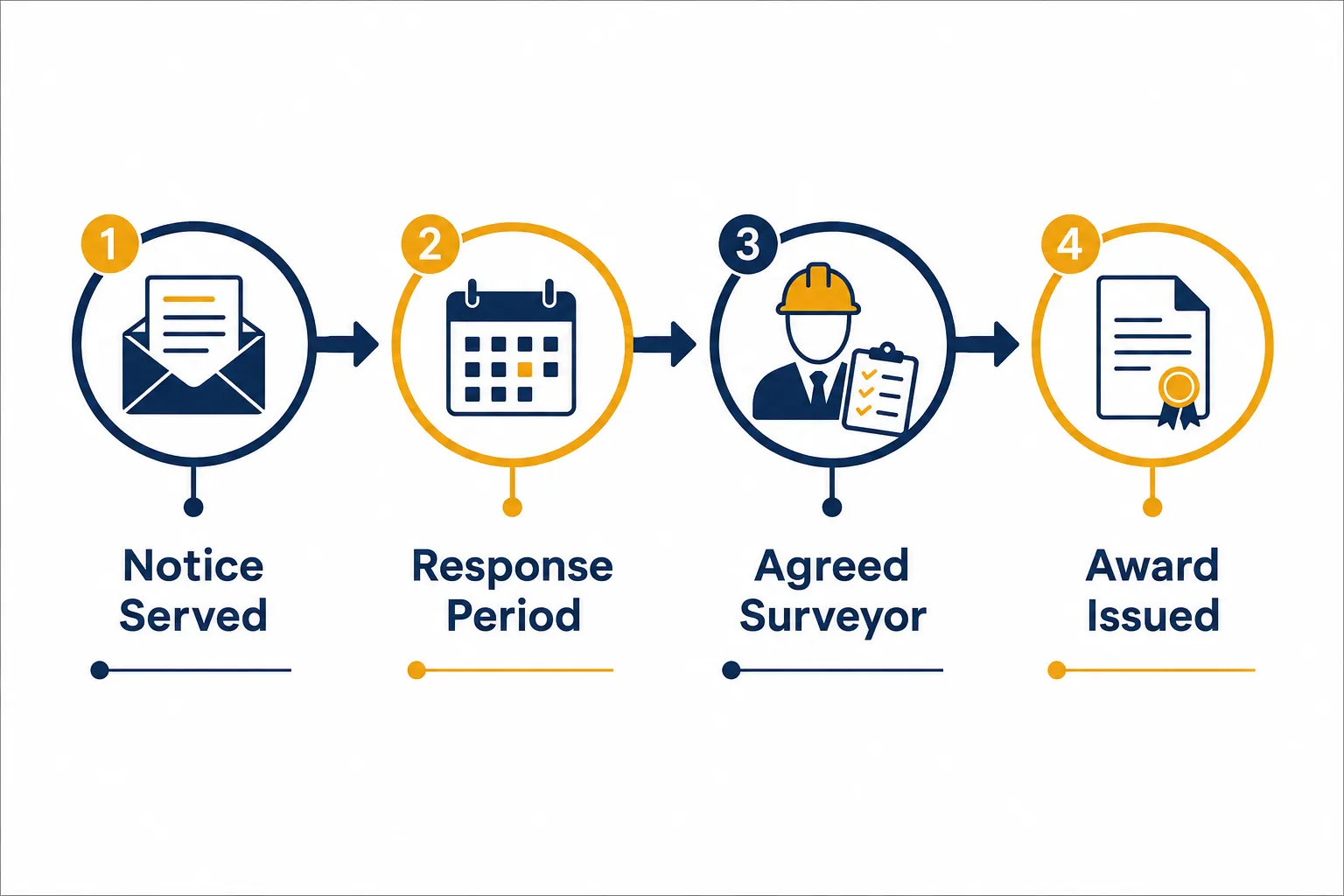
A dispute is formally triggered when an adjoining owner either:
- Fails to respond to a notice within 14 days (deemed dissent)
- Serves a counter-notice that is not agreed
- Expressly dissents in writing
It is important to note that dissent does not mean hostility. Many adjoining owners dissent simply because they want a surveyor to review the works on their behalf, a perfectly reasonable and legally protected position. RICS surveyors advise building owners to treat dissent as a procedural step, not a personal conflict.
Common causes of avoidable disputes include:
- Notices served too late, leaving insufficient time before contractor mobilisation
- Works beginning before the notice period expires
- Failure to identify all notifiable elements of a project (for example, treating a loft conversion as purely internal when it involves the party wall)
- Obstruction or uncooperative behaviour, a topic explored in detail in the context of obstruction in party wall proceedings
When obstruction does occur, such as an adjoining owner refusing to allow access for a schedule of condition, the Act provides mechanisms for the surveyor to proceed. However, invoking those mechanisms takes time and creates friction that early intervention is specifically designed to avoid.
The Role of RICS Accreditation in Party Wall Matters
Not every person who offers party wall surveying services holds RICS accreditation. The distinction matters significantly in the context of pre-dispute resolution.
RICS-trained surveyors are bound by the RICS Rules of Conduct, which require them to act with integrity, competence, and in the public interest. In party wall matters, this means:
- Providing impartial advice even when appointed by one party
- Disclosing any conflict of interest before accepting an appointment
- Maintaining professional indemnity insurance
- Keeping up to date with case law and changes in practice guidance
For building owners, engaging an RICS-accredited surveyor provides a layer of accountability that unregulated practitioners cannot offer. For adjoining owners, it means the surveyor appointed by the building owner is not simply an advocate for the works, they have professional obligations that constrain their conduct.
“The party wall surveyor’s primary duty is to the Act and to the process, not to the party who pays their fee.”
This professional framework is what makes the agreed surveyor model viable. Both parties can trust that a single RICS-accredited surveyor will produce a fair award, because their professional obligations require it.
RICS-trained surveyors operating across London and the South East, including those working from Canterbury Surveyors’ party wall services, apply this framework consistently, whether the project is a domestic loft conversion or a large-scale commercial development.
Practical Pre-Dispute Checklist for Building Owners in 2026
The following checklist distils the core party wall advice for notifiable works into actionable steps that building owners can follow before, during, and immediately after the notice period.
Before serving notice:
- Confirm which category of notifiable works applies
- Identify all adjoining owners, including leaseholders with interests of more than one year
- Instruct an RICS surveyor to review the notice draft
- Prepare an informal communication to neighbours explaining the project
During the notice period:
- Serve notice by a method that creates a delivery record
- Be available to answer neighbours’ questions promptly
- Do not begin works until the notice period has expired and either consent has been received or a party wall award has been made
If dissent is received:
- Appoint an RICS surveyor promptly, delays extend the timeline
- Propose the agreed surveyor model to the adjoining owner as a cost-effective option
- Instruct the surveyor to arrange a schedule of condition before works begin
During construction:
- Notify the surveyor immediately if any unexpected structural issues arise at the party wall
- Keep a contemporaneous record of works, including photographs dated by the contractor

When Pre-Dispute Strategies Are Not Enough
There are circumstances where early intervention cannot prevent a formal dispute. Adjoining owners who are uncontactable, properties in probate, or genuinely irreconcilable disagreements about the scope of works all require the formal Section 10 process to run its course.
In those cases, RICS surveyors draw on their expertise to produce a party wall award that is legally robust and resistant to appeal. The award sets out the rights and obligations of both parties, the conditions under which works may proceed, and the mechanism for resolving any damage claims after completion.
For building owners who have proceeded without a valid notice, whether through oversight or misunderstanding, the situation is recoverable but requires immediate professional advice. Retrospective agreements are not formally provided for under the Act, but surveyors can sometimes negotiate a pragmatic resolution that protects both parties going forward.
For complex projects involving structural elements, the party wall and structural engineering services available from RICS-accredited firms can address both the legal notice requirements and the technical design elements, including beam calculations where steelwork bears onto a shared wall.
Conclusion
The most effective party wall advice for notifiable works is also the simplest: act early, communicate clearly, and engage an RICS-trained surveyor before problems arise rather than after. The pre-dispute resolution strategies outlined here, notice review, proactive neighbour communication, the agreed surveyor model, and a thorough schedule of condition, collectively reduce the risk of costly formal disputes to a minimum.
Actionable next steps for building owners in 2026:
- Identify whether your planned works are notifiable under the Party Wall etc. Act 1996 before instructing a contractor.
- Contact an RICS-accredited party wall surveyor at least two to three months before your intended start date to allow adequate notice periods.
- Review the full scope of party wall services and guidance available from qualified surveyors in your area.
- Propose the agreed surveyor model to your neighbour at the earliest opportunity to reduce costs and timelines for both parties.
- Never begin notifiable works without a valid notice in place, the legal and financial consequences are disproportionate to the time saved.
Party wall matters reward preparation. The surveyors who resolve these situations most effectively are those who are involved from the very beginning, not called in to manage a dispute that was already avoidable.
Related services from Canterbury Surveyors
- Party wall surveyors in Canterbury & Kent
- Boundary surveys
- RICS property valuations
- Structural engineers in Canterbury & Kent
Get a fixed-fee quote or call 0204 579 8270.