
Canterbury & Kent
Zoopla: Four in Five Homes in London and the South East Are Now Losing Value, How Kent Buyers Can Use a Survey to Negotiate in November 2026
Four out of every five homes across London and the South East now sit in postcode areas where prices are falling. That single figure, published by Zoopla on 27 October 2026, should change how every seller in Canterbury, Whitstable, Herne Bay and Faversham prices their home this month, and how every buyer approaches negotiation.
The story behind Zoopla’s South East house price data this November is not one of panic. It is one of leverage shifting, slowly but clearly, toward buyers who do their homework. For East Kent households weighing a move before the year ends, understanding exactly what the data shows, and what a RICS survey can do with it, matters more than ever.
Key Takeaways
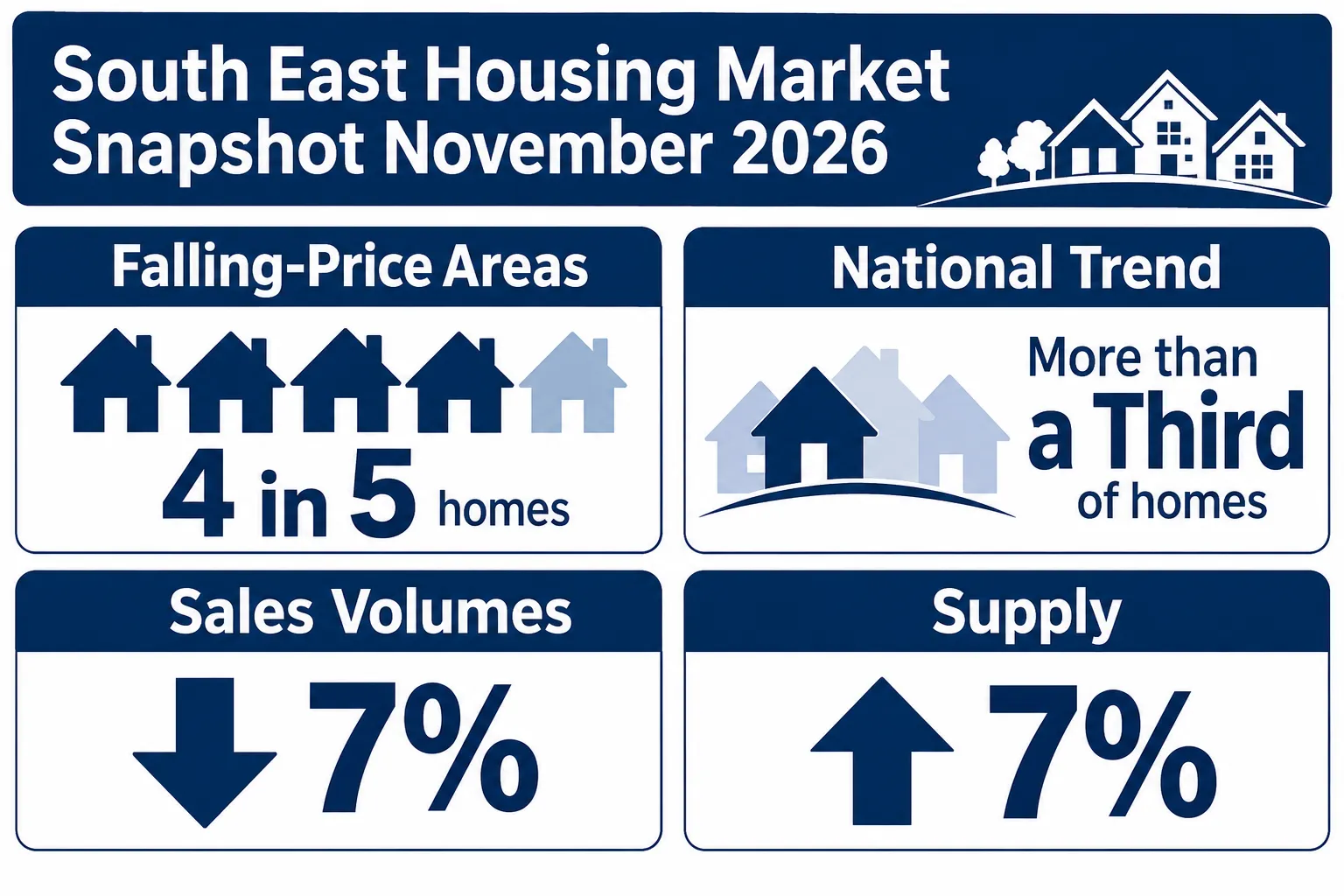
- Zoopla’s 27 October 2026 index shows four in five South East and London homes are in areas with falling prices; nationally, more than a third of homes are in postcode areas where prices are falling, up from 12% a year earlier.
- Sales volumes are down 7% annually while supply is up 7%, giving buyers more choice and more negotiating room.
- HMRC recorded 94,800 UK transactions in September 2026, down 4% year-on-year; Nationwide reports prices flat in October with annual growth of just 0.5%.
- Mortgage costs remain high, average two-year fixes at 5.97%, with a Bank of England decision expected 5 November 2026.
- A RICS Level 2 HomeBuyer or Level 3 Building Survey gives Kent buyers and sellers independent, evidence-based grounds for renegotiation.
What the Zoopla House Price Index Reveals for Kent Buyers
Zoopla’s data, released 27 October 2026, draws a sharp regional line. Outside London and the South East, prices have generally risen, led by the North West. Within the South East, the picture is reversed: four in five homes are in areas registering falls. Nationally, more than a third of homes now sit in postcode areas with falling prices, almost triple the 12% recorded a year earlier.
Richard Donnell of Zoopla has pointed to higher mortgage costs making buyers more selective, with the impact felt most acutely by sellers in southern England. Importantly, he notes demand has not vanished: well-priced homes are still selling as quickly as they did last year. Zoopla estimates higher mortgage rates have reduced buying power for mortgage borrowers by around 15%, and expects roughly 100,000 fewer transactions in 2026 than in 2025. Donnell expects activity to strengthen once mortgage rates fall back below 5%.
For readers tracking the broader regional story, our earlier analysis of valuation strategies for lagging southern markets and regional divergence in valuations set out why this North-South split has been building for months.
Nathan Emerson of Propertymark has described a market becoming increasingly localised, where realistic pricing is essential. Tom Bill of Knight Frank agrees that sellers increasingly need to reflect the tougher mortgage-rate landscape, warning that downward pressure may continue into the final months of the year.
The Transaction and Mortgage Backdrop for Kent Buyers
The wider data confirms the slowdown is not confined to sentiment. HMRC’s 2 November 2026 release recorded 94,800 seasonally adjusted UK residential transactions in September, down 1% on August and 4% on September 2025. Nationwide’s October figures show UK prices flat for the month, with annual growth of just 0.5%, the weakest reading since January 2024.
Mortgage pricing remains the key constraint. Moneyfacts figures from 4 November put the average two-year fixed rate at 5.97%, with five-year fixes above 6%. The Bank of England’s decision on Thursday 5 November 2026 is widely expected to see rates rise from 3.75% to 4%, which would keep borrowing costs firmly elevated for Kent buyers weighing offers this month.
Jonathan Hopper of Garrington sums up the dynamic for both sides of the table: this is a buyers’ market, but “it does not give sellers a licence to overprice.” That balance, real leverage, not a free-for-all, is exactly where an independent RICS survey earns its value.
How a RICS Survey Helps Canterbury Buyers Negotiate in a Falling Market
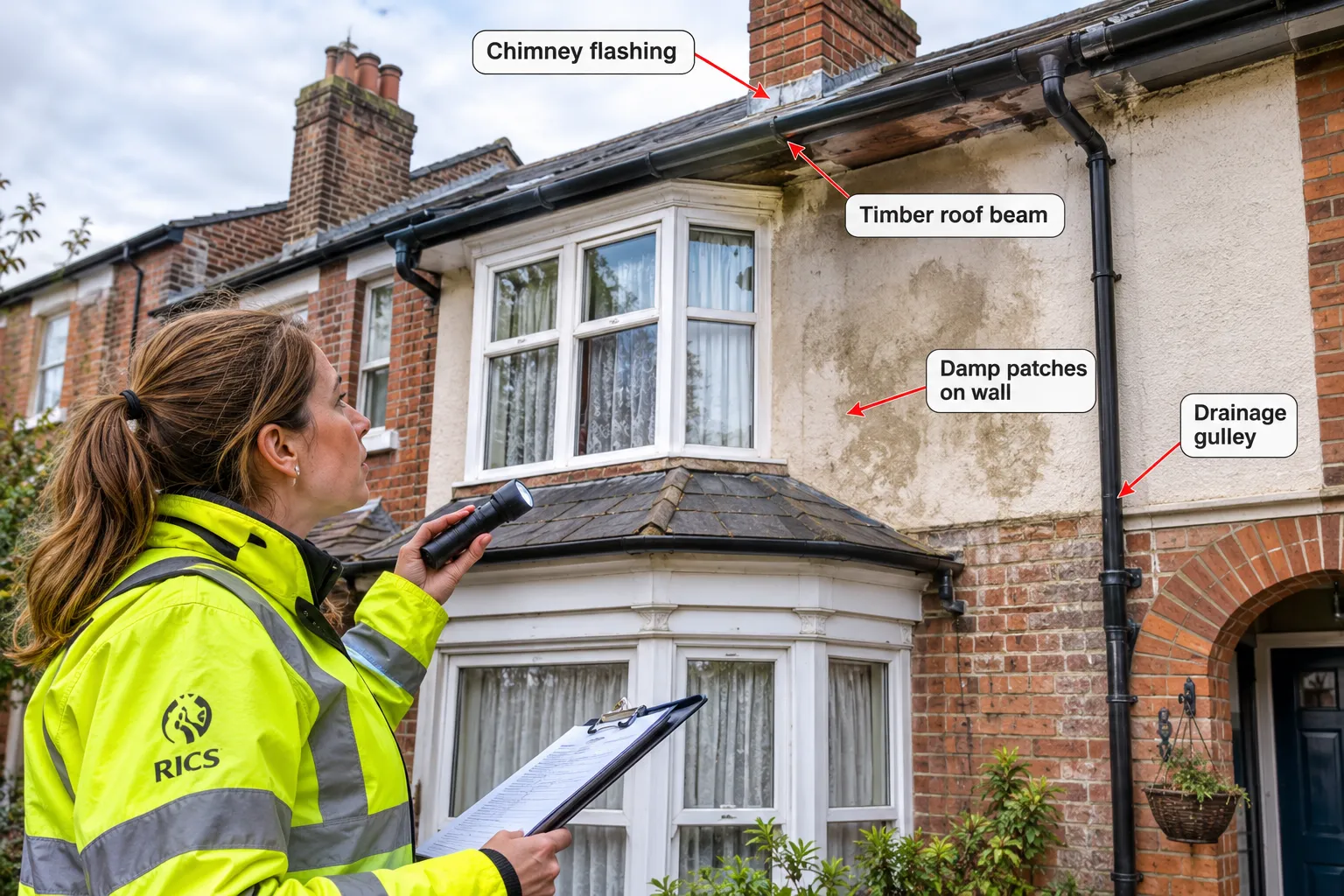
In a market where asking prices often lag what Zoopla’s index now shows, an independent valuation gives buyers hard evidence rather than guesswork. A RICS Level 2 HomeBuyer Report or a more detailed Level 3 Building Survey identifies specific, costed defects that justify a lower offer, particularly important across East Kent’s older housing stock.
Common issues surveyors flag in Canterbury, Whitstable and Faversham properties include:
- Damp in solid-wall Victorian and Georgian terraces, often from failed damp-proofing or poor ventilation
- Roof and chimney defects, including slipped slates, aging flashing and leaning chimney stacks on period homes
- Timber decay and woodworm in exposed beams and floor joists common to listed and converted buildings
- Drainage problems, especially in coastal Whitstable and Herne Bay properties exposed to groundwater
- Period-specific issues such as inadequate insulation, outdated electrics, and non-standard extensions
Each identified defect becomes a concrete, evidence-backed figure that a buyer can put back to the agent or seller, far stronger than a vague “the market has moved” argument. This mirrors the approach we’ve detailed in building survey defect prioritisation for competing properties and defect checklists for stabilising markets.
An independent valuation also helps when agents’ asking prices have not caught up with Zoopla’s falling-price postcodes. If a RICS valuation comes in below the asking price, buyers have documented grounds to renegotiate before exchange, not after discovering problems post-completion.
Advice for Sellers: Price Realistically Before the Survey Finds the Gaps
Sellers in East Kent can turn this market to their advantage by acting ahead of a buyer’s survey rather than reacting to it. Practical steps include:
- Commission a pre-sale survey or valuation to understand likely defects and price accordingly from day one.
- Address obvious issues, guttering, minor damp, loose roof tiles, before marketing, removing easy renegotiation points.
- Set an asking price that reflects local, not national, trends, given how localised this market has become.
- Prepare documentation on recent repairs, damp treatments or roof work to reassure buyers’ surveyors.
- Expect scrutiny, with sales down 7% and supply up 7%, buyers can afford to walk away from overpriced listings.
Sellers who have followed this approach are reflected in our guidance on pricing strategies for lagging southern markets and realistic pricing amid regional divergence.
Key Figures at a Glance
| Metric | Figure | Source |
|---|---|---|
| South East/London homes in falling-price areas | 4 in 5 | Zoopla House Price Index, 27 Oct 2026 |
| Homes nationally in falling-price postcode areas | Over a third (up from 12%) | Zoopla, 27 Oct 2026 |
| Annual change in home sales | -7% | Zoopla, 27 Oct 2026 |
| Annual change in supply | +7% | Zoopla, 27 Oct 2026 |
| Reduction in mortgage buying power | ~15% | Zoopla, 27 Oct 2026 |
| Fewer transactions expected in 2026 vs 2025 | ~100,000 | Zoopla, 27 Oct 2026 |
| UK residential transactions, September 2026 | 94,800 (seasonally adjusted), -1% MoM, -4% YoY | HMRC, 2 Nov 2026 |
| UK house price growth, October 2026 | Flat month; 0.5% annual (weakest since Jan 2024) | Nationwide |
| Average two-year fixed mortgage rate | 5.97% | Moneyfacts, 4 Nov 2026 |
| Bank of England base rate decision | Expected rise 3.75% to 4% | Bank of England, 5 Nov 2026 |
FAQ
Is now a good time to buy in Canterbury or East Kent? Buyers have more choice and more negotiating power than a year ago, with supply up 7% and sales down 7%. However, mortgage rates remain high, so affordability still needs careful planning.
Will prices keep falling in the South East? Tom Bill of Knight Frank expects downward pressure may continue in the final months of 2026. Richard Donnell expects activity to strengthen once mortgage rates fall below 5%.
Should sellers lower their asking price now? Nathan Emerson of Propertymark advises realistic, localised pricing. A pre-sale valuation can help sellers set a figure that reflects current conditions rather than last year’s market.
How does a survey help me negotiate? A Level 2 or Level 3 RICS survey documents specific defects with cost implications, giving buyers concrete evidence to request a price reduction rather than relying on general market sentiment.
What happens at the Bank of England meeting on 5 November 2026? A rate rise from 3.75% to 4% is widely expected, which could keep mortgage rates elevated and sustain cautious buyer behaviour into year-end.
Conclusion
Zoopla’s latest South East data confirms what many East Kent agents are already seeing on the ground: this is a genuinely localised, buyer-favourable market, but one that still rewards accuracy over guesswork. Sellers who price realistically and address defects early will move faster. Buyers who back their offers with independent survey evidence will negotiate with confidence rather than assumption.
Whether you are buying in Canterbury, Whitstable, Herne Bay or Faversham, or preparing to sell before the year ends, contact Canterbury Surveyors for a RICS Level 2 HomeBuyer Report or Level 3 Building Survey to get the independent evidence you need in this changing market.
Related services from Canterbury Surveyors
- RICS property valuations
- RICS Homebuyer Surveys (Level 2)
- Building Surveys (Level 3)
- CCTV drain surveys
Get a fixed-fee quote or call 0204 579 8270.