
Canterbury & Kent
UK House Prices Flat in October as Kent Values Slip £1,878 in a Year: What Canterbury Buyers and Sellers Need to Know (November 2026)
Average Kent homes are now worth £1,878 less than they were a year ago. That single number, buried in official data published this autumn, tells a story that matters hugely for anyone buying, selling or remortgaging in Canterbury and East Kent right now. Kent house prices November 2026 Canterbury buyers need to understand is this: the market is not crashing, but it is patchy, cautious and unevenly priced across different parts of the county.
This article pulls together the latest national and Kent-specific house price data, the outcome of the Autumn Budget, and the interest rate decision expected this week, to give Canterbury buyers and sellers a clear, practical picture.
Key Takeaways
- UK average house price was £273,566 in October 2026 (Nationwide), down 0.3% month-on-month, with annual growth of just 0.5%, the weakest since January 2024.
- The average Kent home was worth about £345,200 in the year to August 2026, down £1,878 annually, according to the ONS/HM Land Registry data reported by KentOnline.
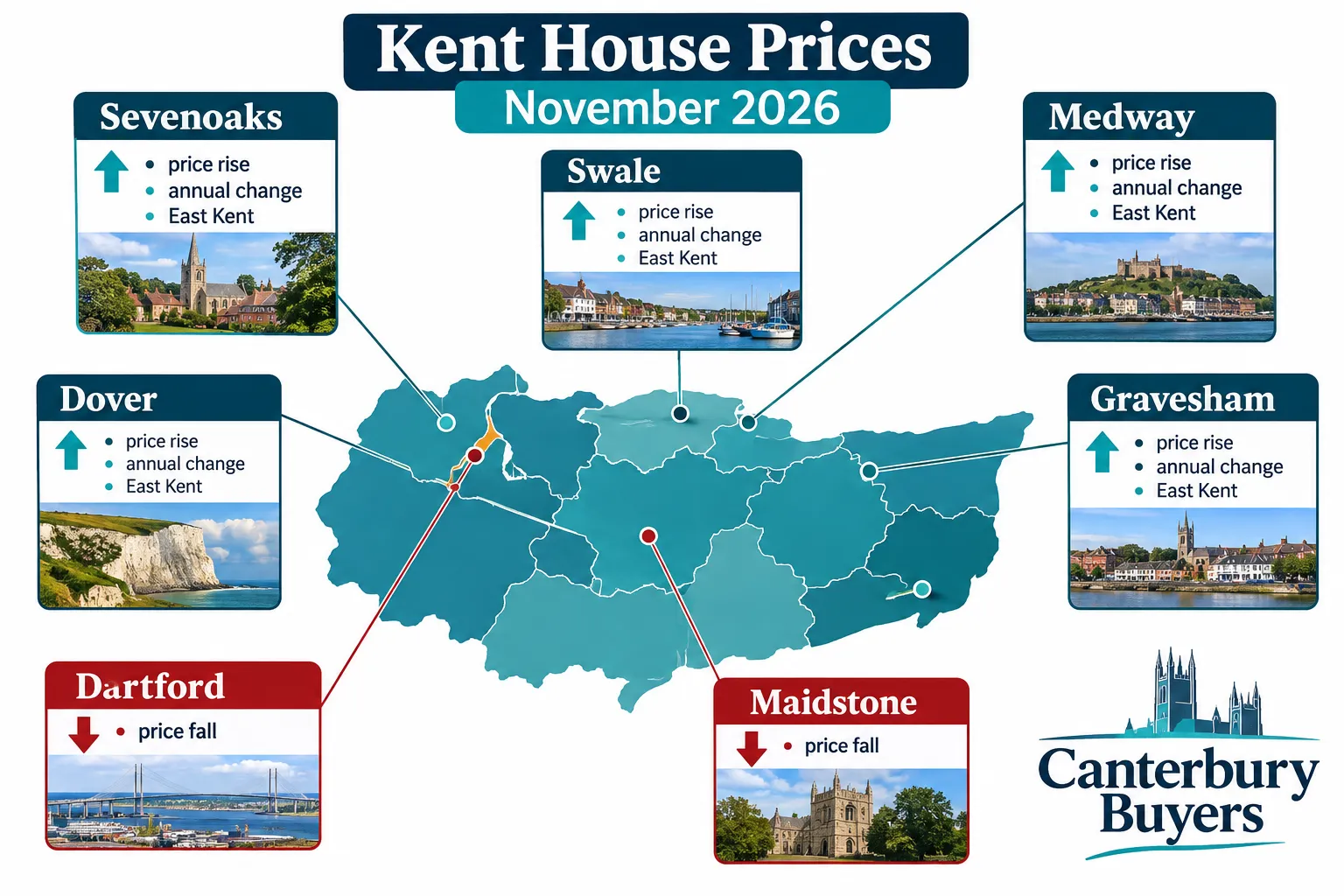
- Only five Kent areas saw price rises: Sevenoaks, Swale, Medway, Dover and Gravesham. Dartford and Maidstone saw the biggest falls.
- Canterbury-specific figures were not separately reported in this data release, so local buyers and sellers must rely on comparable evidence and professional valuations rather than county averages.
- Bank Rate is expected to rise to 4% on 5 November 2026, and mortgage approvals have already fallen to their lowest since December 2023.
Kent House Prices November 2026 Canterbury Buyers: The National Picture
According to the Nationwide House Price Index for October 2026, published on 30 October, the average UK home price fell to £273,566, down from £274,251 in September. Annual growth slowed to just 0.5%, the weakest pace since January 2024.
Robert Gardner, Nationwide’s chief economist, said market activity has slowed amid “geopolitical tensions… fanning inflation concerns.” He pointed to weak buyer enquiries reported by surveyors and lower consumer confidence, though he struck a cautiously optimistic longer-term note: “once the energy shock fades, there are good reasons to believe the market will regain momentum.” He highlighted that the underlying economy remains resilient, employment is stable, household debt is near 20-year lows relative to income, and income growth still comfortably outpaces house price growth.
Jeremy Leaf, a north London estate agent, described the market as “highly sensitive,” noting that uncertainty ahead of the Budget contributed to the softening. Tom Bill of Knight Frank observed that both main house price indices are hovering around zero, with mortgage approvals down almost a fifth year on year. He believes rising mortgage costs are currently outweighing any support from the Budget, though a modest relief bounce remains possible.
What the Kent Numbers Mean for Canterbury
The UK House Price Index for August 2026, published by the ONS and HM Land Registry on 21 October and reported by KentOnline, shows the average Kent home was worth about £345,200, down £1,878 over the 12 months to August. That compares with a UK average of £273,000 in August, which was actually up 0.9% annually and 0.3% on the month, showing Kent underperforming the national trend in that particular dataset.
The picture across Kent is genuinely mixed. Only five areas recorded price growth:
| Area | Change over 12 months | New average price |
|---|---|---|
| Sevenoaks | up about £1,886 | £535,810 |
| Swale | up £1,771 | £296,578 |
| Medway | up £1,571 | £297,757 |
| Dover | up £1,202 | £282,945 |
| Gravesham | up £906 | about £342,498 |
The sharpest falls were in Dartford, down £17,563 to £342,167, and Maidstone, down £4,057 to £352,878.
Tom Evans, sales director at Purplebricks, summed up the mood: “the latest data shows just how subdued the property market has become,” adding that “affordability remains the biggest barrier” but “we’re confident this is a period of adjustment rather than a trend.”
Importantly, Canterbury itself was not broken out as a separate figure in this coverage. That absence is itself useful information: it means county-wide averages cannot be safely applied to Canterbury’s own streets, which include a dense mix of Victorian terraces, converted period properties, listed buildings and newer estate housing. Buyers and sellers here should treat county-level trends as context, not a substitute for local comparable evidence and an independent valuation. For readers wanting background on how regional divergence is reshaping valuation practice more broadly, our earlier piece on the Kent property market and why a RICS survey matters now remains relevant.
The Budget, Interest Rates and What They Mean for Mortgages
The Autumn Budget, delivered by Chancellor John Healey on 28 October 2026, left stamp duty unchanged: first-time buyers still pay nothing up to £300,000, then 5% on the portion between £300,001 and £500,000. The mansion tax, officially the High Value Council Tax Surcharge, stays at a £2m threshold from April 2028, rather than being lowered to £1.5m as some had speculated. A new Your First Home equity-loan scheme for new-build first-time buyers was announced, with the first loans due in April 2027.
On rates, Bank Rate currently sits at 3.75%, with a rise to 4% widely expected on Thursday 5 November 2026, the first increase since August 2023. CPI inflation was 3.5% in September, and average fixed mortgage rates are close to 6%. The Bank of England reported that house-purchase approvals fell to 53,400 in September, the lowest since December 2023.
This combination of flat-to-falling prices in some Kent districts, rising borrowing costs and cautious lending explains why asking prices and lender valuations can now diverge noticeably. A seller pricing on last year’s comparable sale may be some way ahead of what a surveyor or mortgage valuer will support today.
Five Practical Steps for Buyers This November

- Do not rely on county averages. Canterbury’s period and listed housing stock behaves differently from newer estates in Dartford or Medway. Get a street-level comparable analysis.
- Commission an independent RICS Level 2 or Level 3 survey. Older Canterbury properties often hide structural, damp or roofing issues that a basic mortgage valuation will not uncover. See our guide on whether homebuyer reports are still enough for UK buyers.
- Use survey findings to negotiate. In a flat market, documented defects give buyers genuine leverage on price, as explored in our piece on defect prioritisation in a slower market recovery.
- Factor in the likely rate rise. With Bank Rate possibly moving to 4% this week and fixed rates near 6%, stress-test affordability before committing.
- For first-time buyers eyeing new-build, check eligibility for the Your First Home equity-loan scheme ahead of its April 2027 launch, and read about survey considerations for new-build properties.
Advice for Sellers and Homeowners Remortgaging
Sellers in Canterbury should price realistically against genuine local comparables rather than headline county figures, given how widely performance varies even within Kent. An up-to-date RICS valuation helps avoid overpricing that leads to a stale listing.
Homeowners considering remortgaging as rates edge toward 4% should also consider an independent valuation survey, particularly if their property has had work done since the last mortgage valuation, or features older construction typical of Canterbury’s housing stock. Our overview of valuation adjustments amid mortgage rate and stabilisation pressures explains how surveyors approach this in the current climate.
Get Independent, Local Advice
Canterbury Surveyors, RICS chartered surveyors based in Canterbury, can provide an independent Level 2 or Level 3 building survey or RICS valuation tailored to East Kent’s period and listed housing stock. Contact the team before you buy, sell or remortgage this November.
Frequently Asked Questions
Has Canterbury’s own house price fallen like the rest of Kent? A separate Canterbury district figure was not reported in the latest ONS/HM Land Registry release. Buyers and sellers should rely on local comparable sales evidence rather than county-wide averages.
Why did some Kent areas rise in price while others fell? The ONS data shows a patchy market: Sevenoaks, Swale, Medway, Dover and Gravesham all recorded modest rises, while Dartford and Maidstone saw substantial falls, reflecting differing local demand and affordability pressures rather than a uniform county trend.
Will the expected interest rate rise affect my mortgage offer? Bank Rate is widely expected to rise to 4% on 5 November 2026, which could affect new fixed-rate deals, already averaging close to 6%. Anyone with an offer in progress should check with their lender or broker promptly.
Is now a good time to get a building survey in Canterbury? Given the divergence between asking prices and current market conditions, an independent RICS Level 2 or Level 3 survey is particularly valuable now, helping buyers negotiate fairly and avoid overpaying on older or listed properties.
Conclusion
The national and Kent data together paint a market that is flat, cautious and far from uniform. Canterbury buyers and sellers cannot assume county-wide figures apply to their own street, especially given the city’s mix of period and listed homes. With a possible rate rise this week and mortgage approvals already at multi-year lows, careful, locally grounded decisions matter more than ever. An independent RICS survey or valuation from Canterbury Surveyors offers the clearest way to price, negotiate and borrow with confidence this November.
Related services from Canterbury Surveyors
- RICS property valuations
- RICS Homebuyer Surveys (Level 2)
- Building Surveys (Level 3)
- Structural engineers in Canterbury & Kent
Get a fixed-fee quote or call 0204 579 8270.