
Canterbury & Kent
Mortgage Rates Three-Year High Kent: What the 5.89% Average Means for You Today
A single number landed on desks across the country this morning: 5.89%. That is the new Moneyfacts Average New Mortgage Rate, published on 4 November 2026, and it is the highest reading since November 2023. For anyone in Kent watching today’s Bank Rate decision, this is not background noise. It is the figure that decides whether your next mortgage payment grows by tens of pounds or hundreds.
The jump to a mortgage rates three-year high Kent borrowers are now facing did not happen overnight, but it has accelerated fast. Rates have climbed from 5.83% at the start of October to 5.89% now, and the average two-year fixed deal has leapt from 4.83% in January to 5.97% today. For a typical £250,000 repayment mortgage, that shift alone adds roughly £169 a month, or just over £2,000 a year.
Key Takeaways
- The Moneyfacts Average New Mortgage Rate hit 5.89% on 4 November 2026, the highest since November 2023.
- Two-year fixed rates averaged 5.97%, up from 4.83% at the start of the year, adding about £169 a month on a £250,000 mortgage.
- The average standard variable rate sits at 7.13%, costing around £182 a month more than a typical two-year fixed deal.
- Bank Rate is currently 3.75%, held in September, but fixed rates track swap rates, not Bank Rate directly.
- Kent buyers and remortgagers should lock in deals early and consider an independent RICS survey to protect against down-valuations in a tighter lending market.
Why Mortgage Rates Have Hit a Three-Year High in Kent
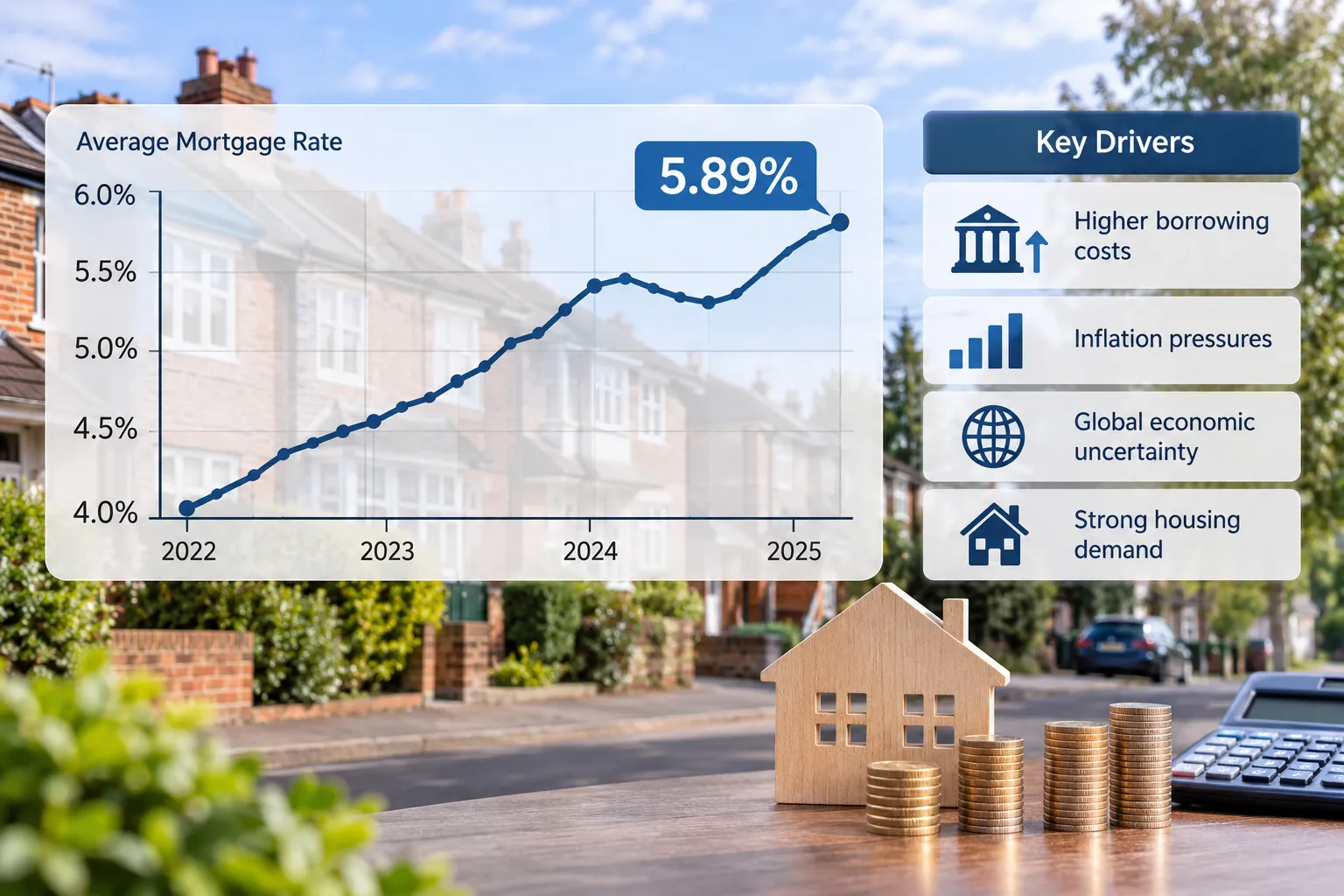
Rising rates are not a local Kent phenomenon in origin, but they land on local wallets all the same. Rachel Springall, finance expert at Moneyfactscompare.co.uk, explained the cause plainly: “Mortgage rates have risen to a three-year high as a result of lenders grappling to re-adjust rates amid swap rate volatility.”
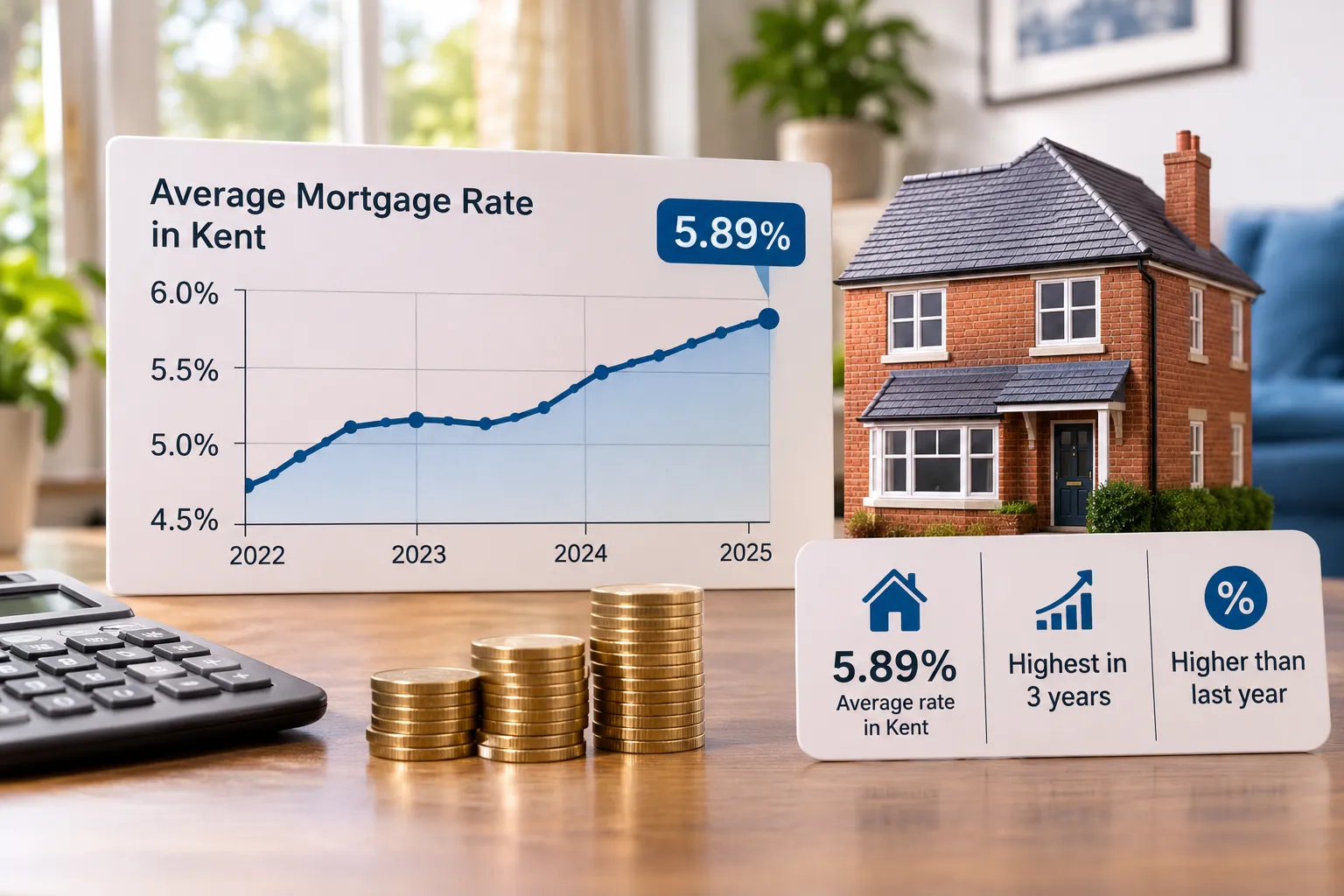
Swap rates are the wholesale costs lenders pay to fix money for two, five or ten years. When swaps move, fixed mortgage pricing follows within days or weeks, often well ahead of any Bank Rate change. That is why the mortgage rates three-year high Kent households are seeing today has built up gradually since January, even while Bank Rate itself has stayed relatively stable.
Context matters here. Bank Rate was held at 3.75% on 17 September 2026, by a 6-3 vote among policymakers. Meanwhile, CPI inflation rose to 3.5% in September, up from 3.1% in August, according to the ONS. Inflation running hotter than expected makes it harder for the Bank of England to cut rates, and it keeps upward pressure on swap markets, which feeds straight through to fixed mortgage pricing.
The Numbers Behind the Mortgage Rates Three-Year High Kent Borrowers Face
| Mortgage type | Current average rate | Change since start of 2026 |
|---|---|---|
| Average new mortgage rate | 5.89% | Up from 5.83% in early October |
| Two-year fixed | 5.97% | Up from 4.83% in January |
| Five-year fixed | 6.00% | Up from 5.95% in October |
| Standard variable rate | 7.13% | Roughly £182/month costlier than a typical fixed deal |
Even the best deals from major high street names have moved. The lowest two-year fixed rates from Barclays, HSBC, Lloyds, NatWest and Santander are, on average, 0.44 percentage points higher than they were at the start of September. That is a meaningful shift in just two months.
A further 0.25-point rise, say from 5% to 5.25%, would add around £37 a month, or £444 a year, on a £250,000 mortgage over 25 years. Small percentage moves translate into real monthly budgeting decisions.
What Kent Buyers and Remortgagers Should Do Now
With a mortgage rates three-year high Kent reality now confirmed by the latest Moneyfacts data, the practical question is what to do before the next two Monetary Policy Committee decisions, on 17 December 2026 and 4 February 2027.
For remortgagers:
- Check your current deal’s end date now. Many lenders allow you to secure a new rate up to six months before your existing deal ends.
- Locking in early protects you if rates climb further, while most lenders let you switch to a cheaper deal if one appears before completion.
- If you are on, or close to falling onto, a standard variable rate, act quickly. At 7.13% on average, SVRs remain significantly more expensive than fixed alternatives.
- Tracker mortgage holders should remember their rate moves directly with Bank Rate, so today’s decision has an immediate, direct effect on monthly payments.
For buyers:
- Get a mortgage agreement in principle before house hunting seriously, so offers reflect realistic affordability under current rates.
- Factor the higher cost of borrowing into your maximum offer. Lenders will stress-test affordability more cautiously in this climate.
- Build in a buffer for a further 0.25-point rate move, given swap rate volatility has not fully settled.
For sellers:
- Price realistically. Buyers facing higher borrowing costs have less room to stretch, so overpricing risks longer time on market.
“Mortgage rates have risen to a three-year high as a result of lenders grappling to re-adjust rates amid swap rate volatility.”, Rachel Springall, Moneyfactscompare.co.uk
Why an Independent Survey Matters More When Rates Are High
When borrowing costs rise, lenders tighten their risk appetite. Valuations become more conservative, and down-valuations, where a lender’s valuer assesses a property below the agreed purchase price, become more common. A down-valuation can force a buyer to find extra cash or renegotiate the price at short notice, a stressful position in any market but especially one with a mortgage rates three-year high Kent backdrop.
An independent RICS Home Survey, whether Level 2 or Level 3, gives buyers an evidence-based report on a property’s condition and value. This is distinct from a lender’s valuation, which exists purely to protect the lender’s security on the loan. A RICS survey can:
- Identify structural issues that justify a lower offer
- Provide leverage to renegotiate before exchange
- Flag costly repairs that affect long-term affordability, which matters more when monthly mortgage costs are already higher
For sellers, commissioning a pre-sale survey or having realistic pricing backed by an independent assessment can reduce the risk of a sale collapsing after a lender down-valuation.
Frequently Asked Questions
Is 5.89% the highest mortgage rate in three years? Yes. The Moneyfacts Average New Mortgage Rate of 5.89%, published 4 November 2026, is the highest since November 2023, when the average stood at 6.07%.
Why are fixed mortgage rates rising if Bank Rate is unchanged? Fixed rates track swap rates, which reflect lenders’ wholesale funding costs and market expectations, not the current Bank Rate. Swap rate volatility has pushed fixed pricing up even while Bank Rate held at 3.75%.
Should I fix now or wait for the next Bank Rate decision? Many lenders let you secure a deal up to six months ahead and switch to a cheaper rate before completion if one becomes available. Locking in early generally limits downside risk without closing off better options.
How much more could a 0.25-point rate rise cost me? On a £250,000 repayment mortgage over 25 years, a 0.25-point increase adds roughly £37 a month, or £444 a year.
Does a RICS survey help if rates are high? Yes. It provides independent evidence of a property’s condition and value, useful for renegotiating price or avoiding costly surprises when borrowing costs are already elevated.
Conclusion
The mortgage rates three-year high Kent homeowners and buyers are grappling with today is driven by swap rate volatility, not a single Bank Rate decision. Still, with inflation running at 3.5% and the next MPC meetings set for December and February, conditions remain fluid. Remortgagers should check deal end dates and lock in early. Buyers should secure agreements in principle and build in a rate buffer. Everyone should treat valuation risk seriously by commissioning an independent RICS Home Survey before committing. Acting early, with accurate information, remains the strongest protection against further rate uncertainty.
mortgage rates three-year high Kent, Bank Rate decision 2026, remortgage advice Kent, two-year fixed rate mortgage, standard variable rate, RICS Home Survey, Kent property market, swap rate volatility, mortgage affordability, Moneyfacts data, down-valuation risk, Canterbury Surveyors
Related services from Canterbury Surveyors
- RICS property valuations
- RICS Homebuyer Surveys (Level 2)
- Building Surveys (Level 3)
- Structural engineers in Canterbury & Kent
Get a fixed-fee quote or call 0204 579 8270.