
Canterbury & Kent
Why Addresses Matter in UK Building Surveys: Title, Boundary and Identity Checks Explained
Approximately one in three boundary disputes in England and Wales involves a mismatch between the physical property and the address recorded at HM Land Registry [1]. That single statistic reveals how much weight a simple street address carries in the world of professional building surveys. Understanding why addresses matter in UK building surveys, covering title, boundary and identity checks, is not a procedural footnote. It is the foundation on which legally sound surveys, valuations and party wall awards are built.
Key Takeaways
- A property address is the primary key that unlocks HM Land Registry title registers, title plans and tenure data essential for building surveys.
- Title plans show only “general boundaries,” so precise address matching is critical when interpreting or disputing boundary lines.
- Address verification is now a formal Anti-Money Laundering (AML) requirement, linking client identity to the specific property being surveyed.
- Errors in address data can invalidate official copies of title documents, creating legal risk in mortgage lending and conveyancing.
- Surveyors, buyers and solicitors should use official GOV.UK address-based search services to avoid misleading results from unofficial portals.
How Addresses Unlock HM Land Registry Title Data
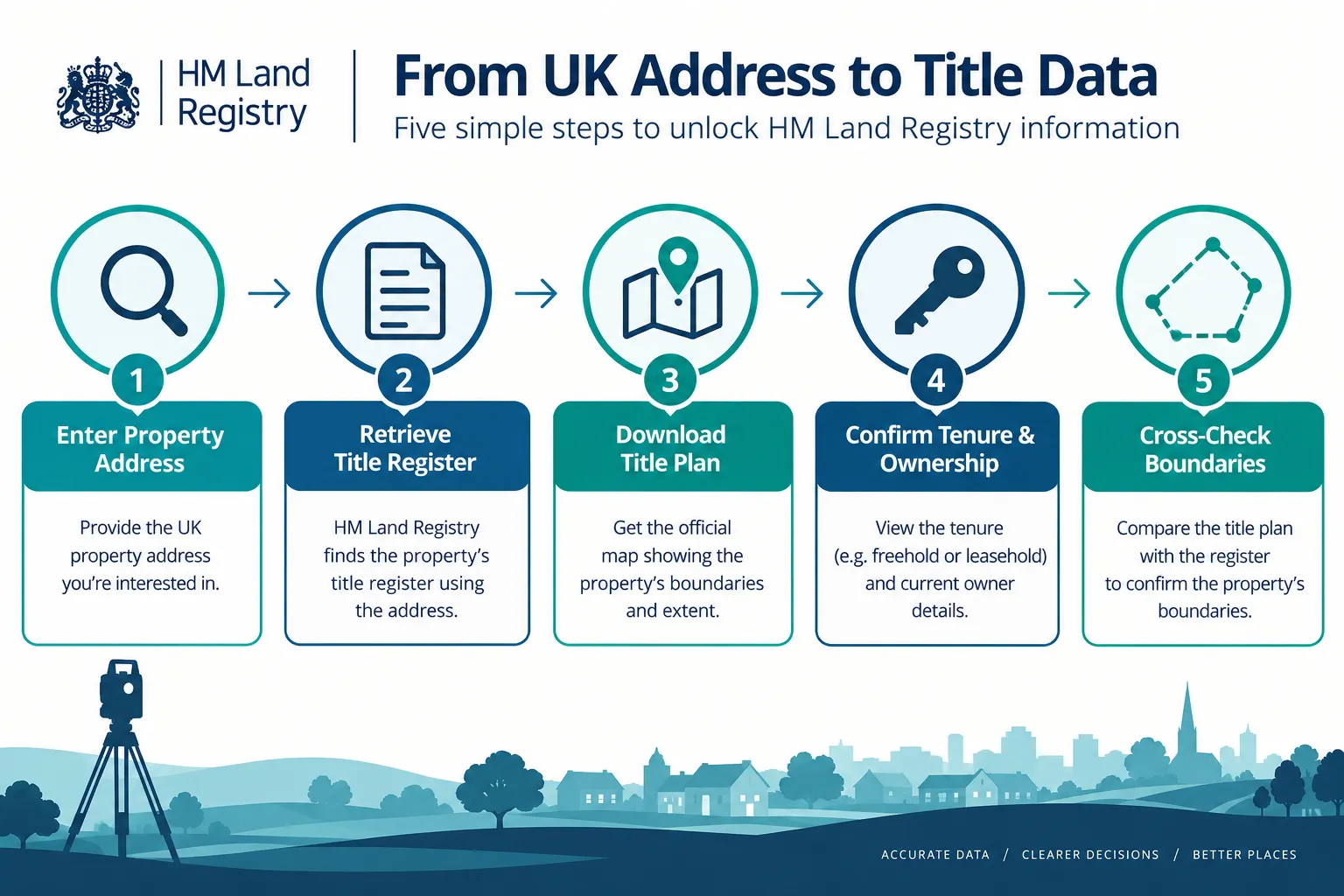
Every formal building survey begins before a surveyor sets foot on site. The preparatory phase relies almost entirely on address-based searches of official records. HM Land Registry holds title registers and title plans for more than 87% of land in England and Wales [1], and the entry point into that data is the property address.
When a surveyor or solicitor searches the register using the official GOV.UK portal, the address entered must match the recorded data precisely [2]. A missing flat number, an outdated postcode, or a street name variant, “Road” versus “Street”, can return no results or, worse, the wrong property’s records entirely. This is not a minor inconvenience. It means the survey is being prepared against incorrect title information.
What title data an address search returns:
| Document | What It Confirms | Why It Matters for Surveys |
|---|---|---|
| Title Register | Ownership, tenure, charges, covenants | Identifies legal owner and encumbrances |
| Title Plan | General boundary position on OS map | Foundation for boundary analysis |
| Official Copy | Legally admissible proof of title | Required by lenders and courts |
| Leasehold Schedule | Lease term, ground rent, service charges | Critical for flat and leasehold surveys |
The distinction between an official copy and a downloaded copy is legally significant. Official copies obtained through the Land Registry portal carry a certification date and are admissible as evidence in court or mortgage proceedings [3]. A downloaded copy from an unofficial third-party site may not carry the same legal standing. For surveyors preparing reports that may later be used in disputes or lending decisions, this difference matters enormously.
Surveyors preparing building surveys for 2026 agreed sales recovery should ensure their pre-inspection title checks use address-verified official copies rather than cached third-party data, particularly in a market where transaction volumes are rising and timelines are compressed.
Pull quote: “The address is not just a label. It is the legal key that connects a physical building to its registered title, its boundaries and its ownership history.”
Official vs Unofficial Search Portals
Consumer guides published in 2026 consistently warn buyers and professionals to use the official GOV.UK search service [3] rather than commercial portals that replicate Land Registry data with varying degrees of accuracy [4]. Several third-party services present themselves with official-sounding names but are not affiliated with HM Land Registry [5][6]. The risk is that address matching on these platforms may be less rigorous, returning title data for a neighbouring property or an outdated register entry.
For professionals, the guidance is clear: always verify title data through the official Land Registry portal [2], cross-referencing the address against the Ordnance Survey reference shown on the title plan.
Title Plans, General Boundaries and Why Address Precision Matters
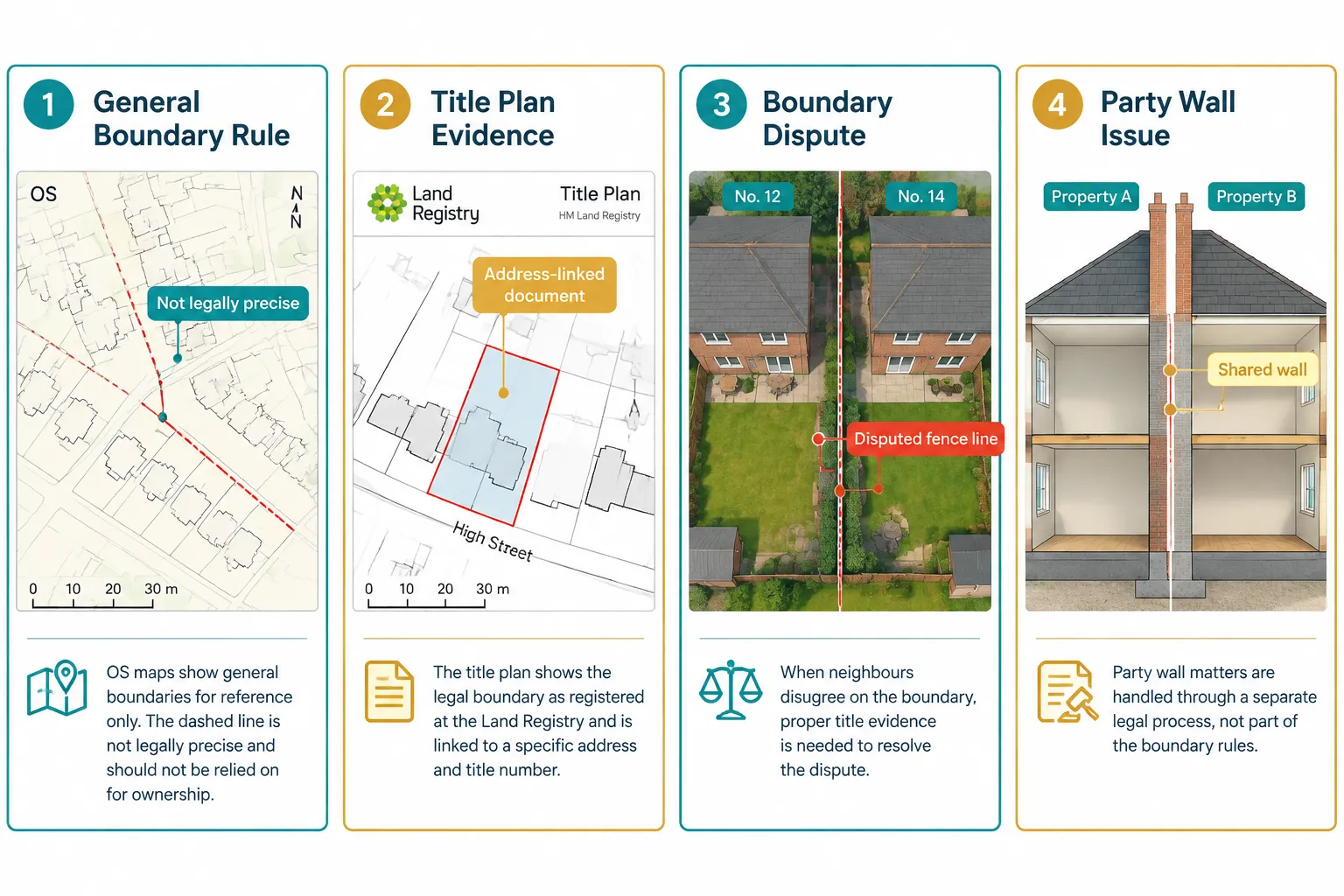
One of the most misunderstood aspects of UK property law is the general boundary rule. Title plans produced by HM Land Registry are drawn on Ordnance Survey mapping at a scale that does not define the precise legal boundary of a property [1]. The red edging on a title plan indicates the general extent of the registered title, it does not specify which side of a wall, fence or hedge the boundary falls on.
This creates a significant practical challenge for building surveyors. When a client asks whether a boundary feature, a garden wall, a shared fence, a driveway edge, belongs to their property, the surveyor must work from the title plan outward, using physical evidence on site to interpret what the general boundary likely means in practice.
The address is the anchor point for this entire process. If the title plan retrieved does not correspond to the correct property address, the surveyor is interpreting boundaries for the wrong parcel of land. In terraced streets, where properties share near-identical footprints and are separated by only a few metres, address errors can place the surveyor one or two properties off from the correct title.
Boundary Disputes vs Party Wall Issues: A Critical Distinction
Expert commentary from boundary dispute specialists makes clear that boundary disputes and party wall issues are legally distinct matters, even though both involve the interface between neighbouring properties [7]. A boundary dispute concerns the position of the legal boundary itself, where one owner’s land ends and another’s begins. A party wall issue concerns the rights and obligations relating to a shared structural element, governed by the Party Wall etc. Act 1996.
Address and title evidence sit at the core of both:
- In a boundary dispute, the title plan retrieved via address search is the primary documentary evidence. Surveyors acting as expert witnesses must demonstrate that the title plan they are relying on was obtained for the correct registered title [7].
- In a party wall matter, the address of the adjoining owner must be correctly identified to serve a valid party wall notice. An incorrectly addressed notice may be legally defective.
For surveyors involved in complex structural work, understanding how party wall awards for structural alterations in flats depend on accurate address identification of all affected owners is essential to avoiding procedural errors that can invalidate the entire award.
When defect diagnosis in older properties reveals structural movement near a boundary, surveyors must first confirm via address-verified title data whether the movement originates within the registered title or on an adjoining parcel. Getting that wrong at the outset can misdirect remediation advice and expose the surveyor to professional liability.
Address Errors in Practice: Common Failure Scenarios
- Converted buildings: A Victorian house converted into four flats may have a single street address for the building but separate registered titles for each flat. Searching on the building address alone may return the freehold title rather than the leasehold title relevant to the flat being surveyed.
- New-build estates: Street naming and numbering on new developments is sometimes registered before physical completion. The address in the Land Registry system may differ from the developer’s marketing address or the postal address assigned by the local authority.
- Rural properties: Properties without conventional street addresses, identified by property name rather than number, require particular care. The address used in the Land Registry search must match the registered description exactly [4].
- Renamed streets: Historical street renaming means that older deeds may reference a previous address. Surveyors must reconcile the current postal address with the historic description in the title register.
Address Verification, AML Compliance and Identity Checks in Building Surveys
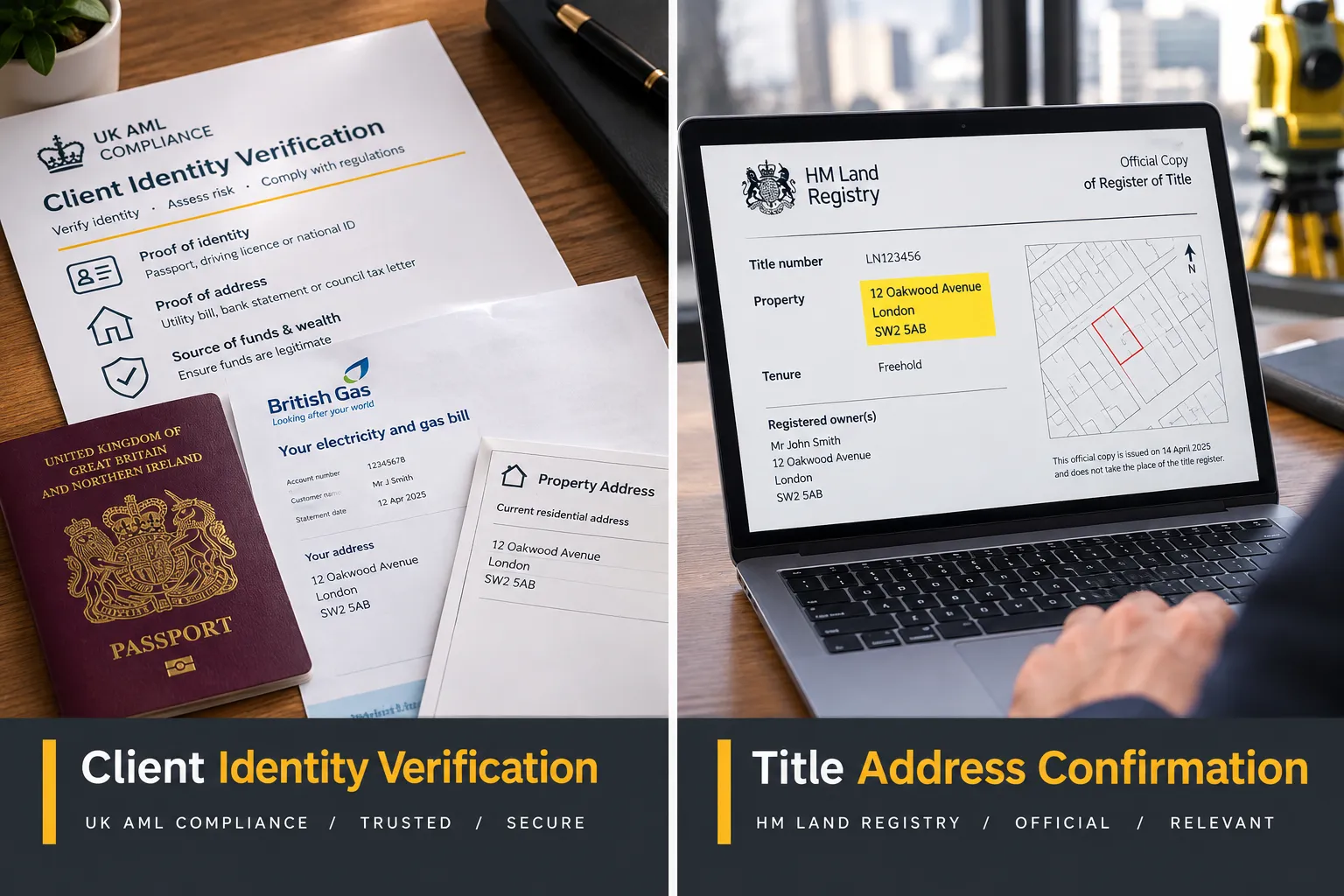
The role of address data in building surveys extends well beyond title and boundary analysis. Since 2017, UK anti-money laundering (AML) regulations have required all professionals involved in property transactions, including surveyors and valuers, to conduct formal Customer Due Diligence (CDD) on their clients [9]. Address verification is a documented, mandatory component of that process.
Why address verification closes a critical AML risk gap:
The property being surveyed and the client commissioning the survey must be demonstrably linked. Address verification achieves this in two directions:
- Client identity to address: The client must provide proof of their residential address, a utility bill, bank statement or official correspondence dated within three months, to confirm they are who they claim to be [9].
- Address to property: The surveyed property’s address must be confirmed against the registered title to verify that the client has a legitimate interest in the property (as owner, buyer or lender’s representative).
Without both checks, a surveyor cannot be certain that the instruction is genuine and that the property transaction does not involve the proceeds of crime. Regulators have made clear that incomplete address verification represents a material failure in AML compliance, not a minor administrative gap [9].
Pull quote: “Address verification does not merely confirm where someone lives. It connects the client’s legal identity to the specific parcel of land being surveyed, closing a gap that financial criminals have historically exploited.”
Change of Address Procedures and Survey-Related Notices
HM Land Registry maintains a formal electronic change-of-address (e-COA) procedure for registered proprietors and their representatives [10]. This matters for building surveys in several practical ways:
- Notices served during a survey process, such as party wall notices or requisitions from a lender’s surveyor, must be sent to the address recorded at Land Registry for the registered proprietor. If that address is outdated because the proprietor has moved and not updated the register, notices may go undelivered and legal timescales may be missed [10].
- Mortgage lenders rely on the Land Registry address record to contact borrowers in default or to register charges. A discrepancy between the surveyed property address and the registered address can delay or prevent charge registration.
- Leasehold service charge disputes often hinge on whether notices were correctly served at the registered address. Surveyors advising on leasehold properties should check the registered address as part of their pre-inspection review.
Professionals working on building survey protocols for accelerated 6-week completions in 2026’s faster-moving market need to build address verification into their compressed timelines, not treat it as an afterthought that can be resolved post-report.
The Growing Integration of Address Data in Survey Workflows
The surveying profession is moving toward tighter integration of address-based title and identity data into digital survey workflows. Several developments are driving this:
- Digital Land Registry search services now allow bulk address-based title searches, enabling portfolio surveyors to retrieve multiple title registers simultaneously [4]. This is particularly relevant for building surveys for institutional buy-to-let portfolios, where address accuracy across dozens of properties must be verified before inspections begin.
- AML compliance platforms are integrating address verification APIs that cross-reference client-provided addresses against Royal Mail’s Postcode Address File and Land Registry data in real time [9]. This reduces manual error and creates an auditable compliance trail.
- Drone and laser scanning surveys generate point-cloud data that is geo-referenced to OS coordinates. Tying that data back to a specific registered title requires precise address-to-title matching at the outset. For more on how technology is changing evidence gathering, see drones and laser scanning in expert witness building surveys.
Checklist: Address Verification Steps for Building Survey Preparation
- Confirm the full postal address including flat/unit number and postcode
- Search the official Land Registry register using the exact address [2]
- Retrieve an official copy of the title register and title plan [3]
- Cross-reference the OS title number against the postal address
- Confirm the registered proprietor’s address for service [10]
- Obtain client proof-of-address documentation for AML compliance [9]
- Note any address discrepancies in the survey report with recommended actions
For surveyors working on complex structural cases, the structural surveys preparation process should incorporate all of the above steps before any site inspection takes place.
Conclusion
The connection between a property address and the legal, physical and identity data that underpins a building survey is more complex, and more consequential, than most buyers and even some professionals appreciate. Why addresses matter in UK building surveys encompasses three distinct but interconnected functions: unlocking accurate title and tenure data from HM Land Registry, anchoring boundary analysis to the correct registered parcel, and satisfying the AML and identity verification obligations that now form a mandatory part of professional survey practice.
Actionable next steps for buyers, surveyors and solicitors in 2026:
- Always use the official GOV.UK Land Registry search portal [2][3], not third-party commercial sites, to retrieve title data before commissioning or preparing a survey.
- Verify that the address used in the Land Registry search matches the postal address, the OS reference on the title plan, and the address in the draft contract.
- For converted buildings, new-build estates and rural properties, obtain the specific registered title number from the solicitor before searching, to avoid retrieving the wrong register.
- Build AML address verification into the survey instruction process from day one, not as a post-instruction formality.
- Check the registered proprietor’s address for service via the e-COA system [10] before serving any formal notices connected to the survey.
- Where address discrepancies are found, note them explicitly in the survey report and recommend that the client’s solicitor investigates before exchange of contracts.
Address data is not administrative background noise. In UK building surveys, it is the thread that connects the physical building to its legal identity, and getting it right from the start protects every party in the transaction.
References
[1] Land Registry – gov.uk [2] Search Property Information Land Registry – gov.uk [3] Search The Register – gov.uk [4] Finding Information Held By HM Land Registry – gov.uk [5] onlinelandregistry – onlinelandregistry.org [6] landregistrysearch.uk – landregistrysearch.uk [7] Boundary Disputes Vs Party Wall Issues Expert Witness Differentiation And Resolution Tactics For Surveyors – princesurveyors.co.uk [9] Address Verification Real Estate AML Compliance – shuftipro.com [10] Land Registry Portal Change Of Address E COA – gov.uk
Related services from Canterbury Surveyors
- Party wall surveyors in Canterbury & Kent
- Boundary surveys
- Building expert witness surveyors
- RICS property valuations
Get a fixed-fee quote or call 0204 579 8270.