
Canterbury & Kent
Structural Survey Red Flags: When a UK Buyer Should Walk Away from a Property
Nearly one in five UK property transactions fall through after a survey reveals unexpected defects, yet the majority of buyers who receive a worrying report do not know how to distinguish a manageable problem from a genuine deal-breaker. Understanding the difference between structural survey red flags that warrant a price renegotiation and those that justify walking away entirely can save buyers from inheriting six-figure repair bills, unmortgageable properties, or years of litigation.
This guide offers a practical decision-making framework for UK buyers in 2026, categorising survey findings into three tiers: repairable issues, complex but manageable problems, and genuine deal-breakers. It also explains when escalation to specialist reports or expert witnesses becomes necessary.
Key Takeaways
- A RICS Condition Rating 3 is not automatically a reason to withdraw, it is a signal to investigate, cost, and renegotiate before exchange of contracts.
- Active structural movement, serious roof failure, widespread timber decay, and environmental hazards such as Japanese knotweed or unsafe cladding are the most serious structural survey red flags.
- If cumulative remediation costs approach or exceed 10-15% of the agreed purchase price and the seller refuses to renegotiate, walking away is the financially sound decision.
- Mortgage or insurance refusal triggered by survey findings effectively renders a property unmortgageable, a clear walk-away signal for most buyers.
- All decisions must be made before exchange of contracts; withdrawing after exchange can result in deposit forfeiture and legal liability.
Understanding the RICS Condition Rating System
Before categorising red flags, buyers need to understand how surveyors communicate risk. RICS-accredited surveyors use a three-tier Condition Rating system across Level 1, Level 2, and Level 3 reports.
| Condition Rating | Meaning | Typical Action Required |
|---|---|---|
| 1 | No repair currently needed | Monitor only |
| 2 | Defects that need repairing or replacing but are not considered serious | Plan maintenance |
| 3 | Serious defects needing urgent repair, replacement or investigation | Obtain quotes; renegotiate or withdraw |
Updated RICS home survey documentation revised in 2026 defines a Condition Rating 3 as a defect that is serious and/or needs urgent repair, with failure to act risking serious safety issues or severe long-term damage. Buyers are explicitly advised to obtain written repair quotations before any legal commitment to purchase [7][8].
Critically, a red rating is not an automatic instruction to walk away. It is a structured alert that the defect must be fully understood and costed before proceeding [3][10]. The decision to withdraw becomes appropriate only when the cost, risk, and seller’s response combine unfavourably.
For buyers uncertain about which level of report they need, an RICS specialist defect survey can provide targeted analysis of a specific concern identified during an initial inspection.
The Three-Tier Framework: Categorising Structural Survey Findings
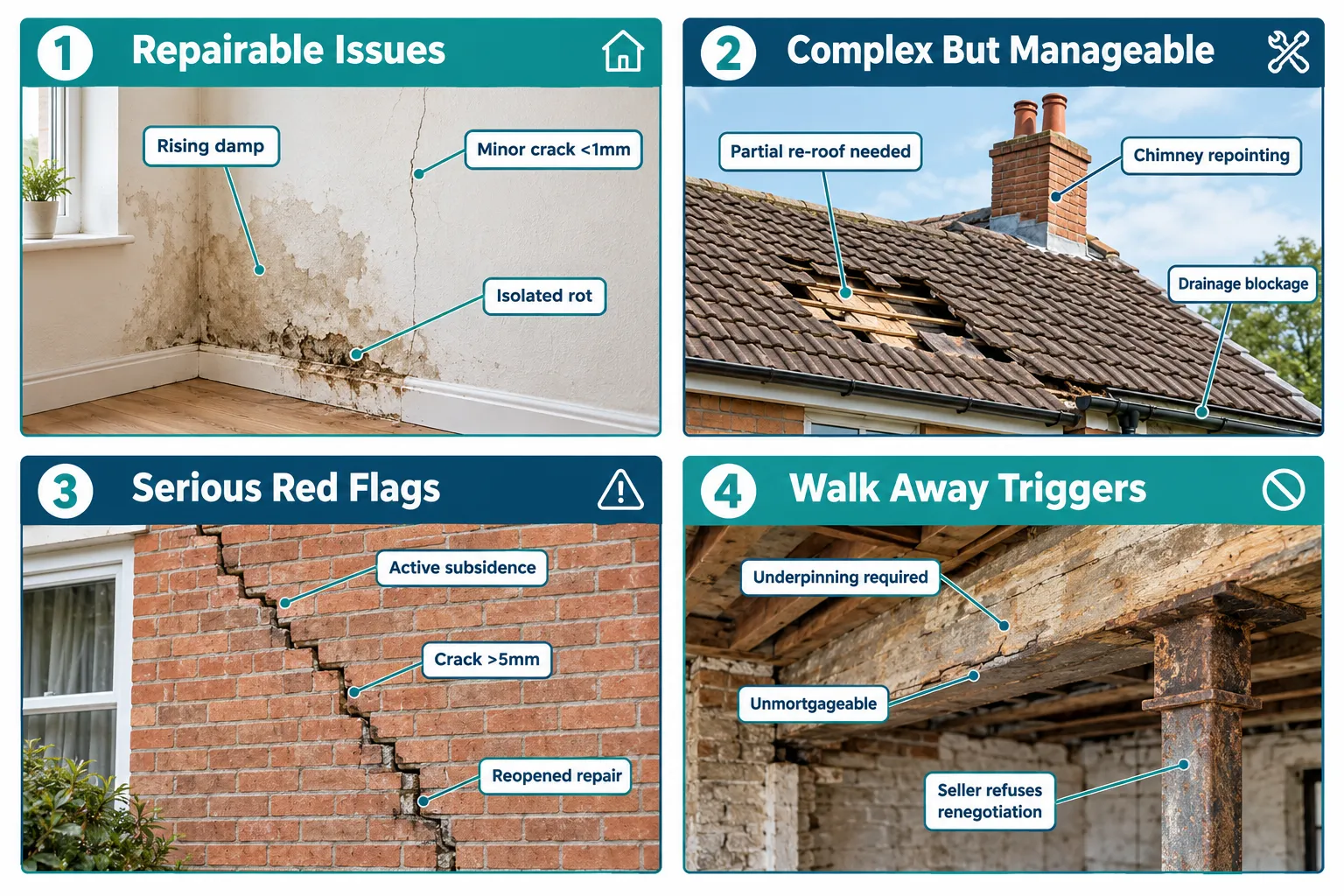
Tier 1: Repairable Issues, Renegotiate, Do Not Withdraw
Most survey findings fall into this category. These are defects that are real, cost money to fix, and justify a price reduction request, but they do not threaten the structural integrity of the building or its insurability.
Common Tier 1 findings include:
- Minor damp patches caused by isolated leaks or poor ventilation
- Small hairline cracks in plaster or render (under 1 mm)
- Isolated areas of timber decay without spread
- Guttering or downpipe failures
- Dated but functional electrical consumer units
- Single-room roof tile replacement
The appropriate response is to obtain written quotes from qualified contractors, then use those figures to negotiate a price reduction or request that the seller carries out remediation before exchange. Most transactions that survive a survey do so through this process [3].
Tier 2: Complex But Manageable Problems, Investigate Thoroughly Before Deciding
These findings require specialist investigation beyond the surveyor’s initial report. They may be expensive to resolve, but they are not automatically deal-breakers if the cost is fully understood and the seller engages reasonably.
Common Tier 2 findings include:
- Partial roof failure requiring significant re-roofing works
- Chimney stack movement or repointing needs
- Drainage defects (a drainage survey is strongly recommended before exchange)
- Localised subsidence with a clear, resolvable cause
- Presence of asbestos in accessible but undisturbed locations (see surveys for asbestos)
- Non-standard construction materials that may affect mortgage terms
For Tier 2 issues, buyers should commission specialist reports, a structural engineer, damp specialist, or asbestos surveyor, and obtain written quotes before any renegotiation. The key question is whether the total remediation cost, when added to the purchase price, still represents fair value for the property [9][2].
The 10-15% cost threshold is a useful benchmark: if specialist reports and quotes show cumulative remediation approaching or exceeding 10-15% of the agreed purchase price, and the seller refuses to renegotiate, walking away becomes the recommended course of action [4][1].
Tier 3: Genuine Deal-Breakers, Serious Structural Survey Red Flags That Justify Walking Away
This is the category that defines the most critical structural survey red flags when a UK buyer should walk away from a property. These findings either carry costs and risks that cannot be reliably quantified, render the property unmortgageable, or involve hazards the seller is unwilling to address.
The Most Serious Structural Survey Red Flags in UK Property Transactions
Active Structural Movement and Subsidence
Structural movement is consistently identified as the most critical red flag in UK building surveys [2][9]. Not all cracks are equal. Buyers and surveyors distinguish between:
- Historic movement, cracks that are stable, have been repaired, and show no signs of reopening
- Active movement, cracks that are widening, have reopened after previous repairs, or are accompanied by sloping floors, sticking doors, or distorted window frames
The most serious indicators of active subsidence include:
- Diagonal “stair-step” cracks following mortar joints in brickwork
- Cracks exceeding approximately 5 mm in width [2][9]
- Cracks that have reopened after previous repair attempts
- Evidence of previous underpinning that has not resolved the underlying cause
Active subsidence requiring underpinning typically costs between £10,000 and £50,000 or more, depending on the extent and method [2]. Where the underlying cause, such as tree roots from a neighbouring property or clay shrinkage, cannot be permanently resolved, the risk of recurrence remains. In these circumstances, walking away is appropriate unless the seller reduces the price to cover full remediation plus a meaningful risk premium [14][12].
Subsidence surveys and monitoring surveys can establish whether movement is active or historic, a distinction that is essential before any purchase decision is made.
Mortgage and Insurance Refusal
If a mortgage lender declines to lend, imposes unaffordable retentions, or applies conditions that cannot be met, the property is effectively unmortgageable for mainstream buyers. Similarly, if standard home insurance is unavailable or only offered on terms that are commercially unacceptable, the financial risk of ownership becomes unmanageable [1][14].
These outcomes are not merely inconveniences, they are structural survey red flags that signal a property the market has already assessed as too risky to finance. For most buyers, mortgage or insurance refusal is a definitive walk-away trigger.
Serious Roof Failure
A roof in complete or near-complete failure, where replacement rather than repair is required, and where internal damage from water ingress is already extensive, can represent a six-figure liability. A specialist roof survey will establish the true scope of the problem. Where the cost of full replacement, combined with remediation of internal water damage, approaches the 10-15% threshold and the seller will not adjust the price, withdrawal is justified [1][9].
Widespread Timber Decay and Damp
Isolated damp or localised timber decay is a Tier 1 or Tier 2 issue. However, widespread wet rot or dry rot, particularly where it has spread through structural timbers, floor joists, or roof members, is a different matter entirely. Dry rot in particular can spread rapidly through masonry and is expensive to eradicate completely. Where a surveyor identifies extensive spread and the full scope cannot be determined without opening up works, buyers should treat this as a potential Tier 3 issue until specialist reports confirm otherwise [9][1].
Environmental and Compliance Hazards
Several environmental issues feature prominently in 2026 red-flag guidance because of their impact on insurance, resale value, and remediation cost:
- Japanese knotweed within approximately 7 metres of the property requires a specialist report. A red survey rating on knotweed signals a serious defect requiring urgent attention, with treatment programmes typically running for several years [6].
- Unsafe cladding on flats over 11 metres where an EWS1 form is unavailable renders the flat unmortgageable and unsaleable in the current market [14].
- Flood risk above the buyer’s tolerance, discovered after an offer is made, is a legitimate reason to withdraw, particularly where insurance is unavailable or prohibitively expensive [12].
- Large-scale asbestos removal requirements, particularly where asbestos-containing materials are in a friable or damaged condition throughout the property, can generate remediation costs that make the purchase unviable [6].
For properties with non-standard construction, such as prefabricated concrete, steel frame, or timber frame systems, specialist assessment is essential. Guidance on non-standard construction surveys explains the specific risks these building types carry for mortgage and insurance purposes.
Unresolvable Legal and Title Issues
Structural survey red flags are not limited to physical defects. Several legal issues discovered during conveyancing are equally valid reasons to walk away:
- Unresolved title or boundary disputes the seller cannot remedy
- Lease lengths that have deteriorated to a point where the property is unmortgageable
- Leasehold terms (such as ground rent escalation clauses) that materially worsen value or financeability
- Defective legal packs that cannot be corrected before exchange [12][14]
These issues are grouped alongside major structural problems in professional buyer guidance because their financial consequences can be equally severe.
When to Escalate: Specialist Reports and Expert Witnesses
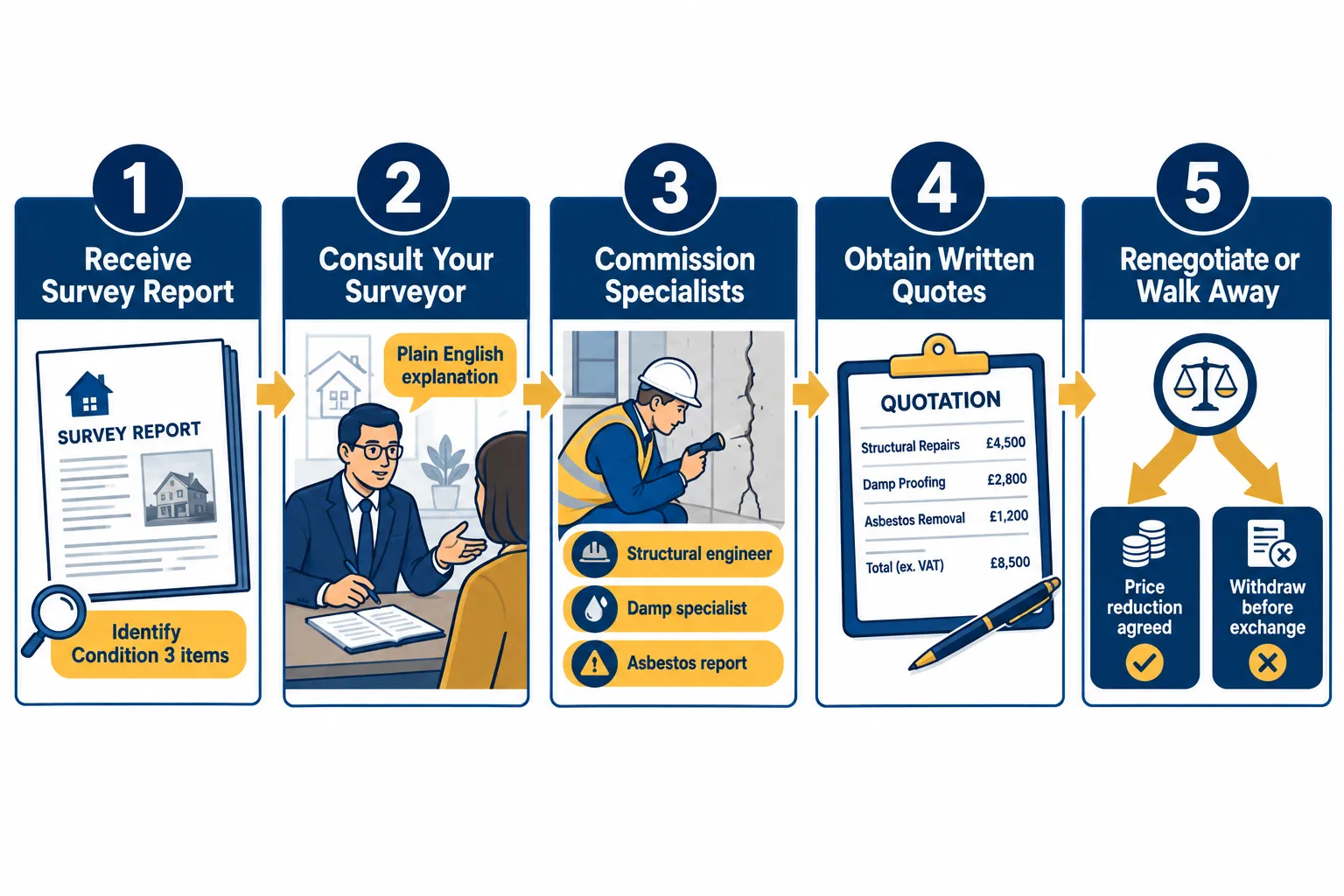
The recommended response sequence when a survey uncovers serious findings is consistent across professional guidance [3][9][2]:
- Re-read every Condition Rating 3 item carefully
- Ask the surveyor to explain findings in plain English
- Commission specialist reports (structural engineer, damp specialist, asbestos surveyor, knotweed specialist)
- Obtain written, itemised repair quotations
- Use these figures to renegotiate, request seller remediation, or withdraw
Where a defect is disputed, for example, where the seller’s surveyor and the buyer’s surveyor disagree on the severity of structural movement, escalation to an expert witness surveyor may become necessary. This is particularly relevant in higher-value transactions or where litigation is a possibility. An April 2025 RICS practice alert to members on expert witness functions in housing cases has reinforced tighter expectations around how survey-based evidence is prepared and presented [5].
For buyers dealing with complex defect histories, a specific defect report can provide the focused, evidence-based analysis needed to support renegotiation or legal proceedings.
Timing Is Everything: Act Before Exchange of Contracts
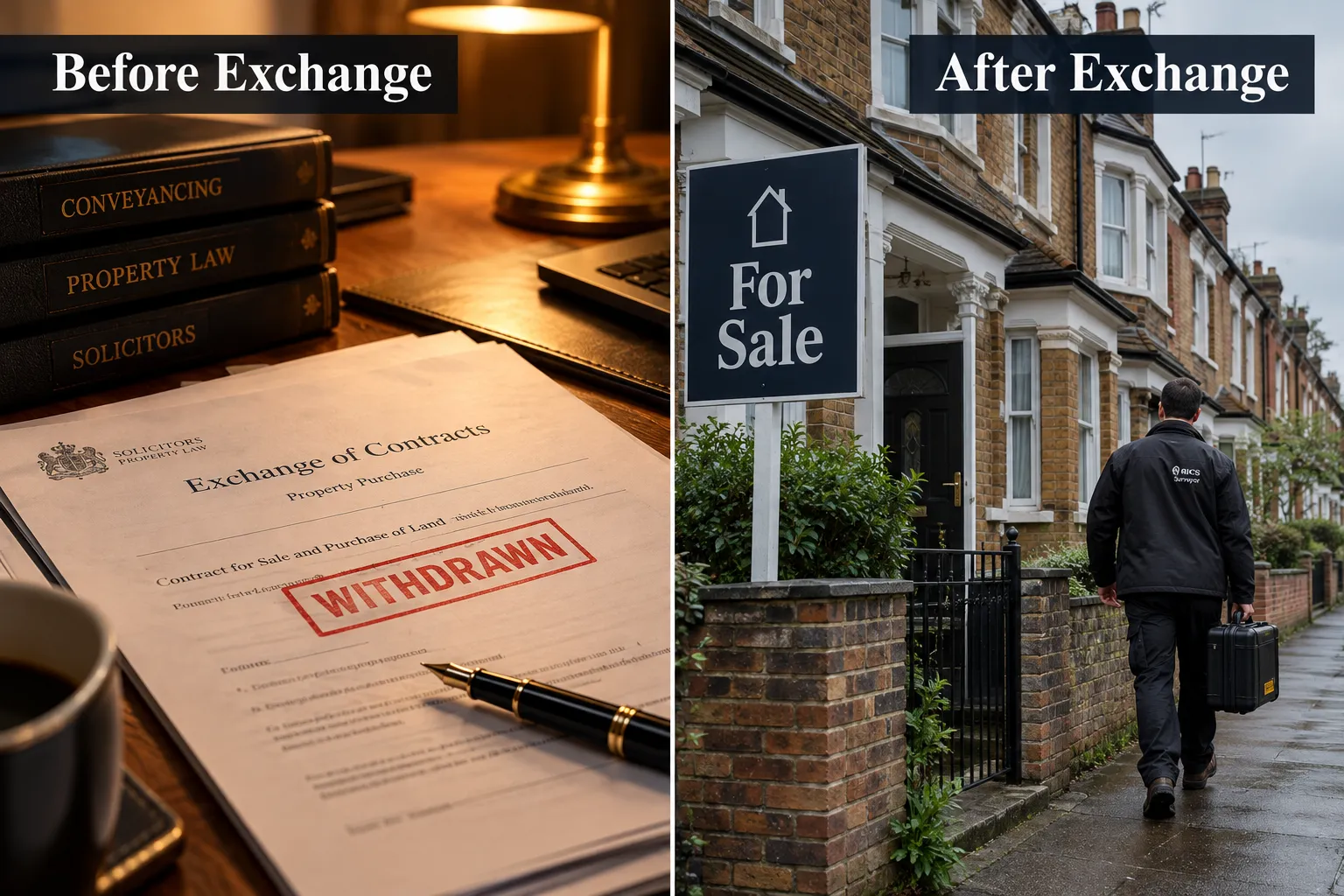
UK property law creates a clear and unforgiving boundary at exchange of contracts. Before exchange, a buyer can withdraw from a transaction for any reason without legal penalty, though survey and legal costs already incurred will be lost [11][14].
After exchange, withdrawal can result in:
- Forfeiture of the deposit (typically 10% of the purchase price)
- Liability for the seller’s losses and legal costs
- Potential litigation
This means that all decisions relating to structural survey red flags must be made, and acted upon, before exchange. Buyers who receive a worrying survey report should not allow conveyancing momentum to carry them past this point without fully understanding and costing every Condition Rating 3 finding [13][14].
Practical signs that a buyer is preparing to withdraw, such as prolonged silence of two to three weeks, the buyer’s solicitor ceasing contact, or a mortgage offer being withdrawn, are recognised signals in the market, but they do not substitute for a formal, timely withdrawal before exchange [11][1].
Conclusion: A Framework for Clear-Headed Decision-Making
Structural survey red flags are not all created equal. The decision-making framework presented here, Tier 1 (renegotiate), Tier 2 (investigate thoroughly), Tier 3 (consider walking away), gives buyers a structured way to respond to survey findings without either panicking unnecessarily or proceeding recklessly.
Actionable next steps for buyers who have received a worrying survey:
- Do not exchange contracts until every Condition Rating 3 item is fully costed and understood.
- Commission specialist reports for any finding that cannot be fully assessed by a generalist surveyor.
- Apply the 10-15% cost threshold: if cumulative remediation approaches this level and the seller will not renegotiate, withdrawal is the financially sound choice.
- Treat mortgage or insurance refusal as a definitive walk-away signal.
- Seek specialist guidance on environmental hazards, knotweed, asbestos, flood risk, and cladding, before making any final decision.
- Where findings are disputed or complex, consider engaging an expert witness surveyor to provide independent, evidence-based assessment.
A bad survey is not the end of a property search. In most cases, it is the beginning of a negotiation. But when the defects are severe, the costs are prohibitive, and the seller proves unwilling to engage, walking away before exchange is not a failure, it is the most financially responsible decision a buyer can make.
References
[1] Should I Pull Out After Survey – mypropertyscan.com
[2] Evergreen Red Flags In Building Surveys Updating Rics Checklists For Stabilising National Prices – princesurveyors.co.uk
[3] Bad House Survey Report – hoa.org.uk
[4] How To Renegotiate After Survey – mypropertyscan.com
[5] Expert Witness Functions In The Housing Disrepair Sector – localgovernmentlawyer.co.uk
[6] Property Survey Checklist 2025 What Buyers Must Know – japaneseknotweedagency.co.uk
[7] Description Of The RICS Home Survey Level 1 – rics.org
[8] RHS Level One Final – rics.org
[9] The 5 Biggest Red Flags Your House Survey Will Find And How To React – surveyhut.co.uk
[10] First Time Buyer Survey Guide – housesmartsurveying.co.uk
Related services from Canterbury Surveyors
- Boundary surveys
- Building expert witness surveyors
- RICS Homebuyer Surveys (Level 2)
- Building Surveys (Level 3)
Get a fixed-fee quote or call 0204 579 8270.