
Canterbury & Kent
Damp Survey Readings Explained: What UK Homeowners Should Make of Moisture Meter Results
Roughly one in five UK homes has a damp problem significant enough to affect habitability or value, yet the numbers printed on a surveyor’s moisture meter report remain a mystery to most buyers and owners. Understanding damp survey readings explained: what UK homeowners should make of moisture meter results is not just academic; it directly shapes repair decisions, renegotiation leverage, and whether a mortgage lender will release funds.
This guide breaks down the scale, the thresholds, the equipment, and the professional interpretation process so that any homeowner can read a damp report with genuine confidence.
Key Takeaways
- Moisture meters report readings on the Wood Moisture Equivalent (WME) scale; readings below 16% are generally considered dry, while readings above 20% indicate active damp requiring investigation.
- A single high reading means very little without a pattern of readings across multiple points and heights on the same wall.
- Different materials, plaster, masonry, and timber, have different acceptable moisture ranges, so the same number can be fine in one material and serious in another.
- Surveyors combine meter readings with visual evidence to distinguish rising damp, penetrating damp, and condensation, each of which requires a different remedy.
- Homeowners who understand these readings are better placed to question remediation quotes, negotiate on price, and satisfy lender requirements.
What a Moisture Meter Actually Measures
Before interpreting any numbers, it helps to understand what the instrument is detecting. Most handheld damp meters used in UK surveys work on one of two principles: pin-type (resistive) meters and non-invasive scan (capacitance) meters. Many modern professional units combine both modes in a single device [1].
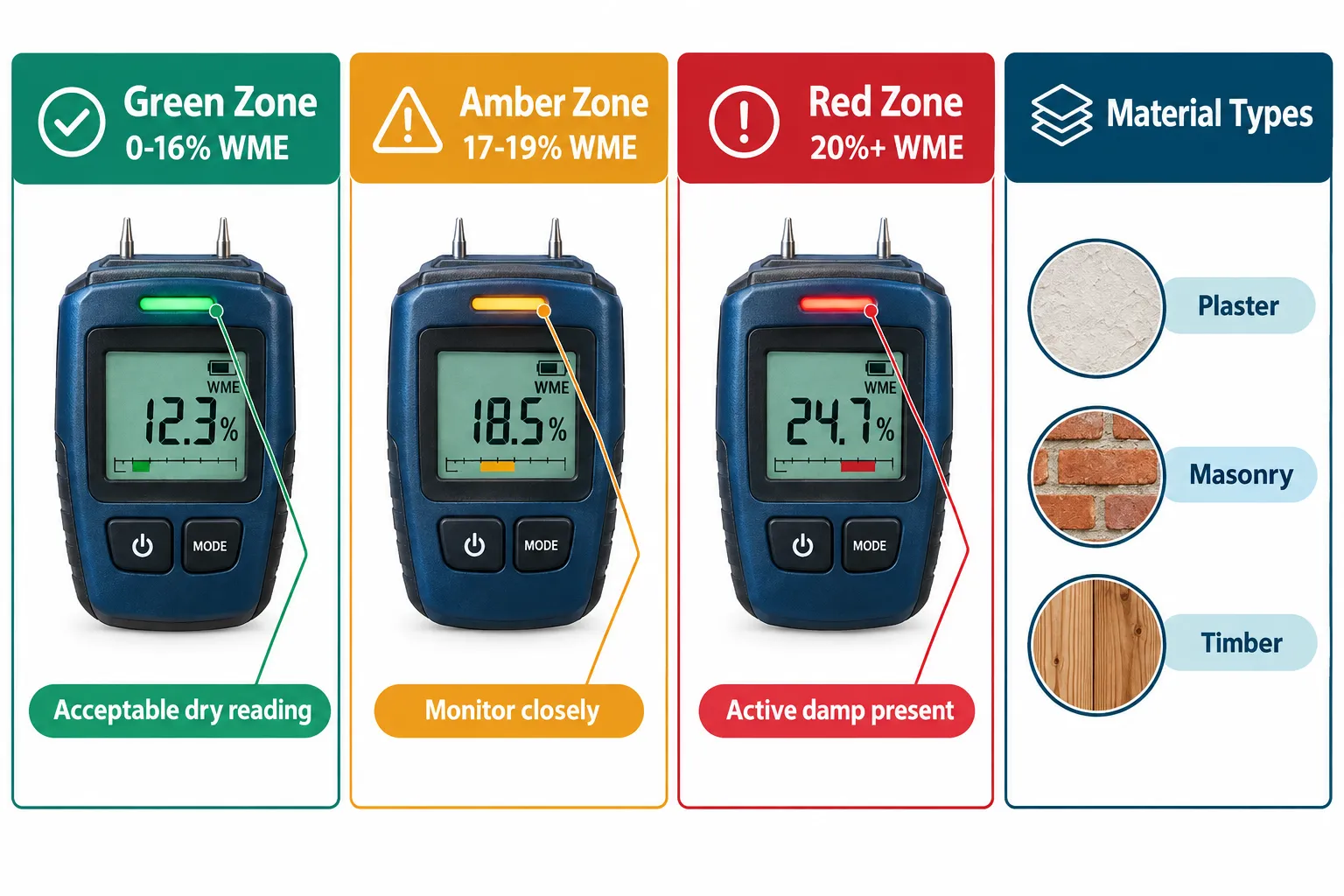
Pin meters pass a small electrical current between two metal probes inserted into the material. Because water conducts electricity, higher moisture content produces lower electrical resistance, which the meter converts into a percentage reading. Scan meters use radio-frequency or capacitance technology to sense moisture through the surface without penetrating it, making them ideal for initial screening before pin confirmation [9].
Both types report results on the Wood Moisture Equivalent (WME) scale, expressed as a percentage. The WME scale was originally calibrated for timber, but surveyors apply it to plaster and masonry as a comparative index rather than an absolute moisture content figure [4]. This distinction matters enormously: a reading of 25% WME in a wall does not mean the plaster is 25% water by weight. It means the electrical or capacitance properties of that material are equivalent to timber containing 25% moisture, a strong indicator of elevated dampness, but not a direct measurement [8].
“Moisture meter readings are indicators, not verdicts. They tell a surveyor where to look harder, not what the final diagnosis is.”
For homeowners who have purchased their own consumer-grade meter, it is worth noting that budget devices often lack the calibration and material-compensation settings found in professional instruments such as the Protimeter range [7]. This can lead to misleading readings, particularly in dense masonry or on surfaces with metallic paint.
The WME Scale: Reading the Numbers Correctly
Understanding the thresholds is central to damp survey readings explained: what UK homeowners should make of moisture meter results. The industry broadly uses the following bands, influenced by Protimeter’s long-established guidance and widely adopted across RICS-regulated surveys [4][8]:
| WME Reading (%) | Zone | Interpretation | Typical Action |
|---|---|---|---|
| 0-16% | Green (Dry) | Acceptable moisture level | No action required |
| 17-19% | Amber (At Risk) | Elevated; monitor closely | Investigate source; retest |
| 20-28% | Red (Damp) | Active damp present | Identify and treat source |
| 28%+ | Saturated | Severe ingress or leak | Urgent professional investigation |
These bands apply primarily to plaster and masonry. Timber has different thresholds because it is the calibration material for the WME scale. For structural timber, a reading above 20% WME is considered the threshold at which fungal decay can begin, making this a critical figure for floor joists, roof timbers, and window frames [4][8].
Material-Specific Ranges
The same meter reading carries different weight depending on what is being tested:
- Plaster: Readings above 20% WME are a reliable indicator of moisture ingress. However, freshly applied or newly dried plaster can give elevated readings for weeks after application, so context is essential.
- Masonry (brick, stone, block): Dense materials can retain residual salts from historic damp episodes. Salts conduct electricity and can produce false-high readings on pin meters even when the wall is structurally dry. A surveyor will look for hygroscopic salts, white crystalline deposits, as a qualifier [8].
- Timber: The 20% threshold is particularly significant. Below 20%, most timber species resist fungal decay. Above 20%, conditions favour wet rot or dry rot, both of which can cause serious structural damage [4].
How Surveyors Build a Pattern of Readings
A single elevated reading is rarely diagnostic. Professional practice, and the guidance underpinning damp surveys carried out by chartered surveyors, requires a systematic grid of measurements across a suspect wall [6].
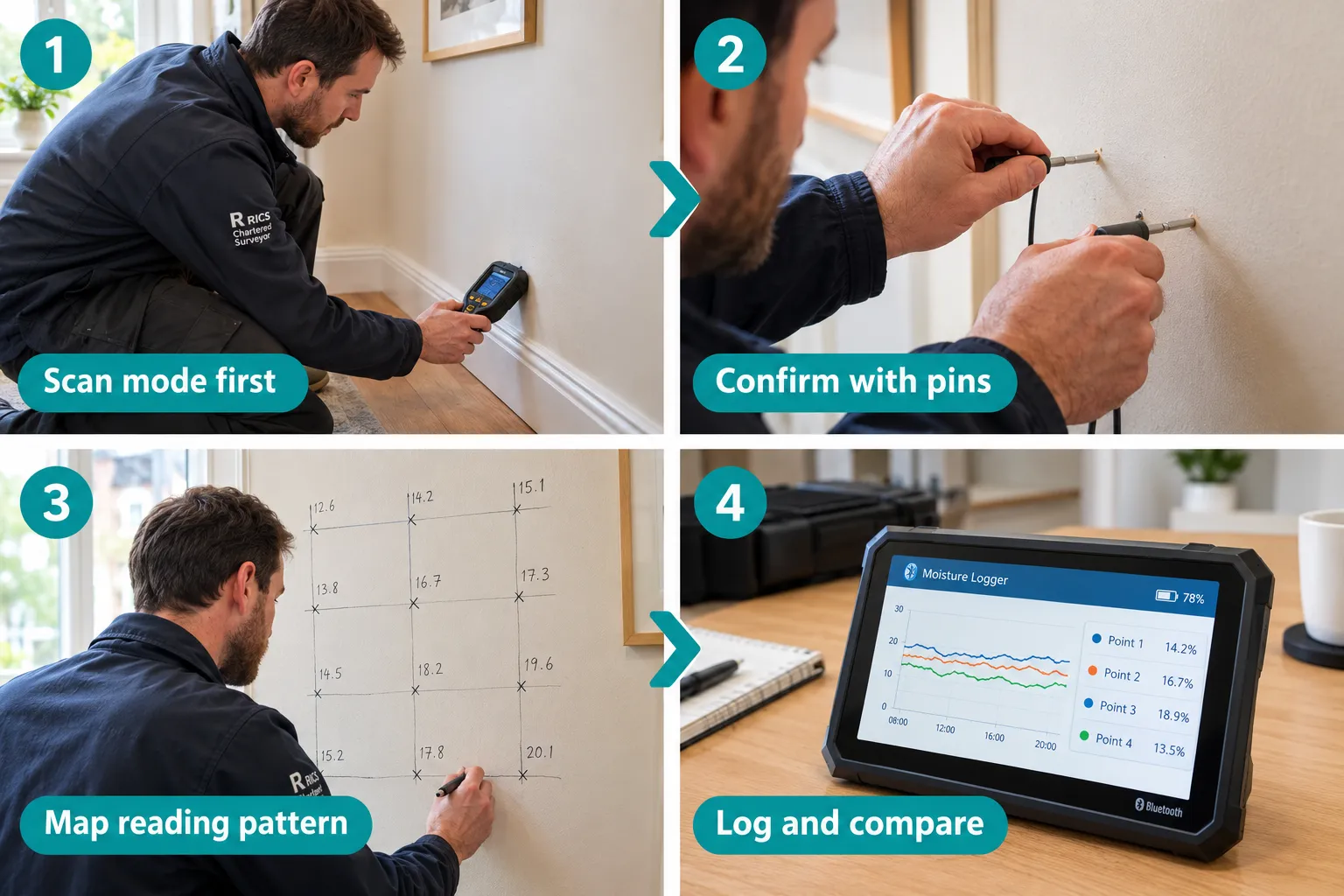
The Measurement Protocol
A well-conducted survey typically involves:
- Baseline readings on a dry, unaffected wall for comparison.
- Vertical profile readings at 150mm, 300mm, 600mm, 900mm, and 1200mm above floor level on the suspect wall.
- Horizontal readings at each height across the full width of the wall.
- Adjacent surface checks on the floor, skirting boards, and any plasterwork returns.
- Internal vs external correlation, checking whether the damp pattern on the inside aligns with a visible external defect.
This grid approach produces a moisture map of the wall. The shape of that map is often more informative than any individual reading [8]. For example:
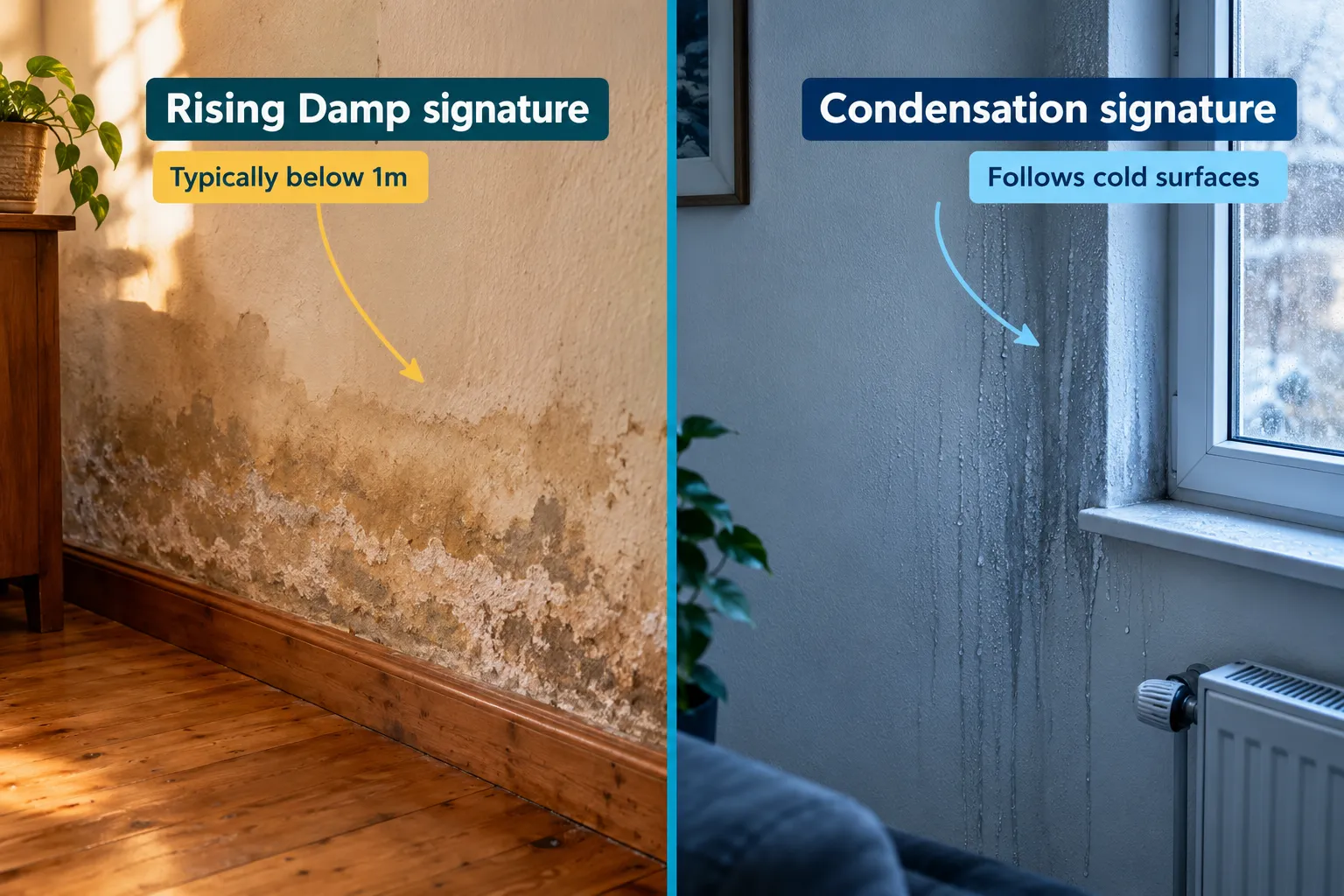
- A triangular pattern rising from floor level, widest at the base and tapering as it rises, is the classic signature of rising damp caused by a failed or absent damp-proof course (DPC).
- A localised patch at mid-wall or above skirting level, often with a clear horizontal boundary, typically points to penetrating damp from a defect in the external envelope, a cracked render, faulty pointing, or a leaking gutter.
- Widespread elevated readings across large areas, concentrated on external walls and around cold bridges near windows, are characteristic of condensation, which is a ventilation and thermal issue rather than a structural one.
Understanding this distinction is vital because the remedies differ entirely. Treating condensation with a chemical DPC injection, a common mis-selling scenario in the UK, wastes money and fails to address the actual cause.
For homeowners considering a homebuyer survey or a more detailed building survey, it is worth confirming in advance that the surveyor will use a moisture meter as part of the inspection and will provide a pattern of readings rather than a single spot check.
Linking Readings to Visible Symptoms
Damp survey readings explained: what UK homeowners should make of moisture meter results cannot be complete without addressing how numbers connect to what the eye can see. Meter readings should always be cross-referenced with visual evidence [10].
Common Visual Indicators and Their Meter Correlations
| Visual Symptom | Likely WME Range | Probable Cause |
|---|---|---|
| Tide marks / salt staining at low level | 20-30%+ | Rising damp or historic ingress |
| Peeling wallpaper, bubbling paint | 18-25% | Penetrating damp or condensation |
| Black mould on walls/ceilings | 17-22% | Condensation (surface moisture) |
| Efflorescence (white salt crystals) | Can be low (historic) | Previous ingress; salts remain |
| Wet rot in skirting boards | 25%+ in timber | Sustained moisture at floor level |
| Staining below windows or parapets | 20-28% | Penetrating damp from external defect |
A critical point: efflorescence can produce elevated meter readings on a wall that is now dry. The hygroscopic salts left behind from a previous damp episode absorb moisture from the air and conduct electricity, fooling a pin meter into reporting active dampness. An experienced surveyor will account for this by using a non-invasive scan meter alongside pin readings, and by checking whether the wall feels cold or shows any visible moisture [8].
This is one reason why the RICS Home Survey Standard in practice guidance for Level 2 and Level 3 reports emphasises that defect advice must be based on a combination of instruments, visual inspection, and professional judgement, not meter readings alone.
What Readings Mean for Repairs, Valuation, and Lenders
The practical consequences of damp survey readings depend on their severity, location, and likely cause. Here is how different scenarios typically play out:
Amber Zone Readings (17-19% WME)
Amber readings are a prompt to investigate further, not an automatic cause for alarm. In many cases, they reflect:
- Seasonal variation in an otherwise sound wall
- Residual moisture from recent decoration
- Minor condensation that can be resolved with improved ventilation
A surveyor will typically note these as a condition rating 2 item in a Level 2 report, defects requiring attention but not urgent action [6]. Lenders rarely object to amber-zone readings unless they are widespread or accompanied by visible structural damage.
Red Zone Readings (20%+ WME)
Readings in the red zone, particularly when forming a consistent pattern, are likely to trigger a condition rating 3, defects that are serious and/or need to be repaired, replaced, or investigated urgently [6]. The consequences can include:
- Mortgage retention: The lender withholds a portion of the loan until remediation is completed and verified.
- Price renegotiation: Buyers use the survey findings to negotiate a reduction reflecting the cost of repair.
- Specialist referral: The surveyor recommends a specialist damp contractor or structural engineer for further investigation.
For properties in social housing, the stakes are even higher. Under Awaab’s Law and the obligations it places on building surveyors in social housing reports, landlords face strict timelines for investigating and remedying damp and mould once it is identified.
Repair Cost Context
Professional damp surveys in 2026 typically cost between £200 and £400 for a standard residential property, with specialist investigations for larger or more complex properties reaching £600 or more [3][5]. This cost is modest relative to the remediation bills that can follow an undetected damp problem. Rising damp treatment, for example, can cost £2,000,£6,000 depending on the extent of the affected area, while structural timber repairs caused by wet rot can run significantly higher.
Equipment in 2026: What Surveyors Are Using
The technology behind damp surveys has evolved considerably. The most capable professional instruments in current use combine pin and scan modes in a single unit, with some models offering Bluetooth data logging that allows readings to be automatically mapped to a floor plan on a tablet or smartphone [1][7].
Key features of professional-grade meters used in 2026 include:
- Material compensation settings for timber, plaster, masonry, and concrete, improving accuracy across different substrates
- Deep-wall probes for measuring moisture behind wall linings without full removal
- Thermo-hygrometers integrated into the same unit to measure relative humidity and dew point, helping distinguish condensation from structural damp
- Data export for inclusion in digital survey reports
Consumer meters available from tool retailers are significantly cheaper but lack these features [2]. For a homeowner who wants to monitor a known problem between professional visits, a mid-range pin meter is a useful tool, but it should not be used to contradict or replace a professional survey.
For those considering older properties where defect diagnosis is more complex, the guidance on defect diagnosis in older properties and building pathology essentials provides useful context on how surveyors approach pre-offer assessments in 2026.
Interpreting a Damp Report: A Practical Checklist for Homeowners
When a damp survey report lands in an inbox, these are the questions worth asking before accepting or disputing the findings:
- Are multiple readings provided, or just one? A single high reading without a pattern is inconclusive.
- What material was tested? Plaster, masonry, and timber have different thresholds.
- Were scan and pin modes both used? Scan-only surveys may miss deep moisture; pin-only surveys may be skewed by surface salts.
- Does the reading pattern match a recognisable damp type? Rising, penetrating, and condensation each have distinct signatures.
- Are visual symptoms consistent with the readings? Elevated readings without visible symptoms may indicate salt contamination rather than active damp.
- What condition rating has been assigned? Condition 2 and condition 3 carry very different implications for urgency and lender response.
- Is a specialist referral recommended? If so, seek at least two quotes from contractors who are not affiliated with the surveying firm.
For buyers who receive a homebuyer report with damp-related red flags, the guidance on homebuyer report red flags that should trigger a full building survey sets out a clear decision framework for when to escalate to a Level 3 inspection.
Conclusion
Moisture meter readings are the starting point of a damp diagnosis, not the conclusion. The WME scale gives surveyors a consistent, comparable index, with 16% as the accepted dry threshold and 20% as the point at which active damp is confirmed, but those numbers only become meaningful when read alongside a spatial pattern of measurements, the material being tested, and the visible condition of the building fabric.
Actionable next steps for UK homeowners in 2026:
- Request the full reading grid from any damp survey, not just the headline findings. Ask for readings at multiple heights and points on each suspect wall.
- Check the material context. A 22% WME reading in a floor joist is a structural emergency; the same reading in a freshly plastered wall may resolve itself within weeks.
- Cross-reference with visual evidence. If the report flags high readings but the surveyor has not identified a consistent visual pattern, ask for clarification before commissioning remediation work.
- Understand the condition rating. Condition 2 readings warrant monitoring; condition 3 readings require action before exchange of contracts.
- Commission a specific defect report if a single area of concern has been identified but the full survey scope does not cover it in sufficient depth.
- Use professional surveys as the benchmark. Consumer meters are useful for ongoing monitoring but should not replace a chartered surveyor’s assessment when property transactions or structural integrity are at stake.
A well-interpreted damp survey is one of the most cost-effective pieces of due diligence a property buyer or owner can commission. The numbers on the meter are the beginning of that conversation, not the end.
References
[1] Best Damp Meters Uk 2026 4 Moisture Detectors For Walls Timber And Caravans – digitaltoolbelt.co.uk
[2] mytoolshed.co.uk – mytoolshed.co.uk
[3] Damp Survey Cost Complete Guide To Pricing And What To Expect In 2025 – wimbledonsurveyors.com
[4] Moisture Meter Readings Explained – dcileakdetection.co.uk
[5] How Much Does A Damp Survey Cost – thedampandmouldman.co.uk
[6] Will A Level 2 Survey Check For Damp – howorth.uk
[7] C410574 – dm-tools.co.uk
[8] Moisture Meter Readings Explained – mcrleakdetection.co.uk
[9] Moisture Meter – buildwiz.uk
[10] Moisture Meter – waterleak.co.uk
Related services from Canterbury Surveyors
Get a fixed-fee quote or call 0204 579 8270.