
Canterbury & Kent
Party Wall Act Timeline: How Long Does the Process Take from Notice to Award?
Only 14 days. That is the window a neighbour has to respond to a party wall notice before the entire process shifts into a formal dispute resolution track, whether they intended that or not. For homeowners planning extensions, loft conversions, or any work near a shared boundary, understanding the Party Wall Act timeline from notice to award is not optional. It is the difference between a project that starts on schedule and one that stalls for months.
This article breaks down every stage of the party wall process in concrete weeks and months, with practical examples for the most common residential projects in 2026.
Key Takeaways
- The statutory notice period is either 1 month or 2 months depending on the type of work, and the clock starts from the date the notice is served.
- If a neighbour dissents or fails to respond within 14 days, a formal dispute is triggered and surveyors must be appointed within 10 days.
- A party wall award is typically served 2 to 6 weeks after surveyor appointment on straightforward cases.
- End-to-end, most homeowners should budget 6 to 10 weeks from first notice to award for typical domestic projects.
- Complex or contentious cases can extend the timeline to 3 to 6 months or longer.
Understanding the Party Wall Act: What the Process Actually Involves
Before examining the timeline in detail, it helps to understand what the party wall process is designed to achieve. The Party Wall etc. Act 1996 sets out a statutory framework for managing building work that affects shared walls, boundary structures, or excavations near neighbouring properties. The process does not prevent work from happening, it ensures neighbours are properly informed and protected.
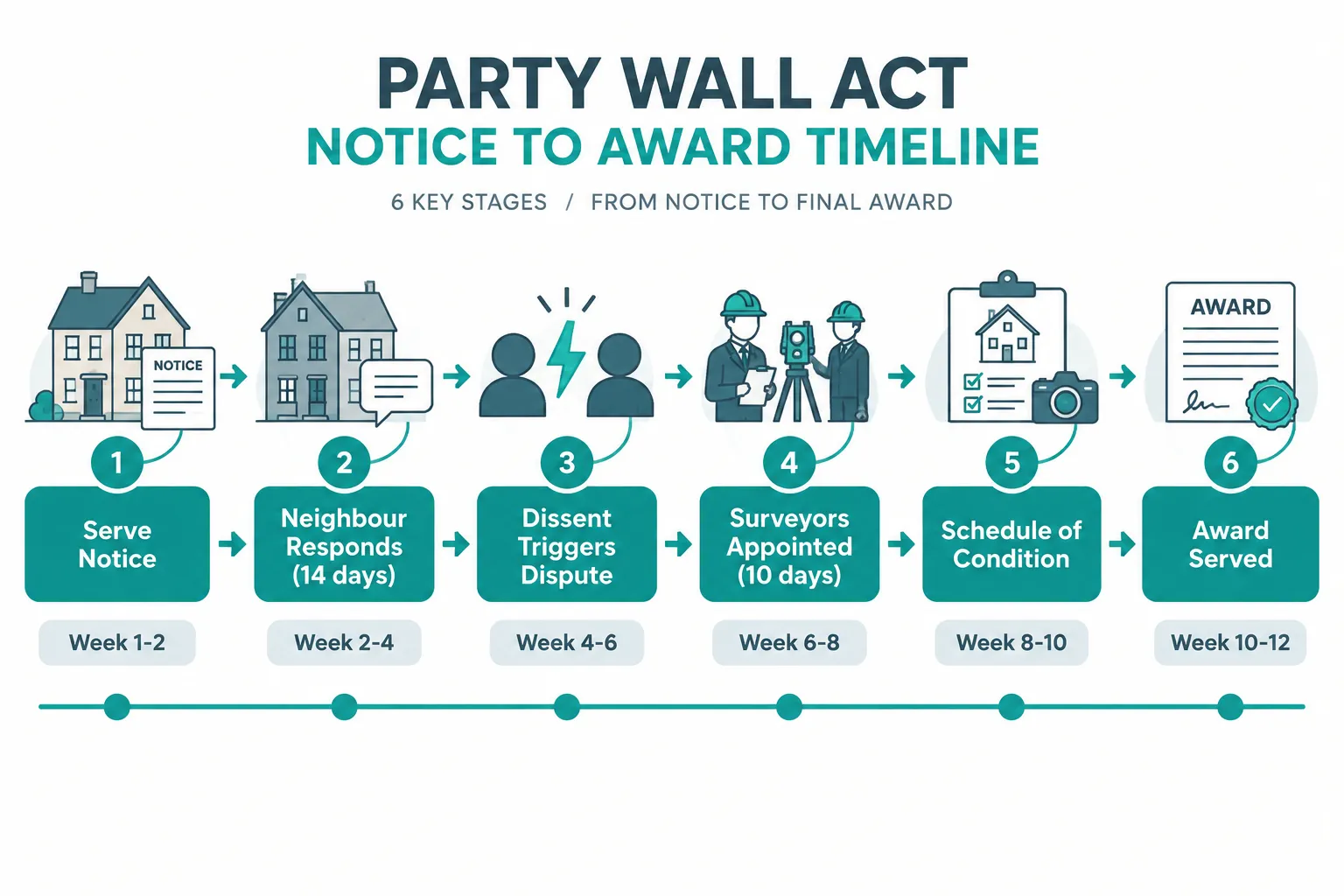
The process has three core components that run in sequence:
- The notice, a formal written document served on the adjoining owner before work begins
- The response period, the window in which the neighbour agrees or dissents
- The award, a legally binding document produced by appointed surveyors that sets out how work will proceed
For a full overview of how these components interact, the Party Wall service page at Canterbury Surveyors provides a useful starting reference. Understanding each stage is essential to planning realistic project timelines.
What Triggers the Formal Process?
The formal dispute process is triggered in one of three ways [8]:
- The adjoining owner expressly dissents to the notice
- The adjoining owner fails to respond within 14 days of service
- The adjoining owner agrees in principle but cannot agree on the terms
In all three cases, surveyors are appointed and the process moves toward a formal award. Consent, where the neighbour signs and returns the notice agreeing to the work, is the only route that avoids the full formal process.
The Party Wall Act Timeline: How Long Does the Process Take from Notice to Award? A Stage-by-Stage Breakdown
The timeline is best understood by working through each statutory stage and attaching realistic durations to each one.
Stage 1: Serving the Notice (Week 1)
The process begins when the building owner serves a party wall notice on the adjoining owner. The notice must be in writing and must describe the proposed work clearly [8].
Notice periods by work type:
| Type of Work | Statutory Notice Period |
|---|---|
| Works to the party wall itself (Section 2) | 2 months |
| New building on or at the boundary (Section 1) | 1 month |
| Excavation near a neighbouring structure (Section 6) | 1 month |
These periods are non-negotiable. Work cannot begin until the notice period has expired, regardless of whether the neighbour has responded [1]. Serving the notice on Day 1 of the project planning phase is therefore critical.
Stage 2: The Neighbour’s Response Window (Weeks 1-2 After Service)
Once served, the adjoining owner has 14 days to respond [5]. The possible outcomes are:
- Consent in writing, no further process required; work can proceed after the notice period expires
- Dissent, triggers the formal dispute resolution process
- No response, legally treated as dissent after 14 days [8]
It is worth noting that silence is not neutral under the Act. A neighbour who does nothing within 14 days is automatically deemed to have dissented, which is a common source of confusion for first-time building owners [4].
Stage 3: Surveyor Appointment (Within 10 Days of Dissent)
Once dissent is triggered, both parties must appoint surveyors within 10 days [5]. There are two appointment routes:
- Agreed surveyor, a single surveyor agreed upon by both parties (faster and cheaper)
- Two surveyors, each party appoints their own, and those two may appoint a third surveyor if they cannot agree [6]
The 10-day window for appointment is a statutory benchmark, not a hard deadline with automatic consequences, but delays here directly extend the overall timeline. Choosing a qualified professional is important, see guidance on selecting RICS-listed party wall specialists for 2026 disputes to understand what to look for.
Stage 4: Schedule of Condition (Weeks 2-4)
Before the award is drafted, the appointed surveyor or surveyors will typically carry out a schedule of condition, a detailed photographic and written record of the adjoining property’s current state [2]. This protects both parties: it establishes a baseline against which any damage claims can be assessed after work is complete.
The schedule of condition is not always a separate formal document, but on most domestic projects it is completed before the award is finalised. It typically takes 1 to 2 weeks depending on access availability and the complexity of the property.
Stage 5: Drafting and Serving the Award (Weeks 3-6 After Appointment)
The award itself is a formal document that sets out [3]:
- The nature of the proposed works
- How and when the work will be carried out
- Any protective measures required
- The surveyor’s fees and who pays them
- Rights of access for inspection
On straightforward domestic projects, the award is typically served 2 to 6 weeks after surveyor appointment [9]. Combined with the schedule of condition, the total time from dissent to award commonly runs 3 to 6 weeks.
“On a simple loft conversion or rear extension, the award process from surveyor appointment to service of the award document typically takes between three and five weeks when both parties cooperate with access requests.”
Realistic End-to-End Timelines: What to Expect in 2026
The total Party Wall Act timeline from first notice to award depends heavily on the type of work, the neighbour’s response, and the complexity of the project. The table below summarises the most common scenarios.
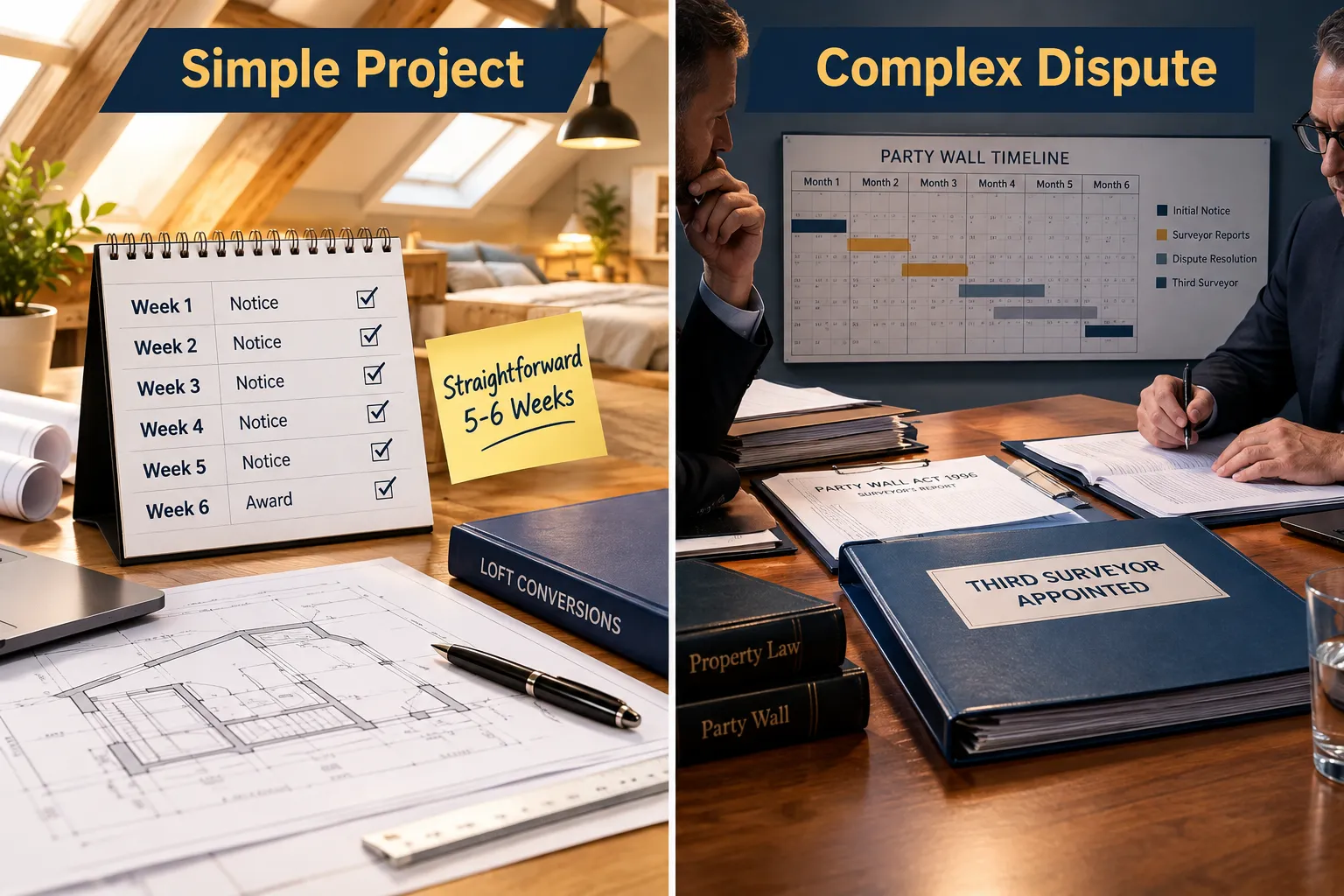
| Scenario | Notice Period | Award Process | Total Timeline |
|---|---|---|---|
| Neighbour consents (simple extension) | 1-2 months | None required | 4-8 weeks |
| Dissent, agreed surveyor, simple works | 1-2 months | 3-5 weeks | 6-10 weeks |
| Loft conversion, two surveyors appointed | 2 months | 4-6 weeks | 10-14 weeks |
| Contentious dispute, third surveyor required | 1-2 months | 8-20 weeks | 3-6 months+ |
Practical Example: Loft Conversion
A loft conversion involving work to a party wall (such as cutting in steel beams) typically requires a 2-month notice period under Section 2. If the neighbour dissents:
- Week 1: Notice served
- Weeks 1-2: 14-day response window expires; dissent triggered
- Weeks 2-3: Surveyors appointed
- Weeks 3-5: Schedule of condition completed
- Weeks 5-7: Award drafted, reviewed, and served
- Week 9 onwards: Work can begin (notice period has now expired)
Total: approximately 8 to 10 weeks from notice to award, with work starting after the 2-month notice period has run [5].
For more detail on managing timelines specifically for loft conversions and extensions, the guide on party wall notices for 2026 residential extensions and loft conversions covers current market conditions and practical strategies.
Practical Example: Rear Extension (Excavation)
A rear extension involving excavations within 3 metres of a neighbouring structure requires a 1-month notice under Section 6. If the neighbour consents:
- Week 1: Notice served
- Week 2: Neighbour signs and returns consent
- Week 4-5: Notice period expires; work can begin
Total: approximately 4 to 5 weeks. No award is required when consent is given in writing [7].
What Causes Delays?
Several factors commonly extend the Party Wall Act timeline beyond the typical 6 to 10 week window:
- Access disputes, if the adjoining owner restricts access for the schedule of condition, the process stalls
- Surveyor availability, high demand periods in 2026, particularly in areas with elevated construction activity, can delay appointment [10]
- Disagreement between surveyors, if two appointed surveyors cannot agree, a third surveyor must be appointed, adding weeks to the process [6]
- Incomplete or defective notices, a notice that does not comply with the Act’s requirements may need to be re-served, restarting the clock [1]
- Legal challenges, in rare cases, parties appeal the award to the County Court, which can extend the timeline by months
After the Award: Post-Works Inspection and Final Steps
The party wall process does not end when the award is served. Most awards include a provision for a post-works inspection, where the surveyor returns after the building work is complete to compare the current condition of the adjoining property against the schedule of condition [2].
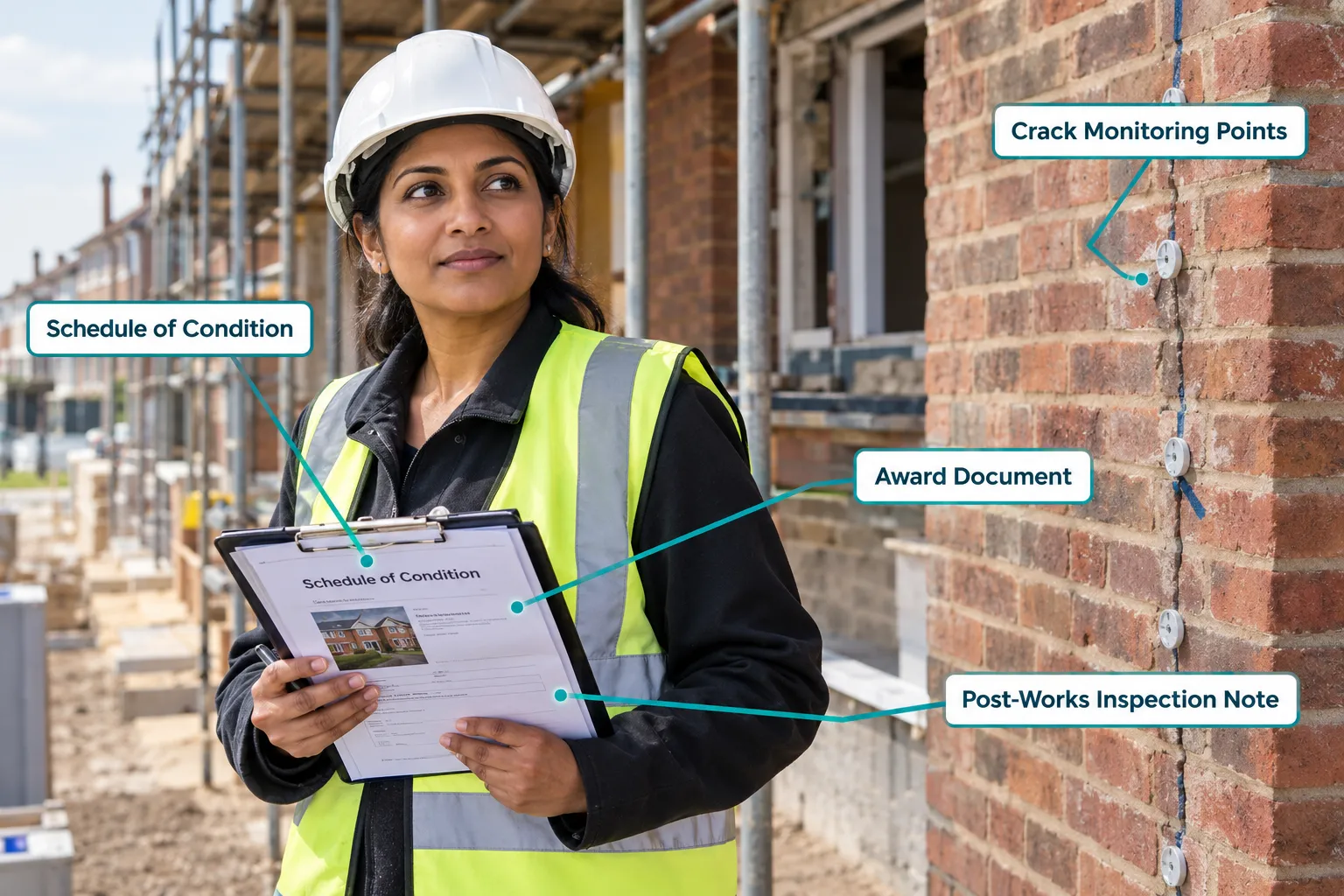
If damage has occurred, the award provides the framework for resolving compensation claims. Understanding how surveyors approach this stage is important, the article on how party wall surveyors calculate compensation and security for expenses on domestic UK projects explains the methodology in detail.
The post-works inspection is typically completed within 2 to 4 weeks of the building work finishing, though this depends on the surveyor’s availability and whether any damage claims are disputed.
What Happens If No Party Wall Agreement Is in Place?
Starting work without a valid party wall agreement or award in place is a serious risk. The adjoining owner can seek an injunction to stop the works, and the building owner may be liable for any damage caused without the protection of a formal award [8]. For a detailed look at the consequences, the guide on what happens with no party wall agreement sets out the legal and practical implications.
Common Questions About the Party Wall Act Timeline
Can the notice period be shortened? No. The statutory notice periods are set by the Act and cannot be waived or shortened, even if both parties agree. The only flexibility is in when the notice is served, serving it early in the project planning phase is the most effective way to avoid delays [8].
Does the award expire? Yes. A party wall award is typically valid for 12 months from the date it is served. If work has not started within that period, a new notice may need to be served [4].
Can work begin before the award is served? No. Work that requires a party wall award cannot legally begin until the award has been served, even if the notice period has expired [5]. This is a common planning mistake that causes significant project delays.
Who pays the surveyor’s fees? In most cases, the building owner (the party carrying out the work) pays the fees for both surveyors [6]. The award itself will specify the fee arrangements. For a breakdown of typical costs, the party wall cost guide provides current fee ranges.
Planning Your Project Around the Party Wall Act Timeline in 2026
The 2026 construction environment, characterised by elevated activity in many regions, makes early engagement with the party wall process more important than ever. Surveyors in high-demand areas are reporting longer lead times for appointments, which can add weeks to an already tight schedule [10].
The practical consensus for 2026 project planning is to:
- Serve notice at least 3 months before the planned start date on any project requiring a 2-month notice period, to allow time for the award process
- Engage a qualified surveyor early, ideally before serving the notice, to ensure the notice is correctly drafted and the process is managed efficiently
- Build contingency into the programme, a minimum of 2 additional weeks beyond the expected award date is a reasonable buffer for most domestic projects
- Do not assume consent, even a neighbour who has verbally agreed to the works must provide written consent for the party wall process to be satisfied
For projects in areas with high construction volumes, the resources on party wall surveys for Northern England’s 2026 construction uptick and party wall surveys for Scotland’s 2026 residential uptick provide region-specific guidance on managing compliance as development activity accelerates.
Conclusion
The Party Wall Act timeline from notice to award is not a single fixed duration, it is a sequence of statutory stages, each with its own timeframe, that adds up to a realistic planning window of 6 to 10 weeks for most domestic projects. Complex or contentious cases can run to 3 to 6 months or more.
Actionable next steps for building owners in 2026:
- Identify whether your proposed work triggers the Act before engaging contractors or setting a start date
- Serve notice as early as possible, the statutory clock cannot be shortened, but it can be started sooner
- Appoint a qualified, RICS-registered party wall surveyor to manage the process and reduce the risk of procedural errors
- Plan for the post-works inspection as part of the overall project close-out, not an afterthought
- If a neighbour dissents, treat it as a normal part of the process rather than a conflict, the award framework exists to protect both parties
The party wall process, managed well, adds predictability to a project rather than uncertainty. The key is understanding the timeline in advance and building it into the project programme from day one.
References
[1] Difference Between Party Wall Notices And Awards – partywallslimited.com
[2] Party Wall Award – partywallsurveyorlondon.uk
[3] Party Wall Awards London – houricanassociates.com
[4] Party Wall Common Questions – hsa-surveyors.com
[5] Step By Step Party Wall Process From Notice Service To Award Finalization In 2026 Projects – partywallsurveyorlondon.uk
[6] Party Wall Awards The Complete Guide England Wales – simplesurvey.co.uk
[7] Party Wall Agreement Explained – theextensioncompany.co.uk
[8] The Party Wall Etc Act 1996 Explanatory Booklet – gov.uk
[9] Fast Party Wall Award – collier-stevens.co.uk
[10] Process – ukpartywall.co.uk
Related services from Canterbury Surveyors
- Party wall surveyors in Canterbury & Kent
- Boundary surveys
- Building expert witness surveyors
- New-build snagging surveys
Get a fixed-fee quote or call 0204 579 8270.