
Canterbury & Kent
North and West: Why ‘North West’ Facing UK Properties Need Extra Survey Attention
Moss colonies on a garden wall, persistent damp patches on an internal corner, and a heating bill that never quite matches the neighbours’, these are not random misfortunes. They are often the predictable consequences of a property’s orientation. North and West: Why ‘North West’ Facing UK Properties Need Extra Survey Attention is not a niche technical concern; it sits at the intersection of climate science, building pathology, and hard financial risk for buyers across the UK. Understanding what surveyors look for, and why, can be the difference between a sound purchase and an expensive remediation project.
Key Takeaways
- North-facing walls are consistently colder than other elevations, making them the most vulnerable surfaces for condensation, mould, and damp staining.
- West and north-west facing elevations receive the heaviest loading from the UK’s prevailing south-westerly wind-driven rain, accelerating weathering of masonry, pointing, and render.
- Combined north-west orientation creates a dual-exposure problem: cold surfaces that are also regularly saturated, a combination that amplifies decay and moisture ingress.
- A standard Level 2 HomeBuyer Survey may not capture the full depth of defects in a north-west facing property; a Level 3 Building Survey is frequently more appropriate.
- Surveyors inspecting these orientations should prioritise gutters, downpipes, pointing, render, roof coverings, and internal damp readings as a minimum.
Why Orientation Matters More Than Most Buyers Realise
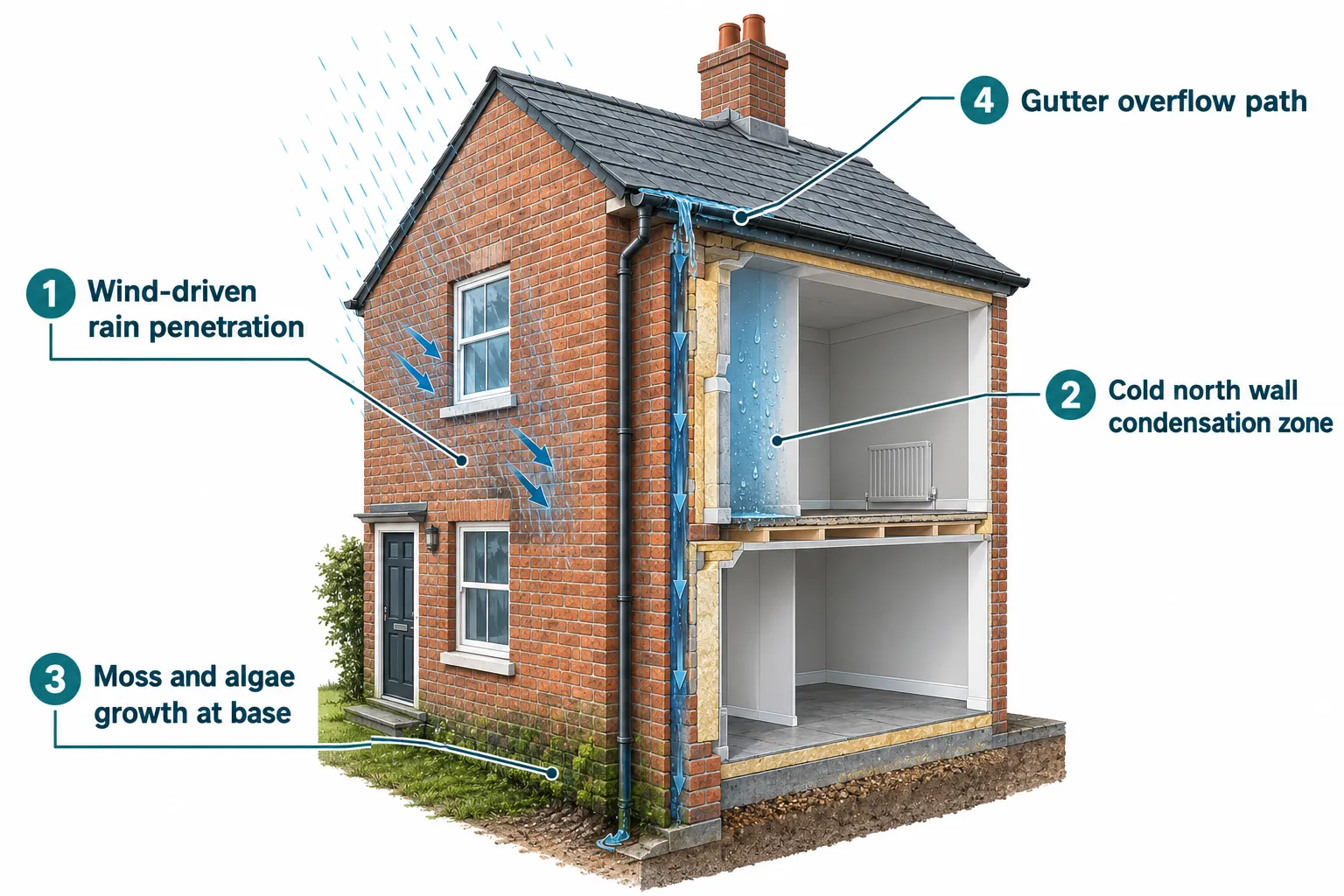
Most buyers focus on whether a garden faces south. Fewer think carefully about what the front or side elevations face, and almost none consider the compound effect of a combined north and west exposure. Yet orientation is one of the most reliable predictors of long-term maintenance costs in UK residential property.
The UK’s climate is defined by its Atlantic influence. Rainfall arrives predominantly from the south-west, carried on persistent westerly winds. Chartered surveyor Neil Marsden has documented this clearly in case work: the prevailing wind-driven rain in the UK generally arrives from a south-westerly direction, with south and west elevations showing clear evidence of rainwater penetration even when the fabric is fundamentally sound [6]. When a property’s principal exposed face is oriented to the north-west, it sits in the path of this rain-bearing airflow while simultaneously losing heat faster than south or east-facing walls.
Research published in a peer-reviewed building science journal confirms that orientation and wind direction are the primary controls on rain deposition rates across different facades, forming the basis for climate-based exposure assessment in the UK [3]. Building science guidance on driving rain prediction reinforces this, showing that wind-driven rain loads vary substantially by compass direction and that north-west and west-facing elevations in Atlantic-influenced climates carry the highest cumulative moisture loads [9].
The north-west combination is therefore not simply additive, it is synergistic. A north-facing wall is cold and slow to dry. A west-facing wall is regularly wetted by wind-driven rain. A north-west facing wall is both, simultaneously.
“Damp on external walls almost always has an external cause. Surveyors must inspect gutters, downpipes, pointing, render condition and ground levels before specifying any internal remedial work.”, Kenwood plc, 2026 damp guidance [11]
The Science Behind Cold Walls, Condensation, and Damp
North-facing walls receive little or no direct solar radiation throughout the year. In the UK, where the sun tracks a southern arc even in summer, the north elevation of a building is perpetually in shade. This has two important consequences for surveyors.
First, the surface temperature of north-facing walls is consistently lower than that of south or east-facing walls. When warm, moisture-laden indoor air contacts a cold surface, it reaches its dew point and condensation forms. Recent damp guidance from Kenwood (2026) confirms that condensation is “particularly common on north-facing internal walls” because their surface temperatures are consistently lower than the rest of the room, increasing the risk of mould and visible damp staining [11]. This is not a problem confined to poorly insulated Victorian terraces; it affects modern properties with inadequate vapour control as readily as older stock [2].
Second, because north-facing walls receive no solar drying, any moisture that enters, whether from condensation, rain penetration, or rising damp, takes far longer to dissipate. The Core Conservation technical literature on wind-driven rain in Britain describes how UK rain “arrives too often” for traditional walls to dry fully between storms, making wind-driven rain an ongoing challenge for older masonry [12]. On a north-facing wall, this drying deficit is compounded by the absence of solar heat gain.
What Surveyors Should Look For on North-Facing Elevations
- Mould and algae growth on the external face, particularly at lower levels and around window reveals
- Efflorescence (white salt deposits) indicating moisture movement through masonry
- Damp staining on internal plaster, especially in corners and at floor-wall junctions
- Cold bridging at structural elements where insulation is absent or compromised
- Condensation damage to window frames, sills, and adjacent joinery
For buyers considering older properties, a defect diagnosis in older properties building pathology essentials for pre-offer surveys approach is strongly recommended before exchange.
West-Facing Exposure: Wind-Driven Rain and Weathering Acceleration
While the north elevation creates cold-surface damp problems, the west elevation introduces a different but equally serious risk: sustained mechanical weathering from wind-driven rain. The UK’s Atlantic climate means that west-facing facades are subjected to the highest cumulative rain loads of any orientation [3][9].
Wind-driven rain does not behave like vertical rainfall. It strikes facades at an angle, forcing water into gaps that would otherwise remain dry. Mortar joints, hairline cracks in render, poorly sealed window frames, and deteriorating pointing all become entry points under wind pressure. A south-west or west-facing elevation that appears superficially sound in dry conditions may show active penetration during or after a sustained Atlantic weather system.
The Checkatrade guidance on north-west facing gardens notes that moss “often appears in a north-westerly facing garden as it loves the damp and cold” [5]. The same biological logic applies to external masonry: moss, lichen, and algae colonise surfaces that remain persistently damp, and their presence on a west or north-west facing wall is a reliable indicator of sustained moisture retention rather than temporary surface wetting.
Key Defects Associated with West-Facing Elevations
| Defect Category | Specific Risk | Survey Priority |
|---|---|---|
| Pointing deterioration | Wind-driven rain forces water into open joints | High |
| Render cracking | Moisture ingress behind render face | High |
| Window and door reveals | Sealant failure under wind pressure | Medium-High |
| Roof verges and flashings | Rain driven under tiles at exposed edges | High |
| Gutter and downpipe condition | Overflow saturates wall base | High |
Kenwood’s 2026 guidance stresses that damp on external walls almost always has an external cause, and that surveyors must inspect gutters, downpipes, pointing, render condition, and ground levels before specifying any internal remedial work [11]. On a west-facing elevation, this external inspection is not optional, it is the foundation of any credible assessment.
For properties in areas with high construction activity, party wall surveys for rapid build-out in high-growth northern markets may also be relevant where adjacent works could affect exposed elevations.
The Compound Problem: When North Meets West
The combination of north and west exposure in a single property creates what building pathologists describe as a dual-exposure problem. The north elevation suffers from chronic cold and slow drying; the west elevation suffers from repeated wetting under wind pressure. A property with a north-west facing principal elevation, or with significant north and west exposed surfaces, faces both problems simultaneously.
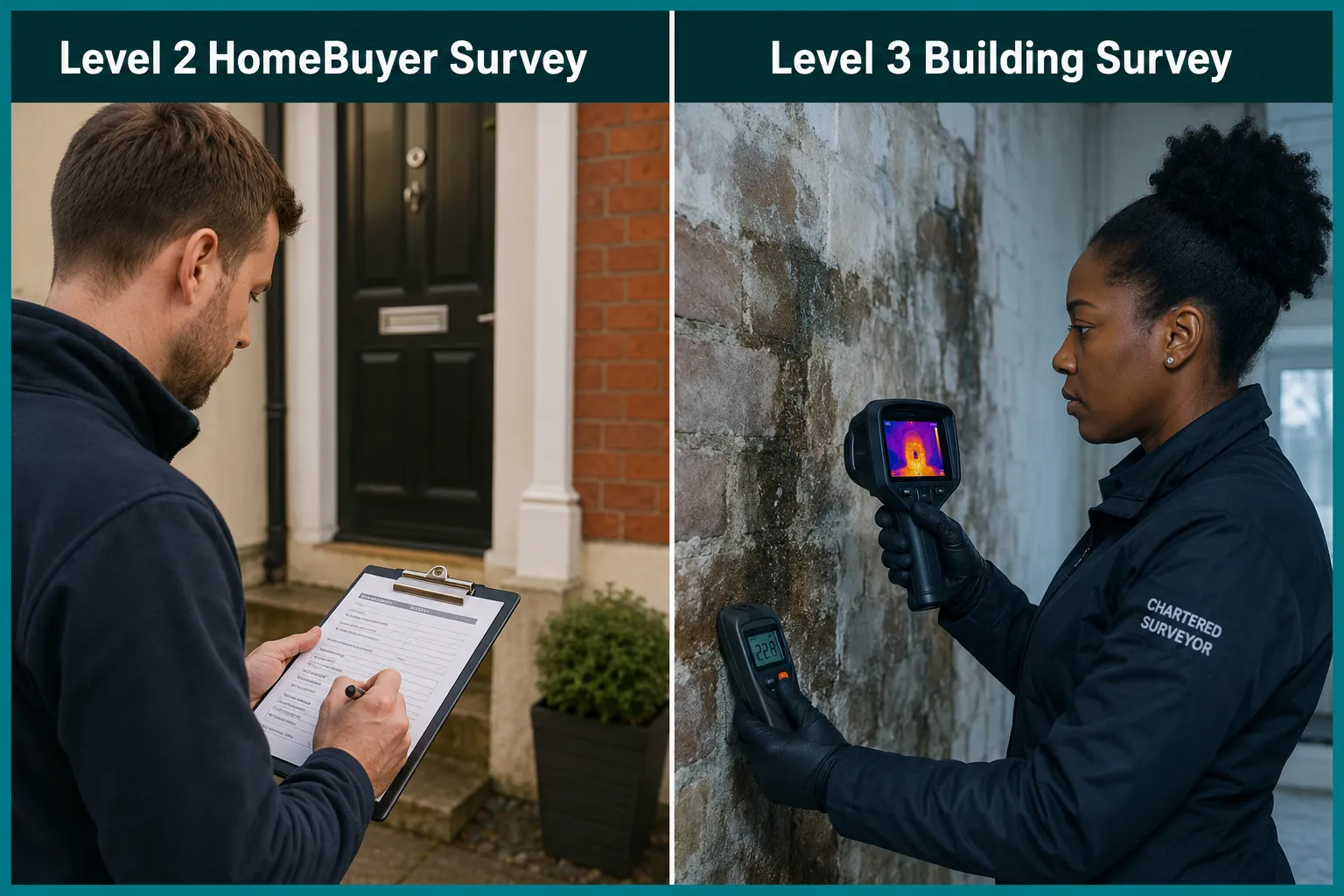
This matters for survey strategy. A surveyor inspecting a south-east facing property in good condition may reasonably conclude that a Level 2 HomeBuyer Survey is proportionate. The same surveyor, facing a north-west oriented Victorian terrace with original pointing and no cavity wall insulation, should be recommending a Level 3 Building Survey as the minimum appropriate scope. Understanding the difference between Level 2 and Level 3 survey is therefore directly relevant to orientation-based risk assessment.
A May 2025 blog from North West Damp Proofing makes the point plainly: warm weather does not mean homes are free from damp, and detailed damp and mould surveys are needed to detect hidden moisture and structural issues before they evolve into costly repairs [8]. In a north-west facing property, this hidden moisture risk is elevated year-round, not only in winter.
Garden Orientation and Property Value
It is worth noting that buyers often conflate the direction a garden faces with the direction the house faces. These are opposite. A property with a north-west facing rear garden has a south-east facing rear elevation, the most desirable thermal orientation for a UK home [1][7]. However, a property with a south-east facing rear garden has a north-west facing rear elevation, meaning the main living spaces at the back of the house face the coldest, wettest direction.
Houzz community discussions on north-west facing rear gardens reflect genuine buyer uncertainty about this trade-off [4]. The surveyor’s role is to translate that uncertainty into specific, quantified defect risk.
What a Thorough Survey of a North-West Facing Property Should Cover
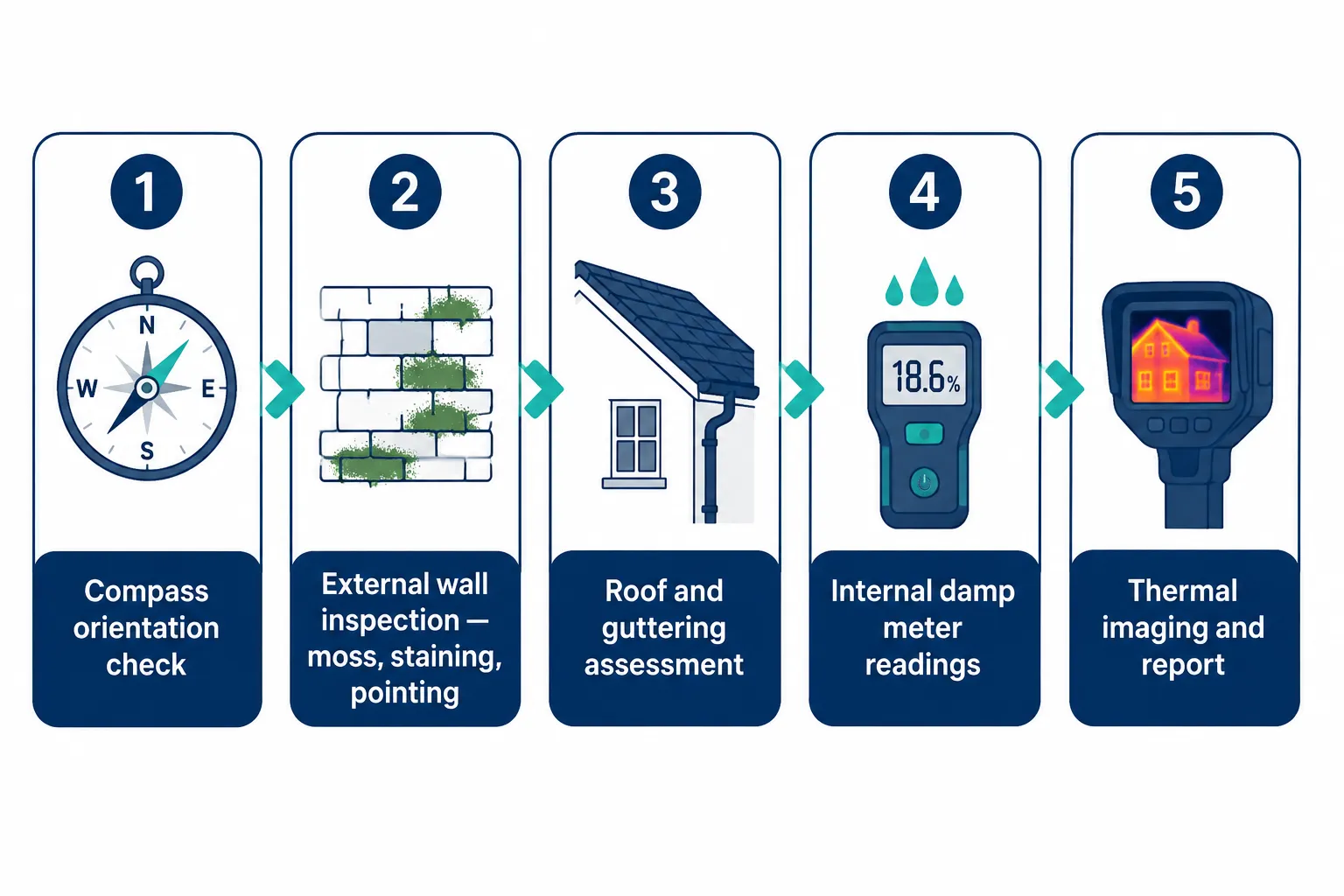
Given the elevated risk profile of north and west facing UK properties, a comprehensive survey should go beyond the standard visual inspection. The following areas warrant specific, detailed attention.
External Inspection Priorities
Roof and guttering: Blocked or overflowing gutters are among the most common causes of damp on north-facing walls, because water cascades down the cold face and is absorbed rather than evaporating. Roof surveys should assess tile condition, verge details, flashings, and all rainwater goods on the north and west elevations specifically.
Masonry and pointing: Open joints on a west-facing wall allow wind-driven rain direct access to the wall core. Repointing costs can be substantial on a full terrace elevation, and the surveyor should quantify the extent of deterioration rather than simply noting its presence.
Render condition: Render that has debonded or cracked on a west-facing elevation is not a cosmetic issue. It traps moisture behind the face, accelerating decay of the substrate and potentially causing frost damage in winter.
Ground levels and drainage: High ground levels against north or west-facing walls can direct surface water towards the building rather than away from it. A drainage survey may be warranted where ground drainage appears inadequate.
Internal Inspection Priorities
Damp meter readings: All internal surfaces adjacent to north and west-facing external walls should be tested with a calibrated moisture meter. Readings should be taken at multiple heights, not just at skirting level.
Thermal imaging: Where available, thermal imaging identifies cold bridges, areas of missing insulation, and moisture-affected zones that are invisible to the naked eye. This is particularly valuable on north-facing walls where condensation risk is highest.
Salt analysis of plaster: Where rising damp is suspected, Kenwood’s 2026 guidance confirms that it should be confirmed by full damp surveys including salt analysis of plaster samples, with external causes ruled out first [11]. A damp survey by a qualified specialist is the appropriate next step where the building surveyor identifies elevated moisture readings.
Floor slabs: Ground-floor slabs adjacent to north-facing walls are at elevated risk of moisture ingress, particularly in older properties without a damp-proof membrane. A solid floor slab survey may be appropriate where the surveyor suspects sub-slab moisture.
Choosing the Right Survey Level
For most north-west facing UK properties, particularly those built before 1980 or with any visible signs of damp, weathering, or deferred maintenance, a Level 3 Building Survey is the appropriate choice. The RICS Home Survey at Level 2 may be adequate for newer, well-maintained properties, but buyers should discuss orientation-specific risks with their surveyor before selecting a survey type.
For properties in North West London specifically, chartered surveyors in North West London with local knowledge of the area’s predominant building types and exposure conditions are well-placed to advise on the appropriate survey scope.
EPC Ratings, Thermal Performance, and the North-West Factor
Energy performance is increasingly central to property value and mortgage eligibility in 2026. North and west-facing properties face a structural disadvantage in EPC assessments: reduced solar gain, higher heating demand, and greater risk of condensation-related damage to insulation systems all contribute to lower ratings.
Buyers planning retrofit works, cavity wall insulation, external wall insulation, or internal dry-lining, should be aware that the north and west elevations are the most technically challenging to treat. Poorly installed insulation on a cold, wet north-facing wall can shift the dew point into the wall structure, creating interstitial condensation and accelerating decay. A building survey for EPC retrofits in 2026 should assess the existing wall construction in detail before any retrofit specification is finalised.
Conclusion: Actionable Steps for Buyers and Surveyors
North and West: Why ‘North West’ Facing UK Properties Need Extra Survey Attention is ultimately a question of informed risk management. The science is clear: north-facing walls are cold, slow to dry, and prone to condensation; west-facing walls are repeatedly wetted by wind-driven rain; and properties that combine both orientations face an elevated and compounding defect risk that standard visual inspections can easily underestimate.
For buyers, the following steps are recommended before exchange:
- Establish the precise orientation of all principal elevations using a compass reading taken from inside the property facing the main window [13].
- Commission a Level 3 Building Survey for any north-west facing property, particularly those built before 1980.
- Ensure the surveyor specifically addresses damp meter readings, pointing condition, render integrity, and guttering on the north and west elevations.
- Budget for a specialist damp survey if the building surveyor identifies elevated moisture readings, rather than accepting a contractor’s remedial quote without independent diagnosis.
- Factor orientation-related maintenance costs into the purchase price negotiation, using the survey report as the evidential basis.
For surveyors, north-west facing properties demand a more systematic approach than the default inspection protocol. Orientation should be recorded at the outset, and the inspection methodology should be explicitly adjusted to reflect the elevated exposure risk on cold and wind-driven rain-facing elevations.
The cost of a thorough survey is modest relative to the cost of discovering significant damp, masonry decay, or insulation failure after completion. In a north-west facing UK property, that survey investment is not a precaution, it is a necessity.
References
[1] Does It Matter Which Way You House Faces – eleanorcharleshomes.co.uk [2] Why Are So Many Homes In The Uk Cold And Damp – reddit.com [3] S0167610518302290 – sciencedirect.com [4] North West Facing Rear Garden Should We Buy The Property – houzz.co.uk [5] North West Facing Garden – checkatrade.com [6] Penetrating Damp Southwest Facing Elevation – neil-marsden.co.uk [7] What Is The Best Facing Garden For Sun In Uk – countytownhomes.co.uk [8] Why Warm Weather Doesnt Mean Your Home Is Free From Damp – northwestdampproofing.co.uk [9] Bsd 148 Wufi Simplified Driving Rain Prediction – buildingscience.com [10] What Look When Buying A House – localsurveyorsdirect.co.uk
Related services from Canterbury Surveyors
- Party wall surveyors in Canterbury & Kent
- RICS Homebuyer Surveys (Level 2)
- Building Surveys (Level 3)
- Structural engineers in Canterbury & Kent
Get a fixed-fee quote or call 0204 579 8270.