
Canterbury & Kent
Address Accuracy in UK Survey Reports: How Wrong Details Can Derail Valuations, Party Wall Awards and Legal Compliance
A single transposed digit in a postcode has voided a party wall notice. A mismatched property name has caused a mortgage valuation to reference the wrong comparable sale. These are not theoretical risks, they are the kind of errors that cost clients money, expose surveyors to negligence claims, and unravel months of legal work. Address accuracy in UK survey reports sits at the intersection of professional standards, statutory compliance, and financial reliability, yet it is routinely treated as administrative detail rather than a substantive risk.
This article examines how surveyors should verify addresses, title plans and boundary references, what the legal and financial consequences of getting them wrong look like in practice, and how emerging data standards, including HM Land Registry’s 2026 move to attach Unique Property Reference Numbers (UPRNs) to Price Paid Data, are reshaping the landscape of address-based risk management.
Key Takeaways
- An incorrect address in a survey report can void a party wall notice, invalidate a valuation, or trigger a professional negligence claim.
- RICS requires surveyors to include the full property address in every valuation report as a basic professional standard.
- HM Land Registry is integrating UPRNs into its Price Paid Data from August 2026 to reduce mis-identification errors in comparables.
- Ordnance Survey’s AddressBase Premium is the authoritative address dataset underpinning UK land registration and valuation data.
- Surveyors must cross-check addresses against title registers and authoritative datasets rather than relying solely on client-supplied details or derived data tools.
Why Address Accuracy in UK Survey Reports Matters More Than Most Surveyors Realise
The professional obligation to record accurate addresses is not simply a matter of good housekeeping. The RICS Valuation Report Framework 2025 explicitly requires that reports include the “full address” of the property being valued [3]. This embeds address accuracy as a formal professional standard, not an optional courtesy. When a surveyor fails to meet this standard, the consequences can cascade across multiple parties and processes.
Three core risk categories emerge when addresses are wrong:
- Valuation risk, Comparable sales data is matched to properties by address. If the address in a report does not align with the registered address, automated matching tools may pull comparables from the wrong property or a neighbouring one, distorting the valuation figure.
- Legal notice risk, Statutory notices, including party wall notices, must be served at a correct and identifiable address. An error can render the notice invalid.
- Compliance and registration risk, HM Land Registry’s “avoidable requisitions” dataset (June 2026) confirms that applications with missing or inconsistent address details still trigger requisitions and delay registrations [12]. Downstream, this can stall valuations dependent on clear title.
How Surveyors Should Verify Addresses
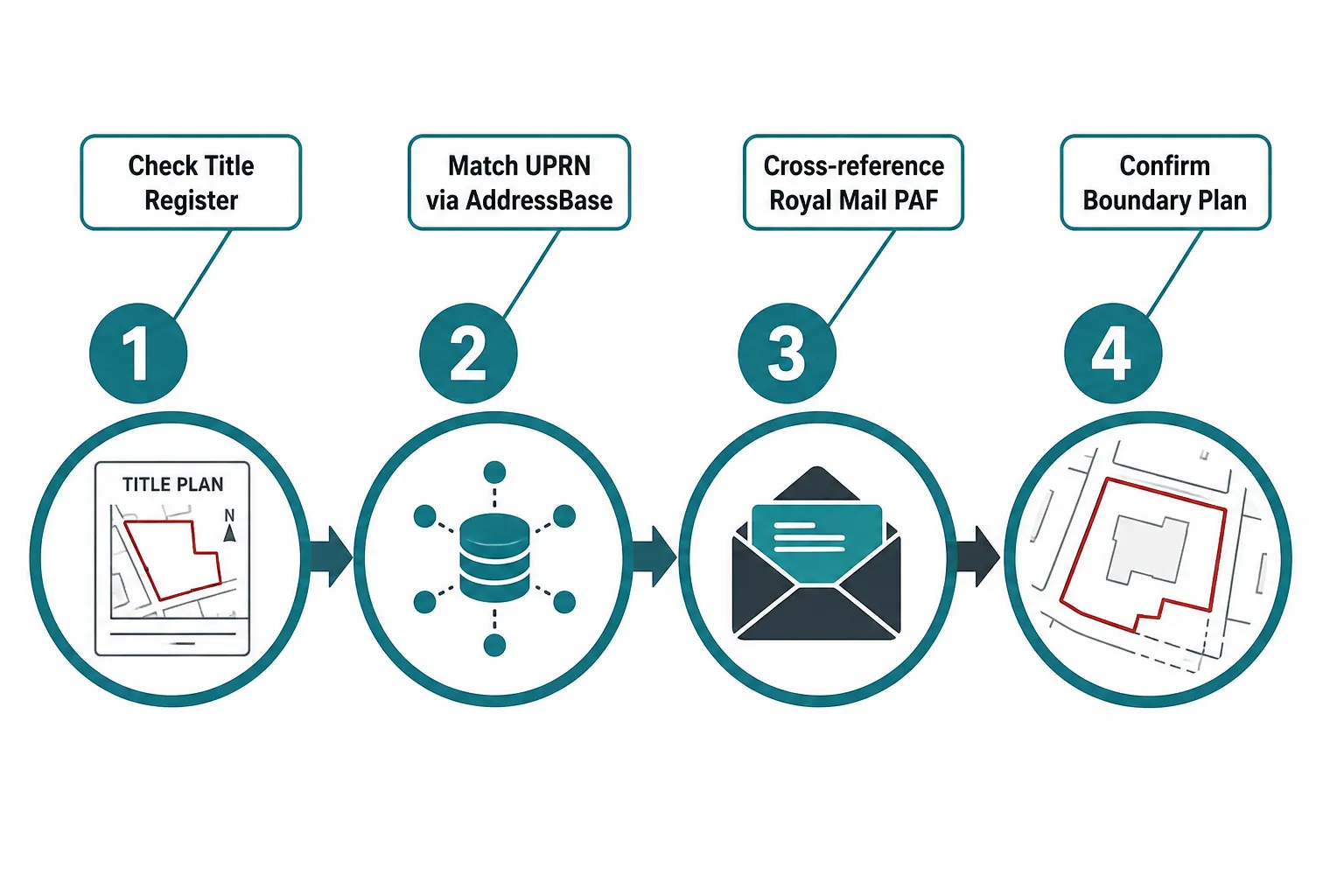
The verification process should be methodical and multi-source. Relying on a client’s instruction letter or an estate agent’s listing is insufficient. A robust address check involves:
- Confirming the title register entry at HM Land Registry, including the property description and any filed plan.
- Cross-referencing the Royal Mail Postcode Address File (PAF) to confirm the standard postal address format.
- Checking Ordnance Survey’s AddressBase Premium, which is described by the National Data Library as “a complete and authoritative dataset of addresses in England, Scotland and Wales,” updated daily and tracking an address’s lifecycle from pre-build to historical phases [7]. This is the same dataset HM Land Registry uses to validate addresses for its own records [2].
- Reviewing the title plan to confirm that the boundary shown matches the physical property being surveyed, not an adjacent or similarly named one.
For properties with non-standard addresses, converted buildings, rural properties with house names rather than numbers, or new developments where postal addresses have not yet been assigned, this verification step is especially critical.
“Unlike written addresses, UPRNs remain consistent even when address formats vary across systems.”, Propertymark, August 2026 [14]
The introduction of UPRNs into HM Land Registry’s Price Paid Data from 28 August 2026 is a direct response to the problems caused by inconsistent address formats and duplicate records [2][5]. A UPRN is a unique numerical identifier assigned to every addressable location in Great Britain. Because it does not change when a property is renamed, renumbered, or when its postal address format varies between systems, it provides a stable anchor for matching historic sale prices to the correct property [14]. This matters enormously for surveyors using comparable transaction data, because a mismatch between address formats in different systems has historically caused sale prices to be attributed to the wrong property.
However, the technical specification for this new dataset acknowledges a significant limitation: some transactions will not have a UPRN where the registered address cannot be matched to the Royal Mail Postcode Address File or lacks sufficient detail [2][5]. This means that address errors at the point of registration break the link between a legal title and its UPRN, increasing mis-identification risk in every downstream process that depends on automated address matching.
For surveyors preparing valuation reports in Canterbury or elsewhere, understanding this limitation is essential. Automated comparables tools that rely on UPRN matching will have blind spots wherever address data is incomplete or non-standard.
Address Accuracy in UK Survey Reports: The Party Wall Dimension
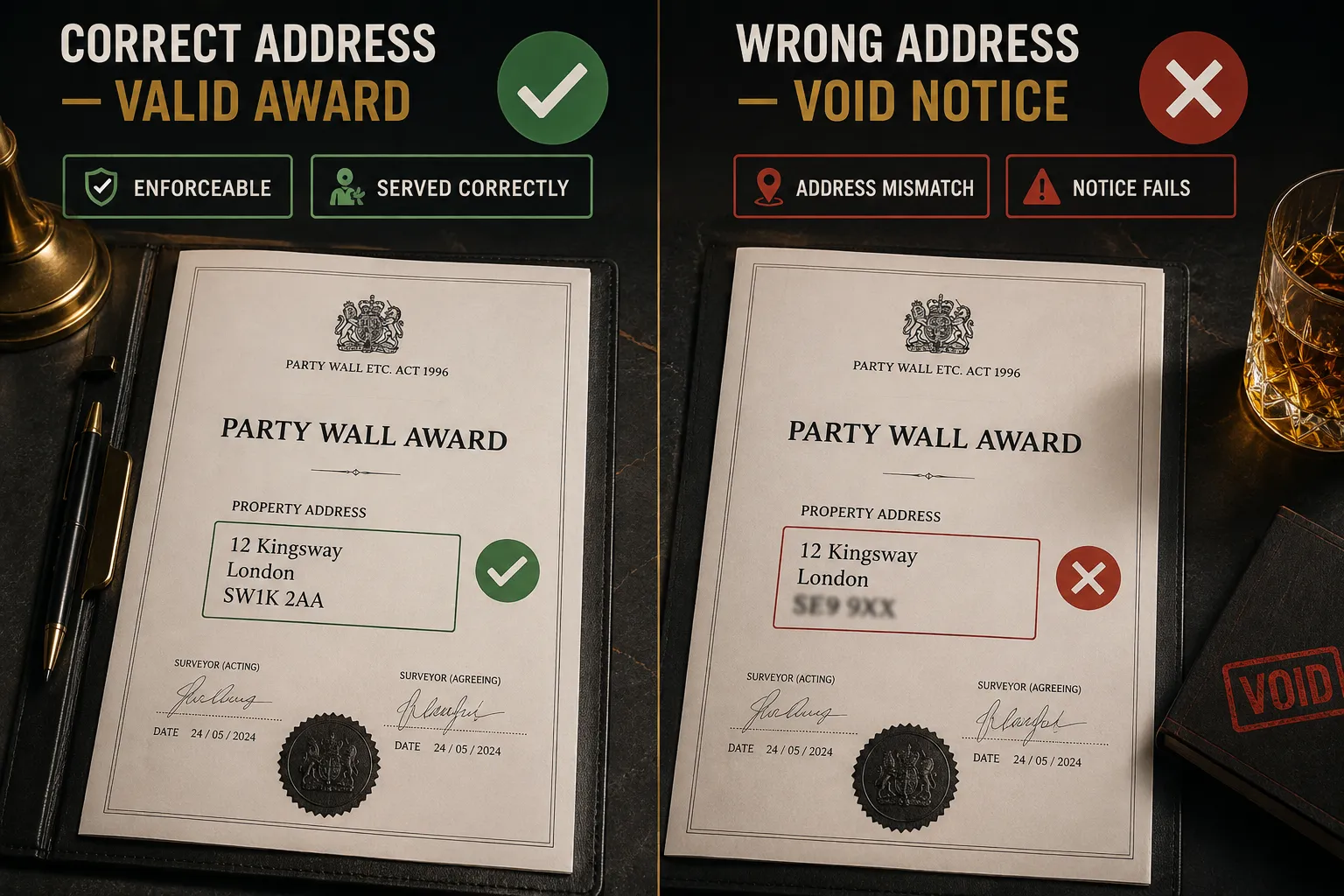
Party wall matters are where address errors carry some of the most immediate legal consequences. Under the Party Wall etc. Act 1996, notices must be served on adjoining owners at their correct address. HM Land Registry’s guidance on validating “addresses for service” confirms that the register will challenge any address that cannot be matched to its internal address data, and sets out specific requirements for UK addresses, overseas addresses, DX addresses, and email addresses [4]. While this guidance dates from 2017, its operational relevance is unchanged: an incorrectly served notice can be unenforceable.
Consider the practical scenario: a building owner serves a party wall notice using an address taken from an online property portal rather than the title register. The adjoining owner has since updated their registered address for service, but the portal data has not been refreshed. The notice is served at the old address. The adjoining owner claims non-receipt. The entire party wall process must restart, adding weeks or months to a project timeline and potentially exposing the building owner to claims if work has already commenced.
Common Address Errors in Party Wall Notices
| Error Type | Common Cause | Potential Consequence |
|---|---|---|
| Wrong postcode | Copied from listing rather than title register | Notice served at wrong property; invalid |
| Outdated address for service | Owner has updated register; portal not refreshed | Non-receipt claimed; process restarted |
| Flat number omitted | Multi-occupancy building; address truncated | Wrong unit identified; award unenforceable |
| House name vs. number | Property uses name; register shows number | Ambiguity over which property is subject |
| Typographical error | Manual data entry; no cross-check performed | Mismatch with register; requisition or dispute |
The HM Land Registry’s March 2026 blog on AI-assisted local land charges migration reported that a new AI tool has eliminated common typographical errors, such as confusing “O” with “0” or “I” with “1”, in migrated data [11]. This kind of error, trivial in appearance, can cause a property record to fail automated matching entirely, meaning a party wall surveyor checking the register might not find the correct title entry at all.
For those managing party wall disputes or preparing party wall notices for 2026 residential extensions and loft conversions, verifying the address against the current title register, not just the client’s instruction, is a non-negotiable step.
The schedule of condition attached to a party wall award faces the same risk. If the schedule references the wrong address, the document’s legal standing as evidence of pre-works condition is compromised. Should a dispute arise after works complete, a schedule that cannot be definitively linked to the correct property by address and title reference is of limited evidential value.
Address Accuracy in UK Survey Reports: Valuation, Expert Witness and Legal Compliance Risks
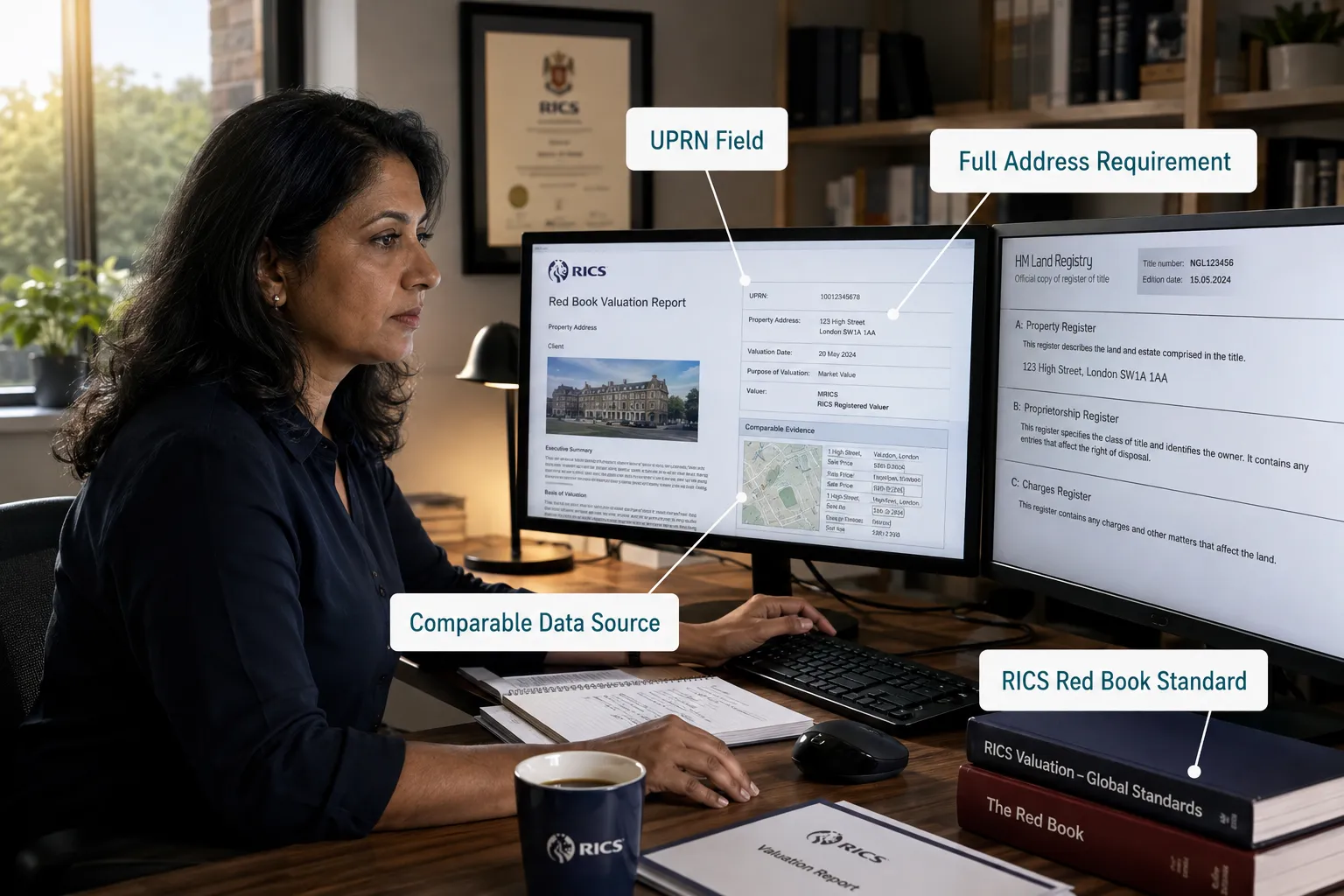
Beyond party wall matters, address errors create serious problems in formal valuations and expert witness reports. The RICS Valuation Report Framework 2025 is unambiguous: the full address is a required element of every valuation report [3]. This is not merely a formatting requirement. An address error in a formal valuation can mean that the report legally describes a different property from the one inspected, which has profound implications for mortgage lending, litigation, and tax compliance.
Valuations and Comparable Data
Surveyors preparing formal valuations rely on comparable transaction data. HM Land Registry’s House Price Index quality assurance targets a 98% Quality Key Performance Indicator for data accuracy [6]. While this is a high standard, it also means that a residual error rate exists in public datasets. The QA note explicitly acknowledges that any residual error can distort price comparables used in professional reports [6][13].
HM Land Registry’s own guidance confirms that while its internal processes aim to ensure data correctly reflects registration information, it does not guarantee that public datasets are free from errors or fit for every user’s purpose [13]. This caveat is significant. Surveyors and valuers who rely solely on derived commercial comparables tools, without cross-checking against official title registers and authoritative address datasets, carry the risk of acting on flawed data.
The integration of UPRNs into Price Paid Data from August 2026 will improve this situation materially, because it will allow more reliable matching of sale prices to specific properties [5][14]. However, as noted above, the system will not assign a UPRN where the registered address lacks sufficient detail [2][5]. Surveyors should not assume that the new system eliminates all address-matching risk.
For RICS Red Book valuations versus market appraisals, the distinction matters: a Red Book valuation carries formal professional liability, and an address error in that document is a direct exposure point for a negligence claim.
Expert Witness Reports
When a surveyor acts as an expert witness, the stakes for address accuracy are even higher. CPR Part 35 requires expert reports to identify clearly the subject of the expert’s opinion. An address error that creates ambiguity about which property has been assessed can undermine the admissibility or weight of the report. Courts have been clear that expert evidence must be precise and verifiable. A report that cannot be definitively linked to the correct property by address and title reference is vulnerable to challenge.
HM Land Registry’s 2026 Business Plan explicitly prioritises “the quality of new entries” and accurate, consistent completion of applications so that property rights remain “secure and trusted” [9]. This strategic commitment to data quality reinforces the professional expectation that practitioners, including surveyors acting as experts, will align their own records and reports to authoritative address standards.
Mortgage Lender Audits and Professional Negligence
Lenders conducting mortgage lender valuation audits will scrutinise whether the valuation report correctly identifies the security property. An address discrepancy between the valuation report and the mortgage offer documentation can trigger a requisition, delay completion, or in serious cases, prompt a professional negligence investigation.
The RICS guidance on accurate recording of building and site characteristics in residential work reinforces this point [8]. Mis-describing a property’s address or site details is not a minor clerical error, it can be characterised as a failure to exercise the standard of care expected of a competent surveyor.
Practical Standards and Emerging Data Infrastructure
HM Land Registry’s 2026 Business Plan and its 2025+ Strategy both commit to agreed data standards and high data integrity across the register [9]. The move to attach UPRNs to Price Paid Data is the most visible expression of this commitment, but it sits within a broader programme of quality improvement that includes the avoidable requisitions dataset and AI-assisted error correction in local land charges migration [9][11][12].
For surveyors, the practical implication is that the infrastructure supporting address accuracy is improving, but the professional obligation to verify addresses independently has not diminished. Ordnance Survey’s AddressBase Premium, updated every six weeks and tracking properties from pre-build to historical phases, is the authoritative source [7][2]. Surveyors should treat it as the baseline for any address verification, alongside the title register.
A practical address verification checklist for survey reports:
- Confirm the address against the current HM Land Registry title register entry.
- Check the address format against the Royal Mail Postcode Address File.
- Where available, note the UPRN for the property and include it in the report.
- Review the filed title plan to confirm the boundary matches the physical property.
- For party wall matters, confirm the address for service of all adjoining owners against their current registered title entries.
- For new developments or recently converted properties, verify that a postal address has been formally assigned and registered.
- Document the address sources used in the report, so that any discrepancy can be traced and corrected.
Revised RICS Property Measurement guidance in Q2 2026 reinforces a culture of explicit, precise reporting in survey documents [1][10]. The requirement to document the measurement basis used in a report, and to ensure it aligns with current standards, is directly analogous to the requirement to document address sources. Both reflect the same professional principle: that every material fact in a survey report must be traceable, verifiable, and current.
For building surveys and schedule of condition reports, the address and property identifier section of the report is the foundation on which every other finding rests. If that foundation is wrong, the entire document is compromised.
Conclusion
Address accuracy in UK survey reports is not a peripheral concern, it is a foundational professional obligation with direct legal, financial, and reputational consequences. Wrong details can void party wall notices, distort valuations, undermine expert witness reports, and trigger professional negligence claims.
Actionable next steps for surveyors and property professionals in 2026:
- Adopt a multi-source verification protocol. Always check addresses against the HM Land Registry title register, the Royal Mail Postcode Address File, and Ordnance Survey’s AddressBase Premium before finalising any report.
- Record the UPRN where available. From August 2026, UPRNs will be attached to Price Paid Data. Including the UPRN in valuation and survey reports provides a stable, system-agnostic property identifier that reduces mis-matching risk.
- Do not rely on portal or listing data alone. Estate agent listings and property portals are not authoritative address sources. They may reflect outdated or non-standard address formats.
- For party wall matters, verify the address for service against the current title register. An outdated or incorrect address for service can render a notice unenforceable and restart the entire statutory process.
- Document your address sources in the report. This creates an audit trail that protects the surveyor in the event of a later dispute about which property was assessed.
- Stay current with RICS standards. The Valuation Report Framework 2025 and the revised Property Measurement guidance both reinforce the expectation of precise, documented property identification in all professional reports.
The infrastructure supporting address accuracy in the UK is improving rapidly. Surveyors who align their verification practices to these emerging standards will not only reduce their own risk exposure, they will deliver more reliable, defensible reports to every client they serve.
References
[1] RICS Standards and Guidance – rics.org
[2] Technical Specification Transaction Unique Identifier and UPRN Look Up Table Dataset – gov.uk
[3] Valuation Report Framework 2025 – rics.org
[4] How We Ensure an Address for Service is Valid – wired-gov.net
[5] Transaction Unique Identifier and UPRN Look Up Table Dataset – gov.uk
[6] HM Land Registry Data – gov.uk
[7] Addresses – data.gov.uk
[8] Residential December 2025 – rics.org
[9] HM Land Registry Business Plan 2026 – gov.uk
[10] Revised RICS Property Measurement Guidance Impacts on Building Surveys and Valuations in Q2 2026 – princesurveyors.co.uk
Related services from Canterbury Surveyors
- Party wall surveyors in Canterbury & Kent
- Boundary surveys
- Building expert witness surveyors
- RICS property valuations
Get a fixed-fee quote or call 0204 579 8270.