
Canterbury & Kent
Slope and Ground Stability in UK Property Surveys: How Gradient Affects Foundations and Valuations
Around 21% of UK homes could face high subsidence risk by the 2050s, compared with roughly 4% today, and properties on or near unstable slopes sit at the sharp end of that projection [10]. For buyers, lenders and investors navigating the 2026 market, understanding slope and ground stability in UK property surveys: how gradient affects foundations and valuations is no longer a niche concern. It is a core part of due diligence.
This article explains how surveyors assess sloping sites, what datasets and tools they rely on, how retaining walls and hillside plots are evaluated, and how those findings translate into structural risk ratings and tangible valuation adjustments.
Key Takeaways
- Gradient and ground instability can trigger significant valuation reductions, lender conditions or mortgage refusal on UK properties.
- The BGS GeoSure dataset and the newer Property Subsidence Assessment tool are the authoritative baselines for identifying slope-related landslip and shrink-swell risk across Great Britain.
- Desk-based ground-stability searches (costing roughly £30,£92 plus VAT) are now a standard conveyancing step, but they do not replace an on-site RICS survey.
- Surveyors look for diagonal cracks, distorted openings, out-of-level floors and retaining wall movement as primary indicators of slope-related structural stress.
- A London-focused study found flooding and subsidence could cut property values by up to 31% in worst-affected areas, underscoring the long-term valuation risk of sloping or unstable sites [10].
Why Slope Matters More Than Most Buyers Realise
A gentle gradient can look attractive in a listing photograph. In practice, it introduces a set of engineering challenges that flat sites simply do not face. Soil on a slope is subject to continuous downhill creep, seasonal wetting and drying cycles, and the lateral pressures that accumulate behind retaining walls. Each of these forces acts on foundations in ways that can be slow, cumulative and expensive to remediate.
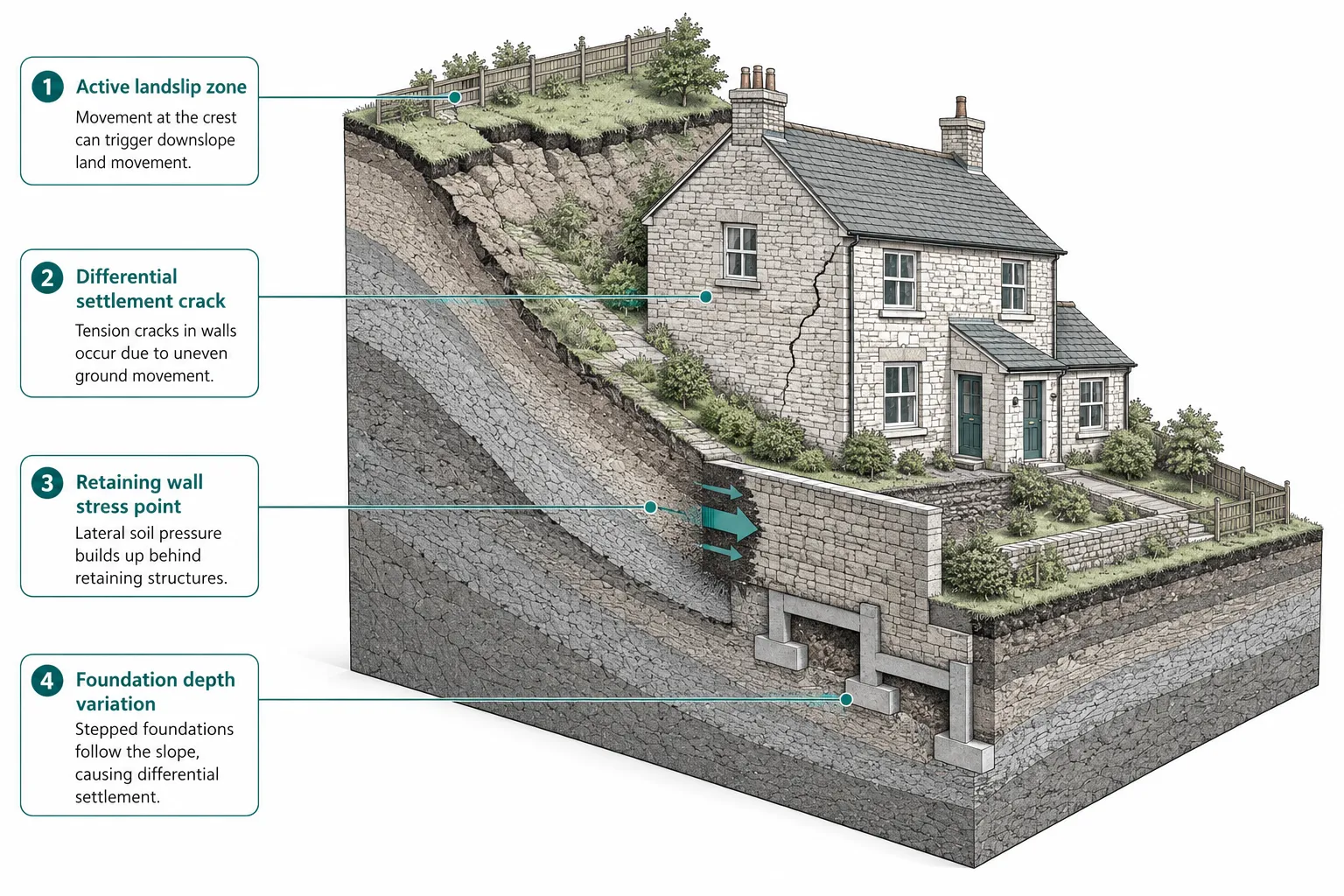
The steeper the gradient, the more pronounced these effects become. Surveyors and geotechnical engineers typically classify slope risk by angle:
| Gradient | Description | Typical Risk Level |
|---|---|---|
| Below 1:20 (5%) | Gently sloping | Low, standard foundation design usually adequate |
| 1:20 to 1:10 (5-10%) | Moderate slope | Medium, stepped foundations, drainage review required |
| 1:10 to 1:5 (10-20%) | Steep residential | High, retaining structures, specialist design needed |
| Above 1:5 (20%+) | Very steep | Very high, geotechnical investigation essential |
Beyond the physical gradient, the underlying geology matters enormously. Clay soils shrink during dry spells and expand when wet, creating differential movement that is amplified on slopes. Sandy or made-ground soils can liquefy under saturation. Hillside plots in areas of former mining activity carry additional cavity risk. All of these variables feed directly into the structural risk rating that a surveyor assigns and, by extension, into the valuation.
Retaining walls deserve particular attention. A poorly maintained or inadequately designed retaining wall is one of the most common defects found on sloping residential plots in the UK. Signs of failure, bulging masonry, horizontal cracking, inadequate drainage weep holes, or visible lean, indicate that lateral soil pressure is winning against the structure. Replacing or underpinning a failing retaining wall can cost tens of thousands of pounds, and that cost must be reflected in any realistic valuation.
The Data Behind Slope and Ground Stability in UK Property Surveys
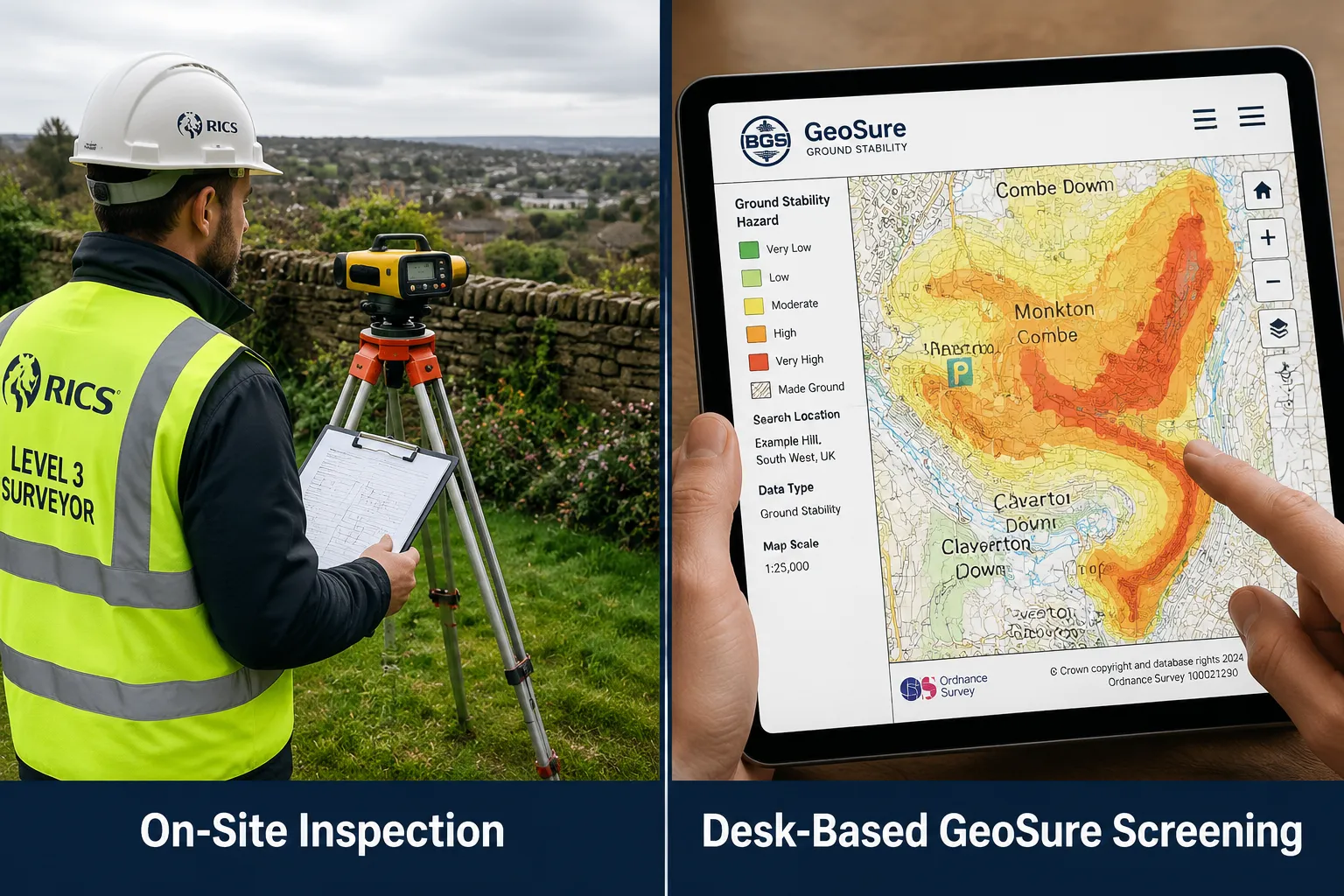
Before a surveyor sets foot on site, desk-based screening has already begun. Two datasets now underpin most commercial ground-stability assessments used in UK conveyancing.
BGS GeoSure (Version 8), updated in August 2026, provides national mapping of susceptibility to shrink-swell clays, landslides, compressible ground, collapsible deposits and running sand at 1:50,000 scale across Great Britain [8]. This dataset is the most authoritative baseline for identifying slope-related landslip risk near properties and feeds directly into the environmental search products that solicitors order as standard [1][6].
BGS Property Subsidence Assessment, launched and updated in mid-2026, goes further by combining geology with tree locations, property age, drainage characteristics and building type to produce property- and postcode-specific shrink-swell susceptibility scores [5]. On sloping sites where clay shrinkage and differential movement are more pronounced, this fine-grained dataset is increasingly referenced in lender and insurer models [5].
Consumer-facing tools such as HouseCheckup now offer free GeoSure-based ground-stability checks for any UK property, with paid aggregated reports (combining GeoSure with around 69 other datasets) available from approximately £9.99 to £24.99 [1][2]. These low-cost checks have become a common first step for buyers deciding whether a more comprehensive RICS Level 3 building survey is warranted.
Standard lender-accepted environmental searches, such as Groundsure Homebuyers (around £92.60 plus VAT) or Groundsure Avista (from roughly £132), bundle ground-stability analysis with flood, contaminated land, radon and planning constraints, backed by professional indemnity cover of up to around £10 million [3][4][6]. Results are colour-coded as “pass”, “further action” or “fail”. A “further action” outcome on a sloping site almost always triggers a recommendation for a full on-site survey or geotechnical investigation [6].
For buyers who want a rapid subsidence-specific screen before committing to a full survey, dedicated desktop products such as the FCI Ground Stability Report provide screening within two working hours for approximately £45 including VAT, based on soil shrinkage data [12][13]. These are positioned as a bridge between a free GeoSure check and a full structural survey.
“A ‘further action’ result on a ground-stability search for a hillside property is not a reason to walk away, it is a reason to look more carefully before proceeding.”
How Surveyors Assess Sloping Sites: The On-Site Process
Desk-based data tells a surveyor where risk is likely. On-site inspection confirms whether that risk has materialised and to what degree. For slope and ground stability in UK property surveys, the on-site process involves several interconnected assessments.
Reading the Building for Movement Signs
Surveyors are trained to read a building’s fabric as a record of ground behaviour. On sloping sites, the key indicators include:
- Diagonal or stepped cracks in brickwork, particularly running from window and door corners, these suggest differential settlement caused by uneven ground movement beneath the foundations.
- Distorted door and window openings that no longer close properly, indicating the structural frame has racked under ground pressure.
- Floors that feel out of level, detectable by a spirit level or by the surveyor’s own sense of walking across the space.
- Gaps between walls and ceilings or floors, which indicate relative movement between structural elements.
- Visible lean or bulge in external walls, especially on the downhill elevation where soil pressure is greatest.
A 2026 foundation-survey guide notes that surveyors now pay close attention to recent weather stresses, heatwaves, droughts, flooding and heavy rain, as triggers for accelerated ground movement on vulnerable sites [9]. Where evidence is ambiguous, surveyors may recommend crack monitoring, drainage investigations, detailed level checks and trial pits or boreholes to confirm foundation depth and soil behaviour [9].
Assessing Retaining Walls and Drainage
On any sloping residential plot, retaining walls and surface drainage are critical systems. Surveyors inspect:
- The construction type and age of retaining walls (brick, block, concrete, timber or natural stone each have different failure modes).
- The presence and condition of weep holes or land drains, inadequate drainage is the single most common cause of retaining wall failure, as waterlogged soil dramatically increases lateral pressure.
- Evidence of previous repair or underpinning, which may indicate a history of movement.
- Proximity of trees to retaining structures, since root action can destabilise walls and foundations simultaneously.
For plots where significant construction is planned, the guidance in 2026 recommends a comprehensive geotechnical investigation, including trial pits, boreholes and laboratory testing, and consultation with a structural engineer to design foundations suited to the specific gradient and ground conditions [11]. This is particularly important for sites valued above £50,000,£100,000 where the cost of getting the foundation design wrong would be substantial [11].
Visible ground depressions, unexplained dips or hollows across a plot are treated as potential indicators of subsidence or slope instability, warranting closer inspection before any development proceeds [11].
Specialist services such as Natural Subsidence Assessments combine physical inspection with BGS subsidence-risk datasets to relate mapped susceptibility to on-site evidence of movement on sloping plots, and can recommend targeted foundation reinforcement or monitoring where necessary [7]. For buyers of hillside properties, commissioning such an assessment alongside a standard Level 2 Homebuyer Survey provides a more complete picture of risk.
How Gradient and Ground Instability Affect Valuations
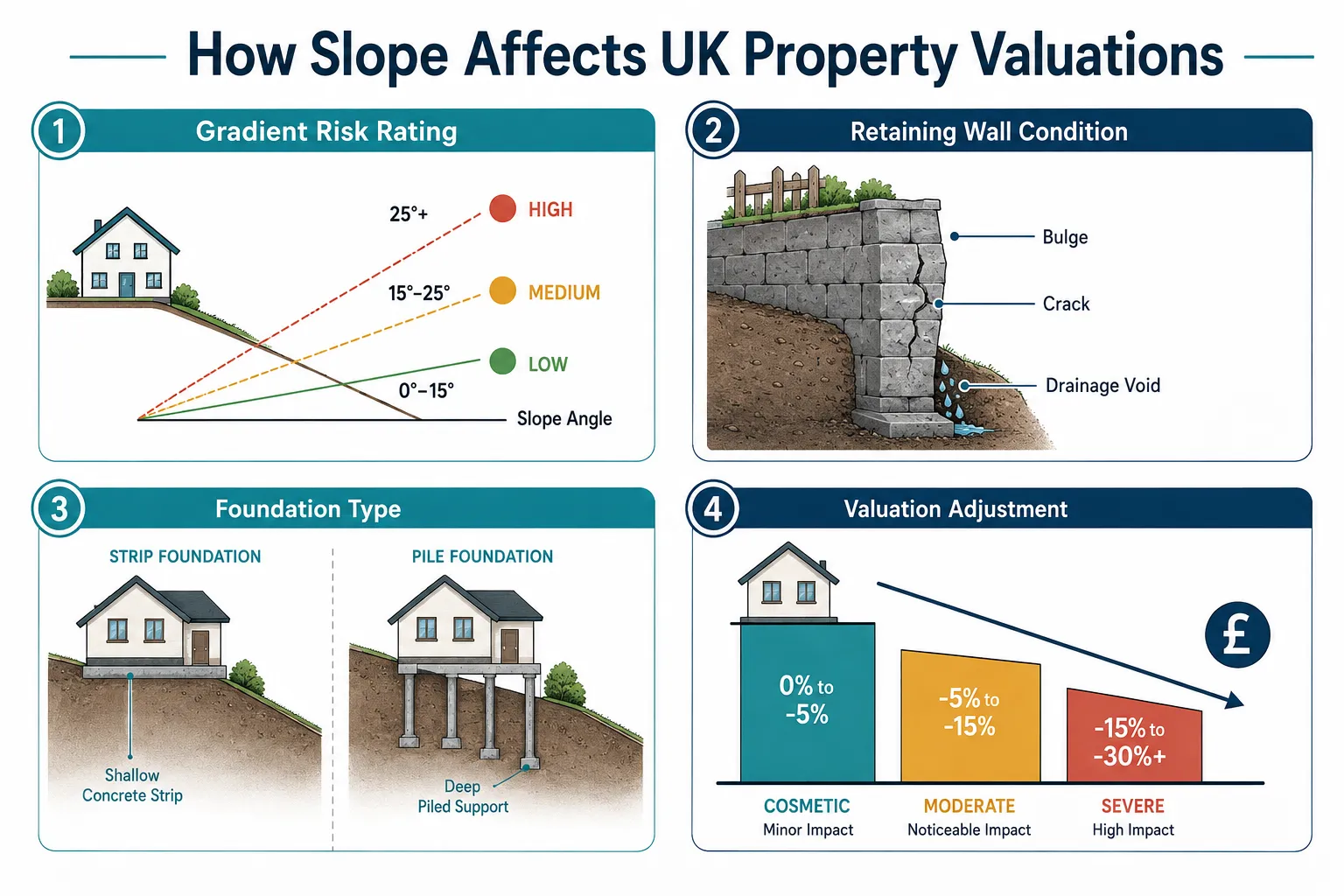
The financial consequences of slope-related ground instability are real, measurable and increasingly well-documented. Understanding how gradient affects foundations and valuations requires looking at both immediate and long-term effects.
Immediate Valuation Adjustments
When a surveyor identifies slope-related defects, the valuation report must reflect the cost of remediation. Common adjustments include:
- Retaining wall replacement or reinforcement: costs typically range from £5,000 to £50,000+ depending on length, height and construction method.
- Foundation underpinning or piling: on steep or unstable sites, underpinning can cost £10,000,£30,000 for a standard semi-detached property, more for larger buildings.
- Drainage remediation: installing or replacing land drains and surface water management systems on sloping plots typically costs £3,000,£15,000.
- Crack monitoring and specialist investigation: even where no immediate remediation is needed, the cost of ongoing monitoring and geotechnical reports may be factored into a reduced offer.
Surveyors working on Canterbury property valuations and across the wider South East regularly encounter hillside plots where the combination of shrink-swell clay geology and steep gradients creates compounding risk. The valuation factors that apply to such sites go beyond simple comparable evidence and require a judgment about the cost and certainty of remediation.
Long-Term Market Pressure
The long-term picture is more sobering. A study highlighted in early 2026 found that flooding and subsidence could cut London property values by up to 31% in the worst-affected areas [10]. Climate-risk modelling suggests that around 21% of UK homes could face high subsidence risk by the 2050s, compared with approximately 4% today [10]. Properties flagged by ground-stability datasets, especially those on unstable slopes, face significant long-term valuation pressure as lenders, insurers and buyers become more sophisticated in pricing climate-related ground risk [10].
Insurance implications compound this. Mid-2026 reports note growing concern among insurers about subsidence, heave and landslip, with recommendations that homeowners contact insurers promptly if they notice any signs of ground movement [15]. Properties with a documented history of slope-related movement may face higher insurance premiums, restricted cover or difficulty obtaining standard policies, all of which affect resale value and mortgage availability.
Lender Conditions and Mortgage Implications
Conveyancing practice in 2026 explicitly links ground-stability search results to mortgage lender requirements. Solicitors must ensure searches are no more than six months old at completion under the UK Finance Mortgage Lenders’ Handbook [14]. Where a ground-stability search returns a “further action” or “fail” result on a sloping site, lenders may:
- Require a full building survey before proceeding.
- Impose a retention on mortgage funds pending remediation.
- Reduce the loan-to-value ratio on the property.
- Decline to lend entirely where landslip or severe subsidence risk is rated high [14][2].
Buyers who have commissioned a building survey identifying risks in the current market are better placed to negotiate price reductions or request remediation as a condition of exchange, rather than discovering problems after completion.
Practical Steps for Buyers and Investors
The combination of improved data tools and more rigorous surveying practice means that slope-related risk is increasingly transparent, but only for buyers who know what to ask for. The following steps represent current best practice in 2026.
Step 1: Run a desk-based ground-stability check early. Before instructing a full survey, use a GeoSure-based tool or a standard environmental search to establish the baseline risk level for the specific property and postcode [1][6]. This costs between £9.99 and £92.60 plus VAT depending on the product and takes minutes to days [1][4][6].
Step 2: Match the survey level to the risk. A Level 1 condition report is insufficient for any property on a moderate or steep slope. A Level 3 building survey, costing roughly £600,£1,500 for a typical residential property, provides the depth of inspection needed to assess foundation condition, retaining wall integrity and drainage adequacy on sloping sites [2][4].
Step 3: Commission a specialist assessment where the data flags risk. Where GeoSure or environmental search results show elevated landslip or shrink-swell susceptibility, a Natural Subsidence Assessment or geotechnical investigation adds targeted analysis that a standard survey cannot provide [7][9][11].
Step 4: Factor remediation costs into the offer. Use the surveyor’s findings to quantify the cost of necessary works and negotiate accordingly. Surveyors experienced in diminution in value calculations can provide defensible figures for use in price negotiations or legal disputes.
Step 5: Review insurance before exchange. Confirm that the property is insurable at a reasonable premium before contracts are exchanged. A history of slope-related movement can make standard cover unavailable or prohibitively expensive.
Conclusion
Slope and ground stability in UK property surveys, and how gradient affects foundations and valuations, is a topic that has moved from specialist concern to mainstream due diligence. The convergence of improved BGS datasets, mainstreamed environmental search products and a growing body of climate-risk evidence means that buyers, lenders and investors have more information than ever before. The challenge is knowing how to use it.
Actionable next steps:
- Run a GeoSure-based ground-stability check on any sloping property before instructing a survey, it takes minutes and costs less than £25 [1][2].
- Always commission at least a Level 3 building survey on hillside plots, properties near escarpments, or any site where the environmental search returns “further action” [6][9].
- Ask the surveyor explicitly about retaining wall condition, drainage adequacy and foundation depth on sloping sites, these are not always covered in detail unless specifically requested.
- Use the survey findings to inform both the offer price and insurance arrangements before exchange.
- For development plots or high-value acquisitions, invest in a full geotechnical investigation, the cost of a borehole survey is trivial compared with the cost of a foundation failure [11].
Ground does not lie. A thorough survey on a sloping site is not a cost, it is the most reliable protection against buying a problem that the landscape has been quietly creating for years.
References
[1] Ground Stability – housecheckup.co.uk
[2] Subsidence Risk Check Before Buying UK – housecheckup.co.uk
[3] Homecheck Residential V2.0 – landmark.co.uk
[4] Best Property Reports – housecheckup.co.uk
[5] Property Subsidence Assessment – bgs.ac.uk
[6] Ground Stability Search Explained – getpine.co.uk
[7] Natural Subsidence Assessment – surveyall.co.uk
[8] GeoSure Ground Stability Data Product Version 8 – data.gov.uk
[9] Foundation Survey – surveymerchant.com
[10] Flooding And Subsidence Could Cut London Property Values By Up To 31% Study Warns – theintermediary.co.uk
Related services from Canterbury Surveyors
- RICS property valuations
- RICS Homebuyer Surveys (Level 2)
- Building Surveys (Level 3)
- Structural engineers in Canterbury & Kent
Get a fixed-fee quote or call 0204 579 8270.