Canterbury & Kent
Compass Readings in Building Surveys: How UK Surveyors Use Bearings to Diagnose Damp, Sun Exposure and Movement
A north-facing wall in the UK receives, on average, less than half the solar radiation of its south-facing counterpart. That single fact explains why experienced chartered surveyors reach for a compass before they reach for a moisture meter. Compass readings in building surveys, how UK surveyors use bearings to diagnose damp, sun exposure and movement, represent one of the most underreported yet practically powerful tools in the profession. This article explains exactly how orientation data is gathered on site, how it feeds into damp, thermal, and structural diagnoses, and why the industry is moving toward formalising these methods in survey reports.
Key Takeaways
- Compass bearings are a foundational diagnostic tool, not an optional extra, they explain why damp, movement, and overheating cluster on specific elevations.
- North-facing walls, west-facing elevations, and shaded roof slopes each carry distinct risk profiles that a bearing-aware surveyor can identify quickly.
- RICS, the PCA, and BRE guidance all support orientation-led diagnosis, even where formal compass protocols are not yet mandated.
- A surveyor who records only moisture readings without noting wall aspect risks misdiagnosing condensation as penetrating damp, or vice versa.
- Digital tools and climate data are beginning to formalise what skilled surveyors have always done intuitively, and 2026 survey standards are moving in this direction.
Why Orientation Matters More Than Most Buyers Realise
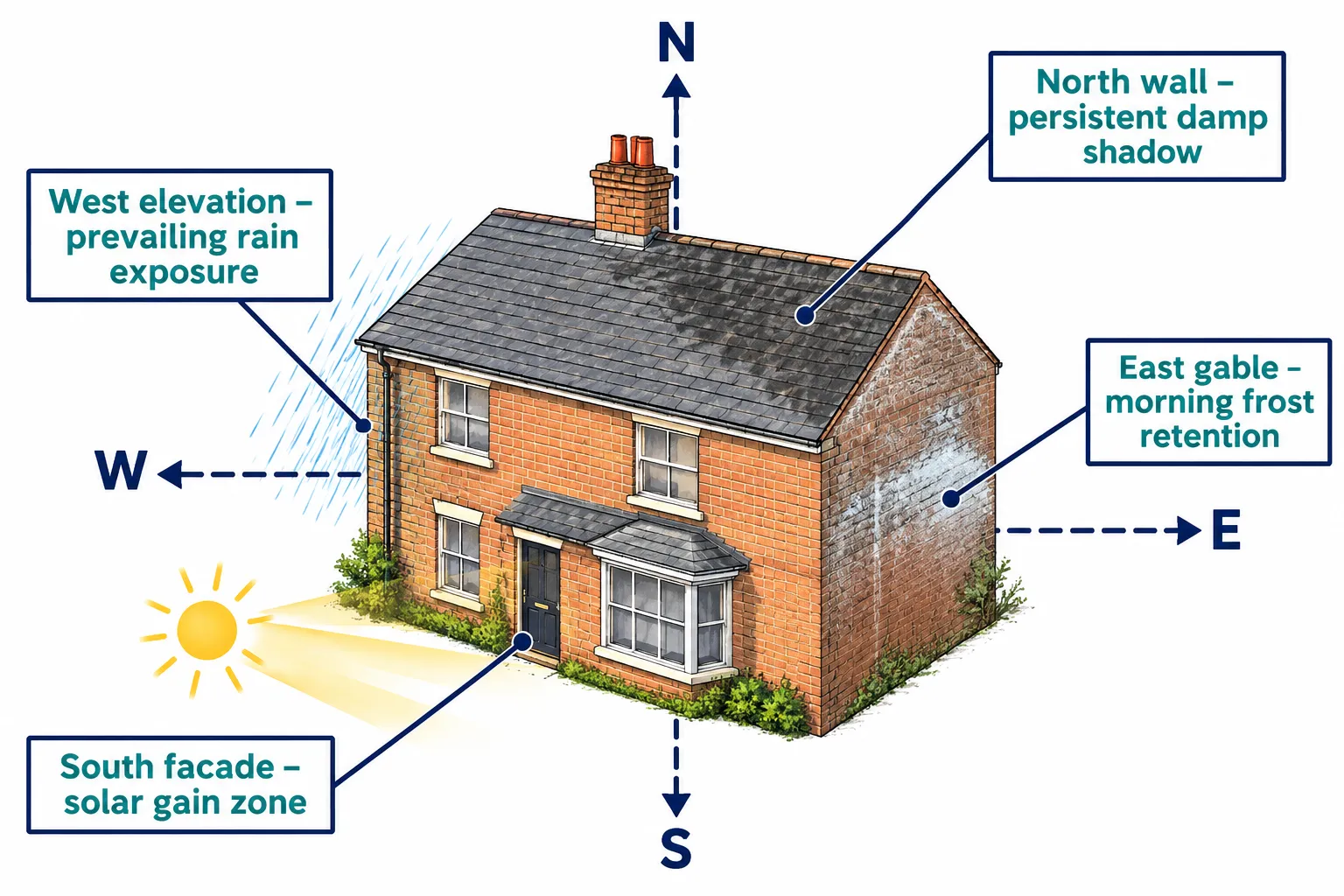
Most property buyers focus on square footage, condition, and price. Very few ask: which way does this building face? Yet orientation governs almost every pathological process a surveyor is trained to identify.
Solar exposure determines how quickly surfaces dry after rain, how much condensation forms on cold mornings, and whether a roof space reaches dangerous overheating thresholds in summer. Prevailing wind direction, broadly south-westerly across most of the UK, dictates which elevations receive the heaviest driving rain. Shading patterns from adjacent buildings, trees, and the building’s own geometry create micro-climates that trap moisture for weeks at a time.
The practical implication is straightforward: two identical walls in the same building can behave completely differently depending on their compass bearing. A surveyor who ignores that context risks producing a report that is technically accurate but diagnostically incomplete.
RICS consumer guidance on damp and mould acknowledges that moisture problems cannot be understood in isolation from the building’s environment [1]. The RICS Built Environment Journal has similarly emphasised that damp, mould, and moisture movement require a holistic assessment that goes beyond instrument readings alone [2].
For buyers and owners seeking a thorough assessment, a full building survey should always include orientation-based context for any defects identified.
How Surveyors Take Compass Readings on Site
Taking a compass bearing on a building survey is not complicated, but it requires method and consistency. The following steps describe standard practice.
Equipment and Setup
Most surveyors use a Silva-type baseplate compass or a digital compass app calibrated against a known reference. Mobile phone compasses are acceptable for general orientation but should be cross-checked against a physical instrument near steel-framed buildings or reinforced concrete, which can deflect magnetic north.
Key locations where bearings are recorded:
- At each external elevation, standing back from the wall and noting the bearing perpendicular to the face
- Inside the loft, noting the bearing of each roof slope
- In the garden or external space, to assess overshadowing from neighbouring structures
- At the base of any reported crack, to record the wall’s aspect before interpreting the fracture pattern
Recording Bearings in the Survey Notes
A professional approach logs bearings against the site sketch at the start of the inspection. This creates a compass rose overlay on the floor plan that the surveyor can reference throughout the inspection. When a moisture meter reading flags elevated moisture on a particular wall, the surveyor immediately knows whether that wall faces the prevailing weather, sits in permanent shade, or receives afternoon sun that should be drying it out.
"A moisture reading without a bearing is like a temperature reading without knowing whether the patient is indoors or outdoors. The number means something only in context."
This context-first approach is consistent with the methodology statement developed through RICS and heritage survey practice, which explicitly criticises instrument-only damp diagnosis and calls for a whole-building assessment that includes site and aspect [5].
Compass Readings in Building Surveys: Diagnosing Damp by Elevation
Damp diagnosis is where compass bearings deliver the most immediate diagnostic value. The three main damp types, penetrating damp, rising damp, and condensation, each have orientation signatures that a bearing-aware surveyor can use to confirm or challenge an initial reading.
Penetrating Damp and the West-Facing Elevation
UK weather data consistently shows that the south-west and west-facing elevations receive the highest volumes of driving rain. Building Regulations Approved Document C and associated BRE guidance use exposure zone maps that are, in effect, compass-based risk assessments. A surveyor finding elevated moisture on a west-facing wall has a strong prima facie case for penetrating damp, particularly if:
- The wall construction is solid masonry with no cavity
- Pointing is eroded or render has cracked
- Moisture levels are highest at mid-wall height and after rainfall events
Conversely, elevated moisture on an east-facing wall, sheltered from the prevailing weather, demands a different explanation. The surveyor should consider internal condensation, plumbing leaks, or a failed damp-proof course before attributing it to driving rain.
North-Facing Walls and Chronic Moisture Retention
North-facing walls in the UK receive little or no direct solar radiation for most of the year. This has two consequences:
- Evaporation rates are low, so any moisture that enters, whether from rain, ground, or condensation, takes far longer to dry out.
- Surface temperatures remain low, which promotes condensation on cold mornings even when internal humidity is not especially high.
A surveyor inspecting a north-facing wall that shows mould growth, algae, or persistent damp staining should record the bearing explicitly in the report. This matters because the remediation strategy differs significantly: a north-facing condensation problem may require improved ventilation and insulation rather than a chemical damp-proof injection [8].
The Property Care Association’s Code of Practice for Damp and Mould reinforces this point, stressing that diagnosis must consider the building’s exposure and orientation before any treatment is specified [8]. This aligns with the broader push from RICS and the PCA for a building-pathology approach rather than a meter-only diagnosis [5].
For properties where damp is already suspected, commissioning a specialist damp survey before exchange of contracts is strongly advisable.
Loft Spaces: Reading the Roof Slopes
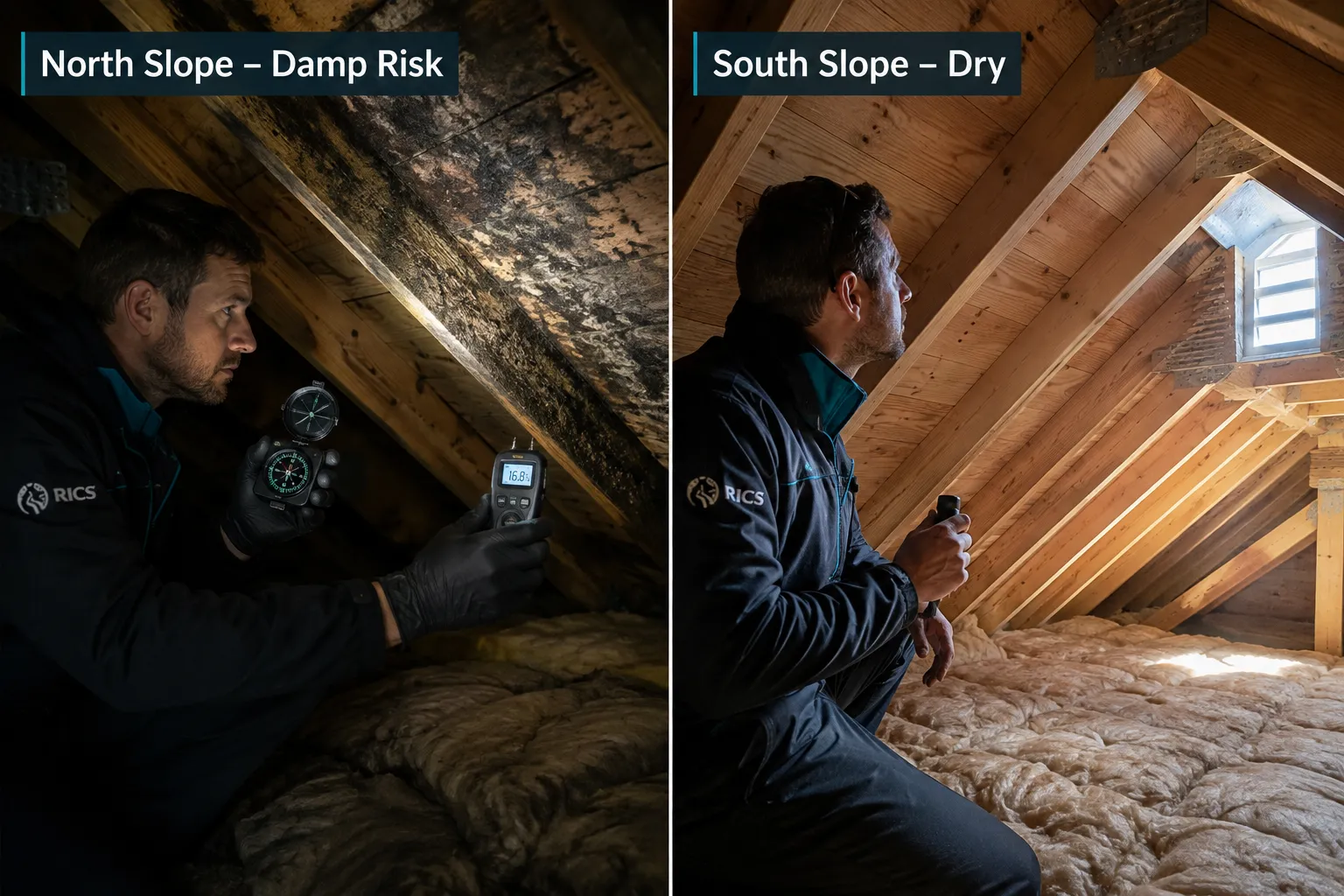
Inside a loft, the compass becomes particularly valuable. A surveyor checking roof timbers should note the bearing of each slope before interpreting any staining or moisture readings.
North-facing roof slopes are prone to:
- Moss and algae growth on tiles, which retains moisture
- Slower drying after rain ingress
- Condensation on cold purlins and rafters
South-facing roof slopes are more likely to show:
- Thermal cycling damage (tile cracking from repeated expansion and contraction)
- Overheating risk in poorly ventilated loft spaces
- UV degradation of felt underlays
Recording these bearings takes under two minutes but fundamentally changes the quality of the diagnostic narrative in the final report.
Awaab’s Law and the Orientation Dimension
The introduction of Awaab’s Law has sharpened scrutiny of damp and mould in social housing. RICS guidance for social housing providers now requires surveyors to demonstrate a thorough diagnostic process, not simply record the presence of mould [6]. Orientation analysis is a natural component of that process, a surveyor who can show that a north-facing bedroom wall with inadequate insulation was always at high condensation risk is providing exactly the kind of evidence-based reasoning the legislation demands.
For a detailed breakdown of what this means in practice, see the article on Awaab’s Law and damp: what building surveyors must do differently in social housing reports.
Using Bearings to Assess Sun Exposure and Overheating Risk
Sun exposure assessment has become increasingly important as the UK experiences hotter summers and as EPC retrofit requirements push surveyors to consider thermal performance more carefully.
The Solar Geometry Surveyors Use
The sun rises in the east and sets in the west, but its arc across the sky varies significantly by season. In winter, the sun stays low and south-facing facades receive the most radiation. In summer, east and west elevations receive substantial morning and afternoon sun respectively, while south-facing walls can be partially shaded by overhanging eaves if the building was designed with solar geometry in mind.
Practical bearing-based assessments surveyors make:
| Elevation | Peak Solar Exposure Period | Key Risk |
|---|---|---|
| South | Winter midday | Overheating in poorly ventilated spaces |
| East | Morning, year-round | Rapid thermal cycling on masonry |
| West | Afternoon, summer | Driving rain combined with solar heating |
| North | Minimal | Chronic damp, algae, condensation |
EPC Retrofits and Orientation
When assessing a property for retrofit measures such as external wall insulation or new glazing, orientation data is essential. A south-facing wall with large windows represents a solar gain asset in winter; covering it with external insulation without considering the glazing ratio could worsen the building’s thermal balance. Surveyors working on EPC-related assessments in 2026 are increasingly expected to integrate this kind of orientation analysis into their recommendations.
For more on how building surveys support EPC compliance, see building surveys for EPC retrofits in 2026: achieving compliance and unlocking buyer incentives.
Compass Readings in Building Surveys: Diagnosing Structural Movement
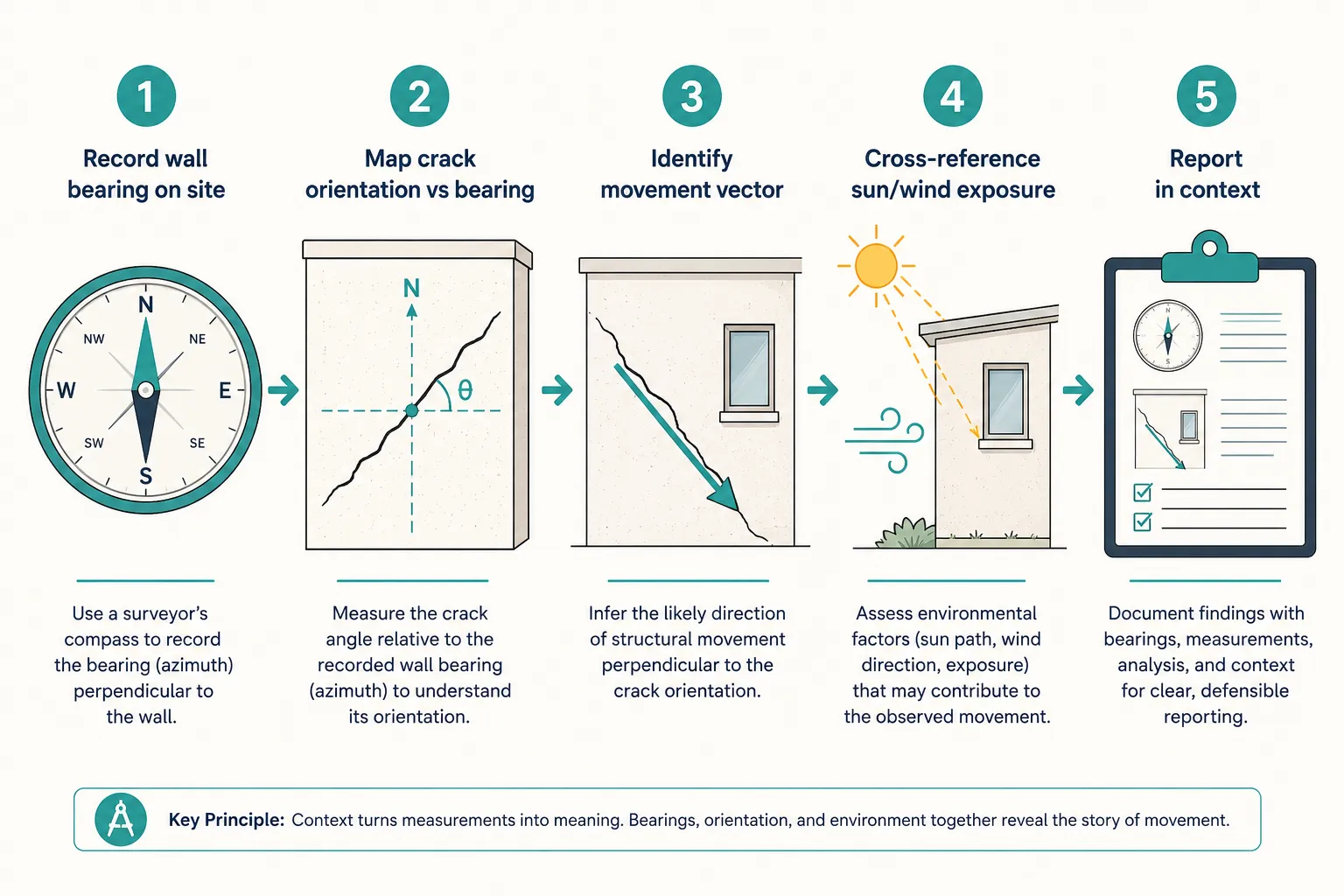
Structural movement diagnosis is the third major area where compass bearings in building surveys provide critical diagnostic context. Cracks do not occur randomly, they follow the stress patterns imposed by the building’s geometry, its foundation conditions, and the directional forces acting on it.
Crack Orientation and Wall Aspect
BRE monitoring guidance establishes that crack patterns should be interpreted in relation to the wall’s orientation and the movement vector being considered. A diagonal crack running from the corner of a window opening tells a different story depending on whether it sits on a:
- South or west elevation subject to thermal expansion from solar heating
- North elevation subject to frost action and moisture-related movement
- Gable wall aligned with the prevailing wind, where differential settlement may be driven by moisture variation in the subsoil
A surveyor who records the bearing of each cracked wall can cross-reference this against known movement mechanisms. Thermal expansion cracks tend to cluster on south and west-facing elevations. Frost-related spalling concentrates on north-facing walls. Subsidence cracks often appear on south-facing walls over clay subsoils, where seasonal moisture loss is greatest.
Movement in Context: The Garden and External Space
The external space around a building also benefits from compass-bearing analysis. A surveyor assessing suspected subsidence should note:
- The bearing of any large trees relative to the affected wall (trees on the south side draw more moisture from clay soils in summer)
- The orientation of drainage runs (a blocked drain on the north side may saturate the subsoil differently than one on the south)
- The aspect of any retaining walls or embankments that may be directing ground water toward the foundations
For properties where subsidence is a concern, a specialist survey for subsidence should be instructed alongside the main building survey.
Reporting Movement with Bearing Data
RICS Level 3 Building Survey reports are expected to provide sufficient context for a client to understand the likely cause of any defect, not merely its location. Including the bearing of a cracked wall, the aspect of the elevation, and a brief note on the relevant exposure risk elevates the report from a description to a diagnosis. This is consistent with the standards discussed in building survey standards post-RICS Retrofit Summit.
The Limits of Compass-Based Diagnosis and When to Go Further
Compass bearings are a powerful contextual tool, but they are not a substitute for specialist investigation. There are clear boundaries to what orientation analysis can resolve.
When compass context is sufficient:
- Explaining why a particular wall is wetter than others in the same building
- Confirming that mould on a north-facing wall is consistent with condensation rather than penetrating damp
- Supporting a recommendation for improved ventilation rather than chemical treatment
When specialist investigation is needed:
- When moisture readings are elevated on multiple elevations with no clear orientation pattern
- When crack widths exceed BRE threshold categories regardless of aspect
- When the building has a complex history of alterations that may have introduced new moisture pathways
In those cases, a specific defect report or a specialist PCA damp survey provides the deeper investigation that a standard building survey cannot deliver. BRE guidance on condensation and dampness assessment (AP 309) sets out the technical framework for this more detailed work [7].
The Future: Digital Tools and Formalised Bearing Protocols
The integration of compass bearings into building surveys is becoming more systematic. Several developments in 2026 are accelerating this trend.
Digital site tools now allow surveyors to log GPS-tagged compass bearings directly into survey software, automatically linking orientation data to moisture readings and photographic evidence. This creates an auditable trail that strengthens both the diagnostic narrative and any subsequent expert witness work.
Climate data overlays from the Met Office and BRE exposure zone maps can be integrated with bearing data to produce a site-specific exposure risk profile. A west-facing solid-brick wall in a high-exposure coastal location carries a demonstrably different risk profile than the same wall type in a sheltered inland setting.
Drone and laser scanning technology is also beginning to complement compass-based diagnosis, particularly for tall or inaccessible elevations. For more on how these technologies are being used in survey practice, see drones and laser scanning in expert witness building surveys.
The PCA’s ongoing training programme and its collaboration with RICS and Historic England on building pathology methodology are expected to produce more explicit guidance on orientation-based diagnosis in the near term [4]. The direction of travel is clear: compass readings in building surveys, how UK surveyors use bearings to diagnose damp, sun exposure and movement, are moving from professional instinct to documented protocol.
Conclusion
Compass bearings are not a specialist add-on to a building survey, they are a foundational diagnostic lens that every chartered surveyor should apply from the moment they arrive on site. Recording the aspect of each elevation, each roof slope, and each cracked wall takes minutes but transforms the quality of the diagnostic narrative. It explains why damp concentrates where it does, why certain cracks follow predictable patterns, and why overheating or condensation risks cluster on specific faces of a building.
Actionable next steps for property owners and buyers:
- Ask your surveyor whether their report will include orientation data for any defects identified, a RICS Level 3 Building Survey should provide this context as standard.
- Commission a damp survey on any property where elevated moisture is noted, particularly on north or west-facing walls, to ensure the diagnosis distinguishes between penetrating damp and condensation.
- Consider orientation when planning retrofits, insulation, glazing, and ventilation strategies should be tailored to the building’s aspect, not applied uniformly.
- Review existing survey reports for properties you already own: if damp or crack findings lack orientation context, a specific defect report may provide the clarity needed to choose the right remediation.
The compass has always been one of the surveyor’s most reliable instruments. In 2026, with tighter damp legislation, rising retrofit demands, and more sophisticated reporting expectations, its role in building surveys is more important than ever.
References
[1] Damp And Mould – rics.org
[2] Damp Mould Moisture Movement Consumer Guide – ww3.rics.org
[4] Pca Courses 2025 – amenityforum.co.uk
[5] Rics Dampness Methodology Statement – heritage-survey.org
[6] Awaabs Law Guidance Social Housing Providers – ww3.rics.org
[7] Condensation And Dampness Assessing And Treating Dampness In Buildings Ap 309 – breeam.com
[8] Property Care Association Code Of Practice For Damp And Mould – bathnes.gov.uk
Related services from Canterbury Surveyors
- Building expert witness surveyors
- Building Surveys (Level 3)
- Structural engineers in Canterbury & Kent
- CCTV drain surveys
Get a fixed-fee quote or call 0204 579 8270.