
Canterbury & Kent
How Land Surveys Boost Property Value: Boundary Clarity, Development Potential, and Market Edge
A property with unclear boundaries can lose up to 10% of its market value before a single buyer even makes an offer [1]. That figure alone makes a compelling case for why land surveys are far more than a bureaucratic formality. Understanding how land surveys boost property value through boundary clarity, development potential, and market edge is one of the most underused strategies available to property owners, sellers, and developers in 2026.
Whether a property is a modest semi-detached home or a multi-acre commercial site, a professionally conducted land survey translates directly into financial confidence, for owners, buyers, lenders, and appraisers alike.
Key Takeaways
- Accurate boundary surveys can increase property value by up to 10% by eliminating legal uncertainty and dispute risk.
- Surveys reveal hidden development potential, including extra usable land, subdivision opportunities, and planning constraints.
- Buyers and lenders place a measurable premium on properties backed by recent, professional survey documentation.
- Survey costs are modest relative to the value uplift they can generate, particularly on larger or more complex sites.
- Sellers who commission surveys before listing gain a significant negotiating and marketing advantage.
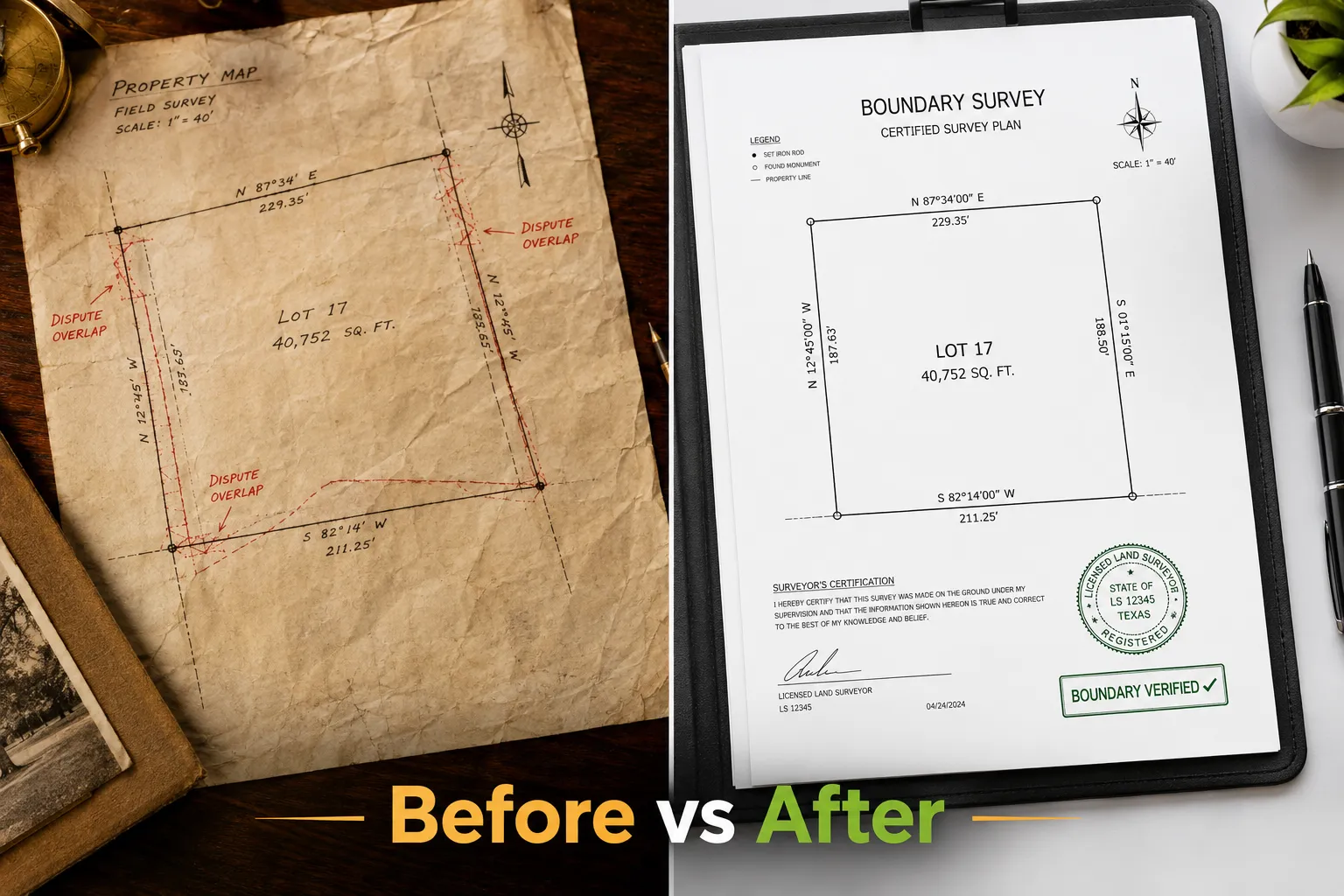
Boundary Clarity: The Foundation of Property Value
Why Boundary Disputes Erode Value
Boundary ambiguity is one of the most common, and most costly, problems in residential and commercial property transactions. When the legal extent of a property is unclear, buyers face the risk of inheriting a dispute, lenders become reluctant to offer competitive terms, and valuers apply a discount to reflect the uncertainty [2].
A professional boundary survey eliminates this risk by establishing the precise legal limits of a property using physical measurements, historical title deeds, and registered land data. The result is a document that all parties, buyer, seller, solicitor, and lender, can rely on with confidence [4].
“Boundary clarity is not just about lines on a map. It is about giving every party in a transaction the certainty they need to proceed without hesitation.”
Quantifying the Value of Certainty
Research consistently shows that properties with documented, dispute-free boundaries attract stronger offers and sell faster than those without [1]. The reasons are straightforward:
- Reduced legal risk: Buyers are not inheriting a potential dispute with neighbours.
- Faster conveyancing: Solicitors spend less time resolving title queries, reducing transaction delays.
- Stronger mortgage offers: Lenders are more willing to lend at favourable loan-to-value ratios when title is clean.
- Higher appraised values: Appraisers factor in legal certainty when assessing comparable sales [10].
In practical terms, a boundary survey costing between £500 and £2,000 for a standard residential property can prevent a price reduction of tens of thousands of pounds on a disputed site [3].
The Role of Professional Surveyors
Not all surveys are equal. A boundary survey conducted by a local chartered surveyor carries professional indemnity, regulatory oversight, and legal standing in any subsequent dispute or planning application. This professional credibility is itself a value-adding factor, it signals to buyers and lenders that due diligence has been carried out to the highest standard.
For properties where boundary issues are suspected, a specific defect report can identify and document concerns before they become deal-breakers during conveyancing.
Development Potential: Unlocking Hidden Value Through Survey Insights
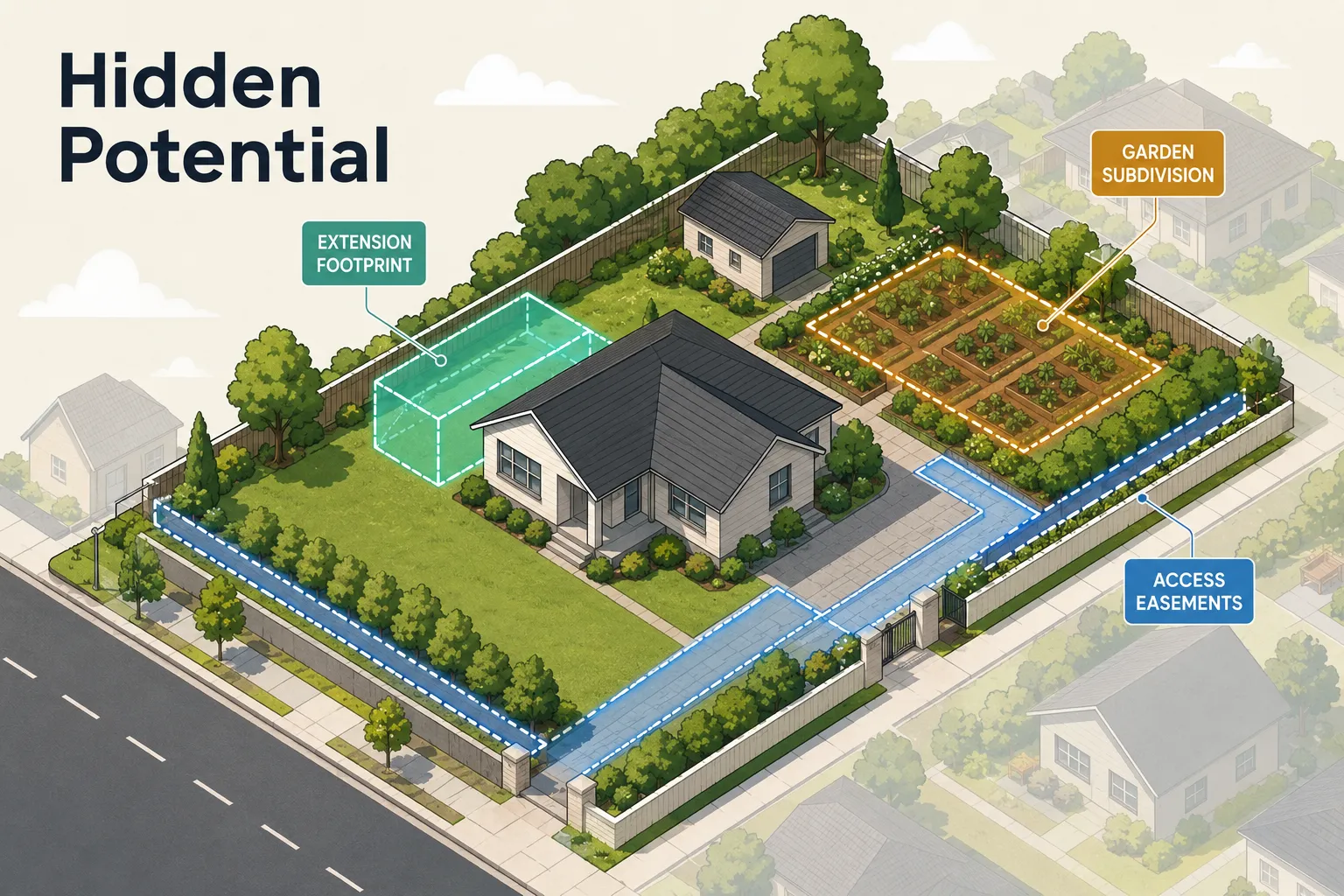
Surveys Reveal What Title Deeds Cannot
One of the most powerful, and least discussed, ways that land surveys boost property value is by revealing development potential that is invisible from title documentation alone. A detailed topographic or measured survey can identify:
- Surplus land: Areas of the plot that are larger than the registered title suggests, potentially usable for extensions, outbuildings, or subdivision.
- Access easements: Rights of way or access strips that could enable development on adjacent land or unlock ransom strip value.
- Encroachments: Structures built over boundaries, by the owner or a neighbour, that, once resolved, clarify the true developable area.
- Gradient and drainage constraints: Physical site conditions that affect planning viability and construction cost [6].
This information transforms a property from a static asset into a development-ready opportunity, a status that commands a meaningful premium in the market [7].
The “Development-Ready” Premium
Developers and investors pay more for certainty. A property marketed as development-ready, supported by a recent survey, planning history, and clear boundary documentation, removes the due diligence burden from the buyer. That saved time and reduced risk is reflected in the offer price.
Consider the following comparison:
| Property Type | Without Survey | With Recent Survey |
|---|---|---|
| Residential with garden plot | Standard market value | Potential 5-10% uplift [1] |
| Commercial site | Lengthy due diligence | Faster exchange, stronger offers |
| Land with subdivision potential | Speculative pricing | Evidenced development value |
For properties where structural considerations are relevant to development plans, a structural survey provides the technical foundation needed to support planning applications and investor confidence.
Surveys and Planning Applications
Local planning authorities require accurate site surveys as part of most planning applications. A property owner who has already commissioned a measured survey is positioned to move faster on any planning submission, a significant advantage in competitive markets where planning permission can add 20-40% to land value overnight.
Owners considering extensions or alterations should also be aware that a licence to alter may be required in leasehold properties, and an accurate survey is a prerequisite for that process.
Cost Versus Return: A Realistic Assessment
Survey costs vary significantly based on property size, complexity, and survey type [5]:
- Boundary surveys: Typically £500 to £2,500 for residential properties [3].
- Topographic surveys: £800 to £5,000 depending on site size and terrain [8].
- ALTA/commercial surveys: Can range from £2,000 to £10,000+ for complex commercial sites [9].
Against these costs, the value uplift from resolving boundary uncertainty, unlocking development potential, or accelerating a transaction is almost always substantially larger. On a £400,000 property, a 5% value increase represents £20,000, a return of 8x or more on a standard boundary survey.
Market Edge: How Surveys Give Sellers a Competitive Advantage

The Buyer’s Perspective in 2026
The property market in 2026 is characterised by cautious buyers, rigorous lender requirements, and a high rate of transaction fall-throughs. In this environment, sellers who can demonstrate transparency and due diligence stand out. A recent, professionally conducted survey is one of the most effective tools for achieving this.
Buyers increasingly factor survey status into their decision-making. A property with a current boundary survey, a clean title, and documented condition evidence is simply less risky, and buyers will pay a premium to avoid risk [2].
Reducing Fall-Through Risk
Transaction fall-throughs cost sellers time, money, and market momentum. The most common causes include:
- Boundary disputes identified during conveyancing
- Structural or condition issues revealed by the buyer’s survey
- Lender down-valuations based on unresolved title questions
- Delays caused by missing or inaccurate land registry data
A pre-listing survey addresses the first and fourth causes directly. When combined with a RICS building survey to document property condition, sellers can enter the market with a comprehensive evidence pack that significantly reduces the probability of a fall-through.
Surveys and Lender Valuations
It is worth understanding the relationship between surveys and mortgage valuations. While a land survey does not automatically increase the lender’s valuation figure, it does remove the uncertainty that can cause valuers to apply a downward adjustment [10].
Appraisers and mortgage valuers rely on survey information to confirm plot size, boundary accuracy, and the absence of encroachments. When this information is already available and professionally verified, the valuation process is smoother and the outcome more likely to support the asking price [10].
For sellers of leasehold properties, accurate survey data also supports freehold valuation and lease extension valuation processes, both of which are directly affected by the accuracy of the demised premises boundaries.
Practical Tips for Sellers Leveraging Survey Data
Sellers who want to maximise the market edge provided by a recent survey should consider the following steps:
- Commission the survey before listing: This allows boundary data to be included in marketing materials and disclosed proactively to buyers.
- Share the survey with the buyer’s solicitor early: Reducing conveyancing time is a direct financial benefit to both parties.
- Highlight survey status in property listings: A line noting “recent boundary survey available” signals transparency and reduces buyer hesitation.
- Use survey data to support pricing: If the survey reveals a larger plot than previously recorded, this can justify a higher asking price with documented evidence.
- Address any issues before going to market: Encroachments, access disputes, or drainage easements are far less damaging when resolved proactively than when discovered mid-transaction.
For properties with complex histories or potential structural concerns, a building survey conducted alongside the boundary survey provides a complete picture that sophisticated buyers and their solicitors will find reassuring.
Choosing the Right Survey for Maximum Value Impact
Not every property requires the same type of survey. The value-boosting impact depends on selecting the survey that addresses the most significant risk or opportunity for a specific property. Key considerations include:
- Age and type of property: Older properties with historical boundary changes benefit most from a full boundary survey.
- Development ambitions: Properties with subdivision or extension potential require a topographic or measured survey.
- Commercial transactions: ALTA or full measured surveys are standard expectations in commercial deals.
- Leasehold properties: Accurate demise plans are essential for lease extension and enfranchisement processes.
For guidance on selecting the most appropriate survey type, the guide to choosing the right property survey provides a practical framework based on property type and transaction context. A comparison of different types of survey is also useful for owners who are weighing their options.
Conclusion
The evidence is clear: understanding how land surveys boost property value through boundary clarity, development potential, and market edge is not an academic exercise, it is a practical strategy with measurable financial returns. In a market where buyer confidence is fragile and transaction fall-throughs are costly, a professionally conducted survey is one of the highest-return investments a property owner can make.
Actionable next steps for property owners and sellers in 2026:
- Identify whether your property has any unresolved boundary questions or title ambiguities before listing.
- Commission a boundary survey from a qualified, RICS-regulated surveyor to establish precise legal limits.
- If development potential is a factor, invest in a topographic or measured survey to document usable land and constraints.
- Prepare a complete evidence pack, survey, condition report, and title documentation, to share with buyers and their solicitors at the earliest opportunity.
- Use survey data actively in pricing discussions, marketing materials, and negotiations to demonstrate transparency and justify asking price.
The cost of a professional survey is modest. The cost of proceeding without one, in lost value, delayed transactions, and unresolved disputes, is almost always far greater.
References
[1] How Land Surveyors Can Increase The Value Of Your Property – realmapinfo.com
[2] Understanding The Role Of Property Boundary Surveys – content.icelabz.co.uk
[3] Land Survey Cost – apexsurvey.us
[4] Land Survey – rocketmortgage.com
[5] Land Survey Cost – homeguide.com
[6] How A Land Survey Can Increase The Value Of Your Property – greatermelbournesurveyors.com.au
[7] Why Should You Get A Boundary Survey Before Buying Or Building A New Home – lpdsurveys.com.au
[8] Land Survey Cost – thespruce.com
[9] Land Survey What It Is Types And What It Costs In – amerisave.com
[10] Surveys In Appraisals – cadeappraisals.com
Related services from Canterbury Surveyors
- Boundary surveys
- RICS property valuations
- Building Surveys (Level 3)
- Structural engineers in Canterbury & Kent
Get a fixed-fee quote or call 0204 579 8270.