
Canterbury & Kent
Fire Safety Regulation Updates in Building Surveys: Retrofitting Older Properties for 2026 Compliance and Valuation Impacts
Roughly 700,000 residential buildings in England are estimated to have some form of combustible cladding or fire safety deficiency, according to government data compiled following the Grenfell Tower disaster. That single statistic has reshaped how surveyors, lenders, and buyers approach every transaction involving a pre-2000 building. Fire Safety Regulation Updates in Building Surveys: Retrofitting Older Properties for 2026 Compliance and Valuation Impacts is no longer a niche concern for high-rise blocks alone, it now sits at the centre of mainstream property due diligence, affecting terraced houses, converted flats, and commercial premises alike.
The legislative landscape has shifted considerably since 2021, and 2026 brings further tightening of obligations under the Building Safety Act 2022 and associated secondary legislation. Surveyors are now expected to assess EWS1 forms, cladding systems, fire compartmentation, and remediation liability as standard components of a thorough inspection, and valuers must reflect those findings in their reports.
Key Takeaways
- The Building Safety Act 2022 and its 2026 updates require surveyors to treat fire safety as a primary inspection category, not an afterthought.
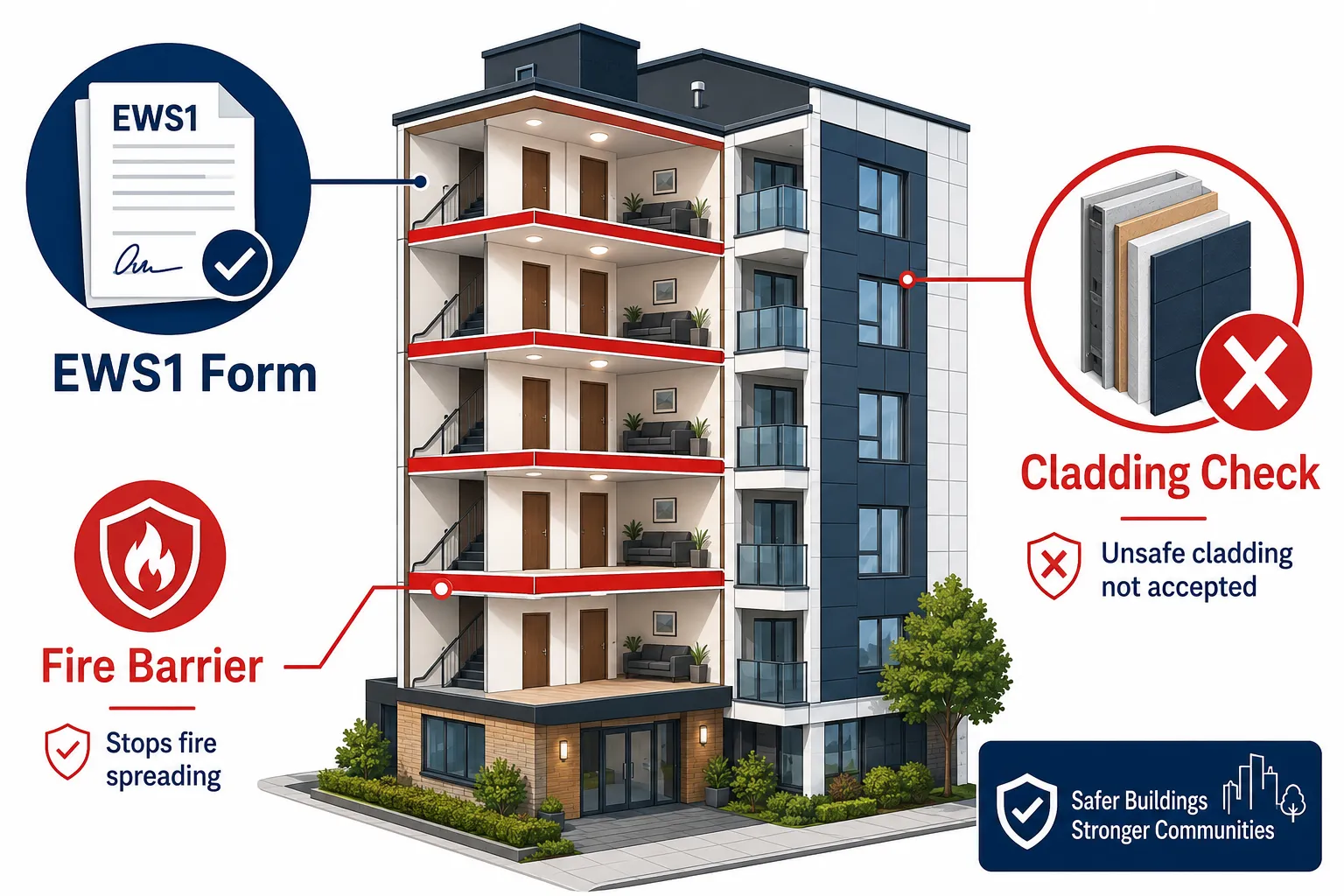
- EWS1 (External Wall System) assessments remain a critical gateway for mortgage lending on multi-storey residential buildings with cladding concerns.
- Pre-2000 buildings carry the highest risk profile because they were constructed before modern fire safety standards, making retrofitting both urgent and costly.
- Remediation costs for cladding and fire door replacement can run into tens of thousands of pounds per unit, directly depressing property valuations.
- A Level 3 building survey is the most appropriate tool for identifying fire safety deficiencies in older properties before purchase or lease.
Understanding the Regulatory Framework Driving 2026 Compliance
The Building Safety Act 2022 established the most significant overhaul of UK building safety law in a generation. It created the Building Safety Regulator (BSR), introduced a new regime for higher-risk buildings (those over 18 metres or seven storeys with at least two residential units), and placed formal duties on “accountable persons”, typically freeholders or management companies.
For 2026, several secondary regulations have come into force or been strengthened:
- The Fire Safety (England) Regulations 2022 require responsible persons to carry out regular inspections of fire doors, communal areas, and external walls in multi-occupied residential buildings.
- The Higher-Risk Buildings (Descriptions and Supplementary Provisions) Regulations 2023 clarified which buildings fall under the most stringent BSR oversight.
- Updated PAS 9980:2022 guidance provides the technical framework for fire risk appraisals of external walls, informing EWS1 assessments.
What this means for surveyors: Any professional conducting a building survey on a property built before 2000 must now treat fire safety as a primary inspection category. This is particularly true for residential blocks, converted properties, and mixed-use buildings where compartmentation, escape routes, and wall construction are harder to verify without specialist investigation.
“The shift is not just regulatory, it is cultural. Surveyors who fail to flag fire safety risks in older buildings are now exposed to significant professional liability.”
The EWS1 Form: Still Relevant in 2026
The External Wall System (EWS1) form was introduced by UK Finance and the Royal Institution of Chartered Surveyors (RICS) in 2019 to give lenders confidence about the fire safety of external wall systems on residential buildings. Despite government attempts to narrow its scope, the EWS1 form remains a practical requirement for mortgage lending on many buildings with cladding.
In 2026, the EWS1 process applies most commonly to:
- Buildings over 18 metres with any cladding system
- Buildings between 11 and 18 metres where combustible materials are present
- Lower-rise buildings where a fire risk appraisal identifies specific concerns
A building that cannot produce a satisfactory EWS1 assessment, or where the assessment reveals combustible materials, will face severe valuation discounts or be effectively unmortgageable until remediation is completed.
How Fire Safety Regulation Updates in Building Surveys Affect Older Properties
Pre-2000 construction presents the greatest challenge for 2026 compliance. Buildings from this era were designed under entirely different regulatory frameworks. Common fire safety deficiencies found in older properties include:
| Deficiency | Typical Properties Affected | Estimated Remediation Cost |
|---|---|---|
| Combustible ACM cladding | 1970s-1990s high-rise blocks | £30,000-£80,000+ per unit |
| Non-compliant fire doors | All pre-2000 converted flats | £800-£2,500 per door |
| Missing or inadequate cavity barriers | 1980s-1990s timber-framed buildings | £5,000-£20,000 per building |
| Inadequate compartmentation | Converted Victorian/Edwardian houses | £3,000-£15,000 per flat |
| Missing sprinkler systems | Pre-2007 care homes and HMOs | £1,500-£3,000 per room |
Note: Cost estimates are indicative and will vary significantly by building type, location, and contractor.
What Surveyors Must Now Assess
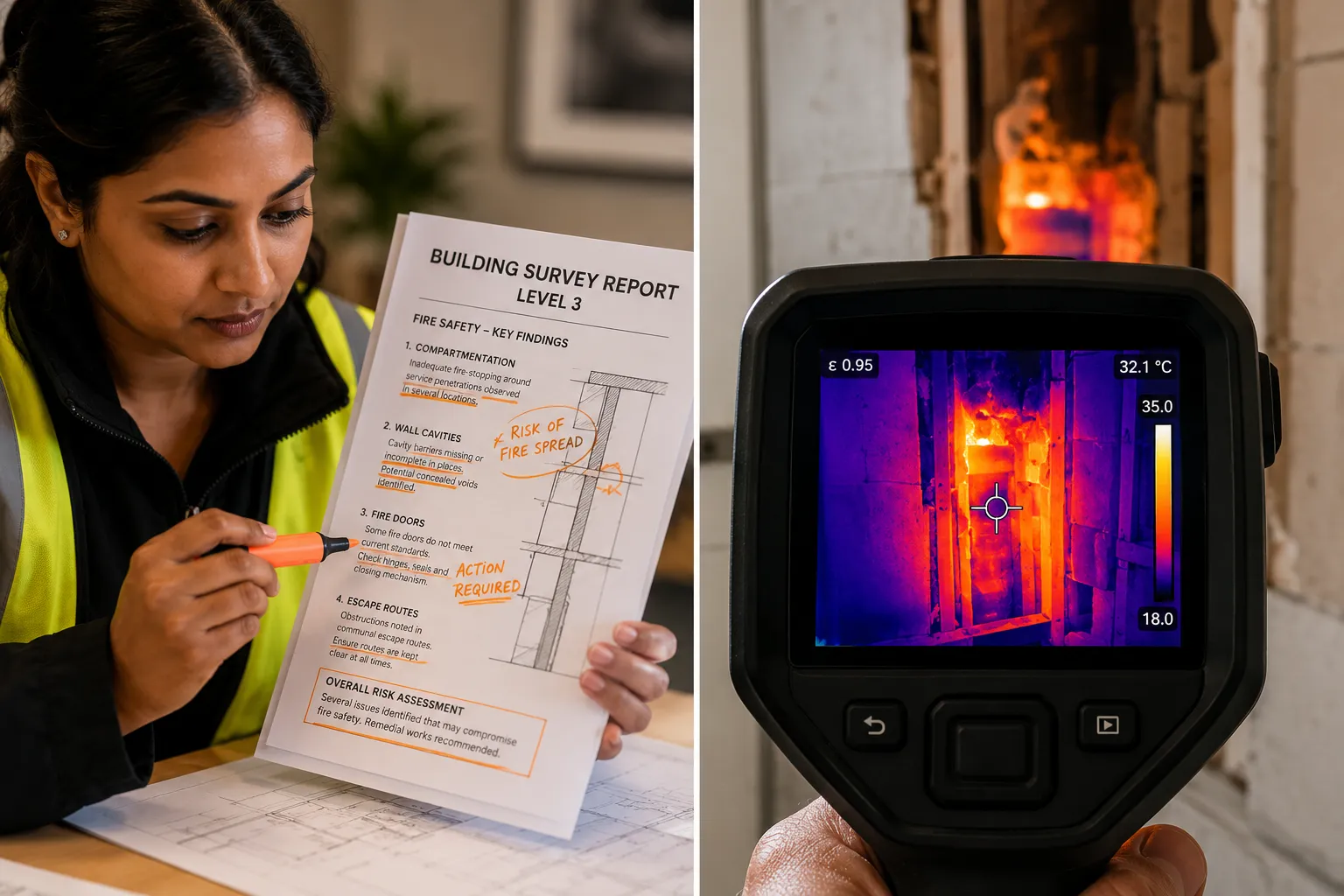
A RICS Level 3 Building Survey is the most comprehensive inspection tool available for residential properties and is the appropriate choice for any pre-2000 building where fire safety concerns may exist. Under current RICS guidance, a Level 3 report should address:
- External wall construction and cladding materials, identifying any potentially combustible systems and noting whether an EWS1 assessment has been obtained
- Fire doors and compartmentation, checking the condition and compliance of fire doors, including self-closing mechanisms and intumescent strips
- Roof construction and loft spaces, assessing whether fire stopping has been installed at party wall junctions (see also roof survey guidance for structural context)
- Escape routes and means of warning, noting the condition of stairwells, signage, and alarm systems
- Evidence of previous fire safety works, reviewing any available documentation, including fire risk assessments and remediation certificates
For leasehold properties, the surveyor should also note whether the building is registered with the BSR (if applicable) and whether the accountable person has discharged their statutory duties.
The Role of Specialist Fire Risk Appraisals
A standard building survey, even at Level 3, cannot replace a specialist fire risk appraisal of an external wall system. Where a surveyor identifies potential cladding concerns, the appropriate course of action is to:
- Flag the issue clearly in the survey report with a risk rating
- Recommend a specialist fire engineer or EWS1 assessor
- Advise the client not to proceed without sight of a satisfactory EWS1 form or equivalent documentation
This recommendation should be made regardless of building height, particularly following 2026 regulatory updates that have extended scrutiny to lower-rise buildings with specific risk factors.
For commercial properties, dilapidations surveys must also now account for fire safety obligations, as tenants and landlords face potential liability for non-compliant fire safety installations at lease end.
Valuation Impacts: Quantifying Fire Safety Risk in Pre-2000 Buildings
Fire safety deficiencies do not just create legal obligations, they create measurable financial risk that must be reflected in property valuations. This is one of the most significant practical consequences of Fire Safety Regulation Updates in Building Surveys: Retrofitting Older Properties for 2026 Compliance and Valuation Impacts.
How Valuers Approach Remediation Costs
RICS guidance requires valuers to reflect known or suspected fire safety deficiencies in their assessments. The standard approach involves:
1. Identifying the deficiency: The valuer notes the presence of potentially combustible cladding, missing fire doors, or other deficiencies, either from the building survey or from documents provided by the vendor or managing agent.
2. Estimating remediation costs: The valuer applies a deduction from the market value equivalent to the estimated cost of bringing the building into compliance. For a flat in a block with ACM cladding, this deduction can exceed the entire purchase price in extreme cases.
3. Assessing mortgageability: If no EWS1 form is available and the building type requires one, the valuer must note that the property may be unmortgageable in its current state. This effectively limits the buyer pool to cash purchasers, further depressing value.
4. Reflecting ongoing liability: Where remediation costs are uncertain, for example, where a fire risk appraisal has not yet been completed, valuers may apply a “blighted” value to reflect the uncertainty premium.
Understanding the broader factors that affect property valuation is essential context for buyers navigating fire safety-related price adjustments.
Shared Ownership and Leasehold Properties: Compounded Risk
The valuation impact is particularly acute for shared ownership and leasehold properties. Leaseholders in buildings with fire safety deficiencies face a double burden: they may be unable to sell or remortgage, and they may also face service charge demands to fund remediation works.
The Building Safety Act 2022 introduced protections for qualifying leaseholders, capping their remediation contributions in certain circumstances. However, the rules are complex, and not all leaseholders qualify. For those considering shared ownership property valuations, fire safety status must be established before any valuation can be considered reliable.
Similarly, for those involved in collective enfranchisement, fire safety remediation costs must be factored into the premium calculation, as they affect the investment value of the freehold.
“A building with unresolved cladding issues is not simply worth less, in many cases, it is effectively untradeable until remediation is completed or funded.”
Practical Steps for Buyers and Owners of Pre-2000 Properties
For anyone buying, selling, or managing a pre-2000 building in 2026, the following steps are strongly recommended:
Before exchange of contracts:
- Commission a Level 3 building survey or, for lower-risk properties, at minimum a Level 2 homebuyer survey with explicit fire safety enquiries
- Request all available fire safety documentation from the vendor, including the fire risk assessment, EWS1 form, and any remediation certificates
- Check the building’s registration status with the Building Safety Regulator if it meets the higher-risk threshold
For existing owners:
- Ensure the building’s fire risk assessment is up to date (annual review is recommended for higher-risk buildings)
- Engage with the accountable person or managing agent to understand the remediation programme and timeline
- Seek independent advice on leaseholder protections under the Building Safety Act before agreeing to any service charge demands for remediation
For landlords and investors:
- Factor fire safety remediation costs into acquisition due diligence and yield calculations
- Obtain specialist advice before purchasing any pre-2000 block without a current EWS1 form
- Consider whether stock condition surveys are appropriate for portfolio-level fire safety assessment
Retrofitting Older Properties: What Compliance Actually Costs
Retrofitting a pre-2000 building for fire safety compliance is rarely straightforward. The works required depend heavily on the original construction method, the building’s height and use, and the findings of the fire risk appraisal.
Common Retrofit Interventions
Cladding replacement: The most expensive and disruptive intervention. Removing and replacing ACM or other combustible cladding systems on a medium-rise block typically costs between £1 million and £5 million for the whole building, depending on size and complexity. Per-unit costs vary widely.
Fire door replacement: All fire doors in a building must meet current standards (typically FD30 or FD60 rating). A full door replacement programme in a 50-unit block can cost £100,000 or more.
Cavity barrier installation: In timber-framed or partially-clad buildings, installing missing cavity barriers requires opening up the external wall, a significant and costly operation.
Sprinkler retrofitting: Required for certain building types under the 2026 regulatory updates, including care homes and houses in multiple occupation (HMOs) above a certain size. Costs range from £1,500 to £3,000 per room.
Compartmentation works: Sealing penetrations in fire compartment walls and floors, replacing non-compliant partitions, and upgrading stairwell enclosures.
Funding Routes Available in 2026
The government’s Building Safety Fund (BSF) has provided grant funding for cladding remediation on eligible buildings. In 2026, the main funding routes include:
- Building Safety Fund: Covers ACM and non-ACM cladding remediation on buildings over 11 metres where the developer cannot be held responsible
- Developer remediation: Under the Building Safety Act, developers who built or refurbished buildings with defects are legally required to fund remediation, a significant shift from the position before 2022
- Responsible Actors Scheme: Developers who have signed the government’s developer pledge are committed to funding remediation of their own buildings
Leaseholders in qualifying buildings are protected from remediation costs above a statutory cap, though the detail of who qualifies is complex and professional advice is essential.
Conclusion: Actionable Steps for 2026 Compliance
Fire Safety Regulation Updates in Building Surveys: Retrofitting Older Properties for 2026 Compliance and Valuation Impacts represent a fundamental change in how older properties are assessed, valued, and transacted. The days of treating fire safety as a box-ticking exercise are over. Surveyors, valuers, buyers, and owners all have heightened obligations, and heightened risks if those obligations are ignored.
Actionable next steps for 2026:
Commission the right survey. Any pre-2000 property, particularly a flat, converted house, or commercial building, warrants a Level 3 building survey that explicitly addresses fire safety. Do not rely on a basic valuation report alone.
Obtain fire safety documentation before exchange. EWS1 forms, fire risk assessments, and remediation certificates should be requested as standard, not as an afterthought.
Adjust valuations to reflect known risks. Buyers and their advisers must ensure that any remediation liability is properly reflected in the agreed purchase price, not absorbed post-completion.
Understand leaseholder protections. If purchasing a leasehold flat in a building with known fire safety issues, take specialist advice on the Building Safety Act protections before committing.
Plan retrofitting works strategically. For owners and landlords, early engagement with a fire engineer and a clear remediation programme will minimise disruption, protect asset value, and demonstrate compliance to lenders and insurers.
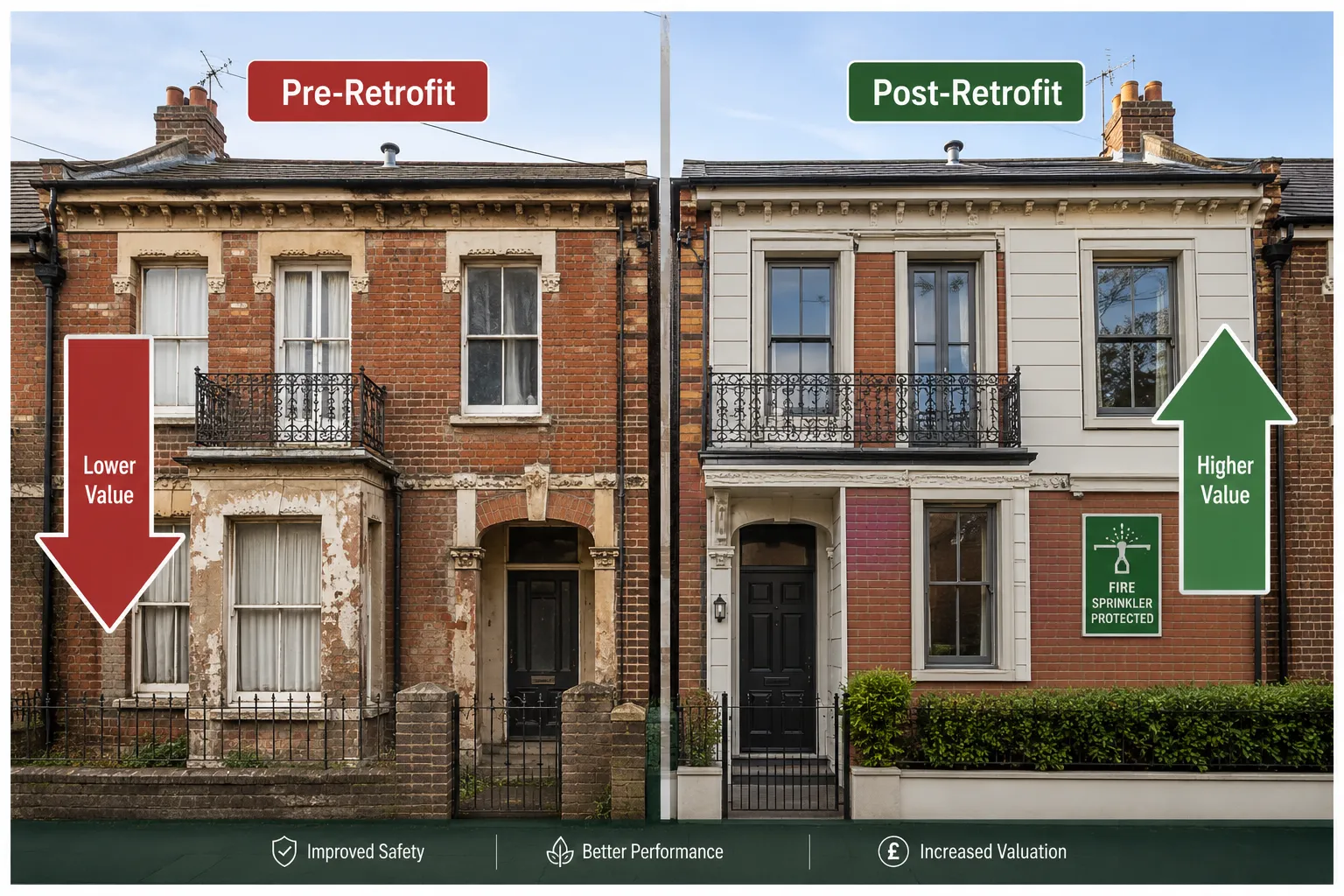
The property market in 2026 rewards those who treat fire safety as a financial and legal priority, not merely a regulatory formality. Buildings with clean fire safety records and completed remediation programmes command stronger valuations, attract more lenders, and transact more smoothly. Those without them face an increasingly difficult market.
Related services from Canterbury Surveyors
- Party wall surveyors in Canterbury & Kent
- Dilapidations surveyors
- RICS property valuations
- RICS Homebuyer Surveys (Level 2)
Get a fixed-fee quote or call 0204 579 8270.