
Canterbury & Kent
Building Surveys for Conventional vs Non-Standard Homes: Level Choices in Q2 2026 Recovery
Roughly one in five UK homes is built from materials or methods that fall outside standard brick-and-block construction, yet a significant number of buyers still instruct the same survey level they would use on a straightforward modern terrace. In the Q2 2026 market, where completions across England and Wales are up 23% year-on-year but sales agreed volumes have softened by 5-7% [1][3], that mismatch carries real financial risk. Understanding how building surveys for conventional vs non-standard homes and the level choices available in the Q2 2026 recovery interact is not a procedural nicety, it is a core part of protecting a purchase.
Key Takeaways
- The RICS three-level survey framework applies to all residential property, but the correct level depends heavily on construction type, age, and condition.
- Non-standard construction, concrete panels, timber frame, steel frame, thatched roofs, conversions, almost always warrants a Level 3 building survey.
- Q2 2026 market conditions (rising stock, softened demand, modest price growth) make survey findings more influential in price negotiations and fall-through decisions.
- Older, equity-rich buyers aged 46-65+ now dominate exchanges [1][7], and this demographic is most likely to purchase period or non-standard homes where detailed surveys add the greatest value.
- Choosing the wrong survey level on a non-standard property is not just a missed opportunity, it can leave serious structural, material, or legal defects undiscovered until after completion.
What Counts as Conventional vs Non-Standard Construction
Before addressing survey level choices, it is worth being precise about what separates these two categories.
Conventional construction in the UK typically means:
- Brick or stone external walls with a cavity
- Timber or concrete floor joists
- Pitched roof with clay or concrete tiles
- Standard mortar, plaster, and render finishes
Non-standard construction covers a wide range of building types, including:
- Prefabricated concrete panel homes (e.g., Airey, Wimpey No-Fines, BISF)
- Timber-frame properties (both traditional and modern)
- Steel-frame construction
- Thatched or flat-roofed properties
- Converted barns, churches, or commercial buildings
- Properties with significant historic fabric (lime mortar, wattle and daub)
- Homes with large-span extensions or structural alterations
The distinction matters because many lenders apply restrictions or require additional reports before offering mortgages on non-standard homes. It also matters for insurance reinstatement costs, which can differ substantially from standard builds.
For properties with unusual structural systems, a non-standard construction survey from a specialist chartered surveyor provides the technical depth that a standard inspection cannot.
The RICS Survey Level Framework in 2026
The Royal Institution of Chartered Surveyors (RICS) Home Survey Standard defines three levels of residential survey:
| Level | Name | Best Suited For |
|---|---|---|
| 1 | Condition Report | New-builds, recently built standard homes in good condition |
| 2 | HomeBuyer Survey | Conventional homes in reasonable condition, no major concerns |
| 3 | Building Survey | Older, larger, altered, or non-standard properties |
Level 1 is the lightest touch, a traffic-light condition report with no detailed commentary. It is rarely appropriate for anything other than a brand-new property, and even then a snagging list inspection often adds more practical value.
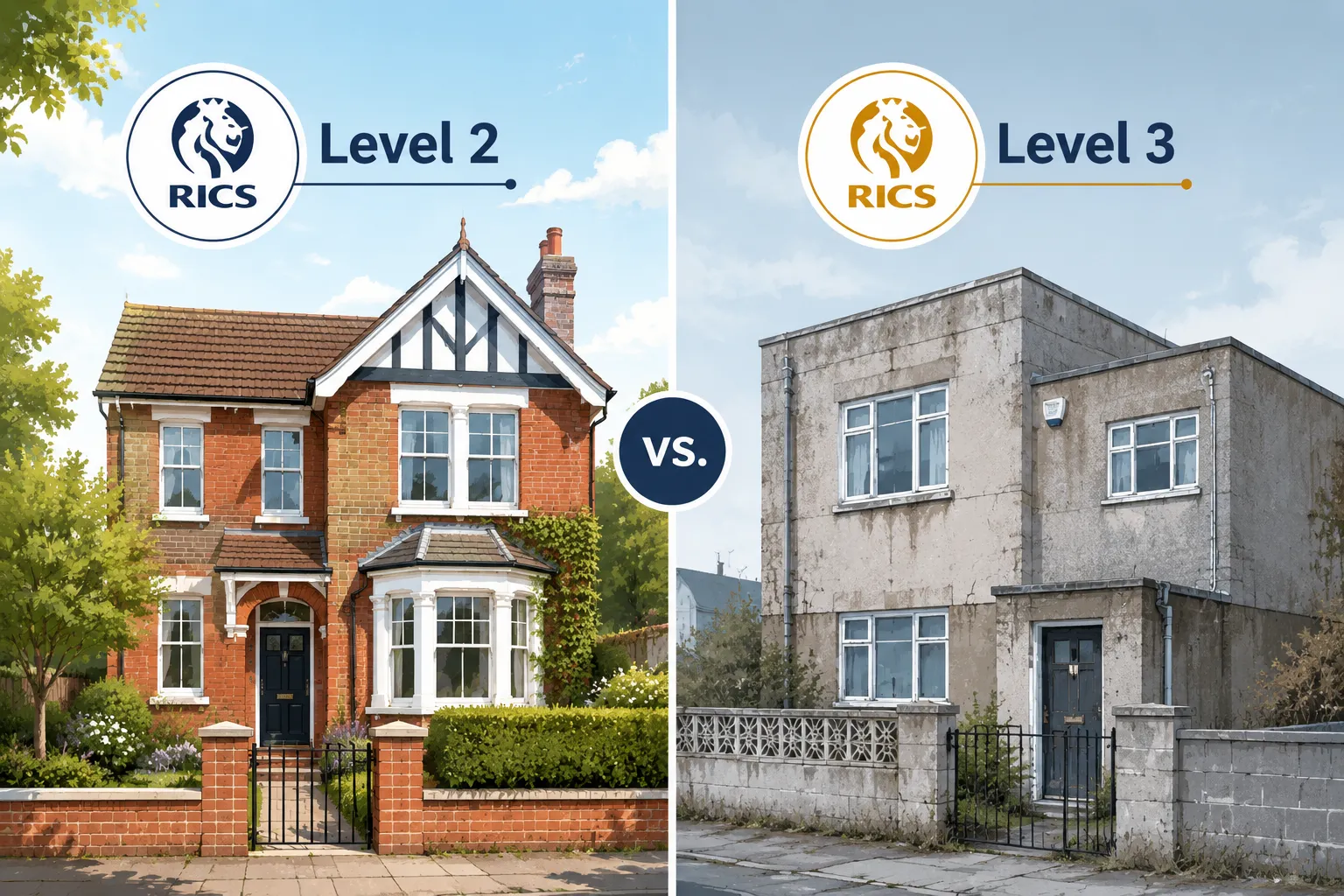
Level 2 (the HomeBuyer Survey) suits conventional homes built after roughly 1930 that show no obvious signs of significant defects. It provides condition ratings and flags issues requiring further investigation, but it does not include detailed structural analysis or advice on repair methods. A RICS HomeBuyer Survey is a cost-effective choice for straightforward purchases, but it has defined limitations.
Level 3 (the full RICS Building Survey) is the most comprehensive option. It covers construction, condition, defects, and, critically, advice on repair options and likely costs. For non-standard homes, it is not merely recommended; it is the only level that provides sufficient coverage.
“The survey level chosen should reflect the complexity of the property, not the confidence of the buyer.”
For a detailed breakdown of the practical differences, the comparison between Level 2 and Level 3 surveys is a useful starting point.
Why Q2 2026 Market Conditions Make Survey Level Choices More Consequential
The Q2 2026 housing market is best described as stable but restrained [3]. Several converging trends make the choice between survey levels more consequential than it was during the frenetic 2021-2022 period.
Rising Stock Includes More Complex Properties
New properties brought to market in Q2 2026 were up 0.5% versus Q2 2025 and 2.7% year-to-date [1][7]. This continued expansion of supply means buyers encounter a wider range of construction types. Older stock, including 1950s and 1960s prefabricated social housing sold under Right to Buy, converted rural buildings, and Victorian terraces, forms a growing proportion of available inventory. These are precisely the properties where Level 3 surveys deliver the most value.
Softer Demand Creates Negotiating Leverage, If You Have the Evidence
Sales agreed volumes were down approximately 5-7% year-on-year in Q2 2026 [1][3]. In a buyer-leaning market, survey findings carry more weight in renegotiations. A Level 3 report that identifies, for example, carbonation in reinforced concrete panels or movement in a non-standard timber frame gives a buyer documented, professional evidence to support a price reduction or request for remediation. A Level 2 report on the same property may simply flag “further investigation recommended” without the depth needed to quantify the issue.
Committed Buyers Are Completing, and Paying More
Exchanges in Q2 2026 were 2.8% higher than in 2025, and completions across England and Wales were up 23% versus Q2 2025 [1][3]. Average UK house prices stood at approximately £270,080 in June 2026, up 1.3% year-on-year [8], with Nationwide reporting annual growth of around 2.2% [2]. Buyers are paying more for both conventional and non-standard homes, which raises the financial stakes of an inadequate survey.
Older Buyers Dominate Exchanges, and They Buy Older Homes
Demographic data for Q2 2026 shows homemovers aged 66+ driving the largest share of growth in exchanges (up over 40% year-on-year), with those aged 46-65 accounting for more than 40% of all exchanges [1][7]. This cohort is disproportionately likely to purchase period properties, rural homes, and properties with complex histories, all categories where a Level 3 building survey is the appropriate choice.
Affordability Pressure Increases the Cost of Post-Purchase Surprises
With mortgage rates remaining elevated and the Bank of England policy rate at 3.75% [8], buyers have less financial headroom to absorb unexpected repair costs after completion. Investing in a more comprehensive survey upfront is a rational hedge against discovering, post-completion, that a non-standard home requires £30,000 in structural repairs.
Matching Survey Level to Property Type: A Practical Guide
Conventional Homes: When Level 2 Is Sufficient
A Level 2 HomeBuyer Survey is generally appropriate when all of the following apply:
- The property was built after approximately 1930
- Construction is standard brick-and-block with a tiled pitched roof
- There is no visible evidence of significant movement, damp, or structural alteration
- The property has not been substantially extended or converted
- The buyer is not planning major works
Even within this category, properties showing signs of subsidence or significant damp should be escalated to a Level 3 survey or a specialist defect survey.
Non-Standard Homes: Why Level 3 Is Almost Always Required
For non-standard construction, a Level 3 building survey is the appropriate starting point, not an optional upgrade. The reasons are structural and practical:
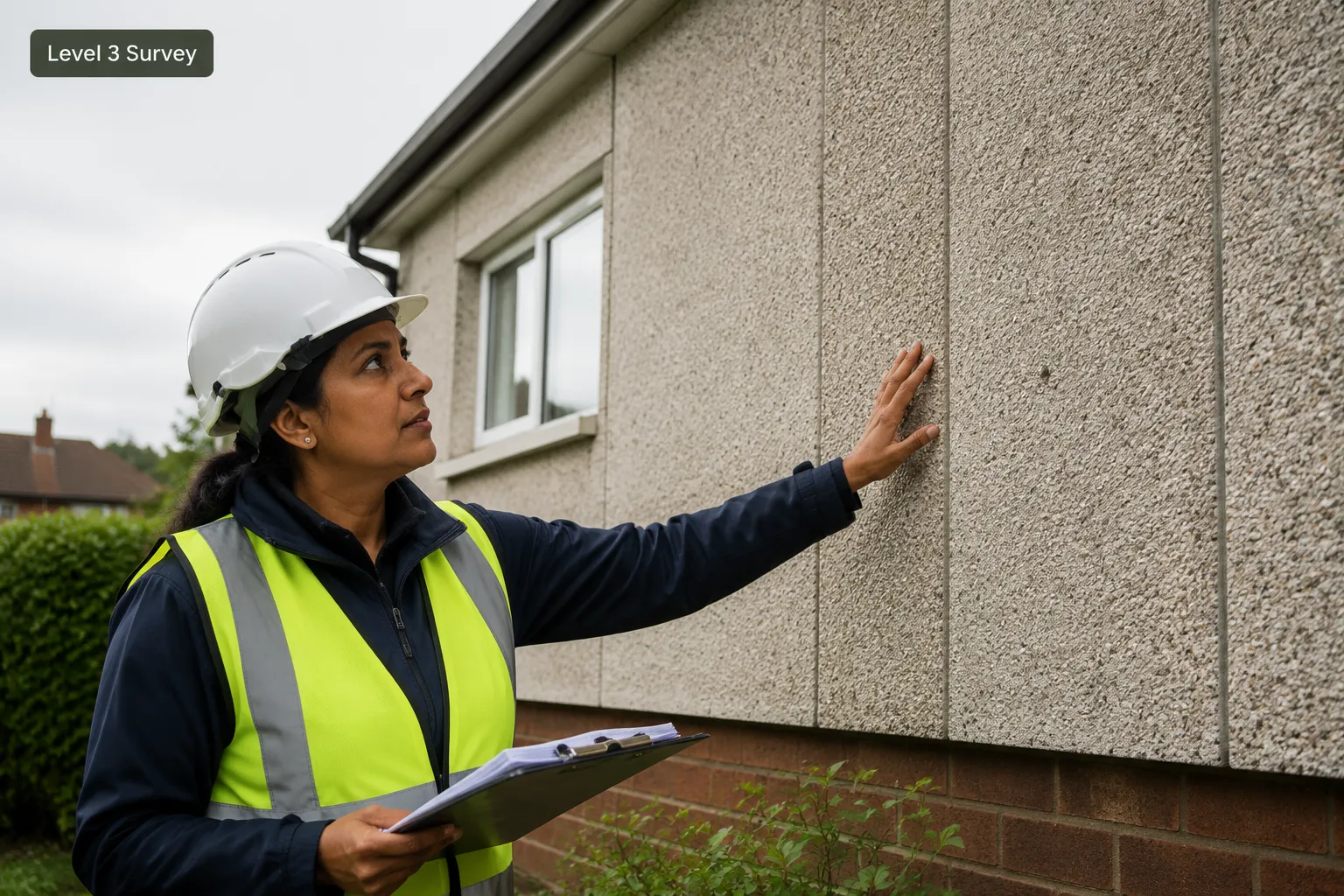
Concrete panel homes (Airey, Cornish Unit, Wimpey No-Fines) may have carbonated reinforcement, failed panel joints, or poor thermal performance. These issues are not visible without close inspection and technical knowledge of the specific system.
Timber-frame properties require assessment of the frame condition, vapour barrier integrity, and any evidence of moisture ingress within the wall build-up, none of which a Level 2 survey addresses in adequate depth.
Converted buildings (barns, chapels, commercial-to-residential) often combine original historic fabric with modern interventions, creating complex junctions where damp, thermal bridging, and structural movement are common.
Thatched properties require specialist knowledge of roof condition, fire risk, and maintenance obligations that fall entirely outside a standard Level 2 inspection.
In all of these cases, a structural survey may also be warranted alongside or as part of the Level 3 report, depending on the specific concerns identified.
Conversions: The Category That Most Often Gets the Wrong Survey
Converted properties, whether a Victorian warehouse divided into flats, a barn converted to a dwelling, or a commercial building repurposed for residential use, occupy a particularly important position in the conventional vs non-standard debate. They may look conventional from the street but contain non-standard structural systems, unusual materials, or building services configurations that require expert interpretation.
The Q2 2026 market includes a growing number of such conversions, particularly in urban areas where permitted development rights have expanded the commercial-to-residential pipeline. Buyers of these properties should always commission a Level 3 survey and consider whether additional specialist reports, for asbestos, drainage, or structural engineering, are also needed.
Additional Surveys That Complement the Right Level Choice
Selecting the correct RICS survey level is the foundation, but it is rarely the complete picture for non-standard or complex properties. The following specialist reports are frequently instructed alongside a Level 3 survey:
- Structural engineering assessment, for properties with movement, unusual spans, or significant alterations
- Asbestos survey, mandatory for pre-2000 properties being altered, advisable for any non-standard home of that era
- Drainage survey, particularly relevant for rural properties, older buildings, and conversions where drainage systems may be non-standard or shared
- Solid floor slab survey, for properties where the ground floor construction is unclear or where damp is suspected at low level; a solid floor slab survey can identify issues that a standard visual inspection misses
These additional surveys do not replace a Level 3 building survey, they supplement it. The Level 3 report provides the overall condition picture; specialist reports provide technical depth on specific risk areas.
Building Surveys for Conventional vs Non-Standard Homes: Level Choices in Q2 2026 Recovery, Key Decision Factors
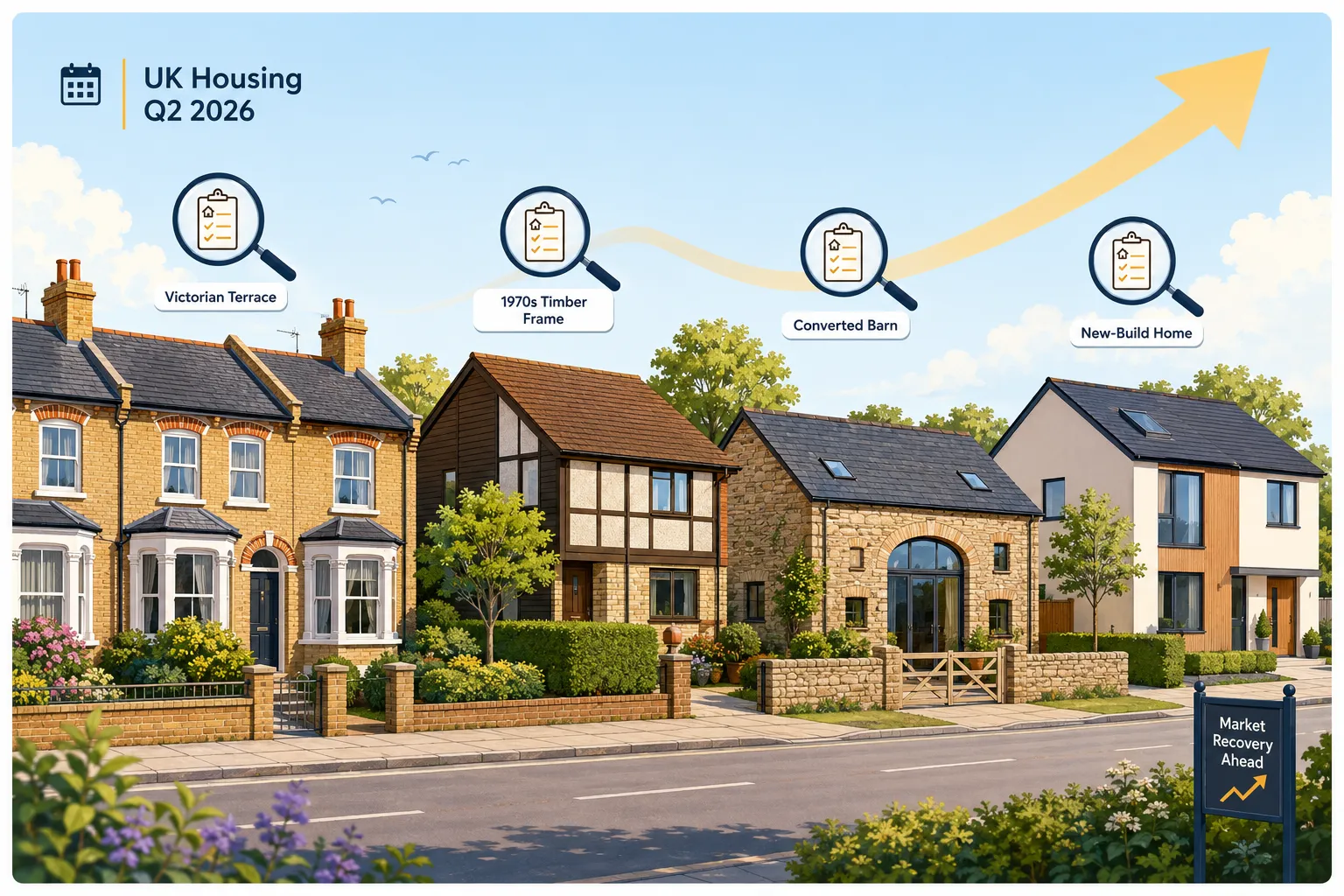
When navigating building surveys for conventional vs non-standard homes and level choices in the Q2 2026 recovery, buyers and their advisers should work through the following decision factors:
1. Construction type and age Any property built before 1930 or using non-standard materials should default to Level 3. No exceptions.
2. Mortgage lender requirements Many lenders require a Level 3 survey, or at minimum a more detailed valuation, before lending on non-standard construction. Check lender requirements before instructing a survey.
3. Planned works If the buyer intends to extend, alter, or renovate, a Level 3 report provides the baseline condition data that any structural engineer or contractor will need.
4. Market conditions and negotiating strategy In Q2 2026’s more cautious market, where stock has risen 23.3% since Q2 2023 but sales have grown only 9.8% [4], a detailed Level 3 report is a negotiating asset. It provides documented evidence of condition that can support price adjustments or withdrawal without penalty.
5. Knight Frank’s forecast of around 1.5% price growth for 2026 [5], with downward revisions for prime London and country markets, means that in segments where non-standard and period properties are concentrated, values are not rising fast enough to absorb undisclosed repair liabilities.
6. Investment and rental context With rental supply rising approximately 2.9% year-on-year in June 2026, institutional landlords acquiring mixed or non-standard stock are increasingly commissioning higher-level technical surveys as standard due diligence. Individual buyers should apply the same discipline.
Conclusion
The Q2 2026 housing market rewards careful due diligence. With completions rising, stock levels high, affordability stretched, and a significant proportion of transactions involving older or non-standard properties, the choice of survey level is not a cost-cutting decision, it is a risk management decision.
For conventional homes in good condition, a Level 2 HomeBuyer Survey remains a proportionate and cost-effective choice. For non-standard construction, conversions, older properties, or any home with visible defects or a complex alteration history, a Level 3 building survey is the appropriate minimum. Supplementary specialist reports should be added wherever the property type or condition warrants them.
Actionable next steps:
- Identify the construction type and age of the property before instructing any survey.
- Consult a local chartered surveyor to confirm the appropriate survey level for the specific property.
- Ask the surveyor explicitly whether additional specialist reports, structural, asbestos, drainage, are recommended given the property’s characteristics.
- Use the survey findings actively: in Q2 2026’s buyer-leaning market, a well-evidenced Level 3 report is a legitimate and effective negotiating tool.
- Do not allow time pressure or budget constraints to drive a downgrade from Level 3 to Level 2 on a property that genuinely warrants the higher level. The cost difference is small relative to the potential liability of an undiscovered defect.
References
[1] Twentyci Property Homemover Report Q2 2026 – twentyci.co.uk
[2] House Price Index Q2 2026 – nationwide-intermediary.co.uk
[3] Landmark Residential Property Trends Report Q2 2026 England And Wales July 2026 – landmark.co.uk
[4] How Q2 2026 Compared With The UK – jacobshunt.co.uk
[5] UK Housing Market Forecast Q2 2026 – knightfrank.co.uk
[6] UK Real Estate Market Outlook Q2 2026 – aberdeeninvestments.com
[7] redrootsproperty.co.uk – redrootsproperty.co.uk
[8] What You Need Know About Property Market Q2 2026 – platformhomeownership.com
Related services from Canterbury Surveyors
- RICS property valuations
- RICS Homebuyer Surveys (Level 2)
- Building Surveys (Level 3)
- Structural engineers in Canterbury & Kent
Get a fixed-fee quote or call 0204 579 8270.