
Canterbury & Kent
Proptech Trends for Property Surveyors in 2026: Agentic AI, VR, and Blockchain Integration
By the close of 2025, more than 85% of real estate brokerages in the United States had adopted at least one AI-powered tool, yet most were still using AI as a passive assistant rather than an active decision-maker [9]. That gap is closing fast. The Proptech Trends for Property Surveyors in 2026: Agentic AI, VR, and Blockchain Integration represent a fundamental shift in how chartered surveyors gather data, assess risk, and deliver value to clients. No longer confined to automated reports or chatbot queries, the new wave of property technology is autonomous, immersive, and cryptographically secure.
For surveyors across the UK, whether working in central London or across the South East, understanding these developments is not optional. The firms that adopt early will set the benchmark; those that wait risk being left behind.
Key Takeaways
- Agentic AI is the defining proptech shift of 2026, moving from passive tools to autonomous systems that can plan, execute, and adapt survey-related tasks without constant human input.
- Virtual reality and augmented reality are enabling remote and pre-visit property assessments, reducing site visit costs and improving client communication.
- Blockchain technology is emerging as the most reliable mechanism for securing property title records and streamlining transaction due diligence.
- Survey firms that integrate these three technologies into a coherent workflow will gain measurable competitive advantages in speed, accuracy, and client trust.
- Adoption does not require a complete overhaul, phased integration starting with AI-assisted reporting is the recommended entry point for most practices.
Agentic AI: From Passive Tool to Autonomous Survey Partner
What Agentic AI Actually Means
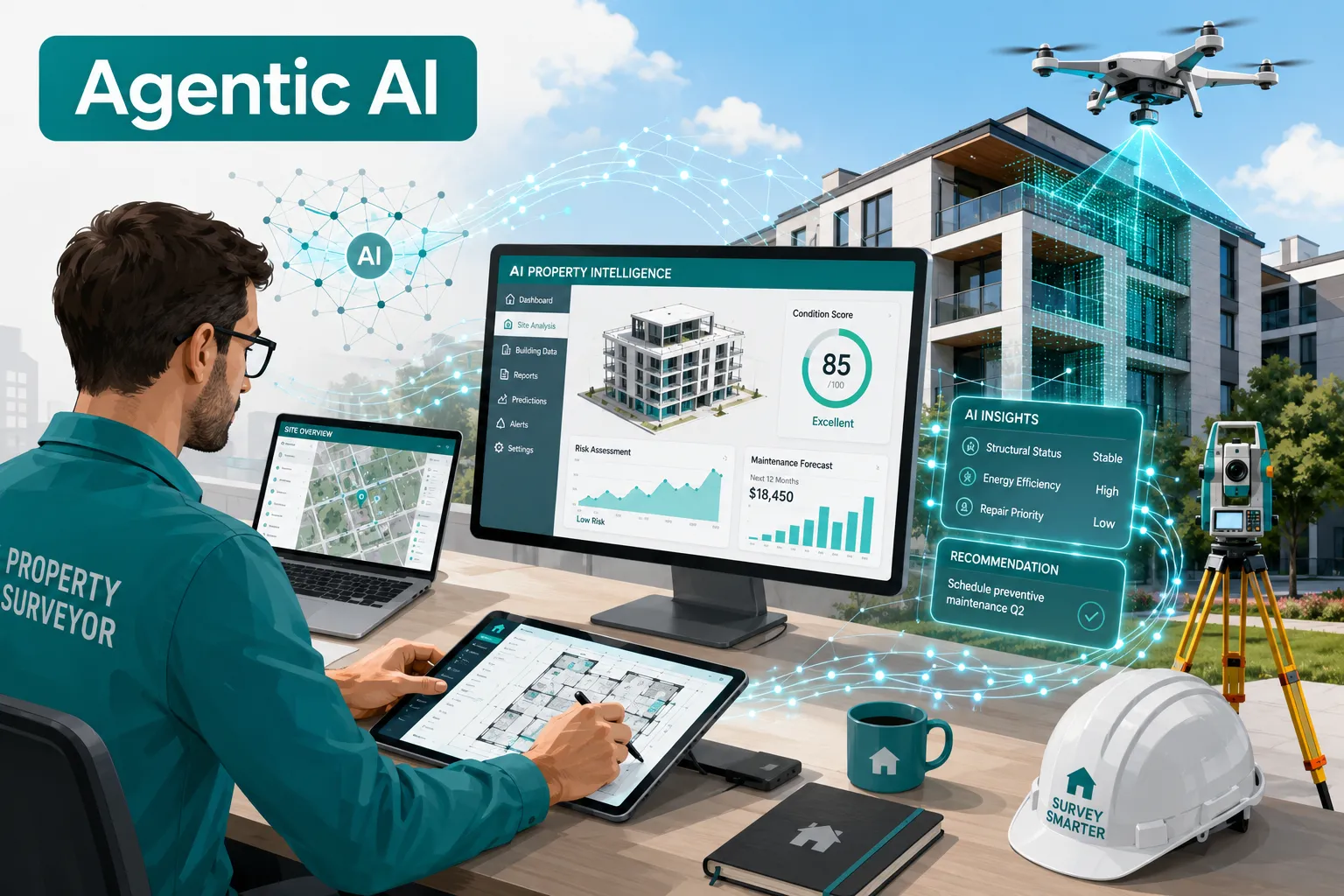
The term “agentic AI” refers to systems that do not merely respond to prompts, they set sub-goals, execute multi-step tasks, and adjust their approach based on real-time feedback [1]. In a surveying context, this means an AI system that can autonomously pull planning history data, cross-reference comparable sales, flag structural anomalies from drone imagery, and draft a preliminary report, all before the surveyor sets foot on site.
“The shift from traditional AI to agentic AI is not incremental. It is architectural.” [4]
This is the defining characteristic of the Proptech Trends for Property Surveyors in 2026 landscape: the move from tools that assist to systems that act.
Practical Applications for Survey Firms
Agentic AI is already being deployed across several surveying workflows:
- Pre-inspection data aggregation: AI agents pull planning applications, flood risk data, EPC ratings, and title register entries automatically, presenting surveyors with a pre-populated briefing pack before site visits.
- Defect pattern recognition: Machine learning models trained on thousands of survey images can identify crack patterns, damp indicators, and roof deterioration with accuracy that rivals experienced practitioners [2].
- Report generation and compliance checking: Agentic tools can draft RICS-compliant report sections, flag missing data fields, and cross-check outputs against current guidance notes.
- Client communication automation: AI agents can handle routine client queries, appointment scheduling, and follow-up correspondence, freeing surveyors for higher-value analytical work [8].
For firms offering building surveys or RICS Level 3 assessments, agentic AI can dramatically reduce the administrative burden that currently consumes a significant portion of each instruction.
Where Agentic AI Will Struggle
Not every application is a success story. Forbes analysis from early 2026 identifies key failure points: agentic systems perform poorly when data inputs are inconsistent, when local knowledge is essential, or when nuanced professional judgment is required [6]. A surveyor assessing a Victorian terrace with non-standard construction cannot be replaced by an algorithm, at least not yet.
The practical takeaway is that agentic AI works best as a force multiplier for experienced surveyors, not as a standalone replacement. Firms should design workflows where AI handles volume tasks and humans handle interpretation.
Adoption Guide: Integrating Agentic AI into a Survey Practice
| Phase | Action | Timeline |
|---|---|---|
| 1 | Audit current workflows for repetitive data tasks | Month 1-2 |
| 2 | Pilot one AI-assisted tool (e.g., report drafting or data aggregation) | Month 3-4 |
| 3 | Train staff on AI output review and quality control | Month 5-6 |
| 4 | Expand to client-facing AI communication tools | Month 7-9 |
| 5 | Review ROI and plan full integration | Month 10-12 |
The ICSC notes that firms treating 2026 as an experimentation year, rather than waiting for a “mature” solution, will build institutional knowledge that becomes a durable competitive advantage [10].
Virtual Reality and Augmented Reality in Property Surveying
The Case for Immersive Technology
Virtual reality (VR) and augmented reality (AR) have moved well beyond gaming and marketing applications. In 2026, these tools are reshaping how surveyors conduct pre-visit assessments, communicate findings to clients, and collaborate with structural engineers and architects on complex instructions.
The core value proposition is straightforward: immersive 3D environments allow surveyors to examine a property in detail before committing to a site visit, and to present findings in a format that non-specialist clients can genuinely understand.
Key Use Cases for Surveyors
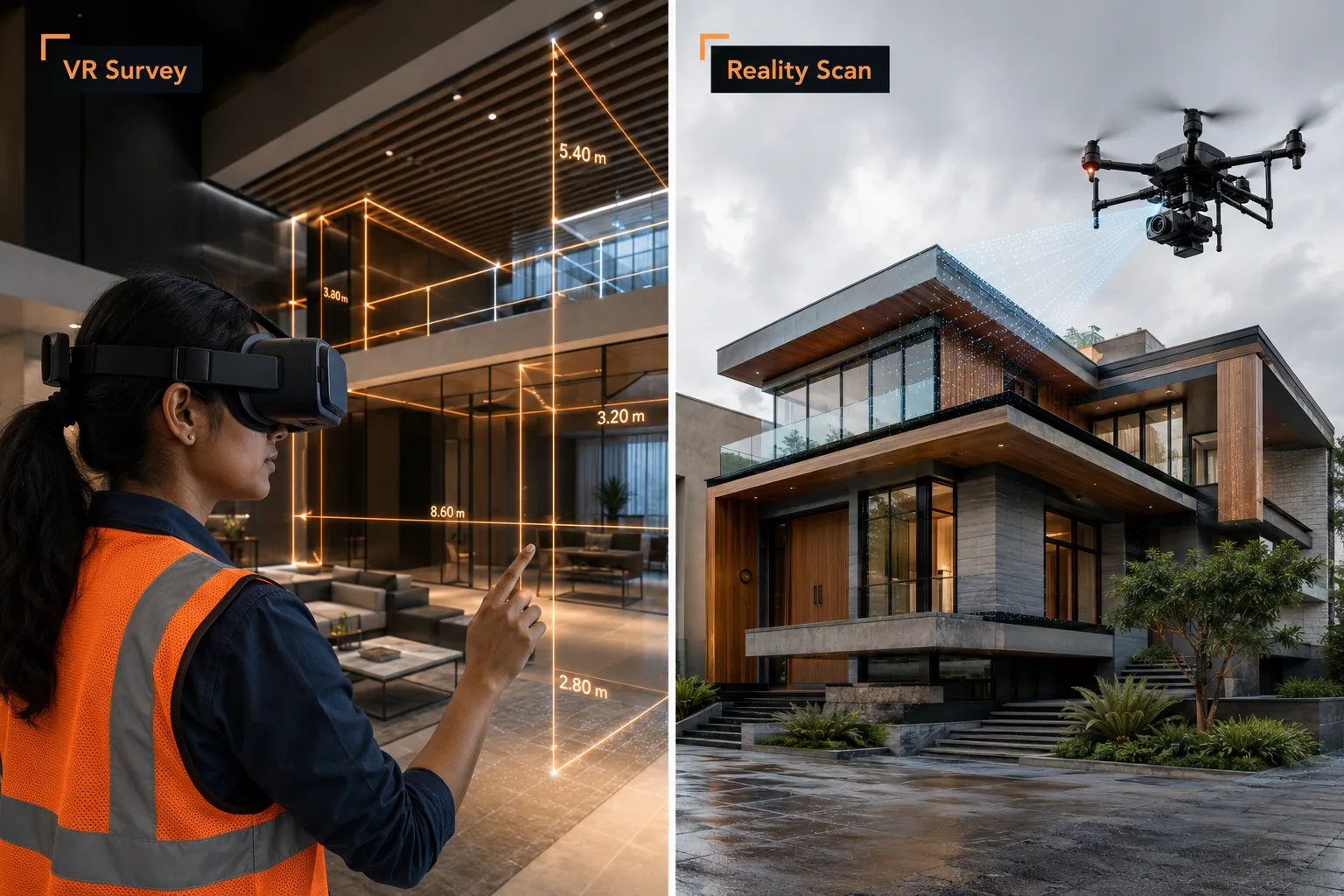
Remote pre-assessment surveys Using LiDAR-equipped drones and 360-degree cameras, survey firms can generate photorealistic 3D models of a property’s exterior and accessible interior spaces. Surveyors can then conduct a preliminary walkthrough in VR, identifying areas of concern that require closer physical inspection. This approach is particularly valuable for commercial building surveys where large floor plates and complex roof structures make initial scoping time-intensive.
Client-facing report presentation Rather than handing a client a 40-page PDF, surveyors can guide them through a virtual model of their prospective purchase, highlighting defects in context. Research consistently shows that visual, spatial communication of risk leads to better client decision-making and fewer post-survey disputes.
Collaborative structural assessment AR overlays allow multiple professionals, surveyors, structural engineers, and project managers, to annotate the same virtual model simultaneously, regardless of physical location. For instructions involving residential structural assessments or damp surveys, this collaborative layer adds significant analytical depth.
Training and competency development VR environments allow junior surveyors to practice defect identification in simulated properties before working on live instructions. This accelerates competency development and reduces the risk of missed defects on early-career inspections.
Hardware and Software Landscape in 2026
The hardware barrier has dropped considerably. Standalone VR headsets capable of rendering survey-quality 3D models now cost under £500, and cloud-based platforms handle the heavy processing load. Key platforms operating in the proptech space include tools that integrate directly with drone capture workflows, producing navigable models within hours of a site visit.
Limitations to acknowledge:
- VR models cannot replace physical touch-and-test inspections for moisture, structural movement, or material quality.
- Data capture quality depends heavily on drone operator skill and site access.
- Client adoption of VR presentation formats remains uneven, some clients still prefer traditional written reports.
The Proptech Trends for Property Surveyors in 2026 picture is therefore one of VR as a powerful complement to traditional methods, not a replacement for them.
Blockchain Integration: Securing Property Data and Streamlining Transactions
Why Blockchain Matters for Surveyors
Property transactions involve a chain of trust: buyers, sellers, solicitors, lenders, and surveyors all rely on the accuracy of title records, planning histories, and valuation data. Blockchain technology, specifically distributed ledger systems, offers a mechanism for making that data tamper-proof, transparent, and instantly verifiable.
For surveyors, the most immediate application is in due diligence. When title data, planning consents, and previous survey records are stored on a verified blockchain, the pre-inspection research phase becomes faster and more reliable. There is no risk of records being altered, misfiled, or selectively disclosed [7].
Practical Blockchain Applications in 2026
Immutable survey records Storing completed survey reports on a blockchain creates a permanent, timestamped record that cannot be retrospectively altered. This has significant implications for professional indemnity claims, where disputes often hinge on what was documented and when.
Smart contracts for transaction milestones Smart contracts, self-executing agreements coded onto a blockchain, can automate the release of survey reports, valuation certificates, and title confirmations at predefined transaction milestones. This reduces delays caused by manual document exchange and eliminates the risk of version-control errors.
Verified property data marketplaces Several proptech platforms are building blockchain-verified data marketplaces where surveyors can access authenticated planning histories, environmental records, and comparable transaction data. The quality of data underpinning a registered RICS valuation or a reinstatement cost assessment directly affects its accuracy, blockchain verification raises that baseline.
Title fraud prevention Property title fraud costs the UK millions of pounds annually. Blockchain-based title registries make fraudulent title transfers significantly harder to execute, as every change requires cryptographic verification from multiple parties.
Adoption Challenges
Blockchain adoption in UK property is still at an early institutional stage. HM Land Registry has been piloting distributed ledger technology for several years, but full integration remains a medium-term prospect. In the near term, surveyors are more likely to encounter blockchain through:
- Third-party proptech platforms that use blockchain for data verification
- Commercial clients requiring blockchain-based audit trails for portfolio transactions
- International transactions where cross-border title verification is complex
Survey firms working with commercial property surveyors on large portfolio instructions are the most likely early adopters, given the volume of due diligence data involved.
How These Three Technologies Work Together
The most powerful version of the Proptech Trends for Property Surveyors in 2026: Agentic AI, VR, and Blockchain Integration story is not about three separate tools, it is about a converged workflow.
Consider a typical residential purchase instruction in 2026:
- An agentic AI system automatically pulls title register data, planning history, flood risk assessments, and comparable sales the moment an instruction is received.
- A drone captures a LiDAR scan and 360-degree imagery of the property, which is processed into a navigable 3D model.
- The surveyor conducts a virtual pre-assessment in VR, identifying areas requiring close physical inspection.
- The physical site visit is focused, efficient, and targeted at the specific risk areas identified in steps 1-3.
- The completed survey report is stored on a blockchain-verified platform, creating an immutable record accessible to the client, their solicitor, and their lender.
- A smart contract releases the report to all parties simultaneously upon payment confirmation.
This workflow is not speculative. Each component exists today. The competitive advantage in 2026 lies in integrating them into a coherent, repeatable process [3].
Building a Technology Adoption Roadmap for Survey Firms
Firms at different scales will approach adoption differently. The following framework applies regardless of practice size:
Assess before investing. Map current workflows to identify where time is lost, where errors occur, and where client satisfaction is weakest. Technology should solve real problems, not create new ones.
Start with AI, then layer in VR and blockchain. Agentic AI tools have the lowest barrier to entry and the fastest return on investment. VR hardware and blockchain platforms require more significant upfront investment and workflow redesign [5].
Invest in staff training. The biggest risk in technology adoption is not the technology itself, it is the gap between tool capability and staff competency. Budget for training alongside hardware and software costs. For guidance on how technology affects overall service pricing, the surveyor pricing guide provides a useful reference point.
Engage clients proactively. Many clients will be unfamiliar with VR-based report presentations or blockchain-verified documents. Firms that explain the benefits clearly will differentiate themselves from competitors who adopt technology without communicating its value.
Monitor regulatory developments. RICS guidance on AI-assisted reporting and blockchain-based records is evolving. Staying current with professional body updates is essential for compliance and professional indemnity purposes.
Conclusion
The Proptech Trends for Property Surveyors in 2026: Agentic AI, VR, and Blockchain Integration are not distant possibilities, they are active developments reshaping how survey firms operate right now. Agentic AI is automating the data-heavy, time-consuming elements of survey preparation and reporting. Virtual reality is transforming how surveyors assess properties and communicate findings. Blockchain is building the trust infrastructure that property transactions have always needed but never had.
Actionable next steps for survey firms:
- Identify one agentic AI tool to pilot within the next 90 days, report drafting or data aggregation are the lowest-risk starting points.
- Invest in a drone and 3D modelling platform to begin building VR pre-assessment capability for commercial and high-value residential instructions.
- Monitor HM Land Registry blockchain pilot developments and engage with proptech platforms offering verified data services.
- Review professional indemnity cover to ensure it addresses AI-assisted outputs and blockchain-stored records.
- Brief clients on new technology capabilities as a differentiator, transparency builds trust.
Firms that treat 2026 as the year to experiment, learn, and build institutional knowledge will be the benchmark practices of 2028 and beyond.
References
[1] What Is Agentic Ai And Why Does It Matter For Real Estate – inman.com
[2] Ai Use Cases In Real Estate – blott.com
[3] Agentic Ai Real Estate 2026 Playbook – bounti.ai
[4] Leading Ai Transformation In Real Estate The Shift From Traditional To Agentic Ai – inman.com
[5] Agentic Ai Real Estate Agents 2026 – blog.kristamashore.com
[6] How Agentic Ai Will Win And Where It Will Fail In Real Estate – forbes.com
[7] Proptech Briefing February 2026 Michael Bristow Wnh5e – linkedin.com
[8] How Agentic Ai Is Transforming The Real Estate Business Model – charterglobal.com
[9] 2026 Ai Productivity Report Us Realtors – theagentalmanac.com
[10] Next Phase Of Proptech Agentic Ai In 2026 – icsc.com
Related services from Canterbury Surveyors
Get a fixed-fee quote or call 0204 579 8270.