
Canterbury & Kent
Your First Home Scheme Kent New-Build Buyers: What We Know Before the 28 October Budget
A scheme that could cut a first-time buyer’s deposit to 2.5% of the purchase price has not yet launched, and already Kent estate agents, developers and buyers are recalculating their plans around it. The “Your First Home” scheme, trailed ahead of the Autumn Budget on 28 October 2026, is generating more questions than answers for anyone hoping to buy a new-build home in Canterbury or East Kent. This article sets out exactly what has been reported so far, why the numbers matter differently in Kent than elsewhere, and what buyers should be doing in the meantime.
Key Takeaways
- The “Your First Home” scheme has not officially launched. Full detail is expected at the Autumn Budget on 28 October 2026, delivered by Chancellor John Healey (Zoopla, 15 October 2026; HomeOwners Alliance, 14 October 2026).
- Reported structure: a 2.5% deposit, a 20% government equity loan, and a mortgage covering the remaining 77.5%, with income caps, local price caps and developer contributions expected.
- Using Canterbury’s £334,750 median sale price across all property types as an illustrative proxy, that split works out to roughly an £8,369 deposit, a £66,950 equity loan and a £259,431 mortgage, figures that will differ for an actual new-build price.
- Canterbury district recorded 1,232 new-build completions in the year to March 2025, up 61% year on year and more than double its 10-year average (Kent County Council, reported by Kent Current, July 2026).
- Mortgage rates remain a real constraint: average five-year fixes briefly topped 6% in early October 2026, the highest in nearly three years (Rightmove via Tembo, 15 October 2026).
What Is the Your First Home Scheme for Kent New-Build Buyers?
The government has announced a new homeownership scheme aimed squarely at first-time buyers purchasing new-build properties from participating developers in England. According to the Zoopla explainer published on 15 October 2026 and the HomeOwners Alliance update of 14 October 2026, the scheme is still awaiting full confirmation, with the Chancellor expected to set out firm details at the Autumn Budget on 28 October 2026.
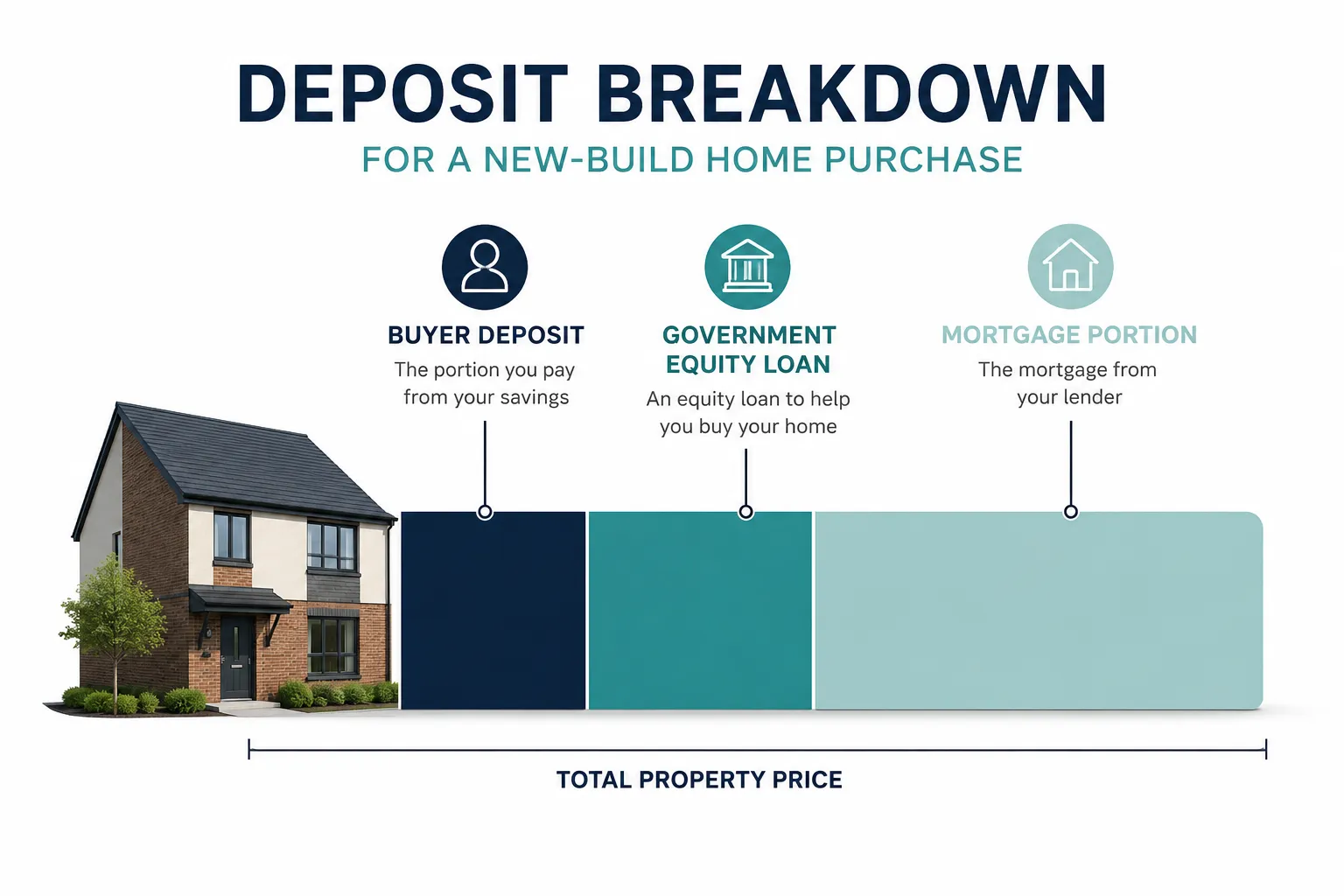
The headline structure reported so far involves three parts: a 2.5% deposit from the buyer, a 20% equity loan from government, and a mortgage covering the remaining 77.5% of the purchase price. Both sources stress that household income caps, regional or local property price caps, and contributions from participating developers are all expected features, alongside an initial interest-free period on the equity loan. None of this is confirmed law or policy yet, it is reported and expected detail, and buyers in Canterbury and across Kent should treat it as provisional until the Budget.
For anyone tracking Your First Home scheme Kent new-build buyers coverage closely, the key point is timing: nothing changes for mortgage applications or reservations until the scheme is formally launched, which has not happened as of 18 October 2026.
How It Compares with the Old Help to Buy Equity Loan
Conceptually, the new scheme echoes the Help to Buy equity loan, which closed to new applicants in 2022/2023. Both use a government equity loan alongside a buyer deposit and a mortgage to reduce the amount a first-time buyer needs to borrow upfront, and both are restricted to new-build homes bought through participating developers.
The proportions reported for Your First Home differ from the old scheme’s structure, and the detail on repayment, interest charging after any initial interest-free period, and regional price caps is still being finalised. Buyers should not assume rules carried over from Help to Buy will apply unchanged, caps, developer participation and repayment terms are all open questions pending 28 October.
The Deposit Maths: Your First Home Scheme Kent New-Build Buyers at Canterbury Prices
Kent pricing data gives a useful, if imperfect, way to picture how the reported structure might work in practice. HM Land Registry figures via the Construction Capital Q3 2026 report, covering sales in the 12 months to 31 May 2026 across all property types, put Kent’s median sale price at £345,000 and Canterbury’s at £334,750, down 1.5% year on year. Kent’s median flat price was £183,956 and its median terraced house £291,250.
Using Canterbury’s £334,750 median sale price across all property types purely as a proxy price, not a new-build figure, the reported 2.5% / 20% / 77.5% split would look like this:
| Element | Share | Illustrative amount |
|---|---|---|
| Buyer deposit | 2.5% | £8,369 |
| Government equity loan | 20% | £66,950 |
| Mortgage | 77.5% | £259,431 |
This is illustrative arithmetic only. New-build prices can sit well above or below an area’s all-property median, and any local price caps confirmed on 28 October could exclude higher-value Kent developments altogether. Still, the exercise shows why a lower deposit threshold could matter in a market where raising a lump sum has been the main barrier for many first-time buyers.
Kent’s New-Build Pipeline: Supply Behind the Headlines
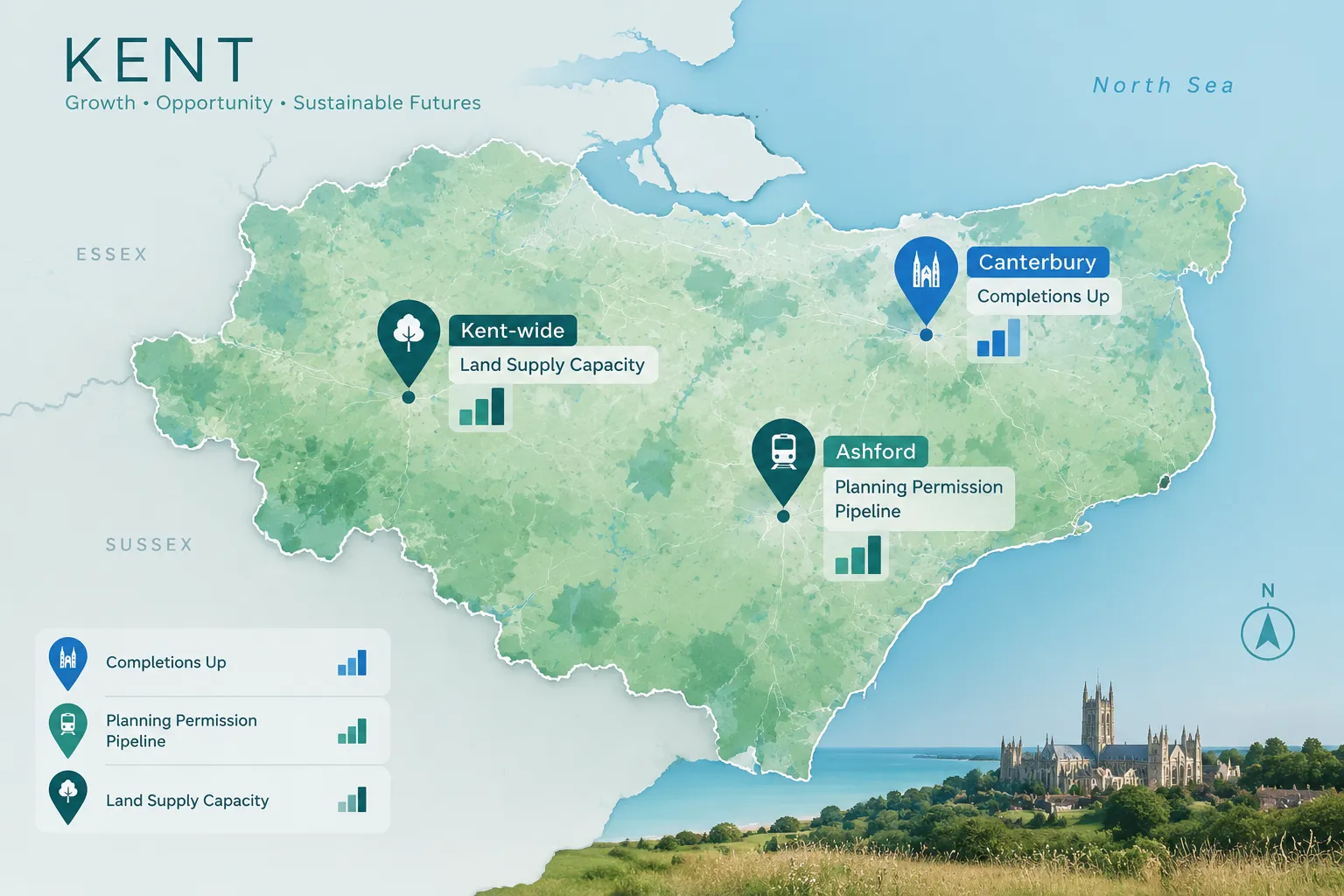
A scheme restricted to new-build homes only works if there is stock to buy into. Kent’s pipeline looks substantial on paper. The Kent County Council Housing Information Audit, reported by Kent Current in July 2026 and covering the year to March 2025, recorded 7,660 net completions across Kent, up almost 8% year on year.
Canterbury district alone delivered 1,232 completions in that period, up 61% year on year and more than twice its 10-year average, with capacity identified for a further 5,275 homes within its five-year land supply. Kent-wide, 47,839 homes have planning permission but are not yet built, 35,040 not started and 12,799 under construction, while Ashford alone has 9,584 permitted homes still to come.
For buyers weighing up whether to wait for new-build stock in East Kent, this pipeline data suggests supply is building, even if the pace at which permitted homes actually reach completion varies by developer and site. Readers tracking the wider local market may find the earlier analysis in Kent’s South East property market and Canterbury house prices useful context for how pricing and supply have moved through 2026.
Mortgage Rates and Affordability Right Now
Any equity-loan scheme still leaves buyers borrowing the majority of a purchase price, so mortgage pricing matters as much as deposit size. Average five-year fixed rates briefly passed 6% in early October 2026 for the first time in nearly three years, and stood at 5.99% on 15 October, with two-year fixes averaging 5.97% (Rightmove via Tembo). The Bank of England base rate has remained at 3.75% since December 2025.
There is some relief at higher loan-to-value tiers: Yorkshire Building Society was offering 90% LTV first-time-buyer five-year fixes at 5.27% as of 14 October 2026, according to Moneyfacts. Zoopla’s House Price Index for September 2026 noted listings up 5% year on year, but also flagged that the highest mortgage rates in three years are reducing buyers’ purchasing power, a reminder that a smaller deposit does not automatically mean a cheaper monthly repayment.
Risks to Weigh Before You Apply
Three risks stand out for anyone considering a new-build purchase under this scheme once it launches:
- New-build premium. New homes often carry a price premium over comparable existing stock, which can affect value from day one and matters if the equity loan’s repayment amount is linked to the property’s future value rather than a fixed sum.
- Equity loan repayment uncertainty. Reported detail suggests the loan will track property value rather than inflation, meaning a rise in value increases what is owed back, similar in principle to how Help to Buy loans operated before closing to new applicants in 2022/2023.
- Rate exposure at the end of any interest-free period. With five-year fixes close to 6%, the mortgage portion of a purchase remains the single biggest cost risk, regardless of deposit size.
What to Watch for on 28 October
The Autumn Budget on 28 October 2026 should clarify the details that currently remain open: exact income caps, whether price caps will be set regionally or locally for Kent districts, which developers will participate, how long any interest-free period on the equity loan will last, and how and when the loan must be repaid. Until then, treat every figure in circulation as reported and subject to change.
Why a Snagging Survey and Independent Valuation Still Matter
Whatever the final scheme design, buying a new-build home under any government-backed structure does not remove the need for independent checks. A builder’s warranty covers certain defects, but it is not a substitute for a professional inspection, and an equity loan tied to future value makes an accurate opening valuation more important, not less.
A snagging and final building survey for new build homes carried out before legal completion, or shortly after, can identify defects while the developer is still obligated to fix them under the defects period. Buyers weighing up whether a survey is needed on a new build at all should note that newly built does not mean defect-free, RICS-qualified surveyors regularly find issues ranging from poor finishing to more serious structural or drainage faults. An independent valuation survey for new build properties can also flag whether a listed price reflects genuine market value or an inflated new-build premium, which matters directly for anyone whose equity loan repayment will be calculated against that value later. Those unsure which level of inspection suits a new-build purchase can review the differences set out in homebuyer survey versus building survey guidance, and broader new-build snagging protocols explain what RICS checklists cover beyond the builder’s warranty.
What to Do Now
- Hold off on firm decisions until the Budget on 28 October confirms scheme rules, caps and eligibility.
- Get mortgage advice in parallel, since current five-year fixes near 6% affect affordability regardless of deposit size.
- Research participating developers once named, and compare any new-build asking price against Kent’s all-property medians as a sanity check.
- Budget for independent surveys and valuations on any new-build reservation, these remain essential whatever the final scheme design.
- Speak to a local RICS firm, such as Canterbury Surveyors, chartered surveyors covering Kent, about timing a snagging inspection or valuation around exchange and completion dates.
Frequently Asked Questions
Has the Your First Home scheme launched yet? No. As of 18 October 2026, it has not launched. Full details are expected at the Autumn Budget on 28 October 2026 (Zoopla, 15 October 2026; HomeOwners Alliance, 14 October 2026).
What deposit will buyers need under the reported structure? Reports describe a 2.5% buyer deposit, a 20% government equity loan and a mortgage for the remaining 77.5%, though income caps, price caps and developer participation are still to be confirmed.
Is the £334,750 figure a new-build price? No. It is Canterbury’s median sale price across all property types in the 12 months to 31 May 2026 (HM Land Registry via Construction Capital Q3 2026). It is used here only as an illustrative proxy, since actual new-build prices can differ.
How does this scheme differ from Help to Buy? Conceptually it is similar, an equity loan plus deposit plus mortgage for new-build purchases, but the proportions and repayment terms reported differ from Help to Buy, which closed to new applicants in 2022/2023.
Will I still need a survey on a new-build home bought through this scheme? Yes. A builder’s warranty does not replace an independent snagging survey or valuation, both of which help confirm the property’s condition and genuine market value.
Why does Kent’s new-build completion data matter for this scheme? Because the scheme only applies to new-build homes, the volume of stock matters. Canterbury alone recorded 1,232 completions in the year to March 2025, up 61% year on year (Kent County Council, reported by Kent Current, July 2026), suggesting more new-build choice locally than the 10-year average.
Conclusion
The Your First Home scheme could meaningfully lower the deposit barrier for first-time buyers targeting new-build homes in Canterbury and East Kent, but nothing is confirmed until the Autumn Budget on 28 October 2026. Kent’s new-build pipeline is expanding, and mortgage products at higher loan-to-value ratios are available, yet rates near 6% mean the size of the deposit is only part of the affordability picture. Buyers should treat all current figures as provisional, keep mortgage advice moving in parallel, and budget for an independent survey and valuation on any new-build reservation regardless of which scheme eventually applies.
Related services from Canterbury Surveyors
- RICS property valuations
- RICS Homebuyer Surveys (Level 2)
- Building Surveys (Level 3)
- Structural engineers in Canterbury & Kent
Get a fixed-fee quote or call 0204 579 8270.