
Canterbury & Kent
Canterbury and Kent Property Market September 2026: Regional Buyer Response to the BoE Rate Hold
Last updated: September 17, 2026
Quick Answer
The Bank of England held Bank Rate at 4% on 17 September 2026, with the best five-year fixed mortgages sitting around 4.38%. Canterbury and Kent property market September 2026 activity shows buyers using stable-but-high borrowing costs, plentiful stock and long selling times to negotiate hard, while HS1-linked Ashford, university-driven Canterbury and coastal Whitstable and Herne Bay each respond differently depending on buyer type and price point.
Key Takeaways
- The Bank of England held Bank Rate at 4% today, keeping the best five-year fixes around 4.38% and giving buyers a stable, if still costly, borrowing backdrop.
- Kent had roughly 41,397 properties for sale in August 2026, with an average of 200 days on market, pointing to a market tilted toward buyers.[1]
- Canterbury district’s average house price stood at £338,030 in June 2026, down 1.6% month-on-month but up 3.3% year-on-year.[2][3]
- Canterbury sits below the Kent county median (£345,000) but above the UK national median (£285,000), making it relatively good value within the region.[4]
- Detached homes face the sharpest affordability pressure, while flats and terraces remain more resilient to the rate environment.[3][4]
- Average private rents in Canterbury reached £1,280 a month in August 2026, keeping buy-to-let yields attractive despite flat capital growth.[5]
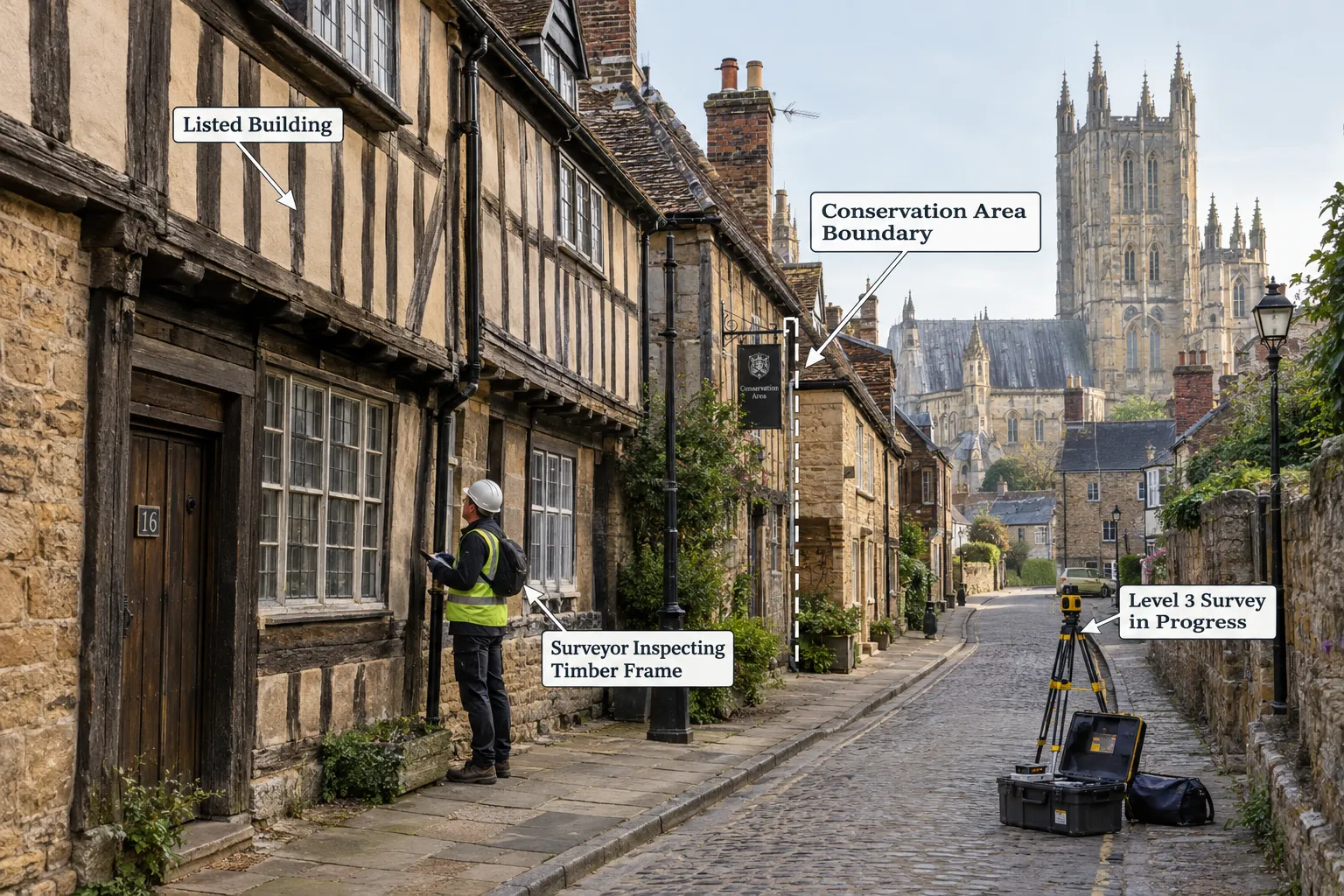
- Conservation area rules and listed building consent shape renovation options across Canterbury’s medieval and Georgian core, and Level 3 Building Surveys are in high demand for this older stock.
What Happened with Bank of England Interest Rates in September 2026
The Bank of England’s Monetary Policy Committee held Bank Rate at 4% on 17 September 2026, confirming the decision via its Monetary Policy Summary and minutes published that day.[10] For Kent buyers, this matters because it removes the risk of an immediate rise in monthly repayments, but it does not bring relief either.
Mortgage lenders have priced this stability into their offers, with the best five-year fixed rates available around 4.38% for well-qualified borrowers with a reasonable deposit. Buyers care about this decision because:
- It sets the floor for monthly mortgage costs across every Kent town, from Canterbury to Ashford.
- It influences how much lenders will offer against a given income, directly affecting maximum purchase budgets.
- Estate agents and sellers watch the announcement closely because it shapes buyer confidence and how quickly offers come in.
A rate hold, rather than a cut, means Kent buyers should plan around current affordability rather than wait for cheaper borrowing that may not arrive soon.
How Did the BoE Rate Hold Affect Canterbury Property Prices
The rate hold reinforced an already cautious Canterbury market rather than triggering a sudden price move. Canterbury’s average price fell by £5,665 between May and June 2026 to £338,030, a 1.6% monthly drop described as the steepest in Kent, even though prices were still up 3.3% over the year.[2][3]
This pattern, strong annual growth alongside a sharp recent dip, tells a specific story: buyers are increasingly price-sensitive and willing to negotiate, even where the longer-term trend still favours sellers. With Bank Rate held rather than cut, there is little pressure pushing buyers to act quickly, so sellers who price ambitiously in Canterbury’s medieval core or Georgian streets risk longer marketing periods.
Decision rule: if a Canterbury seller’s asking price sits more than 3-4% above recent comparable sales, expect buyers to hold out for a discount before committing, particularly on detached family homes.
Are Kent House Prices Going Up or Down in 2026, and What’s the Average Property Price in Canterbury
Kent house prices in 2026 are best described as flat with pockets of softness, not a clear rise or fall. Canterbury’s average sits around £338,030 based on Land Registry data to June 2026, while sold-price data from local agents in mid-August 2026 puts typical achieved prices closer to £347,136 and average prices paid around £364,000, reflecting differences between asking and completed sales.[2][9]
Kent-wide, the average selling price reached £439,707 in August 2026, edging up slightly over the previous two months, while the median sale price held steady at £350,000.[1] Different data sources report Canterbury’s annual growth anywhere between roughly 2.6% and 3.3%, with one report noting a year-on-year decline in achieved sold prices, underlining how the market is oscillating close to zero real growth rather than moving decisively in one direction.[2][4][7]
Kent as a whole also compares favourably against London and the national picture: prices remain notably below London prime property values but sit comfortably above the England-wide median, making the county attractive to buyers priced out of the capital.
Canterbury and Kent Property Market September 2026: Regional Buyer Response Across Towns
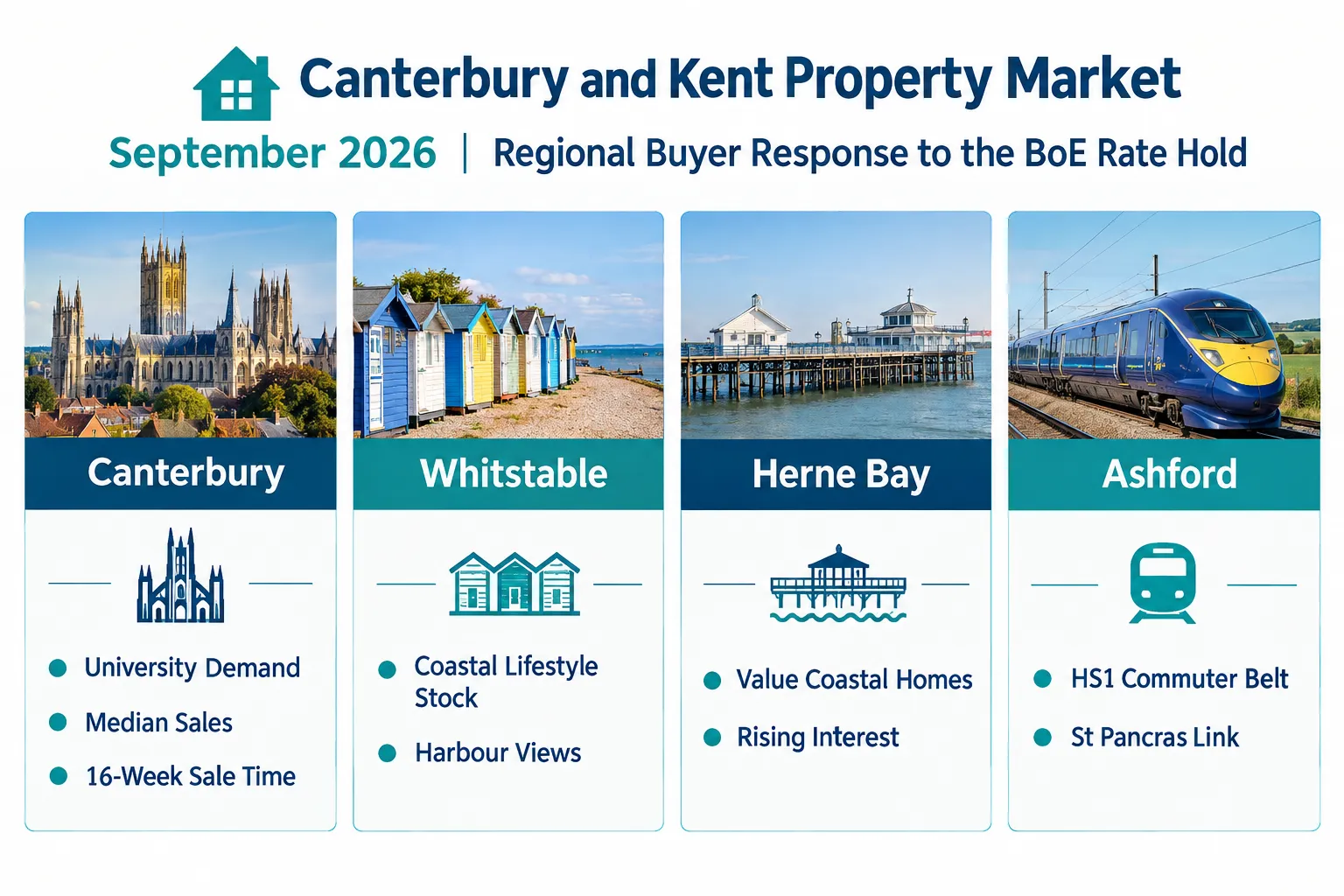
Buyer response to the September 2026 rate hold varies sharply by town, driven by transport links, lifestyle appeal and local employment. Canterbury benefits from University of Kent demand and cathedral-city tourism, Ashford leans on HS1 rail speed to St Pancras, and Whitstable and Herne Bay draw lifestyle buyers chasing coastal living.
| Town | Key Driver | Buyer Type Most Active | Market Signal |
|---|---|---|---|
| Canterbury | University, heritage, cathedral city | Investors, downsizers, families | 16-week average sale time, price-sensitive[9] |
| Ashford | HS1 to St Pancras (under an hour) | Commuters to London | Steady demand, competitive pricing |
| Whitstable | Coastal lifestyle, harbour, seafood scene | Lifestyle buyers, second-homers | Limited stock, resilient asking prices |
| Herne Bay | Value coastal alternative to Whitstable | First-time buyers, retirees | Growing interest, more affordable entry |
Canterbury’s relative liquidity, properties there average around 16 weeks on market versus a Kent-wide average of 200 days, shows that well-priced homes in the city still move faster than the county norm, even with the rate hold in place.[1][9]
How Much Does the Interest Rate Hold Impact Mortgage Affordability
Holding Bank Rate at 4% keeps monthly mortgage costs elevated but predictable, which matters more for affordability than short-term rate movements. At a 4.38% five-year fix, a £300,000 mortgage over 25 years costs noticeably more per month than it would have at pre-2022 rates, which is why lenders continue to apply strict income multiples and stress tests.
Practical affordability guidance for Kent buyers:
- Get a mortgage broker to run affordability checks against both variable and fixed products before house-hunting.
- Factor in Canterbury’s typical £330,000-£365,000 price range when calculating deposit needs.[4][9]
- Remember that detached homes (£471,000-£537,000 range) require significantly higher income multiples than terraces or flats (£184,000-£302,000 range).[3][4]
- Budget for a Level 3 Building Survey cost on older Canterbury stock, since remedial works on medieval or Georgian buildings can be expensive.
Common mistake: assuming a rate hold signals cheaper mortgages are imminent. Lenders price five-year fixes based on swap rates and future expectations, not solely on the current Bank Rate, so waiting for further falls can mean missing suitable stock.
Best Time to Buy Property in Kent Right Now: Buyer’s or Seller’s Market
Kent is currently a buyer’s market, driven by high stock levels and long selling times rather than falling demand. With roughly 41,397 properties listed in August 2026 and an average time on market of 200 days, sellers face real competition for buyer attention, giving purchasers leverage on price and completion terms.[1]
This favours buyers who are:
- Mortgage-ready with an agreement in principle already secured.
- Flexible on completion dates, since motivated sellers often reward speed with price flexibility.
- Willing to negotiate on properties that have been listed for more than three months.
Sellers, meanwhile, should expect a longer marketing period than in previous years and should price close to recent comparable sales rather than aspirational figures, particularly outside prime Canterbury postcodes.
What Do First-Time Buyers Think About the Kent Market in September 2026
First-time buyers in Kent are cautiously optimistic but frustrated by the gap between wages and mortgage affordability at a held 4% Bank Rate. Many are targeting flats and terraced houses in the £184,000-£302,000 range, which remain more accessible than detached family homes.[3][4]
Feedback patterns commonly reported by local agents include:
- Preference for Herne Bay and parts of Ashford over pricier Canterbury postcodes.
- Reluctance to compete for period Georgian or medieval properties requiring extensive Level 3 survey remedial work.
- Growing interest in new-build or recently renovated stock to avoid conservation area restrictions.
Edge case: a first-time buyer targeting a listed building in Canterbury’s conservation core should budget both extra survey costs and planning delays, since alterations often require listed building consent even for internal changes.
Common Mistakes Buying in Kent, and Who Should Avoid Buying Right Now
The most common mistake is underestimating survey and consent costs on Canterbury’s older housing stock, particularly medieval timber-framed and Georgian properties. A standard Level 2 Homebuyer Report is often insufficient for buildings with historic timber frames, uneven floors or previous unauthorised alterations, which is why RICS-registered surveyors report strong demand for full Level 3 Building Surveys across the district.
Other frequent mistakes:
- Skipping a conservation area check before planning an extension, only to find permitted development rights are restricted.
- Assuming all Canterbury sold prices reflect current market conditions, when annual data can mask a recent 1.6% monthly dip.[2][3]
- Overlooking that listed building consent, separate from planning permission, is required for most alterations to listed properties, including some internal work.
Who should avoid buying right now: buyers needing to sell an existing home within a tight three-month window may struggle, given Kent’s average marketing time of 200 days; those with no contingency for survey-flagged repairs on period stock should also pause until a full Level 3 survey is complete.[1]
What Are the Alternatives to Buying in Kent
Renting, shared ownership, and looking at neighbouring commuter towns outside prime Canterbury are the main alternatives for buyers priced out or deterred by current rates. Given Canterbury’s average monthly rent of £1,280, renting remains a viable short-term option while buyers save a larger deposit or wait for mortgage rates to ease.[5]
Other alternatives include:
- Shared ownership schemes, which reduce the deposit and mortgage size needed for a first purchase.
- Considering Herne Bay or wider Ashford borough locations, where entry prices sit below Canterbury’s £330,000-£365,000 median.[4][9]
- Delaying a purchase by six to twelve months to build a larger deposit, accepting the trade-off of continued rent payments.
How Do BoE Rate Holds Affect the Rental Market in Kent
A held Bank Rate supports continued investor activity in Kent’s private rental sector because it keeps buy-to-let borrowing costs predictable rather than rising further. Canterbury’s average monthly rent of £1,280 in August 2026, set against typical purchase prices in the mid-£300,000s, implies gross rental yields in the mid-single-digit range for many buy-to-let properties.[2][4][5]
This combination, solid rents plus a soft-but-stable sales market, means:
- Landlords face less pressure to sell than in a rising-rate environment.
- Tenants should expect rents to stay firm rather than fall, since landlord costs remain elevated.
- Investors weighing new purchases can still find reasonable yields, particularly on flats and smaller terraces near the university or HS1 stations.
Conclusion: Next Steps for Canterbury and Kent Buyers and Sellers
The Canterbury and Kent property market in September 2026 rewards patience and preparation rather than urgency. With Bank Rate held at 4%, five-year fixes near 4.38%, and Kent-wide stock levels high, buyers hold more negotiating power than they have in several years, while sellers need realistic pricing and patience given average marketing times stretching toward 200 days.[1]
Practical next steps:
- Buyers: secure a mortgage agreement in principle now, and budget for a Level 3 Building Survey on any pre-1900 Canterbury property before making an offer.
- Sellers: price against recent sold data, not peak asking prices, and expect a longer sale window than in previous years.
- Anyone buying a listed building or property inside a Canterbury conservation area: check listed building consent and conservation area restrictions with the local planning authority before committing to renovation plans.
- Investors: use Canterbury’s £1,280 average rent alongside current purchase prices to model realistic yields before expanding a portfolio.[5]
FAQ
Did the Bank of England cut interest rates in September 2026? No. The Bank of England held Bank Rate at 4% on 17 September 2026, maintaining the existing borrowing environment rather than cutting or raising rates.[10]
What is the average house price in Canterbury right now? Canterbury’s average house price was £338,030 in June 2026 according to Land Registry-based data, though separate agent sold-price data puts typical figures closer to £347,000-£364,000.[2][9]
Is Canterbury a buyer’s market or seller’s market in 2026? Canterbury and Kent broadly favour buyers in 2026, with high stock levels and average marketing times of around 200 days across the county giving purchasers more negotiating leverage.[1]
Why do I need a Level 3 Building Survey in Canterbury? Many Canterbury properties are medieval timber-framed or Georgian buildings with structural quirks that a standard Homebuyer Report will not catch, making a full Level 3 Building Survey the safer choice before purchase.
Are Kent house prices rising or falling in 2026? Kent house prices are broadly flat, with Canterbury showing around 2.6% to 3.3% annual growth by some measures alongside a recent monthly dip, rather than a clear sustained rise or fall.[2][4][7]
How does the rate hold affect renting in Canterbury? The rate hold keeps landlord borrowing costs stable, supporting firm rents; Canterbury’s average monthly rent stood at £1,280 in August 2026.[5]
References
[1] Insight The Housing Market August 2026 – philip-marks-removals.co.uk [2] Canterbury House Prices – canterburylive.co.uk [3] Canterbury House Prices June 2026 – canterburylive.co.uk [4] Canterbury Kent Property Market – constructioncapital.co.uk [5] E07000106 – ons.gov.uk [7] Canterbury – builtplace.com [9] Canterbury – getagent.co.uk [10] September 2026 – bankofengland.co.uk
Kent Mortgage Affordability Estimator (4% Bank Rate hold)
Enter figures above and click Estimate.
Illustrative capital-and-interest estimate only, not a mortgage offer. Actual lending decisions depend on income, deposit and lender criteria.
Please enter valid figures.’;return;} var m=r===0?p/n:p*r/(1-Math.pow(1+r,-n)); var total=m*n; var interest=total-p; out.innerHTML=’
Estimated monthly payment: £’+m.toFixed(0)+”+
‘ Total repaid over term: £’+total.toFixed(0)+”+
‘ Total interest paid: £’+interest.toFixed(0)+”;
}
Get a fixed-fee quote or call 0204 579 8270.Related services from Canterbury Surveyors