
Canterbury & Kent
Nationwide House Price Index October 2026: What the 0.3% Fall Means for Canterbury and Kent
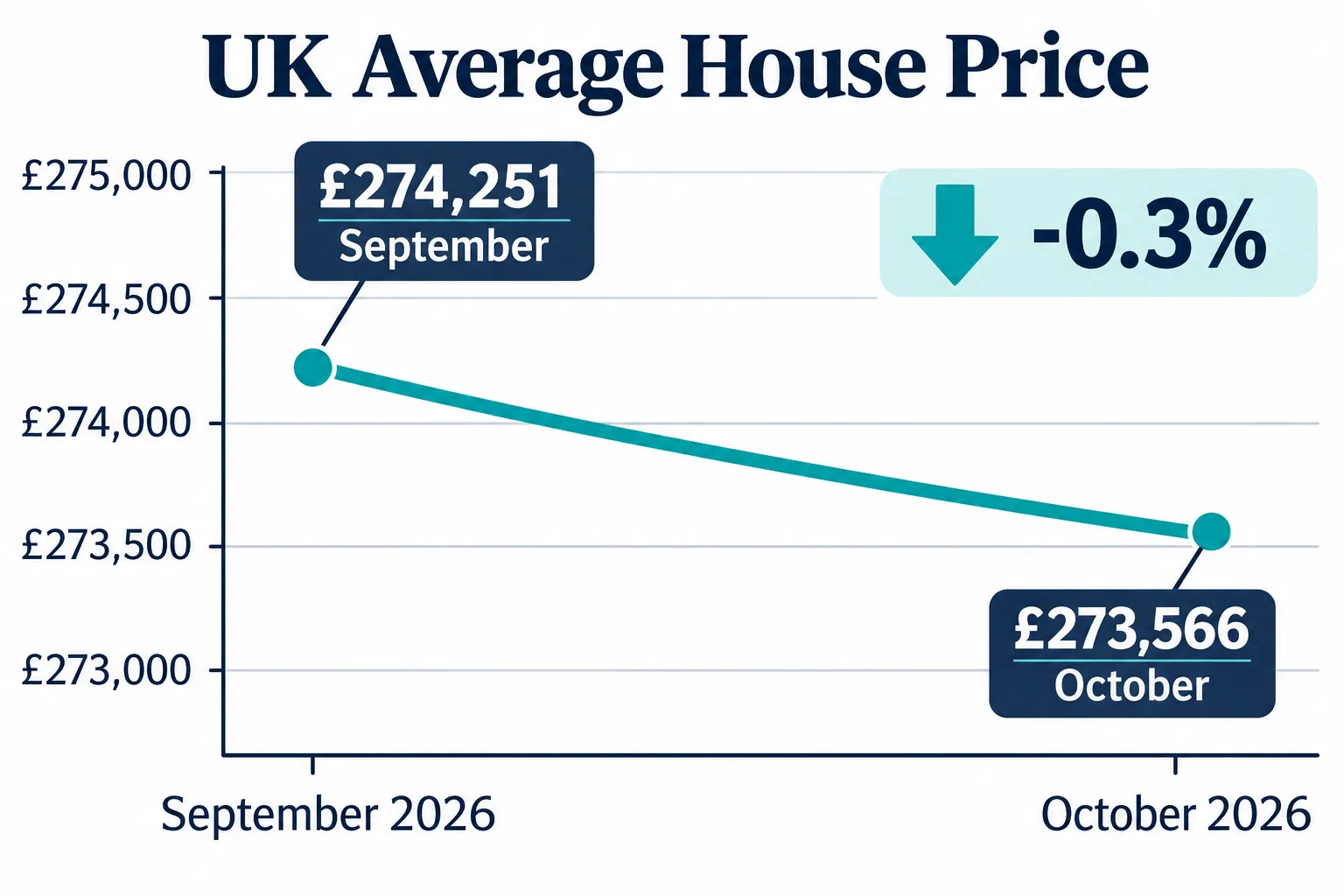
A typical UK home lost £685 in value last month. That is the blunt arithmetic behind the Nationwide house price index October 2026, published on 30 October 2026, which shows the average property price slipping from £274,251 in September to £273,566 in October. Annual growth has slowed to just 0.5%, the weakest pace since January 2024. For buyers and sellers across Canterbury and the wider Kent market, this is not a dramatic crash, but it is a clear signal that the easy pricing assumptions of the past two years no longer hold.
This article, written on 2 November 2026, looks at what the latest Nationwide data actually shows, why the market has cooled, and what practical steps Kent homeowners and buyers should take now.
Key Takeaways
- Nationwide house price index October 2026 shows average UK prices down 0.3% month-on-month, to £273,566.
- Annual house price growth has slowed to 0.5%, the weakest reading since January 2024.
- RICS September survey data already pointed this way: price net balance at -32%, new buyer enquiries down 22%.
- The Autumn Budget (28 October 2026) and the Bank of England’s rate decision (5 November 2026) are both weighing on sentiment.
- Down-valuation risk is rising in Kent; a RICS Level 2 or Level 3 survey gives buyers real negotiating leverage.
Nationwide House Price Index October 2026: The Headline Numbers
According to Nationwide, the average UK house price fell from £274,251 in September to £273,566 in October 2026, a monthly drop of 0.3%. Annual growth now stands at just 0.5%, a sharp slowdown and the softest figure since January 2024.
Robert Gardner, Nationwide’s chief economist, says activity has slowed “amid an uncertain backdrop.” Geopolitical tensions are fanning inflation concerns, and financial markets increasingly expect Bank Rate rises, which keeps upward pressure on mortgage pricing. Gardner expects the market to stay soft in the near term, though he points to resilient employment, real income growth, and household debt near 20-year lows relative to income as offsetting factors.
This is not a story of households being overstretched. It is a story of confidence being tested by external shocks, the Budget, interest rate expectations, and global uncertainty, at a time when prices had already been drifting sideways.
Why the Market Has Cooled: Budget, Bank Rate and Buyer Caution
Several factors are converging at once.

The Autumn Budget, delivered on 28 October 2026, added a fresh layer of uncertainty just as the Nationwide figures were finalised. Jeremy Leaf, a north London estate agent and former RICS residential chairman, describes the market as “highly sensitive,” noting that Budget uncertainty compounded an already softening trend. He says paused buyers and sellers are only slowly returning to the market.
The Bank of England decision, due 5 November 2026, is the next big test. Most economists expect a rise from 3.75% to 4%. Tom Bill of Knight Frank notes that both main house price indices are “hovering around zero” and that mortgage approvals are down almost a fifth year-on-year. He argues that rising mortgage costs are outweighing any support measures from the Budget, and that asking prices “must reflect a tougher landscape.”
RICS survey evidence backs this up. The RICS September survey, published 8 October 2026, recorded a price net balance of -32% and a fall in new buyer enquiries of 22%. These are leading indicators, and they suggest the cooling seen in the Nationwide house price index October 2026 is likely to continue into November and December.
| Indicator | Reading | Source |
|---|---|---|
| Monthly price change | -0.3% | Nationwide, Oct 2026 |
| Annual price growth | 0.5% | Nationwide, Oct 2026 |
| Price net balance | -32% | RICS, Sept survey |
| New buyer enquiries | -22% | RICS, Sept survey |
| Mortgage approvals (YoY) | -~20% | Knight Frank |
What This Means for Canterbury and Kent Buyers
Kent has historically outperformed the UK average, buoyed by commuter demand and relative affordability compared to London. But a national slowdown like this filters through regionally, and Canterbury is not immune.
Pull quote: “Asking prices must reflect a tougher landscape.”, Tom Bill, Knight Frank
For buyers, this environment brings opportunity but also risk:
- Down-valuation risk is rising. Lenders’ panel surveyors are increasingly cautious when annual growth sits at just 0.5%. A mortgage valuation coming in below the agreed sale price is more common in a flat market.
- Negotiating room has opened up. With enquiries falling 22% according to RICS, sellers are more willing to discuss price, condition issues, and timing.
- Mortgage costs matter more than ever. With a possible Bank Rate rise to 4% on 5 November, affordability calculations need to be stress-tested before offers are made.
A RICS Level 2 (HomeBuyer Report) or Level 3 (Building Survey) gives buyers independent, evidence-based grounds to renegotiate if defects or valuation gaps emerge. In a market where every percentage point of price movement is being scrutinised, a detailed survey report is one of the few tools a buyer fully controls.
What This Means for Kent Sellers and Landlords
Sellers in Canterbury and across Kent should treat the Nationwide house price index October 2026 as a reset point, not a one-off blip.
For sellers:
- Price realistically from the outset. Overpricing in a market with falling annual growth risks a stale listing and repeated reductions.
- Expect buyers to request surveys and use any findings as leverage, be prepared with recent maintenance records.
- Consider an independent valuation ahead of listing, rather than relying solely on estate agent appraisals, which can be optimistic.
For landlords and developers:
- Softer price growth alongside a possible Bank Rate rise affects refinancing costs and yield calculations.
- Development viability assessments should be rebased using current, not six-month-old, comparable evidence.
- Independent RICS valuations remain essential for loan security, probate, and portfolio reviews in a market this sensitive to news.
How a RICS Survey or Valuation Helps Right Now
In a flat or falling market, information asymmetry is costly. A RICS Level 2 or Level 3 survey from a chartered firm gives an objective, professionally regulated assessment of a property’s condition and defects, independent of the agent or lender. This is particularly valuable when:
- A mortgage valuation has come in below the agreed price.
- A buyer needs grounds to renegotiate after survey findings.
- A seller wants a credible, independent figure before listing.
- A landlord or developer needs up-to-date comparable evidence for finance decisions.
Readers should take independent professional advice on specific transactions, tax, and legal matters; this article explains market context only.
Conclusion and Next Steps
The Nationwide house price index October 2026 confirms what RICS survey data had already flagged: the UK housing market has lost momentum, with annual growth at its weakest since January 2024. Budget uncertainty and the looming Bank of England decision on 5 November are adding further caution. For Canterbury and Kent, this means down-valuation risk, more room to negotiate, and a greater premium on accurate, independent information.
Buyers should arrange a RICS Level 2 or Level 3 survey before committing. Sellers should price in line with current evidence, not last year’s market. Landlords and developers should refresh valuations before making finance decisions. Canterbury Surveyors, RICS chartered surveyors covering Canterbury and Kent, can provide independent surveys and valuations to support these decisions.
FAQ
What does the Nationwide house price index October 2026 actually measure? It tracks average UK house prices based on Nationwide’s own mortgage lending data, published monthly, and is one of the UK’s most widely cited house price indicators.
Why did annual growth slow to 0.5%? Nationwide’s Robert Gardner attributes it to an uncertain backdrop, including geopolitical tensions, inflation concerns, and expectations of Bank Rate rises affecting mortgage pricing.
Does this mean Kent house prices are crashing? No. A 0.3% monthly fall and 0.5% annual growth indicate a slowing, flattening market, not a crash. Nationwide notes resilient employment and low household debt relative to income as supporting factors.
Should I get a survey if the market is falling? Yes. A RICS Level 2 or Level 3 survey is especially valuable in a softer market, giving independent evidence to support negotiation or confirm a fair price.
Will the Bank of England’s 5 November decision affect Kent buyers? Potentially. Most economists expect a rise from 3.75% to 4%, which would increase mortgage costs and could further dampen buyer demand and pricing.
Related services from Canterbury Surveyors
Get a fixed-fee quote or call 0204 579 8270.