
Canterbury & Kent
UK Subsidence Claims Record October 2026 Kent Homeowners Should Understand Now
Twenty thousand pounds. That is the average cost insurers now attach to a single subsidence claim, a figure that would have seemed extreme just two years ago. As autumn settles over Canterbury, Faversham, Whitstable and Herne Bay, the UK subsidence claims record October 2026 Kent homeowners are now grappling with is not an abstract industry statistic. It is a direct warning about the clay soils beneath thousands of local properties, and about what cracked plaster or a sticking door might really mean this season.
This article explains, in plain terms, what the record figures mean for people buying, selling or simply living in a Kent home built on shrinkable clay, and why professional inspection remains the only reliable way to tell seasonal cracking from genuine structural movement.
Key Takeaways
- The average UK subsidence claim hit a record £20,000 in Q2 2026, according to ABI data published 3 August 2026, up more than £2,000 year-on-year.
- Hastings Direct reported August 2026 subsidence claims almost 140% higher than August 2025, with volumes expected to stay elevated through October without sustained rainfall.
- Kent, along with London, Essex and the Oxford-to-the-Wash corridor, is flagged as a high-exposure area because of shrinkable clay soils.
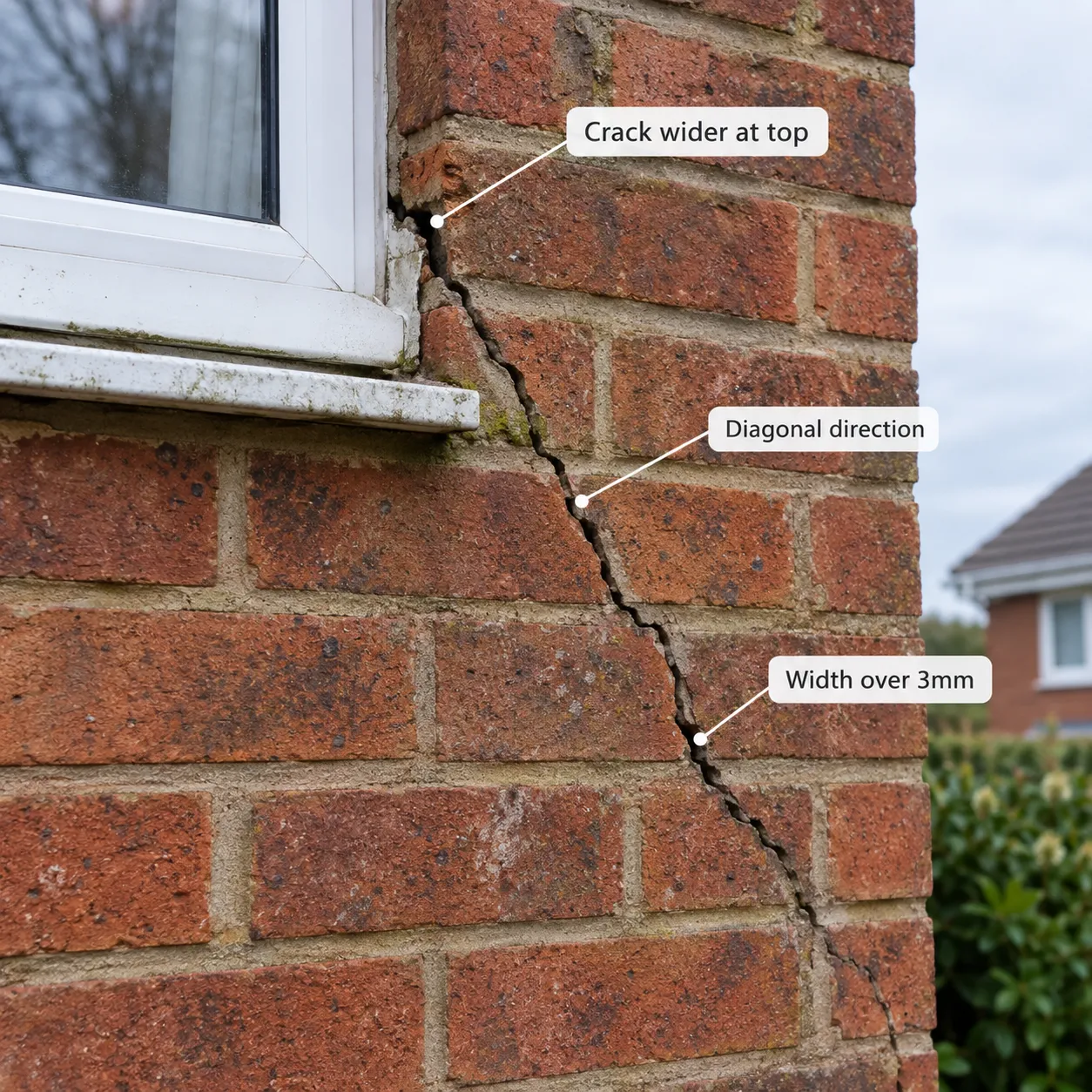
- Not every autumn crack is subsidence; diagonal cracks wider than 3mm, wider at the top, and visible both inside and outside are the signs worth professional attention.
- A RICS Level 3 Building Survey or targeted structural inspection is the recommended way to assess risk before buying, selling or claiming.
The UK subsidence claims record October 2026 Kent homeowners are reading about
The headline numbers come from the Association of British Insurers, whose data published on 3 August 2026 showed that the average subsidence claim reached a record £20,000 in the second quarter of the year, an increase of more than £2,000 on the same period in 2025. Insurers paid out £72 million for subsidence claims in that single quarter, and the average home insurance claim of any kind passed £7,000 for the first time. The ABI linked much of this to spring 2026 being the warmest on record for England and Wales, which dried out clay soils earlier and more severely than usual.
The trend did not stop there. Insurer Hastings Direct reported that subsidence claims in August 2026 were almost 140% higher than in August 2025, and the insurer expects claim volumes to remain elevated through October 2026 unless the country sees sustained rainfall. The Met Office has separately confirmed that summer 2026 was the UK’s hottest on record, reinforcing the pattern of prolonged soil drying across the south east. For context, total UK subsidence payouts across the whole of 2025 reached £307 million, itself a 10% rise on 2024, so the trajectory has been building for some time rather than appearing overnight.
Rebuild costs have risen too, up 3.9% in the year to July 2026, which means that even where subsidence repairs are more modest, the bill for underpinning, redecoration and temporary accommodation is climbing faster than general inflation.
Why Kent’s clay soils put local homes in the exposure zone
Subsidence is most commonly caused by clay soil losing moisture and shrinking, a process that is often made worse by nearby tree roots drawing out further moisture, or by leaking drains softening and washing away ground support. London, Essex, Kent and the broader Oxford-to-the-Wash corridor have been identified as the most exposed parts of the country precisely because of their shrinkable clay geology.
Within Kent, this is not evenly distributed. Parts of Canterbury, Faversham, Whitstable and Herne Bay sit on clay or clay-rich subsoils that have historically produced subsidence claims during dry summers, and the extreme heat of 2026 has tested those soils more than most recent years. Streets with mature trees, Victorian terraces with shallow Victorian-era foundations, and properties close to mains drainage runs tend to carry higher background risk, though every property should be assessed on its own merits rather than by postcode alone.
Seasonal cracking or structural movement: how to tell the difference
Not every hairline crack is subsidence, and homeowners should avoid jumping to conclusions. That said, certain features consistently point towards genuine structural movement rather than ordinary seasonal settlement:
- Diagonal cracks wider than 3mm, often running from window or door corners.
- Cracks that are noticeably wider at the top than the bottom, suggesting the foundation is dropping on one side.
- Doors and windows that stick or no longer close properly, indicating the frame itself has shifted.
- Cracks visible both inside and outside the same wall, in roughly the same location, which rules out simple decorative or plaster cracking.
A single fine crack in plasterwork, particularly one that appears after a dry summer and does not widen further, is frequently nothing more than normal thermal movement. Cracks matching several of the features above, especially where they are new or actively widening, warrant a professional look rather than a DIY filler job.
Why autumn rain brings “heave” and partial recovery
Once autumn rainfall returns, clay soil begins to reabsorb moisture and swell back towards its original volume. This process, known as heave, can partially close cracks that opened during the dry summer months, which sometimes gives homeowners a false sense that the problem has resolved itself. In reality, the underlying soil movement cycle can repeat each year, and repeated shrink-swell cycles can gradually worsen the condition of foundations over several seasons. This is one reason insurers and surveyors are wary of treating a single season’s crack pattern as conclusive, and why monitoring over time matters more than a one-off glance.
Buying in clay areas: why a Level 3 Building Survey matters
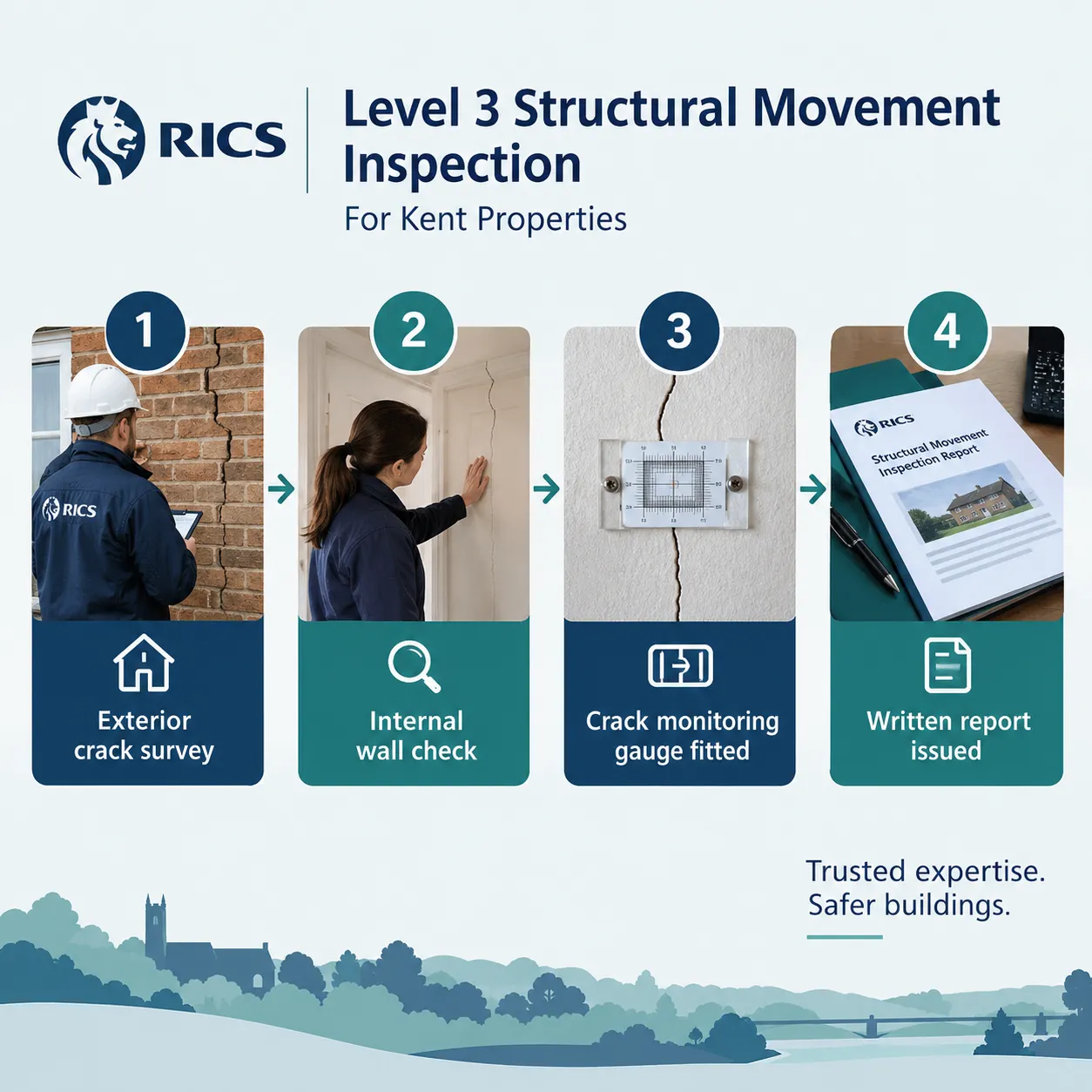
For anyone purchasing a property in Canterbury, Faversham, Whitstable or Herne Bay this autumn, a RICS Level 3 Building Survey, or a specific structural movement inspection where cracking has already been noted, provides a far more detailed assessment than a standard valuation or a Level 2 survey. A Level 3 survey examines foundations, drainage, nearby tree influence and crack patterns in detail, and can recommend further specialist investigation such as borehole testing or drain surveys where needed.
Given the scale of the current UK subsidence claims record October 2026 Kent homeowners and buyers are now navigating, skipping this step on an older property with visible cracking is a false economy. Buyers should also review our guidance on Level 3 building surveys for properties with subsidence risks, covering tree root protocols and underpinning valuations, and our dedicated page on surveys for subsidence for more on what these inspections cover. Bungalows and single-storey properties carry their own particular risk profile, discussed in our piece on Level 3 surveys for bungalows targeting subsidence and damp risks.
What crack monitoring involves
Where a surveyor identifies cracking that needs watching rather than immediate structural intervention, crack monitoring is the standard next step. This typically involves fitting small gauges, tell-tales or glass monitoring strips across the crack and recording measurements at intervals, often monthly, over a period of several months to a year. The aim is to establish whether the crack is stable, seasonal, or actively progressing, and the resulting data gives both homeowners and insurers objective evidence rather than guesswork. Monitoring is particularly valuable for Kent properties where last summer’s heat may have caused movement that has not yet fully settled.
Valuation, insurance and mortgageability after subsidence
A documented history of subsidence, even where it has been successfully repaired, can affect a property in several ways. Mortgage lenders may request further engineering reports before approving a loan, insurers may apply higher premiums or specific excesses, and buyers’ solicitors will usually want full details of any past claims and remedial works, including guarantees for underpinning. This does not necessarily make a property unsellable, but it does make an accurate, well-documented survey essential to avoid delays or renegotiation during a sale. For sellers in Canterbury’s current market, understanding this risk ahead of listing is sensible; our overview of the Kent and south east property market and why a RICS survey matters now offers useful context, as does our comparison of RICS Red Book valuations versus market appraisals for homeowners and lenders.
Before making a claim
Homeowners who suspect subsidence should avoid rushing to fill or redecorate over cracks before they have been properly assessed, since this can remove useful evidence. A sensible approach is to photograph the cracking with a scale reference, note when it appeared, and arrange a professional inspection before contacting an insurer, so that any claim is supported by clear evidence. This article does not provide legal or insurance advice, and homeowners should speak to their insurer and a qualified surveyor directly about their specific circumstances. Our analysis of defect diagnosis and building pathology for identifying hidden structural issues explains more about how surveyors build the evidence base behind a claim.
What Canterbury Surveyors recommends
Given the record claims data and the exposed clay geology across much of Kent, Canterbury Surveyors recommends that homeowners with new or worsening cracking arrange a professional inspection before the colder, wetter months bring heave and potential masking of symptoms. Buyers considering a property in Canterbury, Faversham, Whitstable or Herne Bay should commission a RICS Level 3 Building Survey rather than rely on a mortgage valuation alone, particularly on older properties or those near mature trees. Sellers with a subsidence history should gather all documentation on past repairs and guarantees ahead of marketing their home, to avoid delays later in the transaction. Readers can also review current standards shaping these inspections in our summary of the RICS Home Survey Standard updates strengthening consumer protection and technology integration.
To discuss a specific property, book a RICS Level 3 Building Survey or arrange a structural movement inspection with Canterbury Surveyors this October.
FAQ
Is every crack in a Kent property a sign of subsidence? No. Many cracks are caused by normal thermal or seasonal movement and do not widen further. Diagonal cracks over 3mm, wider at the top, and visible on both sides of a wall are the features that warrant professional assessment.
Why are subsidence claims so high in 2026? ABI data published 3 August 2026 shows the average claim reached £20,000 in Q2 2026, linked to spring 2026 being the warmest on record for England and Wales, followed by a record-hot summer confirmed by the Met Office.
Will autumn rain fix cracks caused by summer subsidence? Rain can cause clay soil to swell and partially close cracks, a process called heave, but this does not always mean the underlying issue has resolved. Monitoring over a full season is more reliable than judging by appearance alone.
Does a past subsidence claim affect selling a house in Kent? It can affect valuation, insurance terms and mortgage approval, particularly if remedial works and guarantees are not well documented. Buyers and lenders typically want clear evidence the issue was properly resolved.
What survey should I get before buying an older property in Canterbury or Whitstable? A RICS Level 3 Building Survey is generally recommended for older properties or those with visible cracking, since it examines foundations, drainage and tree influence in more depth than a standard valuation.
Conclusion
The UK subsidence claims record October 2026 Kent homeowners are now hearing about reflects a genuine shift in risk, driven by the warmest spring and hottest summer on record affecting shrinkable clay soils across the south east. For Kent residents, buyers and sellers, the practical response is not alarm but diligence: learn to recognise the specific signs of structural movement, understand that autumn rain can mask rather than solve underlying problems, and treat crack monitoring and professional surveys as standard practice rather than a last resort. Anyone noticing new or worsening cracking, or planning a purchase in a clay-prone area such as Canterbury, Faversham, Whitstable or Herne Bay, should arrange a RICS Level 3 Building Survey or structural inspection promptly, and contact Canterbury Surveyors to book an assessment this October.
subsidence claims, Kent homeowners, Canterbury surveyors, RICS Level 3 Building Survey, structural movement, crack monitoring, clay soil subsidence, home insurance claims, property valuation, subsidence insurance, Whitstable property, Herne Bay surveys
Related services from Canterbury Surveyors
- RICS property valuations
- RICS Homebuyer Surveys (Level 2)
- Building Surveys (Level 3)
- Structural engineers in Canterbury & Kent
Get a fixed-fee quote or call 0204 579 8270.