Canterbury & Kent
Building Survey Quality Standards and Consumer Transparency: Responding to RICS’ 2026 Strengthening Initiative and Client Expectations
Nearly one in three homebuyers who commission a property survey later report they did not fully understand what the report told them. That figure alone explains why Building Survey Quality Standards and Consumer Transparency: Responding to RICS’ 2026 Strengthening Initiative and Client Expectations has become one of the most debated topics across the surveying profession in 2026. RICS, the Royal Institution of Chartered Surveyors, has made it clear that minimum compliance is no longer enough. Surveyors who want to build lasting practices must now think beyond checklists and embrace a culture of genuine consumer clarity.
Key Takeaways
- RICS is actively strengthening its Home Survey Standard to raise the floor on report quality and consumer understanding across all survey levels.
- Transparent, plain-English reporting is no longer optional, it is a competitive differentiator that drives referrals and repeat instructions.
- Surveyors must understand which survey level is appropriate for each property type and communicate that recommendation clearly to clients.
- Exceeding minimum standards in areas such as condition ratings, photographic evidence, and follow-up communication builds measurable client trust.
- Firms that align their processes with the 2026 strengthening initiative now will be better positioned as regulatory expectations continue to rise.
Why RICS Is Raising the Bar in 2026
The RICS Home Survey Standard, first introduced in 2021, created a unified framework for residential survey reporting. By 2026, RICS has signalled a further phase of strengthening, driven by consumer feedback, complaints data, and a broader government push for transparency in property transactions.
Three forces are converging at once:
- Rising consumer expectations. Homebuyers are more informed than ever. They research properties online, compare reports, and expect professional advice to be actionable, not ambiguous.
- Complaints and redress data. A significant share of surveying complaints relate not to missed defects, but to unclear language, unexplained condition ratings, and a lack of guidance on next steps.
- Regulatory pressure. The broader property sector, from estate agents to conveyancers, is under scrutiny for consumer outcomes. Surveyors are not exempt.
The RICS initiative targets three specific areas: report clarity, condition rating consistency, and client communication protocols. Each area has direct implications for how firms structure their services and train their surveyors.
“A report that is technically accurate but practically unreadable has failed its primary purpose.”
This is the underlying philosophy behind the 2026 strengthening push. The standard does not demand longer reports. It demands more useful ones.
Understanding the Three Survey Levels and Their Quality Obligations
Before addressing how to exceed standards, it is worth grounding the discussion in what each survey level is designed to deliver, and where quality gaps most commonly occur.
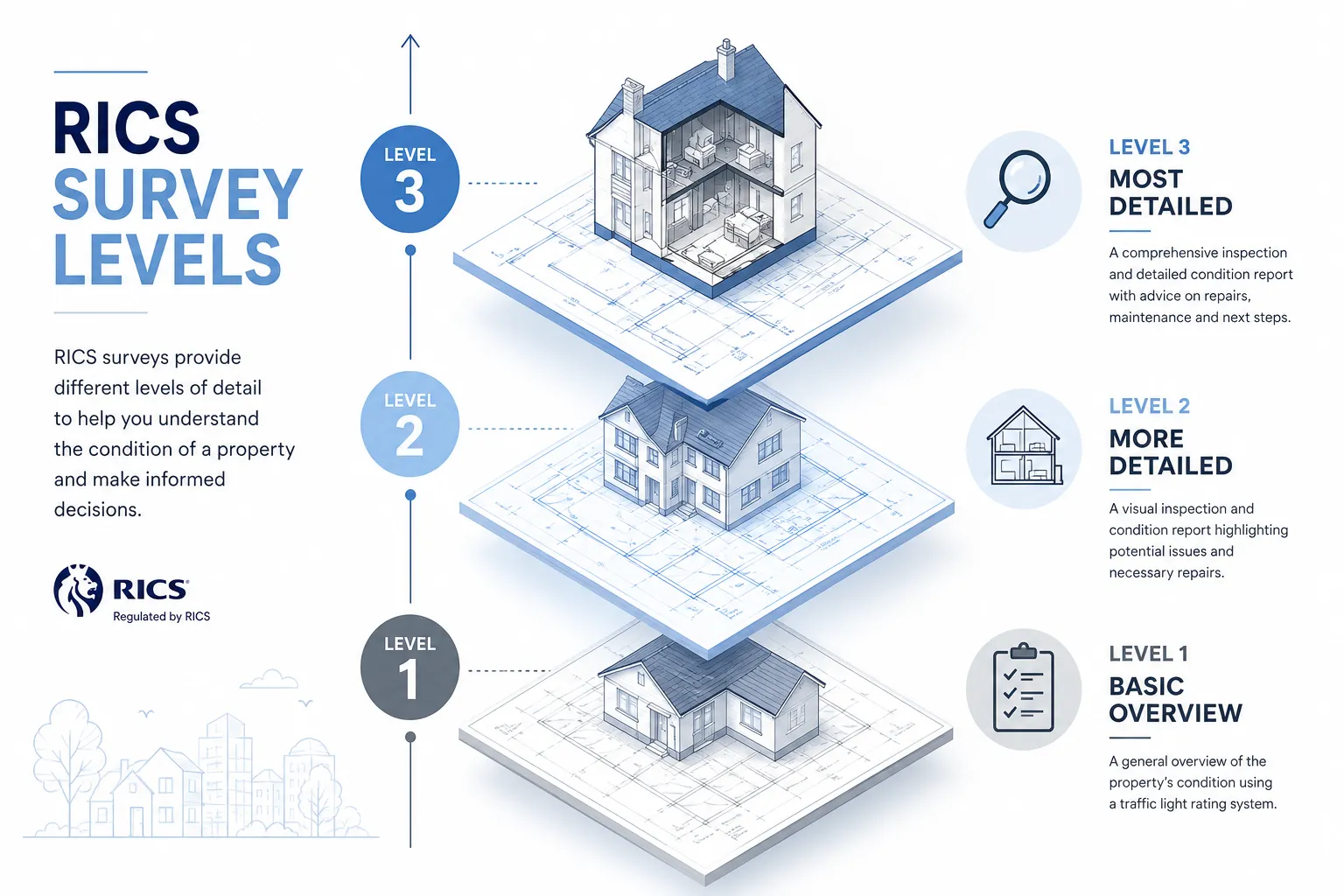
RICS Home Survey Level 1
The RICS Home Survey Level 1 is a condition report designed for conventional properties in apparent good condition. It uses a traffic-light condition rating system and is the most concise of the three levels. Quality concerns here tend to centre on whether surveyors are recommending the correct level for the property in question, and whether condition ratings are explained clearly enough for a lay reader to act on them.
RICS Home Survey Level 2
The Level 2 Homebuyer Survey is the most commonly commissioned survey in England and Wales. It includes a more detailed inspection and advice on defects, repairs, and maintenance. The quality risk at this level is under-reporting, surveyors who hedge every finding with caveats without giving clients a clear sense of priority or urgency.
RICS Building Survey Level 3
The RICS Building Survey Level 3 is the most comprehensive option, recommended for older, larger, or structurally complex properties. At this level, the quality obligation is highest. Clients are paying for expert analysis, and the report must deliver genuine insight, not just a catalogue of observations. Understanding the difference between Level 2 and Level 3 surveys is something surveyors should be able to explain clearly to every client before instruction.
Quick Reference: Survey Level and Common Quality Gaps| Survey Level | Primary Purpose | Common Quality Gap |
|---|---|---|
| Level 1 | Condition overview | Wrong level recommended for property type |
| Level 2 | Defect identification and advice | Over-hedged language, unclear priorities |
| Level 3 | Structural analysis and expert advice | Insufficient explanation of structural findings |
Building Survey Quality Standards and Consumer Transparency: What the 2026 Initiative Demands
The 2026 strengthening initiative is not a wholesale rewrite of the Home Survey Standard. It is a targeted tightening of expectations in areas where consumer outcomes have been weakest. Here is what surveyors need to know.
Condition Rating Consistency
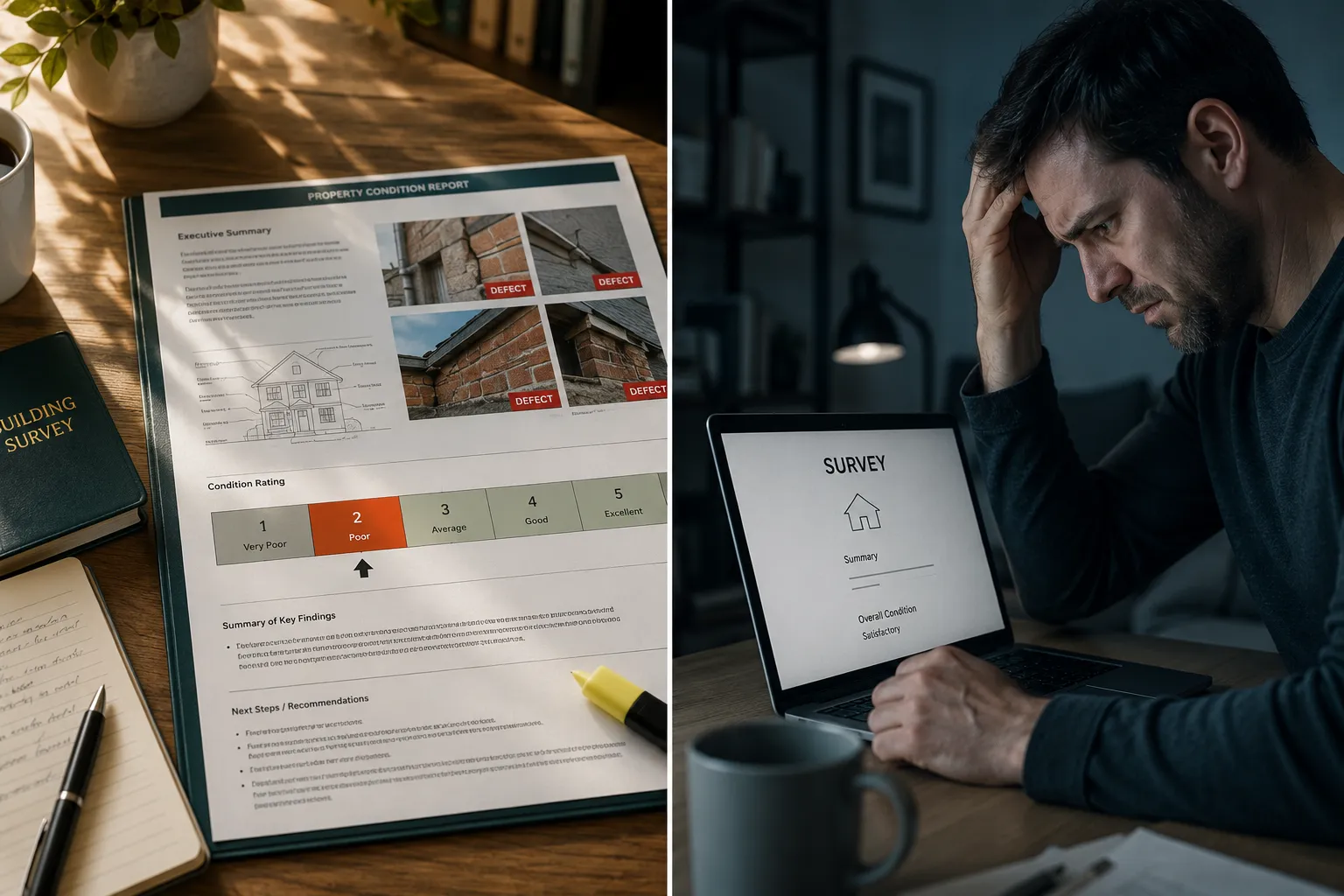
Condition ratings, the 1, 2, 3 system used across RICS surveys, have been applied inconsistently across the profession. A Condition 3 rating (requiring urgent attention) from one firm may describe something that another firm rates as Condition 2. RICS is pushing for greater calibration through guidance, training, and peer review mechanisms.
What this means in practice:
- Surveyors should document their rating rationale within the report, not just assign a number.
- Where a finding sits on the boundary between ratings, the report should explain the reasoning.
- Firms should conduct internal audits to check rating consistency across their surveyors.
Plain-English Reporting
Technical accuracy is not the same as consumer usefulness. The 2026 initiative places explicit emphasis on plain-English drafting. Reports should:
- Avoid jargon without explanation (e.g., “spalling brickwork” should be followed by a brief plain-English note).
- Use short sentences and active voice where possible.
- Structure findings so that the most urgent items are immediately visible.
This does not mean dumbing down professional content. It means presenting it in a way that a first-time buyer with no construction knowledge can understand and act upon.
Photographic Evidence Standards
Photographic evidence within survey reports has become a baseline expectation, not a premium add-on. The 2026 guidance strengthens expectations around:
- Image quality, clear, well-lit photographs that show the defect in context.
- Annotation, brief labels or arrows indicating what the photograph is showing.
- Coverage, key defects should be photographed as a matter of course, not selectively.
Surveyors who have not yet standardised their photographic approach should treat this as a priority update to their workflow.
Pre-Survey and Post-Survey Communication
One of the most significant shifts in the 2026 initiative is the emphasis on communication outside the report itself. RICS is encouraging firms to:
- Conduct a brief pre-survey call or written summary to set expectations about what the survey will and will not cover.
- Offer a post-report call or written Q&A opportunity so clients can ask questions about findings.
This is where many firms currently fall short, and where the opportunity to differentiate is greatest. A client who receives a follow-up call after their survey is far more likely to recommend the firm to a friend.
How to Exceed Minimum Standards and Build Client Trust
Meeting the RICS standard is the floor, not the ceiling. Firms that treat Building Survey Quality Standards and Consumer Transparency: Responding to RICS’ 2026 Strengthening Initiative and Client Expectations as a business opportunity, rather than a compliance burden, will see measurable returns in client satisfaction, referrals, and professional reputation.
Invest in Survey Selection Guidance
Many clients arrive at a surveying firm unsure which product they need. A firm that invests time in choosing the right property survey for each client, rather than defaulting to the most commonly requested option, immediately signals expertise and care. This is especially important for older properties, those with visible defects, or those in areas with known structural risks such as subsidence.
Develop a Report Quality Checklist
Internal quality control is not bureaucracy, it is professional infrastructure. A practical checklist might include:
- All Condition 2 and 3 items photographed and annotated
- Condition ratings accompanied by brief rationale
- Technical terms followed by plain-English explanations
- Urgent items clearly signposted in the executive summary
- Recommendations for specialist further investigation clearly stated
- Report reviewed by a second surveyor before issue (for Level 3)
Train for Client Communication, Not Just Technical Inspection
Technical inspection skills are the foundation of surveying. But client communication skills are what turn a technically excellent report into a trusted professional relationship. Firms should invest in:
- Training surveyors to explain findings verbally in plain language.
- Developing standard post-report communication templates.
- Gathering client feedback systematically and using it to improve.
Use Technology to Improve Consistency
Report-writing software, standardised templates, and digital inspection tools can significantly reduce inconsistency across a firm’s output. When every surveyor in a firm uses the same structure, the same condition rating guidance, and the same photographic standards, quality becomes a firm-wide characteristic rather than an individual one.
Building Survey Quality Standards and Consumer Transparency: The Commercial Case for Going Further

The business case for exceeding minimum standards is straightforward. Property transactions are high-stakes, emotionally charged events. A client who feels genuinely informed and supported by their surveyor does not just leave a positive review, they become an active advocate.
Consider the referral economics:
- The average residential property transaction involves at least four to six professional relationships (solicitor, estate agent, mortgage broker, surveyor).
- A surveyor who is recommended by a solicitor or estate agent receives a warm introduction rather than competing on price alone.
- Client referrals consistently convert at higher rates and with lower acquisition costs than any other channel.
Transparency is not just an ethical obligation, it is a growth strategy.
The Role of Specialist Surveys in Demonstrating Expertise
Clients who receive a Level 2 or Level 3 survey that identifies a potential structural issue, damp problem, or drainage concern will often need to commission further specialist investigation. A surveying firm that can clearly explain what further surveys are needed, and why, positions itself as a trusted advisor rather than a one-time transaction.
For example, a surveyor who identifies signs of movement in a property and clearly explains the need for a structural survey or a drainage survey is adding genuine value to the client’s decision-making process. That clarity builds trust, even when the news is not what the client hoped to hear.
Geographic Consistency Matters
For firms operating across multiple locations, maintaining consistent quality standards is a particular challenge. Whether a client is commissioning a survey through chartered surveyors in North London or chartered surveyors in Surrey, the quality of the report and the standard of client communication should be identical. Geographic inconsistency is one of the fastest ways to damage a firm’s reputation in the age of online reviews.
Practical Steps for Firms Responding to the 2026 Initiative
The following actions represent a practical roadmap for firms looking to align with, and exceed, the expectations set out in the RICS 2026 strengthening initiative.
Short-term (within 3 months):
- Audit a sample of recent reports against the plain-English and photographic evidence standards.
- Introduce a pre-survey client communication template.
- Review condition rating guidance with all fee-earning surveyors.
Medium-term (3 to 6 months):
- Implement a post-report client feedback mechanism.
- Develop or update internal report quality checklists.
- Introduce peer review for Level 3 reports before issue.
Longer-term (6 to 12 months):
- Invest in report-writing software or template standardisation if not already in place.
- Build a formal training programme around client communication skills.
- Use client feedback data to identify persistent quality gaps and address them systematically.
Conclusion
Building Survey Quality Standards and Consumer Transparency: Responding to RICS’ 2026 Strengthening Initiative and Client Expectations is not a passing compliance exercise. It represents a fundamental shift in what the profession owes its clients, and what clients now expect as standard.
The firms that will thrive are those that treat the 2026 initiative as a prompt to examine every stage of their client journey: from the first conversation about which survey is appropriate, through the quality of the inspection and report, to the follow-up communication that helps clients make sense of what they have been told.
Actionable next steps for surveying professionals:
- Review your current reports against the RICS plain-English and photographic evidence expectations.
- Introduce a structured pre- and post-survey communication process if one does not already exist.
- Audit condition rating consistency across your team and address any divergence.
- Position specialist referrals, for structural, drainage, or subsidence investigations, as a client service, not an afterthought.
- Use client feedback actively to drive continuous improvement in report quality.
The standard has been raised. The opportunity for firms willing to rise with it has never been greater.
Related services from Canterbury Surveyors
- Boundary surveys
- RICS Homebuyer Surveys (Level 2)
- Building Surveys (Level 3)
- Structural engineers in Canterbury & Kent
Get a fixed-fee quote or call 0204 579 8270.