
Canterbury & Kent
Kent Mortgage Rates October 2026: What Buyers Need to Know Before the 5 November Bank of England Decision
Last updated: October 20, 2026
Quick Answer
Kent mortgage rates October 2026 are sitting close to a level not seen in nearly three years, with the average 5-year fix briefly touching 6% earlier this month before settling at 5.99%, according to Tembo Market Watch (15 October 2026). The average 2-year fix is 5.97%, up from 5.68% a month earlier. The Bank of England meets on Thursday 5 November 2026, and markets are pricing in a possible rate rise from the current 3.75% Bank Rate, driven by Middle East-linked energy costs and inflation concerns. Buyers and remortgagers in Kent should decide now whether to lock in a rate ahead of that decision.
Key Takeaways
- The average 2-year fixed mortgage rate is 5.97% and the average 5-year fix is 5.99%, per Tembo Market Watch (15 October 2026).
- The Bank of England Bank Rate has held at 3.75% since December 2025, but a rise is possible on 5 November 2026.
- Tracker mortgages (average 4.45% at end-September) remain cheaper than fixes right now, but carry more uncertainty.
- Some lenders, including HSBC and NatWest, cut selected fixed rates from 15 October, NatWest offers a 2-year fix at 5.04% and a 5-year fix at 4.98%.
- Rightmove’s October 2026 index shows average new mortgage rates adding about £250 a month to repayments compared with February 2026.
- South East asking prices average £475,582, roughly flat year on year, with homes taking 74 days on average to sell.
- Nationally, 34% of homes for sale have had a price reduction, a real negotiating opportunity for Kent buyers.
- The Autumn Budget on 28 October 2026 lands just before the Bank of England decision, adding further uncertainty to borrowing costs.
What Does the Bank of England Decision Mean for My Mortgage
The Bank of England’s 5 November 2026 decision will not directly change existing fixed-rate mortgages, but it will influence the rates lenders offer on new deals and remortgages from that date onward. Bank Rate has stayed at 3.75% since December 2025, and markets are currently pricing in the chance of a rise.
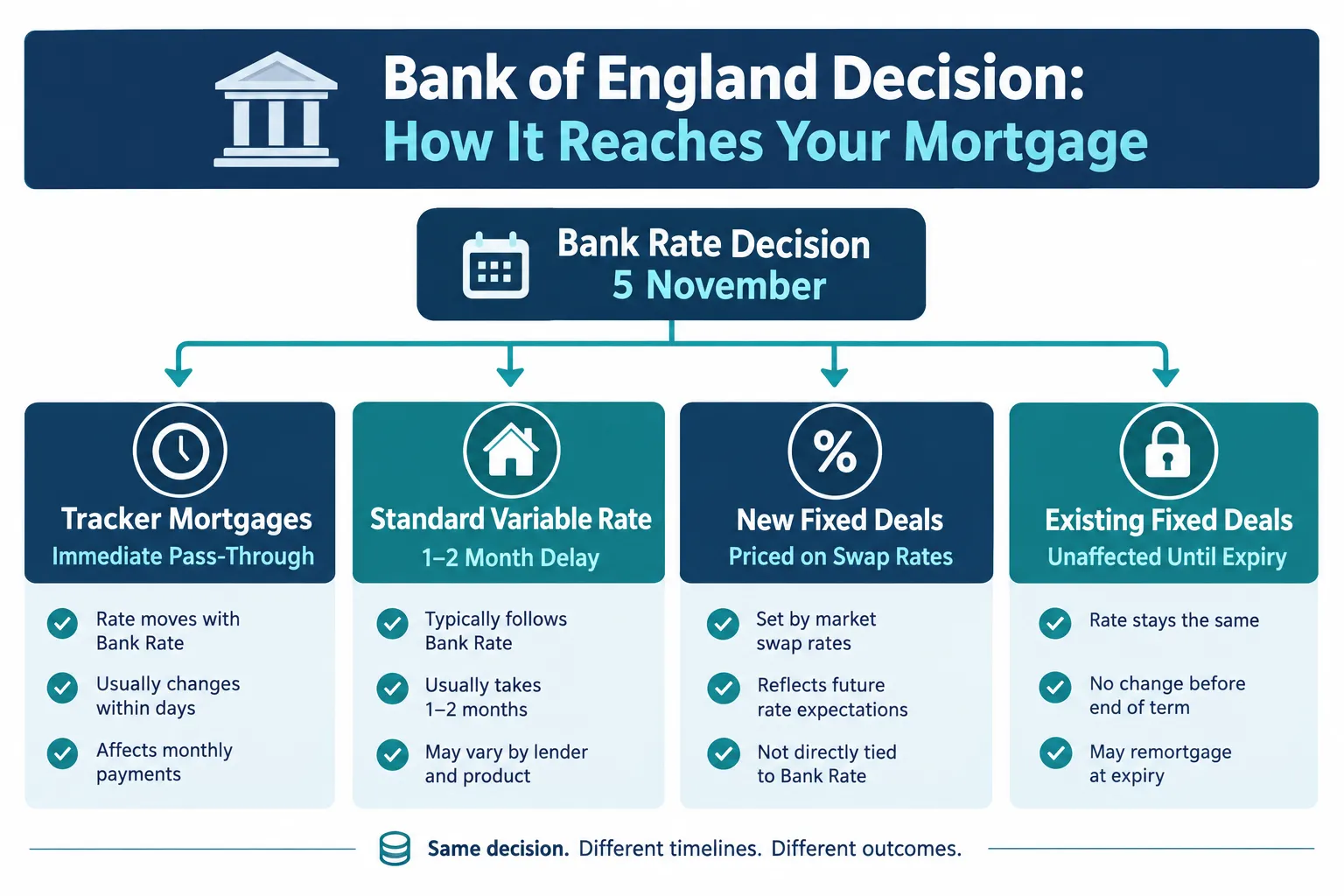
For anyone on a tracker or standard variable rate mortgage, a Bank Rate rise feeds through almost immediately, usually within one or two months depending on the lender’s terms. For anyone shopping for a new fixed deal, lenders tend to move ahead of the actual announcement, pricing in expectations through swap rates, which is a large part of why fixed rates have already climbed this month.
Decision rule: if your current deal expires before December 2026, assume lenders are already pricing in the 5 November outcome and treat today’s rates as your working budget, not a temporary spike.
Should I Lock in My Rate Before the November 5th Decision
Locking in now is the safer move for most Kent buyers and remortgagers facing a deal expiry in the next six months, because most lenders let you secure a rate without penalty if a cheaper one appears before completion.
Most UK lenders allow borrowers to reserve a fixed rate three to six months ahead of their current deal ending, often with a free option to switch down if rates fall before completion. Given that average 2-year and 5-year fixes have both climbed in the past month (Tembo Market Watch, 15 October 2026), waiting carries more downside than upside right now.
Common mistake: assuming a rate lock is binding only one way. Most lock-in products let you move to a lower rate if one becomes available before your mortgage completes, so locking early rarely costs you the chance of a better deal later.
What Are Current Mortgage Rates in Kent Right Now
Current average mortgage rates for Kent buyers mirror the national averages reported by Tembo Market Watch and Rightmove, since pricing is largely set by national lenders rather than regional risk.
- Average 2-year fix: 5.97% (Tembo Market Watch, 15 October 2026), up from 5.68% a month earlier.
- Average 5-year fix: 5.99%, having briefly crossed 6% earlier in October, the first time in nearly three years.
- Average 2-year tracker: 4.45% at end-September, notably cheaper than the average fix.
- Rightmove’s October 2026 House Price Index puts the average 2-year fixed rate at 5.55%, up from 5.29% a month earlier and 4.25% in February 2026.
The gap between Tembo’s figures and Rightmove’s reflects differences in methodology and timing, but both point the same direction: rates are rising fast and have roughly doubled their monthly pace of increase since February.
Why Are Rates Climbing to Near 6% This October
Rates are climbing mainly because of rising swap rates, which lenders use to price fixed mortgages, driven by Middle East conflict pushing up oil and energy prices, plus broader inflation concerns.
The IMF forecasts UK inflation averaging 3.3% in 2026 and 2.8% in 2027, both above the Bank of England’s 2% target. When inflation expectations rise, swap markets price in higher future interest rates, and lenders pass that through to fixed mortgage pricing well before any Bank of England announcement.
Edge case: not every lender is moving the same way. HSBC and NatWest cut rates on selected fixed deals from 15 October, with NatWest’s range including a 2-year fix at 5.04% and a 5-year fix at 4.98%, both well below the national average. This shows individual lender appetite and capital targets can temporarily buck the wider trend, so shopping around matters more than usual this month.
How Much Does a BoE Rate Change Actually Affect Mortgages
A Bank Rate change affects mortgages differently depending on the product: trackers and variable rates move almost in lockstep with the Bank Rate, while fixed rates respond mainly to swap rate expectations that often move before the announcement itself.
- Tracker mortgages: direct, near-immediate pass-through of any Bank Rate change.
- Standard variable rate (SVR): usually follows within one to two months, at the lender’s discretion.
- New fixed-rate deals: priced on swap rates, which already reflect market expectations of the 5 November outcome.
- Existing fixed-rate deals: unaffected until the deal ends.
Example: on a £200,000 repayment mortgage, a 0.25 percentage point rise in the rate adds roughly £30 a month to repayments, before accounting for individual lender terms.
Fixed vs Variable Mortgage: Which Is Better When Rates Are High
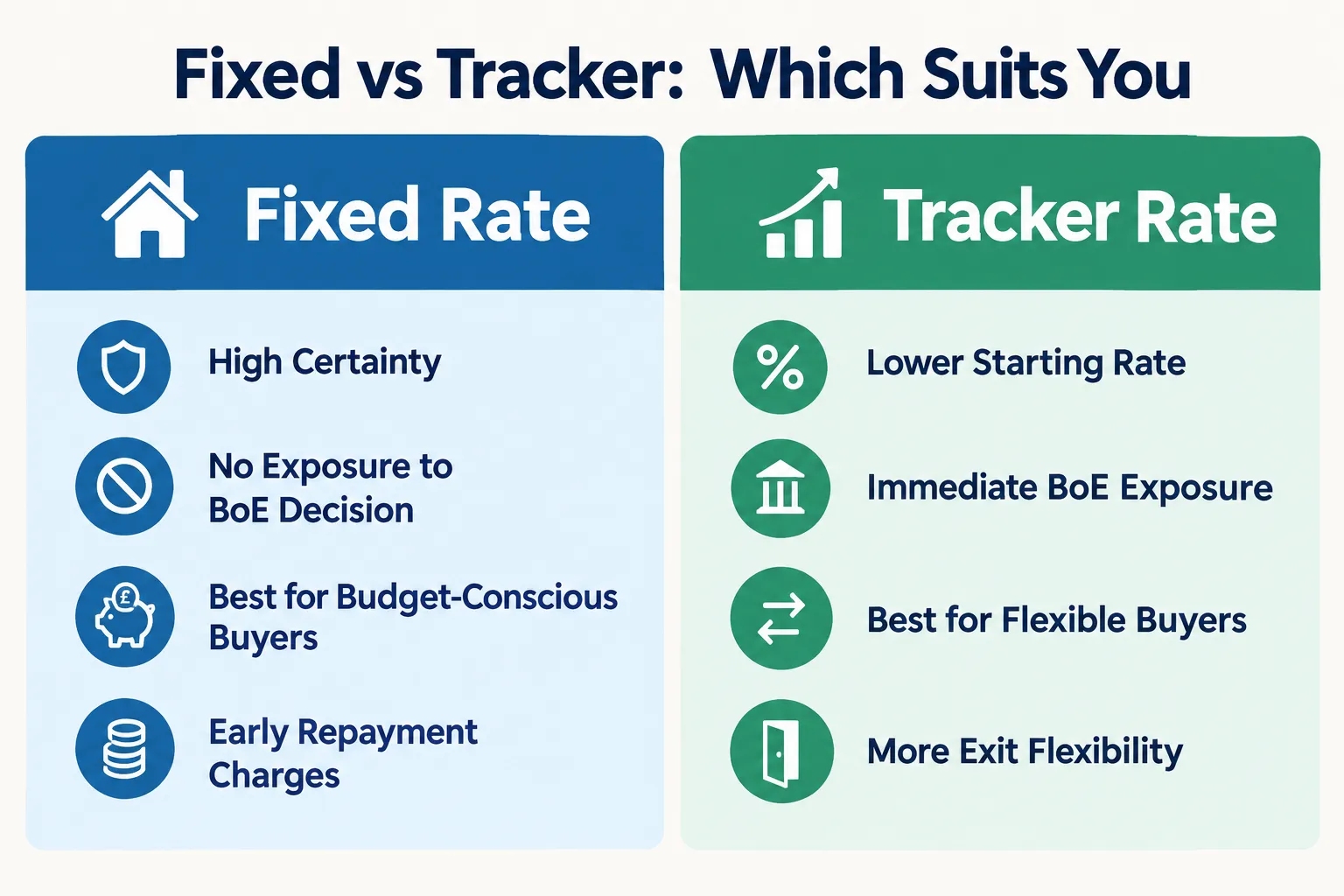
A fix suits Kent buyers who want budget certainty while rates are elevated and volatile, while a tracker suits those comfortable with short-term payment swings in exchange for a lower starting rate.
| Factor | Fixed rate | Tracker rate |
|---|---|---|
| Current average rate | 5.97%-5.99% (Tembo, 15 Oct 2026) | 4.45% (end-September) |
| Payment certainty | High | Low |
| Exposure to 5 Nov decision | None during fix term | Immediate |
| Best for | Budget-conscious buyers, first-time buyers | Buyers expecting rate falls, those with flexibility |
| Exit flexibility | Often early repayment charges | Usually more flexible |
Choose a fix if your household budget cannot absorb a sudden payment rise. Choose a tracker only if you have a financial buffer and believe rates will fall meaningfully within your mortgage term, a riskier bet given the current inflation outlook.
Are Kent Mortgage Rates Higher Than Other Parts of the UK
Kent mortgage rates October 2026 track the national averages closely, since mortgage pricing is set by lenders nationally rather than by postcode. What varies regionally is property price and how far a monthly budget stretches.
Rightmove reports the South East average asking price at £475,582, up 0.9% in the month but down 0.9% year on year, with homes taking an average of 74 days to find a buyer. That slower sales pace, combined with rising rates, is part of why 34% of homes for sale nationally have already seen a price reduction, a trend Kent sellers are not immune to.
Best Time to Apply for a Mortgage Before the Rate Announcement
The best time to apply is now, before 5 November 2026, particularly if your current deal is due to expire within the next few months.
Applying early lets you secure a rate reservation while lenders like HSBC and NatWest still have competitively priced selected fixed deals on offer. Mortgage offers typically remain valid for three to six months, giving flexibility if your purchase or remortgage timeline shifts. The Autumn Budget on 28 October 2026 lands just days before the Bank of England meeting, and any fiscal announcements affecting housing or taxation could add further rate volatility either way.
First-Time Buyers: What You Need to Know About 6% Rates
First-time buyers facing rates near 6% should budget conservatively, get an agreement in principle early, and factor in roughly £250 a month more on a typical new mortgage than buyers faced in February 2026, according to Rightmove’s October 2026 index.
- Get a mortgage agreement in principle before house-hunting seriously, it clarifies your real budget.
- Compare at least three lenders; the spread between NatWest’s 5.04% two-year fix and the market average of 5.97% is substantial.
- Build in a buffer for a possible Bank Rate rise if choosing a tracker or short fix.
- Always commission an independent RICS survey before exchange, when borrowing costs are this high, finding structural issues after completion is the last thing you can afford.
How Long Does a Rate Lock-In Last
A typical mortgage rate lock, or reservation, lasts between three and six months depending on the lender, giving buyers time to complete a purchase without the rate changing.
Most lenders allow switching to a lower rate during this window if one becomes available, at no extra cost, which is why locking in early carries little downside even in a falling-rate scenario.
Will Mortgage Rates Drop After November or Keep Rising
Nobody can say with certainty, and no forward rate forecast is reliable enough to bank on, but the IMF’s inflation forecasts of 3.3% for 2026 and 2.8% for 2027 suggest inflationary pressure, and therefore upward rate pressure, may persist well into next year rather than ease quickly.
Markets are currently pricing in a possible rise on 5 November 2026, not a cut, which is itself informative: lenders are not behaving as though relief is imminent.
What Happens to My Mortgage If I Wait Past November 5th
If you wait past 5 November without locking a rate, you take on the risk that new fixed deals could be more expensive if the Bank of England raises Bank Rate or if swap rates climb further in response.
Conversely, if rates were to fall, waiting could pay off, but current average rate trends (Tembo Market Watch, 15 October 2026) have moved consistently upward each month since February, making this a higher-risk bet than it may have been earlier in the year.
Can I Get a Better Rate If I Switch Mortgages Now
Yes, in some cases. Selected lenders, including HSBC and NatWest, cut rates on specific fixed products from 15 October 2026, meaning switching now could beat both your existing deal and the wider market average.
Check early repayment charges on your current deal before switching, any savings from a lower rate need to outweigh exit fees and any product fees on the new deal.
Biggest Mistakes People Make When Applying for Mortgages in a Rising Rate Environment
The most common mistake is delaying the application while “waiting to see” what the Bank of England does, which often means missing the chance to lock a competitive rate before lenders reprice.
- Not comparing across lenders, the gap between NatWest’s cut-price deals and the market average exceeds 0.9 percentage points.
- Skipping an independent survey to save money, then facing unexpected repair costs on top of a higher mortgage rate.
- Ignoring reduced-price listings as a negotiating lever, when 34% of homes nationally already carry a reduction.
- Overlooking the Autumn Budget’s potential impact on housing costs or taxes before committing to a purchase timeline.
What This Means for You: Advice for Kent Buyers and Remortgagers
For Kent buyers and remortgagers, the practical response to Kent mortgage rates October 2026 is threefold: lock in a rate reservation now if your deal is close to ending, use the current 34% national reduction rate as leverage when negotiating on Kent properties, and commission a RICS survey before committing, since expensive borrowing makes costly post-purchase surprises far harder to absorb.
With South East homes taking an average of 74 days to sell (Rightmove, October 2026), buyers have more room to negotiate than they did a year ago. A Level 2 or Level 3 RICS survey from Canterbury Surveyors can reveal issues, damp, roof condition, structural movement, that strengthen a buyer’s negotiating position on price, which matters even more when every percentage point on a mortgage adds real monthly cost.
FAQ
Will the Bank of England definitely raise rates on 5 November 2026? No. Markets expect a possible rise, but the Bank Rate has held at 3.75% since December 2025 and the decision is not confirmed until the announcement.
Is 5.97% a typical rate for a Kent buyer right now? Yes, broadly. Tembo Market Watch (15 October 2026) puts the average 2-year fix at 5.97% nationally, and Kent pricing tracks national averages closely since lenders set rates centrally.
Should I choose a tracker because it is cheaper right now? Only if you can absorb payment swings. Trackers average 4.45% versus 5.94%-5.97% for fixes, but trackers move immediately with any Bank Rate change.
Does a Bank Rate rise affect my existing fixed mortgage? No. Existing fixed deals are unaffected until they expire; only new deals, trackers, and SVR mortgages are directly affected.
Why are some lenders cutting rates while the average rises? Individual lenders like HSBC and NatWest adjust pricing based on their own lending targets and capital position, which can move against the wider market trend temporarily.
Is it worth negotiating on a Kent property given current price reductions? Yes. With 34% of homes nationally already reduced and South East homes averaging 74 days on market, buyers have genuine room to negotiate, particularly when paired with survey findings.
Conclusion
Kent mortgage rates October 2026 sit close to levels not seen in nearly three years, and the direction of travel ahead of the 5 November Bank of England decision points toward further risk rather than relief. Buyers and remortgagers facing a deal expiry soon should secure a rate reservation now, compare lenders carefully given the gap between cut-price deals and the market average, and treat the current climate of slower sales and price reductions as a genuine negotiating opportunity. Before exchanging contracts on any Kent property, commission an independent RICS survey, when borrowing is this expensive, the cost of skipping one far outweighs the fee.
Related services from Canterbury Surveyors
Get a fixed-fee quote or call 0204 579 8270.