
Canterbury & Kent
Defect Detection in Recovery Properties: Building Survey Insights from RICS January 2026 Market Data
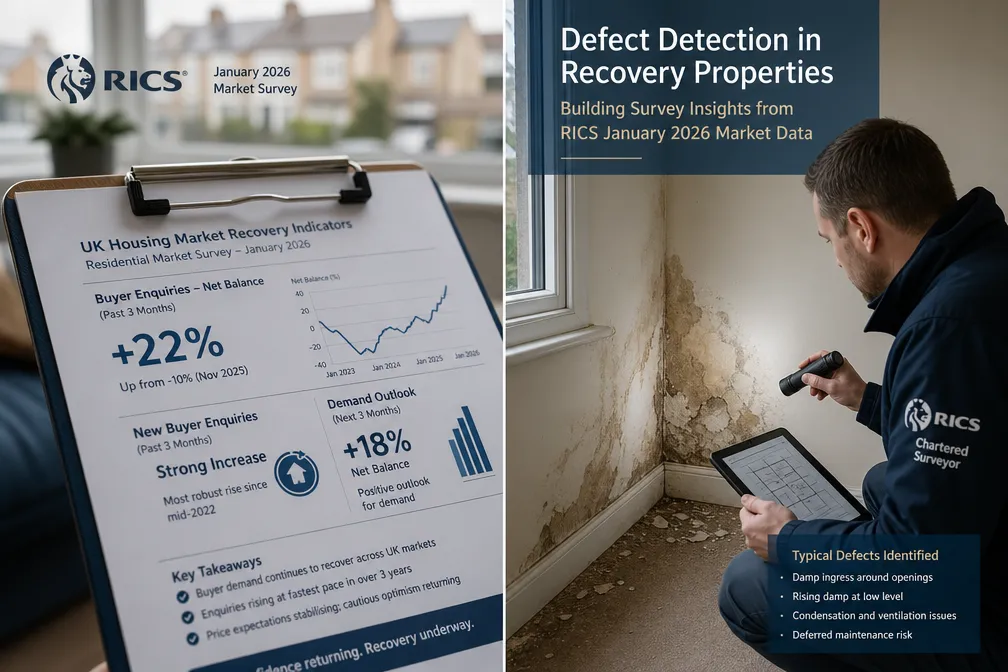
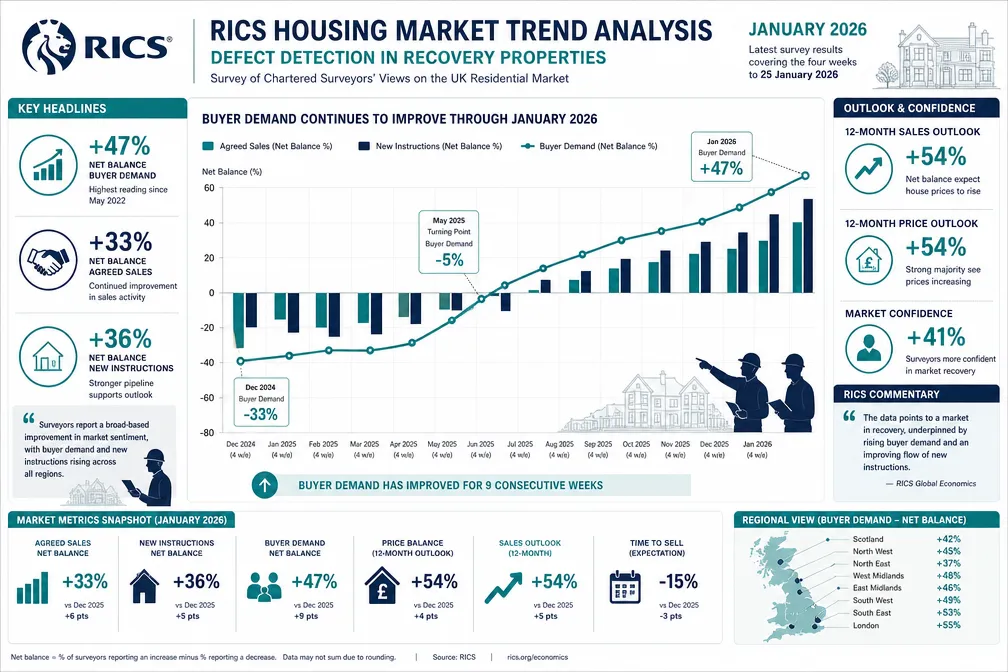
The RICS UK Residential Market Survey for January 2026 recorded a net balance of -15% for new buyer enquiries, a notable improvement from -21% in December 2025 and the least negative demand reading in several months [2][4]. That shift matters beyond headline economics. As transaction volumes begin to recover, a higher proportion of properties entering the market carry deferred maintenance, unresolved structural issues, or concealed defects accumulated during periods of low activity. For building surveyors and buyers alike, defect detection in recovery properties: building survey insights from RICS January 2026 market data has never carried greater professional weight.
Key Takeaways
- The RICS January 2026 survey signals a gradual demand recovery, with buyer enquiries at their least negative reading in months, driving more transactions involving potentially stressed properties.
- Recovery-phase properties frequently exhibit deferred maintenance defects including damp ingress, roof deterioration, structural movement, and failing services.
- A Level 3 RICS Building Survey remains the most thorough tool for identifying hidden defects in older or complex properties entering the market during a recovery cycle.
- Surveyors should apply a prioritised defect checklist aligned to property age, construction type, and the specific risk profile of a recovering market.
- Early defect detection protects buyers from unexpected repair costs and supports more accurate pricing in a market where 12-month price outlooks are turning positive.
What the RICS January 2026 Data Tells Surveyors About Market Conditions
The improvement in buyer demand reported in January 2026 did not emerge in isolation. UK surveyors had already turned more upbeat about the housing market outlook in the preceding weeks [5], and that optimism was reflected in a cautiously improving picture for agreed sales and new instructions. The net balance for house prices remained subdued nationally, but the 12-month price outlook shifted into positive territory, suggesting that market participants expected conditions to stabilise and gradually improve [3][8].
For building surveyors, this data carries a specific operational implication. When markets recover from a period of suppressed activity, the pipeline of properties coming to market often includes:
- Long-vacant stock where heating, ventilation, and drainage systems have been inactive
- Investor disposals where cosmetic refurbishment has masked underlying structural problems
- Probate and estate sales where properties have not been maintained for extended periods
- Repossessions and distressed sales where deferred maintenance has compounded over time
The UK House Price Index for January 2026 confirmed that while prices remained broadly stable, transaction volumes were beginning to edge upward [7]. That combination, stable prices, rising transactions, is precisely the environment in which buyers are most likely to compete for properties without commissioning adequate surveys, and most likely to regret it.
“A recovering market does not automatically mean a healthy property stock. The defects that accumulated during a slow market do not disappear when buyer sentiment improves.”
Understanding this context is essential for anyone commissioning a building survey in 2026. The market signal is positive; the physical condition of the property stock is a separate question entirely.
Common Defects Found in Recovery-Phase Properties
Defect detection in recovery properties requires surveyors to think systematically about the categories of failure most likely to present in stock that has been dormant, under-maintained, or cosmetically improved ahead of a rising market.
Structural Movement and Foundation Issues
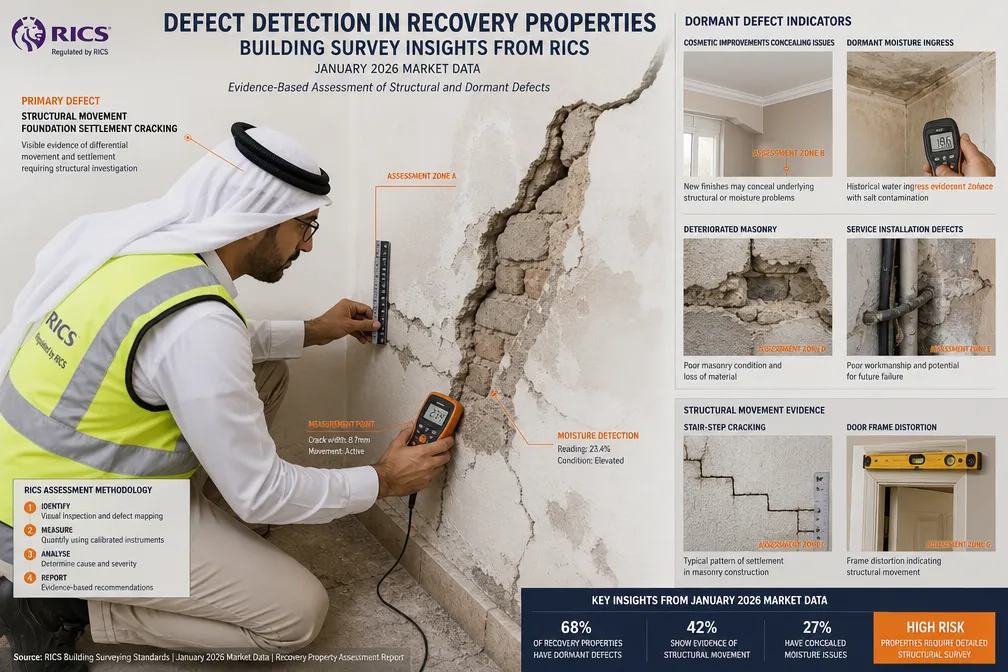
Structural movement is among the most consequential defects a surveyor can identify. In recovery-phase properties, this risk is elevated for several reasons. Properties that have been vacant may have experienced changes in ground moisture levels, particularly relevant in clay-rich soils across southern England, leading to differential settlement or subsidence. Crack patterns should be assessed for:
- Tapered versus parallel cracks (indicating active versus historic movement)
- Location relative to openings (lintels, window frames, door heads)
- Stair-step cracking in brickwork versus horizontal cracking in mortar courses
- Internal plaster cracking aligned with structural walls
A surveyor working to RICS Level 3 standards will probe, measure, and photograph crack patterns, assess their likely cause, and recommend specialist investigation where warranted. For properties in areas with known shrinkable clay geology, this assessment is non-negotiable.
Damp Ingress and Moisture-Related Defects
Damp is the single most frequently encountered defect in UK residential properties, and its prevalence increases significantly in recovery-phase stock. Properties that have been unheated, poorly ventilated, or subject to cosmetic redecoration ahead of sale are particularly vulnerable. A specialist damp survey can distinguish between:
| Damp Type | Common Cause | Survey Indicator |
|---|---|---|
| Rising damp | Failed or absent DPC | Tide mark at low level, salt crystallisation |
| Penetrating damp | Defective pointing, failed flashings | Localised staining, pattern linked to external feature |
| Condensation | Poor ventilation, thermal bridging | Mould growth at cold bridges, even distribution |
| Plumbing leaks | Aged pipework, failed joints | Staining near service runs, floor softness |
Cosmetic redecoration, new plasterwork, fresh paint, new flooring, can conceal moisture damage for weeks or months after a survey. Surveyors should use calibrated moisture meters, thermal imaging where appropriate, and physical probing to look beneath surface finishes.
Roof Structure and Coverings
Roof defects are disproportionately common in properties that have been under-maintained. In recovery-phase stock, the surveyor should assess:
- Tile and slate condition: cracked, slipped, or missing units
- Flashings: lead, mortar, or proprietary flashings at abutments, valleys, and chimney stacks
- Flat roof coverings: blistering, ponding, failed upstands
- Roof structure: sagging ridge lines, spread rafters, inadequate purlin support
- Gutters and downpipes: blockages, failed joints, inadequate fall
A sagging roofline visible from the street is a clear indicator of structural concern. Less visible problems, failed valley flashings, blocked internal gutters, can cause significant water ingress before they become apparent internally.
Building Services and Electrical Installations
Aged or unmaintained building services represent a significant risk category in recovery properties. Electrical installations in properties built before 1970 may contain aluminium wiring, rubber-insulated cables, or outdated consumer units that do not meet current standards. Gas installations in long-vacant properties should be treated as potentially unsafe until inspected by a Gas Safe registered engineer.
Surveyors should note:
- Age and condition of the consumer unit (fuse board versus modern RCD-protected board)
- Evidence of DIY electrical work (non-standard fittings, surface-run cables)
- Age and type of boiler and heating system
- Condition of visible pipework (lead supply pipes in pre-1970 properties)
Prioritised Defect Detection Checklist for Surveyors in a Recovery Market
The RICS January 2026 data, combined with revised RICS property measurement guidance taking effect in Q2 2026 [10], underscores the need for surveyors to apply consistent, prioritised methodologies when assessing recovery-phase properties. The following checklist is structured by risk priority.
Priority 1: Safety-Critical Defects
These defects require immediate attention and should be flagged prominently in any survey report:
- Structural instability: active movement, failed foundations, compromised load-bearing elements
- Electrical hazards: unprotected live conductors, condemned installations
- Gas safety: unsafe appliances, suspect pipework, inadequate ventilation
- Asbestos: suspected asbestos-containing materials in pre-2000 properties requiring specialist survey
For properties with suspected structural issues, a specialist defect survey provides the depth of investigation required to quantify risk and inform remediation costs.
Priority 2: Significant Defects Affecting Value and Mortgageability
- Active damp ingress with evidence of structural timber decay
- Roof structure failure or widespread covering deterioration
- Failed drainage (blocked, collapsed, or root-invaded drains)
- Non-standard construction elements (concrete frame, prefabricated panels), see guidance on non-standard construction
- Absence of required planning consents or building regulations approval for extensions
Priority 3: Maintenance Defects Requiring Budgeting
- Repointing requirements to external brickwork
- Isolated roof tile replacement
- Guttering and downpipe repairs
- Internal redecoration following damp remediation
- Replacement of aged but functional boiler
This three-tier prioritisation maps directly onto the RICS condition rating system used in Level 2 and Level 3 survey reports, where Condition Rating 3 represents defects requiring urgent attention, Condition Rating 2 requires repair or replacement but is not urgent, and Condition Rating 1 indicates no immediate action needed.
Choosing the Right Survey Level
The RICS survey framework offers distinct levels of investigation. For recovery-phase properties, particularly older, larger, or structurally complex buildings, the choice of survey level is critical:
- RICS Level 2 (Homebuyer Survey): Suitable for conventionally constructed properties in reasonable condition. Provides a condition rating for each element but does not include opening up or detailed investigation. Explore Level 2 Homebuyer Surveys for standard properties.
- RICS Level 3 (Building Survey): The most comprehensive residential survey, recommended for older properties, those with known defects, or any property where the buyer has concerns. A Level 3 Building Survey includes detailed investigation of all accessible elements, assessment of construction type, and specific advice on repair.
For buyers uncertain about which level is appropriate, a comparison of different survey types provides clear guidance on matching survey scope to property risk.
Defect Detection in Recovery Properties: Building Survey Insights From RICS January 2026 Market Data and the 12-Month Outlook
The positive 12-month price outlook recorded in the RICS January 2026 survey [2][5] creates a specific dynamic for buyers and surveyors. When prices are expected to rise, buyers are incentivised to act quickly. Speed, however, is the enemy of due diligence. The properties most likely to be rushed through the transaction process are precisely those most likely to carry hidden defects, competitively priced stock that appears attractive on the surface but has been brought to market ahead of a rising tide.
Vail Williams’ spring 2026 residential market update noted that improving sentiment was being supported by gradual improvements in mortgage affordability and a stabilising economic backdrop [6]. That improving affordability means more first-time buyers and less experienced purchasers entering the market, buyers who may be less familiar with the risks of inadequate survey coverage.
For building surveyors operating in this environment, the professional obligation is clear: the improving market conditions described in the RICS data do not reduce the importance of rigorous defect detection. They increase it.
Key survey considerations for the current recovery phase include:
- Commissioning a Level 3 survey for any property built before 1980, regardless of apparent condition
- Requesting specialist investigations (drainage CCTV, structural engineer’s report, asbestos survey) where the Level 3 survey identifies concerns
- Using the survey report as a negotiation tool, documented defects support price reductions or vendor remediation requests
- Building realistic repair cost estimates into purchase calculations, not relying on agent valuations that may not reflect defect liability
For commercial property transactions in the recovery phase, the same principles apply. A commercial building survey provides the equivalent depth of investigation for non-residential stock, where defect liability and dilapidations obligations add further complexity.
Conclusion
The RICS January 2026 market data marks a meaningful turning point in UK residential demand, with buyer enquiries at their least negative reading in months and a positive 12-month price outlook emerging across surveyor sentiment [2][4][5]. That recovery, however, brings with it a cohort of properties that have been deferred, cosmetically improved, or brought to market specifically to capitalise on improving conditions, and those properties carry elevated defect risk.
Actionable next steps for buyers and surveyors in 2026:
Commission the right survey level. For any recovery-phase property with age, complexity, or visible concerns, a Level 3 Building Survey is the appropriate starting point. Do not default to a Level 2 survey to save cost on a property that warrants deeper investigation.
Apply a prioritised defect checklist. Structure the survey assessment around safety-critical, value-affecting, and maintenance defects. This ensures the report is actionable and supports informed negotiation.
Request specialist investigations where warranted. A building survey identifies risk; specialist reports quantify it. Damp surveys, subsidence investigations, and drainage surveys should be commissioned without hesitation when the Level 3 report flags concerns.
Use defect data in price negotiations. A well-documented survey report is a negotiating instrument. Buyers who commission thorough surveys in a recovering market are better positioned to negotiate realistic prices than those who proceed without one.
Stay current with RICS guidance. Revised RICS measurement and survey standards taking effect in 2026 [10] mean that surveyors should ensure their methodologies and report formats reflect current professional requirements.
The market recovery signalled by RICS data is an opportunity, but only for buyers who enter transactions with clear, evidence-based knowledge of what they are purchasing. Defect detection in recovery properties, informed by RICS January 2026 market data and delivered through rigorous building survey practice, is the foundation of that knowledge.
References
[1] UK Residential Market Survey – rics.org
[2] UK Residential Market Survey January 2026 – rics.org
[3] Trading Economics – tradingeconomics.com
[4] UK Housing Market Shows Early Signs Recovery RICS Survey Shows 2026-02-12 – reuters.com
[5] UK Surveyors Turn More Upbeat About Housing Market Outlook 2026-01-15 – reuters.com
[6] UK Residential Property Market Update Spring 2026 – vailwilliams.com
[7] UK House Price Index For January 2026 – gov.uk
[8] Property Market Turns Decisively More Positive Says RICS – littlewoods-estateagents.co.uk
[9] Building Surveys Explained A Clear Guide For UK Buyers – surveymerchant.com
[10] Revised RICS Property Measurement Guidance Impacts On Building Surveys And Valuations In Q2 2026 – princesurveyors.co.uk
Related services from Canterbury Surveyors
- Dilapidations surveyors
- RICS property valuations
- RICS Homebuyer Surveys (Level 2)
- Building Surveys (Level 3)
Get a fixed-fee quote or call 0204 579 8270.