
Canterbury & Kent
Building Surveys for 2026 Data Centre Developments: Identifying Risks in the UK’s AI Power Boom
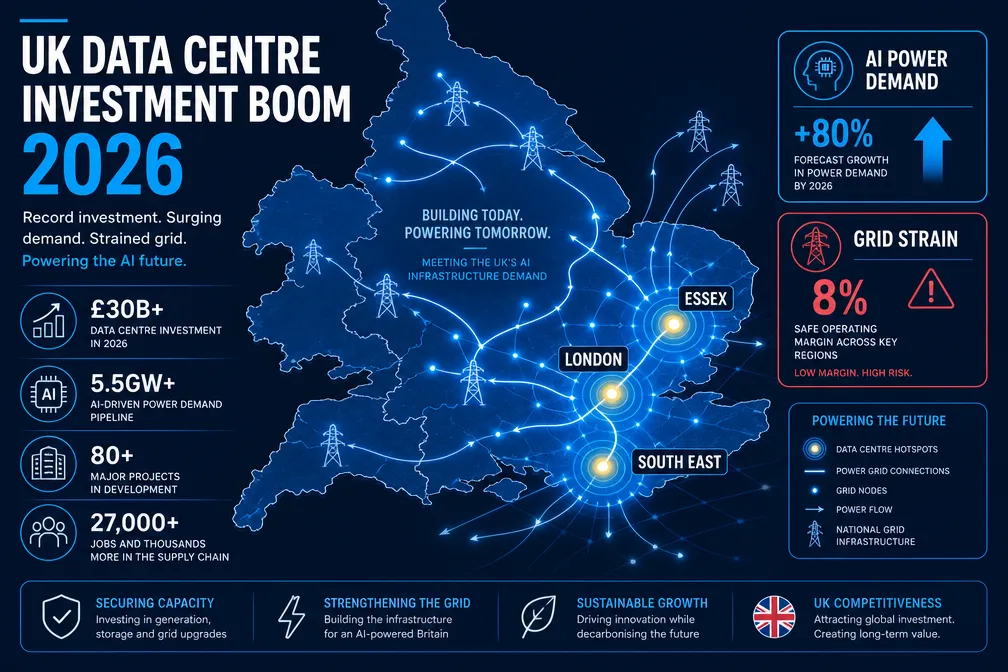
The UK data centre sector attracted over £5 billion in committed investment during 2024 alone, and 2026 is on track to surpass that figure as artificial intelligence workloads drive unprecedented demand for compute infrastructure. Behind every planning approval and ground-breaking ceremony, however, sits a property and structural challenge that many developers underestimate: the buildings housing these facilities must carry electrical loads, floor pressures, and cooling systems that far exceed the tolerances of conventional commercial stock. Building Surveys for 2026 Data Centre Developments: Identifying Risks in the UK’s AI Power Boom are no longer a routine due-diligence box to tick. They are a critical risk management tool that can determine whether a project delivers on time, within budget, and in compliance with RICS standards and UK building regulations.
Key Takeaways
- Data centre developments in 2026 place extreme structural, electrical, and thermal demands on buildings that standard surveys are not designed to assess.
- A specialist RICS-standard building survey should evaluate floor loading capacity, power infrastructure resilience, cooling system integration, and fire suppression compatibility.
- Existing industrial or commercial buildings repurposed as data centres carry legacy risks including inadequate slab thickness, outdated electrical infrastructure, and subsidence vulnerability.
- Compliance checks must address the UK National Planning Policy Framework, Building Regulations Part L (energy efficiency), and the Environment Agency’s cooling water discharge consents.
- Engaging a chartered surveyor with data centre or heavy industrial experience at the earliest possible stage reduces costly redesigns and delays.
Why 2026 Is a Pivotal Year for UK Data Centre Risk Assessment
The convergence of three forces is reshaping the UK data centre landscape in 2026. First, hyperscale cloud providers are expanding their UK footprints to meet the latency requirements of AI inference workloads. Second, the rapid adoption of GPU-dense server racks — drawing 30 kW to over 100 kW per rack compared with the 5-10 kW typical of legacy deployments — is transforming what a “standard” data hall looks like structurally. Third, the National Grid’s constraints in key corridors such as Slough, West London, and parts of Essex mean that developers are increasingly looking at secondary sites, many of which involve older industrial or warehouse buildings that were never designed for critical infrastructure use.
Each of these trends creates a distinct category of surveying risk. A building that comfortably housed a logistics operation may have a ground-floor slab rated to 50 kN/m² — adequate for racking and pallets, but potentially insufficient once UPS battery banks, diesel generators, and densely loaded server racks are factored in. Understanding these risks before contracts are exchanged is the central purpose of Building Surveys for 2026 Data Centre Developments: Identifying Risks in the UK’s AI Power Boom.
“The single most expensive mistake in data centre development is discovering a structural or power infrastructure deficiency after the fit-out has begun. A thorough pre-acquisition survey eliminates that risk.”
Structural Risks: What Surveyors Must Examine
Floor Loading and Slab Integrity
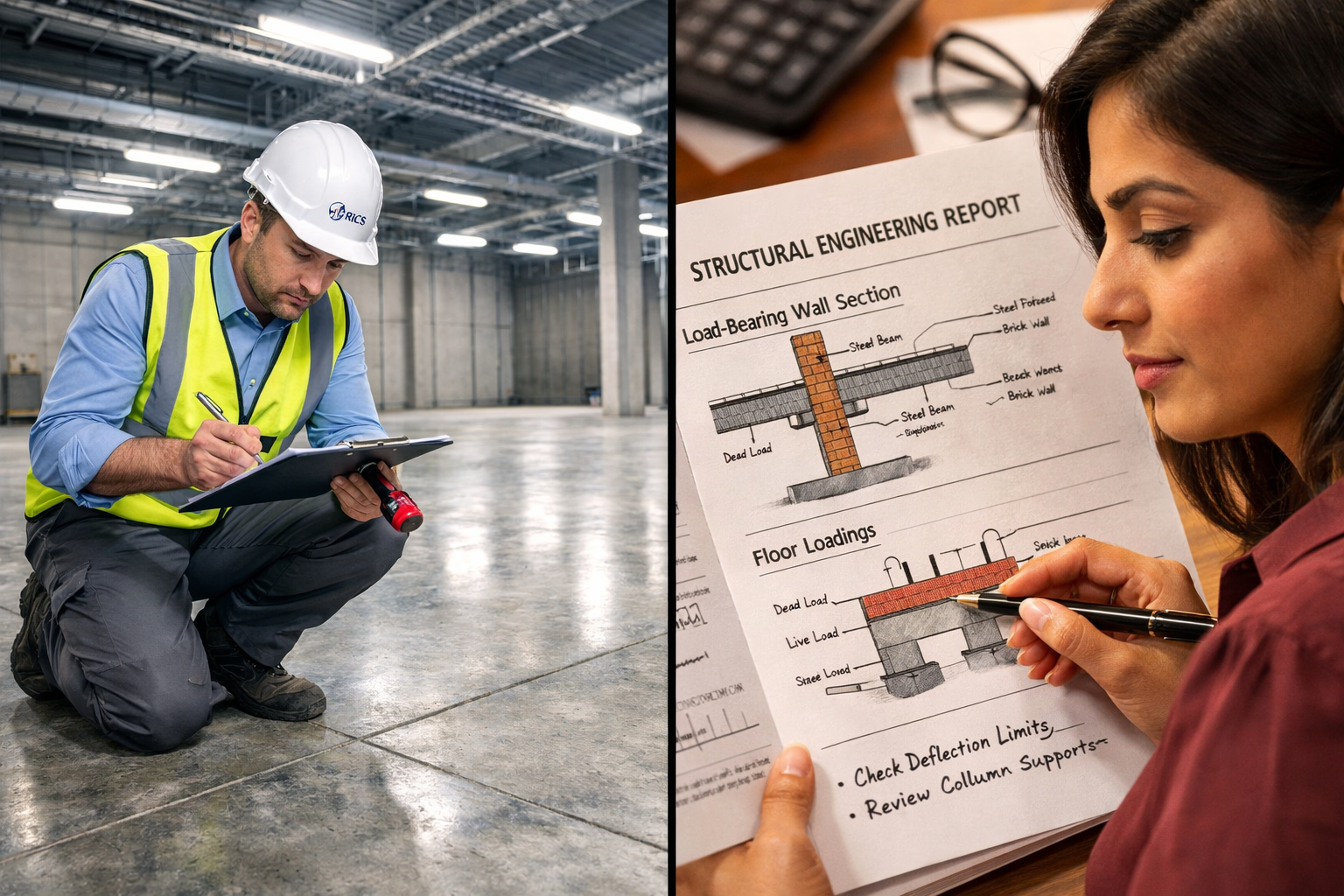
Floor loading is the starting point for any data centre building survey. Modern high-density AI server deployments can impose point loads well above those seen in conventional commercial buildings. A chartered surveyor must assess:
- Slab thickness and reinforcement specification — original construction drawings should be obtained and verified against current loading proposals.
- Condition of the existing slab — cracking, delamination, and previous repairs all affect residual load capacity.
- Sub-base and ground conditions — particularly relevant where raised access floors will carry additional weight.
A solid floor slab survey provides the detailed analysis needed to confirm whether the existing slab can support the proposed fit-out or whether reinforcement, replacement, or load redistribution is required.
Subsidence and Ground Movement
Data centres are long-life assets, typically operated for 15 to 25 years. Ground movement that would be tolerable in a short-term occupancy becomes a significant risk over that timeframe. Sites in areas with shrinkable clay soils — common across South East England, Essex, and parts of Surrey — are particularly vulnerable when the thermal output of a data centre alters soil moisture patterns.
A subsidence survey should be commissioned for any site where:
- The building is founded on London Clay or similar shrinkable subsoil.
- Mature trees are present within root-zone distance of the structure.
- Previous ground-floor cracking has been noted or patched.
- The site has a history of made ground or fill.
Monitoring crack patterns over time using a monitoring survey programme can also provide early warning of progressive movement during the construction and fit-out phases.
Roof Structure and Cooling Infrastructure
Data centres require substantial rooftop plant: cooling towers, dry coolers, air handling units, and increasingly, liquid cooling distribution headers. The roof structure must be assessed for its ability to carry this additional dead load and the dynamic loads imposed by rotating plant.
A roof survey should examine the existing structural frame, purlin condition, waterproofing integrity, and any penetrations required for new services. Older industrial buildings with asbestos-containing roofing materials add a further compliance dimension that must be addressed before any structural work begins.
Electrical Infrastructure Surveys: The Power Density Challenge
Assessing Incoming Power Supply Capacity
The single greatest constraint on UK data centre development in 2026 is grid connection capacity. A building survey for a data centre development must go beyond the physical fabric of the building to assess the electrical infrastructure serving it. Key questions include:
| Assessment Area | Key Risk | Survey Action Required |
|---|---|---|
| Incoming HV supply | Insufficient capacity for planned IT load | DNO capacity confirmation and cable route survey |
| Transformer sizing | Overloading under full IT load | Load flow analysis and thermal rating check |
| Switchgear condition | Age-related failure risk | Thermographic inspection and condition assessment |
| Earthing and bonding | Fault current path integrity | Earth continuity testing and documentation review |
| Generator fuel storage | Planning and fire safety compliance | Bund integrity and drainage survey |
UPS and Battery Room Structural Considerations
Uninterruptible power supply systems and battery banks impose concentrated floor loads that must be assessed separately from the server hall itself. Valve-regulated lead-acid (VRLA) batteries and lithium-ion alternatives both have specific ventilation, temperature, and structural requirements. A structural survey of the proposed battery room should confirm that the floor construction, wall loadings, and ventilation provision are compatible with the battery technology selected.
Fire Suppression System Compatibility
High-pressure inert gas suppression systems — the standard for data halls — impose significant pressure transients on the building fabric when they discharge. Surveyors should check that wall and ceiling constructions are adequately sealed and that pressure relief venting is correctly sized. Failure to address this at survey stage can result in costly remedial works after the suppression system is installed.
Compliance, Dilapidations, and RICS Standards in 2026 Data Centre Surveys
Building Regulations and Planning Compliance
Building Surveys for 2026 Data Centre Developments: Identifying Risks in the UK’s AI Power Boom must address a layered compliance framework. The primary areas of regulatory focus are:
- Part A (Structure): Confirming that structural alterations required for the data centre fit-out comply with approved document standards.
- Part B (Fire Safety): Data centres have specific fire compartmentation requirements, particularly where diesel generators and battery storage are co-located.
- Part L (Conservation of Fuel and Power): The UK’s energy efficiency requirements for new and substantially refurbished buildings apply to data centre fit-outs and increasingly intersect with the sector’s sustainability commitments.
- Part F (Ventilation): Plant room ventilation, cooling system air paths, and battery room ventilation all require compliance assessment.
Where a building is being converted or significantly altered, a licence to alter may be required from the freeholder, and the surveyor’s report should clearly identify which elements of the proposed works trigger this requirement.
Dilapidations Risk for Leasehold Data Centre Sites
Many data centre operators take leasehold interests in industrial buildings rather than purchasing the freehold. This creates a dilapidations exposure at lease end that can be substantial given the scale of fit-out works involved. A pre-acquisition dilapidations survey establishes a clear schedule of the building’s condition at the point of occupation, protecting the tenant from inheriting liability for pre-existing defects.
A schedule of dilapidations prepared at lease commencement is particularly important in data centre developments because the fit-out works — cable penetrations, floor core drilling, structural reinforcement, roof penetrations for plant — are extensive and could otherwise be conflated with pre-existing defects at lease expiry.
RICS Standards and the Role of Chartered Surveyors
The Royal Institution of Chartered Surveyors (RICS) publishes professional standards that govern building surveys in the UK. For data centre developments, the most relevant guidance covers:
- RICS Valuation — Global Standards (Red Book): Relevant where a formal valuation is required alongside the building survey, for example in financing transactions.
- RICS Building Surveys and Technical Due Diligence of Commercial Property: This guidance sets out the scope, methodology, and reporting requirements for commercial building surveys, which form the backbone of data centre due diligence.
- RICS Contamination, the Environment and Sustainability: Particularly relevant for sites with legacy industrial use, where soil and groundwater contamination may affect the development programme.
Engaging a RICS building survey from a qualified chartered surveyor ensures that the assessment meets the professional standards required by lenders, insurers, and planning authorities.
Damp, Contamination, and Environmental Risks
Damp and Water Ingress in Repurposed Industrial Buildings
Older industrial buildings earmarked for data centre conversion frequently present damp-related risks that are incompatible with the operational requirements of IT infrastructure. Water ingress through roof coverings, wall cladding junctions, and below-ground structures can cause catastrophic damage to server equipment and trigger insurance claims that dwarf the cost of a thorough pre-acquisition survey.
A damp survey should assess:
- Roof covering condition and the integrity of all flashings, gutters, and downpipes.
- External wall cladding and the condition of any existing cavity barriers.
- Below-ground waterproofing where the building has basement or semi-basement areas proposed for use as plant rooms or cable vaults.
- Internal condensation risk, particularly in areas where the temperature differential between the IT hall and the external environment is significant.
Soil and Water Contamination
Data centres proposed on brownfield land — former industrial sites, redundant power stations, or decommissioned manufacturing facilities — carry contamination risk that must be assessed before any ground-breaking works. Hydrocarbon contamination from fuel storage, heavy metal residues from manufacturing processes, and asbestos in made ground can all affect the development programme and impose remediation costs.
A soil and water contamination assessment should be commissioned as part of the pre-acquisition survey process, with the results informing both the structural foundation design and the planning application.
Practical Steps for Commissioning a Data Centre Building Survey in 2026
Developers, investors, and operators commissioning Building Surveys for 2026 Data Centre Developments: Identifying Risks in the UK’s AI Power Boom should follow a structured approach:
Define the survey scope clearly. A standard Level 3 RICS building survey covers the physical fabric of the building. Data centre developments require an extended scope that includes structural loading analysis, electrical infrastructure assessment, and compliance review. Agree this scope with the surveyor before instruction.
Obtain all available documentation. Original construction drawings, planning permissions, previous surveys, asbestos management plans, and electrical installation certificates should be assembled before the survey commences. Gaps in documentation are themselves a risk indicator.
Engage specialist sub-consultants where required. Complex structural assessments, electrical infrastructure surveys, and environmental investigations may require specialist input beyond the scope of a single chartered surveyor. A lead surveyor with data centre experience will coordinate these inputs into a coherent report.
Allow adequate time. A thorough building survey for a large industrial building proposed for data centre use will typically take several days on site and several weeks to report. Compressing this timeline increases the risk of missed defects.
Use the survey findings in negotiations. Identified defects and compliance gaps are legitimate grounds for price renegotiation, vendor remediation, or contractual protections. The survey report is a commercial tool as well as a technical document.
Plan for ongoing monitoring. For sites with known ground movement risk or where significant structural alterations are planned, a programme of monitoring surveys during construction provides early warning of problems and protects against future liability.
Conclusion
The UK’s AI-driven data centre boom is creating a wave of complex property transactions and development projects that demand a higher standard of technical due diligence than the market has historically applied. Building Surveys for 2026 Data Centre Developments: Identifying Risks in the UK’s AI Power Boom must address structural loading, electrical infrastructure, compliance obligations, damp and contamination risks, and dilapidations exposure — all within the framework of RICS professional standards.
The cost of a comprehensive specialist building survey is modest relative to the capital at risk in a data centre development. A single unidentified structural deficiency, an inadequate incoming power supply, or an undisclosed contamination liability can each delay a project by months and add millions to the development cost.
Actionable next steps for developers and investors in 2026:
- Commission a specialist RICS building survey with an explicitly extended scope covering structural loading, electrical infrastructure, and environmental risk before exchanging contracts on any data centre development site.
- Ensure the appointed surveyor has demonstrable experience with heavy industrial or critical infrastructure buildings, not just standard commercial stock.
- Request a structural survey that specifically addresses the floor loading requirements of the proposed server hall configuration, including battery rooms and generator plant.
- Where the site is leasehold, commission a pre-acquisition dilapidations survey to establish a clear baseline condition record.
- Build a monitoring programme into the project plan for any site with ground movement, contamination, or significant structural alteration risk.
The UK’s data centre sector will continue to grow as AI adoption accelerates through 2026 and beyond. The developers who build on solid survey foundations will be the ones who deliver on time, on budget, and with the resilient infrastructure that the AI economy demands.
Related services from Canterbury Surveyors
- Dilapidations surveyors
- RICS property valuations
- Building Surveys (Level 3)
- Structural engineers in Canterbury & Kent
Get a fixed-fee quote or call 0204 579 8270.