
Canterbury & Kent
Building Survey Enhancements for 2026 Rental Market Surge: RICS Guidance on High-Yield Tenant Assessments
UK average asking rents have climbed from approximately £1,580 in early 2025 to around £1,950,£1,960 by mid-2026, a rise of nearly 24% in under 18 months, while the number of landlords listing available properties continues to shrink [2][9]. Against that backdrop, Building Survey Enhancements for 2026 Rental Market Surge: RICS Guidance on High-Yield Tenant Assessments has become one of the most pressing professional topics for chartered surveyors, buy-to-let investors, and property managers operating in an increasingly competitive market. The persistent gap between tenant demand and landlord supply, confirmed by consecutive RICS UK Residential Market Surveys, means that properties meeting robust condition and compliance standards will command premium rents and attract higher-quality tenants, but only if surveyors are equipped with updated assessment protocols to identify and quantify those advantages [1][3].
Key Takeaways
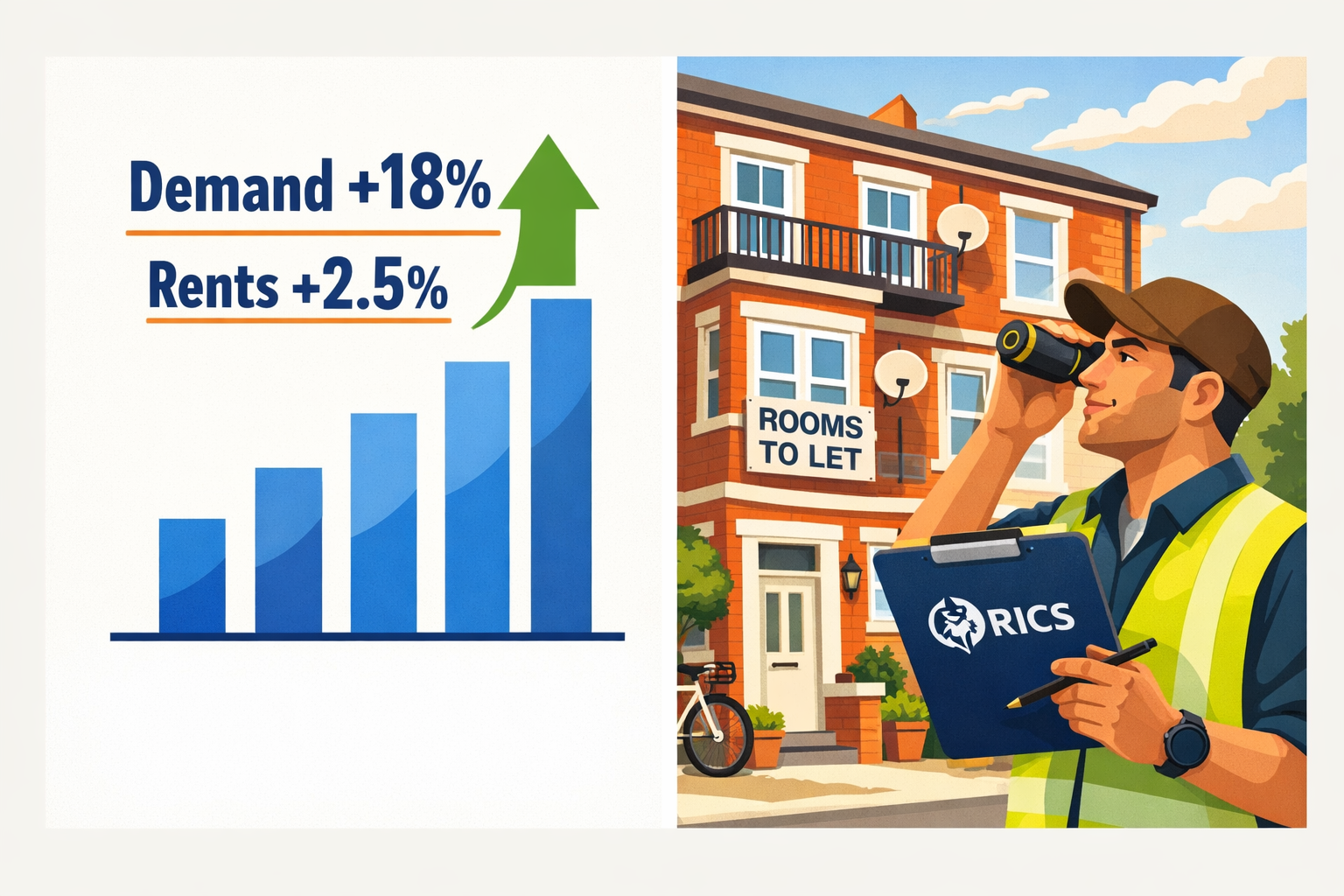
- RICS data for mid-2026 shows tenant demand at a net balance of +18% against landlord instructions at -18%, creating a supply-demand gap that directly inflates achievable yields for well-maintained stock [2][3].
- Enhanced building surveys for the rental market must address HMO licensing compliance, wear-and-tear defect categorisation, and energy performance benchmarks as core deliverables, not optional add-ons.
- Surveyors who integrate yield-impact scoring into their reports provide landlords with actionable data that goes beyond condition ratings, supporting informed investment and refurbishment decisions.
- Dilapidations risk assessment and pre-tenancy condition recording are critical tools for protecting landlord income across all rental property types.
- Selecting the correct survey level and specialist sub-reports, damp, structural, asbestos, is essential for full risk disclosure in the 2026 rental environment.
Why the 2026 Rental Market Demands Upgraded Survey Protocols
The RICS UK Residential Market Survey for May 2026 recorded a net balance of +14% for tenant demand alongside a net balance of -28% for landlord instructions, a divergence that signals acute stock shortages in most UK regions [1][10]. By June 2026, tenant demand had strengthened further to a net balance of +18%, the highest reading since May 2025, while rental price expectations climbed to a net balance of +36%, also the highest since May 2025 [2][3]. RICS survey contributors are forecasting approximately 2.5% rent growth over the next 12 months, reinforcing the commercial case for landlords who invest in property quality [3].
“Where tenant demand persistently outpaces supply, the quality of the asset, verified by a rigorous survey, becomes the primary differentiator between average and exceptional yield performance.”
This environment creates a specific professional obligation for surveyors. Standard condition assessments designed for owner-occupier transactions do not fully address the variables that drive rental income, compliance risk, and tenant retention. The 2026 rental market surge requires surveyors to adopt enhanced protocols that evaluate properties through a dual lens: physical condition and rental viability.
The Supply-Demand Gap and Its Yield Implications
When landlord instructions fall and tenant competition intensifies, rents rise, but not uniformly. Properties with unresolved defects, poor energy ratings, or HMO non-compliance attract lower-quality tenants, generate higher void periods, and expose landlords to enforcement action. Conversely, properties that score well across condition, compliance, and amenity benchmarks achieve rents at or above the upper quartile for their area [5][7].
For surveyors, this means the scope of a rental-focused building survey must expand to include:
- Rental yield impact assessment, quantifying how identified defects affect achievable rent and capital value
- Compliance gap analysis, mapping the property against current HMO, EPC, and fire safety requirements
- Wear-and-tear defect prioritisation, distinguishing cosmetic deterioration from structural or habitability risks
- Tenant-facing condition benchmarking, assessing the property against competing rental stock in the local market
Understanding the full range of building survey options available is the first step toward selecting the right instrument for each rental instruction.
Core Enhancements: HMO Compliance, Defect Categorisation, and Yield Scoring

The practical delivery of Building Survey Enhancements for 2026 Rental Market Surge: RICS Guidance on High-Yield Tenant Assessments rests on three interconnected pillars. Each requires surveyors to go beyond the standard RICS Home Survey Level 2 or Level 3 framework and apply rental-specific analytical layers.
Pillar 1, HMO Compliance Assessment
Houses in Multiple Occupation (HMOs) represent a disproportionately large share of high-yield rental stock, particularly in urban centres and university towns. Yet HMO compliance requirements, covering room sizes, fire door specifications, means of escape, kitchen and bathroom ratios, and licensing thresholds, change regularly, and many existing properties carry latent non-compliance risks that a standard survey will not flag.
An enhanced HMO-focused survey should systematically check:
| Compliance Area | Key Standard | Common Defect Found |
|---|---|---|
| Minimum room sizes | Housing Act 2004 / local authority licensing conditions | Rooms below 6.51 m2 for single adult occupancy |
| Fire safety | BS 5839-6 / BS 9991 | Missing or incorrect grade of interlinked smoke alarms |
| Means of escape | Building Regulations Part B | Blocked or non-compliant escape routes |
| Kitchen/bathroom ratios | Local HMO licensing schedules | Insufficient facilities for occupant numbers |
| Electrical installation | EICR (5-year cycle) | Outdated consumer units, inadequate circuits |
Surveyors should cross-reference findings against the local authority’s HMO licensing register and any applicable Article 4 Direction restrictions. Where a property is approaching a licensing threshold, for example, moving from a small HMO to a large HMO, the survey report should flag the additional compliance obligations that will trigger.
For properties with complex structural or fire-separation issues, a structural survey may be required alongside the main building survey to assess compartmentalisation integrity.
Pillar 2, Wear-and-Tear Defect Categorisation
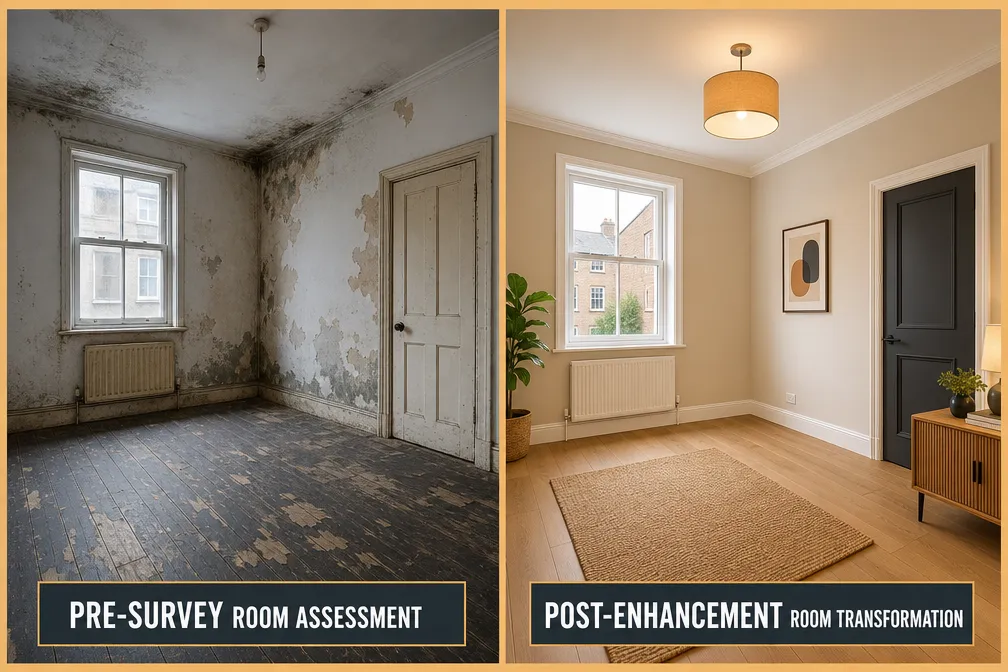
In rental properties, defects accumulate differently from owner-occupied homes. High tenant turnover, deferred maintenance cycles, and the absence of occupier investment in the fabric all accelerate deterioration in specific elements. An enhanced rental survey must categorise defects not only by severity but by tenancy lifecycle impact.
A practical three-tier categorisation framework:
Tier A, Habitability and Compliance Defects These must be resolved before a tenancy commences or renewed. Examples include active damp ingress, defective electrical installations, and inoperative heating systems. Failure to address Tier A defects exposes landlords to Improvement Notices under the Housing Health and Safety Rating System (HHSRS).
Tier B, Yield-Affecting Defects These do not prevent occupation but materially reduce achievable rent or accelerate void periods. Examples include worn floor coverings, dated kitchen and bathroom fittings, and poor decorative condition. Surveyors should quantify the approximate rent uplift achievable through remediation.
Tier C, Monitored Defects These are items that require periodic monitoring but do not currently affect habitability or rent. Examples include minor roof covering wear, isolated pointing deterioration, and early-stage timber movement. The survey should specify a recommended review interval.
For properties where damp is a recurring concern, a common finding in older rental stock, a specialist damp survey provides the detailed diagnosis needed to distinguish condensation from penetrating or rising damp, each of which carries different remediation costs and liability implications.
Pillar 3, Yield Optimisation Scoring
The most significant enhancement surveyors can deliver in 2026 is a yield optimisation score, a structured assessment that translates physical condition findings into rental income projections. This bridges the gap between a condition report and an investment decision tool.
A yield optimisation score should incorporate:
- Current estimated rental value (ERV) based on local comparable evidence
- Post-remediation ERV assuming Tier A and Tier B defects are resolved
- Estimated remediation cost for each tier
- Payback period for Tier B investment based on rent uplift
- Void risk rating based on current condition relative to local market competition
This approach aligns directly with RICS guidance on providing clients with commercially relevant outputs, and it positions the surveyor as a strategic adviser rather than a condition recorder [5][8].
Integrating RICS Guidance into Rental Survey Workflows
Selecting the Right Survey Level
Not every rental property instruction requires a full Level 3 RICS Building Survey. Selecting the appropriate survey instrument is itself a professional judgement that affects both the quality of advice and the cost-effectiveness of the instruction.
RICS Home Survey Level 2, appropriate for standard construction rental properties in reasonable condition, particularly where the landlord requires a rapid assessment of condition and compliance ahead of a new tenancy. The Level 2 Homebuyer Survey provides a structured condition rating across all main elements, which can be supplemented with rental-specific commentary.
RICS Home Survey Level 3, the recommended instrument for older rental properties (pre-1920 construction), HMOs, properties with known structural issues, or any asset where the landlord is considering significant capital investment. The RICS Home Survey Level 3 provides the depth of investigation needed to support yield optimisation scoring and HMO compliance gap analysis.
RICS Commercial Building Survey, applicable to mixed-use rental properties, larger HMOs operating as quasi-commercial assets, and portfolio acquisitions. The commercial building survey framework accommodates the more complex tenure and compliance structures found in commercial-residential hybrid assets.
Pre-Tenancy Condition Recording and Dilapidations Risk
One of the most financially significant, and most frequently overlooked, components of rental property surveying is the pre-tenancy schedule of condition. In the 2026 market, where tenants are competing intensely for available properties and rental values are elevated, disputes over dilapidations at tenancy end have increased in both frequency and monetary value [8].
A properly executed pre-tenancy schedule of condition, prepared by a chartered surveyor, provides a defensible baseline record that protects both landlord and tenant. For commercial and mixed-use rental properties, a formal dilapidations survey at both lease commencement and expiry is standard practice and should be adopted more widely for high-value residential HMOs.
Key elements of a robust pre-tenancy condition record:
- Photographic evidence of all rooms, fixtures, and fittings with date stamps
- Written condition ratings using a consistent scale (e.g., Good / Fair / Poor / Defective)
- Specific notation of any pre-existing defects that could be misattributed to tenant damage
- Confirmation of compliance status for smoke alarms, CO detectors, and electrical installation
Asbestos and Non-Standard Construction Risks
A significant proportion of the UK’s rental stock, particularly properties built between 1950 and 1985, contains asbestos-containing materials (ACMs) in floor tiles, ceiling coatings, pipe lagging, and roof materials. In the context of HMO licensing and ongoing maintenance obligations, the presence of unmanaged ACMs represents both a health and safety liability and a potential licensing barrier.
Enhanced rental surveys should include a preliminary asbestos assessment as a standard component for any property of relevant age, with referral to a specialist asbestos survey where ACMs are suspected or confirmed. This is particularly important where landlords are planning refurbishment works to improve yield, disturbing ACMs without a prior survey and management plan carries significant legal and financial risk.
Practical Application: Building Survey Enhancements for 2026 Rental Market Surge in Regional Markets
The demand-supply dynamics identified by RICS are not uniform across the UK. Regional variation in rental market tightness, local HMO licensing regimes, and the age profile of rental stock all affect how surveyors should prioritise their enhanced assessment protocols [1][7].
In high-demand urban markets, London, Bristol, Manchester, and Edinburgh, the focus should be on compliance gap analysis and yield optimisation scoring, since the rental premium for compliant, well-presented stock is largest in these locations. For surveyors operating in London and the South East, local expertise matters significantly; chartered surveyors in London and chartered surveyors in Surrey bring the local comparable evidence needed to make yield optimisation scoring credible and commercially useful.
In secondary markets and commuter belt locations, the priority often shifts toward wear-and-tear defect remediation and EPC improvement, where the gap between current and achievable rent is most directly linked to physical condition rather than location premium.
Stock Condition Surveys for Portfolio Landlords
Portfolio landlords managing five or more properties face a different set of challenges from single-asset investors. Maintaining consistent condition standards across a portfolio, managing rolling compliance obligations, and planning capital expenditure efficiently all benefit from a systematic stock condition survey approach. This instrument provides a standardised condition baseline across all assets, enabling landlords to prioritise investment where yield impact is greatest and compliance risk is highest.
Conclusion
The convergence of surging tenant demand, constrained landlord supply, and rising rental values in 2026 creates both an opportunity and an obligation for the surveying profession. Building Survey Enhancements for 2026 Rental Market Surge: RICS Guidance on High-Yield Tenant Assessments is not a theoretical framework, it is a practical response to market conditions that are already reshaping the economics of residential and HMO property investment across the UK [1][2][3].
Actionable next steps for surveyors and landlords:
- Audit current survey templates against the three-pillar framework, HMO compliance, wear-and-tear defect categorisation, and yield optimisation scoring, and update reporting structures accordingly.
- Commission the correct survey level for each rental property type, using Level 3 RICS Building Surveys for older stock and HMOs, and supplementing with specialist damp, asbestos, and structural sub-reports where indicated.
- Implement pre-tenancy condition recording as a standard service offering for all rental instructions, with formal dilapidations surveys for higher-value and commercial-residential assets.
- Engage local chartered surveyors with demonstrable knowledge of regional rental market comparables to ensure yield optimisation scores are grounded in real market evidence.
- Review portfolio assets systematically using stock condition survey methodology to identify where capital investment will generate the highest rental return in the current market.
Properties that are surveyed rigorously, maintained proactively, and managed in full compliance with current regulations will consistently outperform the market in yield, tenant quality, and capital resilience, regardless of how the demand-supply balance shifts in the quarters ahead.
References
[1] UK Residential Market Survey May 2026 – rics.org
[2] Rental Demand Surges Landlord Confidence Weakens – realyse.com
[3] RICS Tenant Demand Landlord Supply Tight – landlordknowledge.co.uk
[5] RICS Rents Rising Prices Recovering February 2026 – quidditygroup.co.uk
[7] RICS Update On The Rental Market February 2026 – oakwoodpropertyservices.co.uk
[8] Article – daviesandpartners.co.uk
[9] UK Rental Market Report March 2026 – assets.ctfassets.net
[10] Gloom UK Housing Market Shows No Sign Lifting RICS Survey Shows 2026-05-13 – reuters.com
Related services from Canterbury Surveyors
- Dilapidations surveyors
- RICS Homebuyer Surveys (Level 2)
- Building Surveys (Level 3)
- Structural engineers in Canterbury & Kent
Get a fixed-fee quote or call 0204 579 8270.