
Canterbury & Kent
Snagging and Final Building Surveys for New-Build Homes: Protecting UK Buyers Before the Defects Period Ends
According to the Home Builders Federation’s National New Homes Customer Satisfaction Survey published in March 2025, 93.7% of new-build buyers in the UK reported problems to their builder after moving in, and more than one in four reported over 15 separate snags [4]. That figure alone dismantles the common assumption that buying new means buying problem-free. Snagging and final building surveys for new-build homes represent one of the most effective tools available for protecting UK buyers before the defects period ends, yet a significant proportion of purchasers still rely on developer assurances and standard warranties rather than independent professional inspections.
This guide explains what snagging surveys and end-of-defects-period inspections involve, when to commission them, and how to use the resulting reports to hold developers and warranty providers to account.
Key Takeaways
- Nearly 94% of new-build buyers in the UK report defects to their builder after moving in, making independent snagging surveys essential rather than optional.
- The standard builder responsibility window is two years from legal completion; a dedicated inspection at 21 to 23 months is now considered best practice.
- Two inspection points matter most: a professional snagging survey before or just after legal completion, and a comprehensive final survey near the end of the defects period.
- Independent chartered surveyors produce reports that carry far more weight with developers and warranty providers than buyer-compiled lists.
- Acting before the two-year window closes is critical, once it expires, the contractual obligation for the developer to repair defects at no cost to the buyer ends.
Why New-Build Homes Are Not Immune to Defects
The marketing of new-build properties often centres on the appeal of a blank canvas, modern fittings, energy-efficient systems, and the reassurance of a structural warranty. In reality, the construction process involves dozens of subcontractors working under commercial time pressure, and the result is rarely flawless.
Common categories of defects identified during professional snagging surveys include:
- Cosmetic finish defects: Poorly painted surfaces, misaligned tiles, scratched glazing, uneven plastering, and incomplete grouting.
- Joinery and fitting issues: Sticking or misaligned doors and windows, poorly fitted kitchen units, and gaps around skirting boards.
- Mechanical and services defects: Incorrectly installed boilers, poorly balanced radiators, inadequate ventilation, and plumbing leaks.
- Structural and fabric issues: Hairline shrinkage cracks, settlement cracks, inadequate insulation installation, and roof tile defects.
- External works: Poorly laid driveways, defective pointing, inadequate drainage falls, and fencing not erected to specification [6].
Research consistently shows that latent defects, those which are not visible at completion but emerge as the building settles, seasons change, and occupants use the property, account for a significant proportion of reported issues [1]. This is precisely why a single inspection at the point of handover is insufficient. Snagging and final building surveys for new-build homes are most effective when they are structured across two distinct inspection stages.
“Buying new does not mean buying perfect. Independent inspection is the only way to establish what a developer is genuinely obliged to fix.”
Understanding the Two-Year Defects Liability Period
Most new-build homes in the UK are sold with a structural warranty from a provider such as the National House Building Council (NHBC), whose Buildmark warranty is the most widely used. Under the Buildmark scheme and most comparable warranties, the first two years from legal completion constitute the builder’s defects liability period [6].
During this window, the developer is contractually obliged to repair defects that arise as a result of the build not meeting the warranty provider’s technical standards. After the two-year period expires, the warranty transitions to a structural-only cover phase (typically years three to ten), which does not cover cosmetic or minor functional defects.
Key implications for buyers:
| Period | Who is responsible | What is covered |
|---|---|---|
| Years 1-2 (Defects Period) | Developer/builder | Most defects including finish, services, and fabric |
| Years 3-10 (Structural Period) | Warranty provider | Major structural defects only |
| After Year 10 | Homeowner | No warranty cover |
This structure creates a clear financial incentive for buyers to identify and formally report all defects before the two-year window closes. Once that deadline passes, the cost of remediation falls entirely on the homeowner [8].
The Two Critical Inspection Points
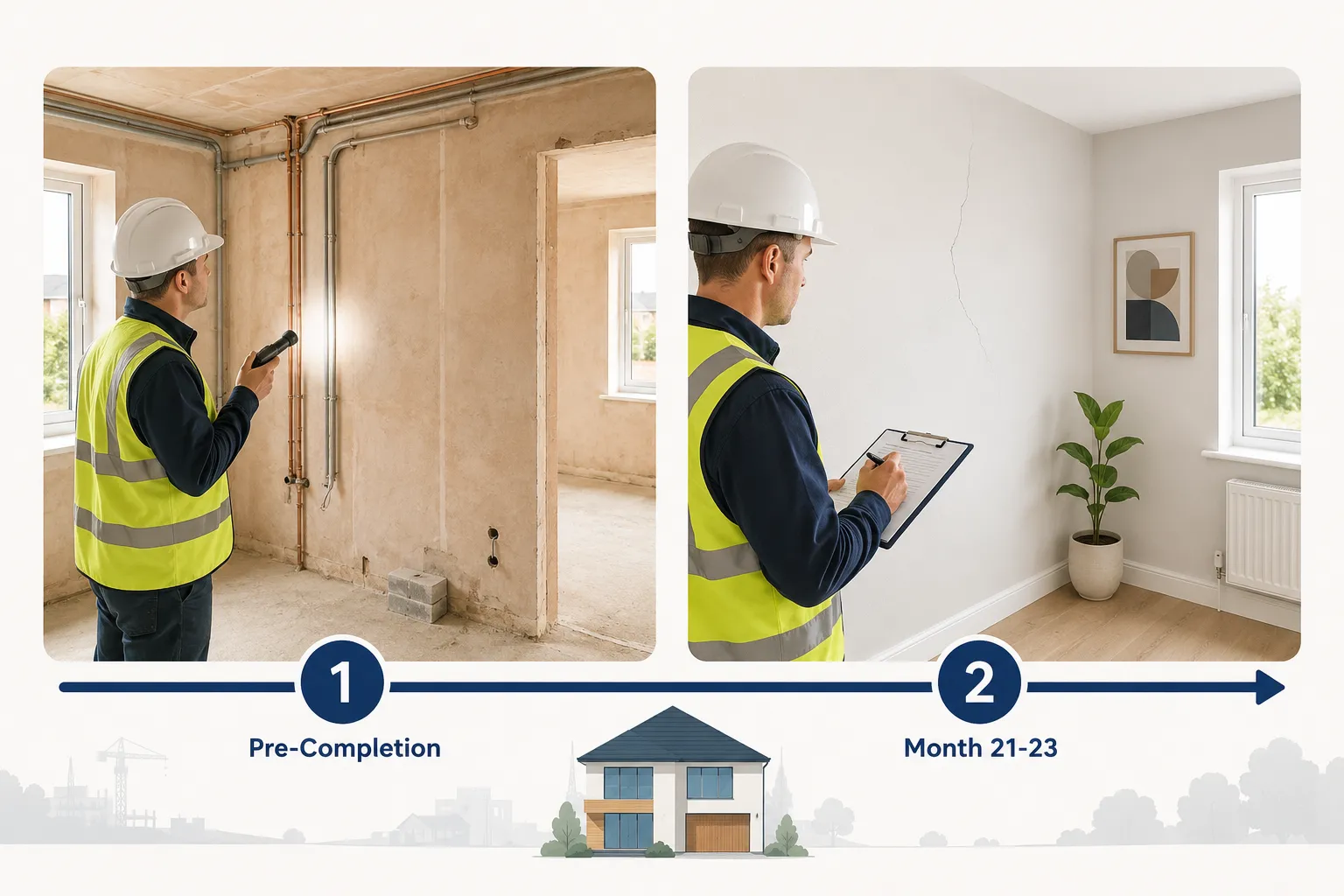
Stage One: The Pre-Completion Snagging Survey
The most effective time to commission an independent snagging survey is before legal completion, when the developer still controls the site and has the strongest incentive to address issues before the sale is finalised. At this stage, a professional surveyor can inspect the property systematically and produce a detailed snagging list that the buyer can submit to the developer as a condition of completion [5].
Some developers resist pre-completion access by independent surveyors, arguing that the property is still a construction site. While this position is legally questionable following the introduction of the New Homes Quality Code, buyers should be aware of this possibility and be prepared to negotiate access firmly. If pre-completion access is refused, the survey should be commissioned as soon as possible after the keys are handed over, ideally within the first two weeks of occupation [1].
A professional snagging survey conducted by a chartered surveyor carries considerably more weight than a buyer-compiled list. Surveyors use systematic inspection methodologies, specialist equipment, and professional terminology that developers and warranty providers recognise and are more likely to act upon.
Stage Two: The End-of-Defects-Period Inspection
The second critical inspection point is a comprehensive survey conducted at approximately 21 to 23 months after legal completion, timed deliberately to fall just before the two-year defects liability period closes [6]. This inspection is sometimes called a final building survey or end-of-warranty inspection.
The purpose of this survey is to identify all defects that have emerged since occupation but that the developer is still contractually obliged to remedy. By month 21 to 23, the building has experienced at least one full seasonal cycle, the structure has undergone initial settlement, and any issues with services, drainage, and ventilation will have had time to manifest [7].
This inspection should be treated as a formal building survey rather than a simple visual walkthrough. It should cover:
- Settlement and shrinkage cracking throughout the structure
- Window and door operation and sealing
- Roof covering and flashings (where accessible)
- Drainage performance and external works
- Heating, ventilation, and hot water systems
- Damp and condensation issues [2]
For buyers who are concerned about moisture ingress or condensation, particularly common in new-builds with high levels of airtightness, a damp survey can be conducted alongside the end-of-defects inspection to provide a complete picture.
What a Professional Snagging Survey Covers
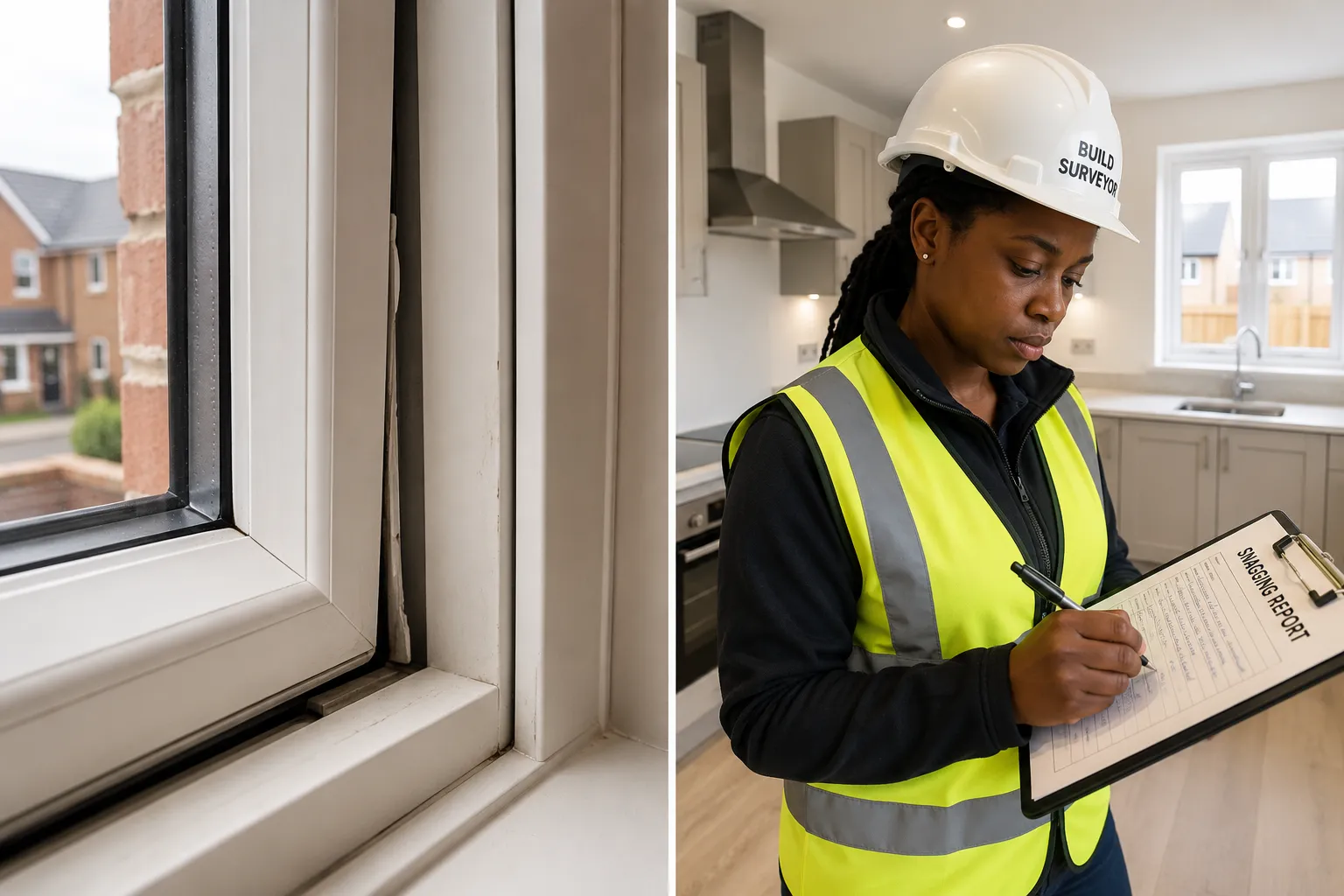
A professionally conducted snagging survey for a new-build home is distinct from a standard Level 2 or Level 3 building survey, though there is significant overlap in methodology. Understanding the scope helps buyers set realistic expectations and use the resulting report effectively.
Inspection Scope
A thorough snagging inspection typically covers the following areas:
Interior:
- All rooms, including loft spaces and storage areas
- Plastering, painting, and decorative finishes
- Flooring installation and condition
- Kitchen and bathroom fittings, tiling, and sanitary ware
- Joinery including doors, windows, staircases, and fitted furniture
- Electrical installation: socket positions, switch alignment, consumer unit labelling
- Plumbing: visible pipework, taps, shower enclosures, and drainage
Exterior:
- Brickwork, pointing, and render
- Roof covering, ridge tiles, verges, and guttering
- Windows and external doors: sealing, operation, and glazing quality
- Driveways, paths, and boundary treatments
- Drainage gullies and inspection chambers
The Snagging Report
The output of a professional inspection is a detailed written report, typically supported by photographs, that categorises defects by severity and location. A well-structured report will distinguish between:
- Category 1: Safety-critical defects requiring immediate attention
- Category 2: Functional defects affecting the use of the property
- Category 3: Cosmetic defects affecting appearance but not function
This categorisation helps buyers prioritise their communications with the developer and provides a clear basis for escalation if the developer fails to act [8].
For buyers who want to understand how snagging surveys compare to other inspection types, the guide to choosing the right property survey provides a useful framework for decision-making.
Using the Snagging Report with Developers and Warranty Providers
Commissioning a survey is only the first step. The report’s value depends entirely on how it is used. The following process is recommended by independent surveying professionals:
- Submit the report formally in writing to the developer’s customer care team within the defects liability period, retaining copies of all correspondence.
- Set a reasonable response deadline, typically 28 days for non-urgent defects and 24 to 48 hours for safety-critical issues.
- Request written confirmation of which items the developer accepts responsibility for and a timetable for remediation.
- Document all remediation work with photographs and written records, noting dates and the identity of contractors.
- Re-inspect after remediation to confirm that defects have been properly addressed rather than superficially concealed.
- Escalate unresolved issues to the warranty provider (e.g., NHBC) if the developer fails to act within the agreed timeframe.
If a developer disputes the findings of an independent snagging report, the report produced by a chartered surveyor carries professional weight and can support formal complaints to the New Homes Ombudsman Service, which became operational under the Building Safety Act framework [7].
For complex disputes involving structural matters, buyers may also benefit from the support of an expert witness surveyor who can provide professional testimony if matters escalate to formal dispute resolution.
Common Defects Found Near the End of the Defects Period
The 21-to-23-month inspection frequently uncovers defects that were invisible at completion. The most commonly reported categories at this stage include:
Settlement and shrinkage cracking: New buildings undergo significant movement in the first two years as materials dry out and the structure settles. While fine hairline cracks are normal, wider or stepped cracks, particularly in masonry, may indicate more significant movement that warrants investigation. Buyers who are concerned about structural movement should consider a specialist survey for subsidence as part of their end-of-defects inspection.
Sticking doors and windows: Differential settlement and timber shrinkage frequently cause doors and windows to stick, bind, or fail to seal correctly. These issues are often dismissed by developers at completion but become clearly attributable to construction defects by the two-year mark.
Heating and ventilation failures: Poorly balanced heating systems, inadequate mechanical ventilation in bathrooms and kitchens, and incorrectly commissioned boilers are common findings. These defects can contribute to condensation and mould growth if left unaddressed.
Drainage and external works: Settlement of driveways and paths, inadequate falls to drainage channels, and poorly installed soakaways are frequently identified at the end-of-defects inspection after the first winter has tested the drainage system under load [2].
Snagging and Final Building Surveys for New-Build Homes: Protecting UK Buyers Before the Defects Period Ends, Practical Checklist
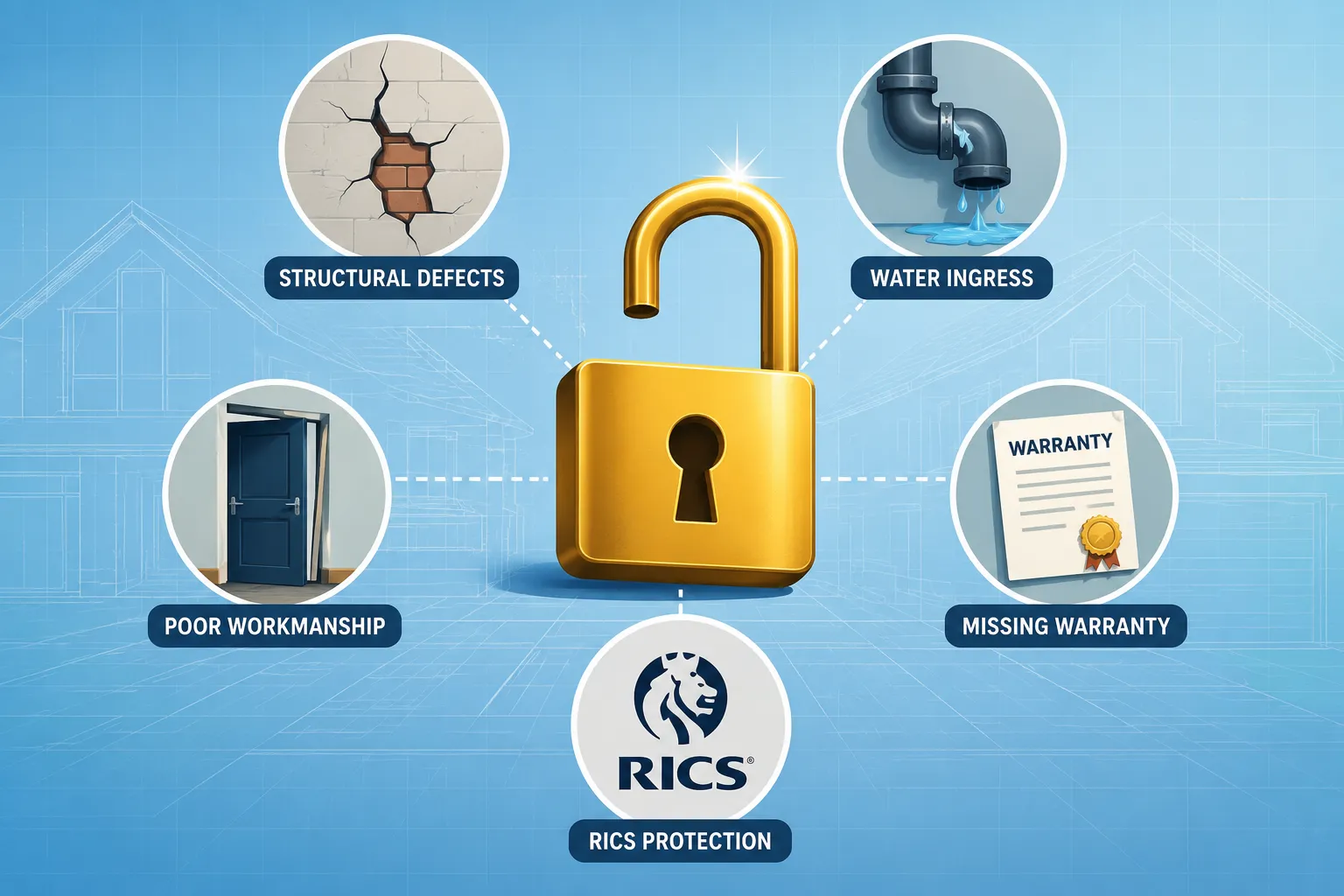
The following checklist summarises the key actions buyers should take to maximise the protection available through snagging and final building surveys for new-build homes before the defects period ends:
- Commission an independent professional snagging survey before or immediately after legal completion
- Submit the snagging report to the developer in writing and retain all correspondence
- Keep a photographic record of all defects and all remediation work
- Book a comprehensive end-of-defects survey at 21 to 23 months after completion
- Report all outstanding and newly identified defects to the developer in writing before the two-year anniversary
- Escalate unresolved issues to the warranty provider and, if necessary, the New Homes Ombudsman
- Retain all survey reports, correspondence, and remediation records for the full warranty period
How to Choose the Right Surveyor for a New-Build Inspection
Not all surveyors have equal experience with new-build inspections. When selecting a professional for a snagging survey or end-of-defects inspection, buyers should look for:
- RICS membership or equivalent professional accreditation, this ensures the surveyor is bound by professional standards and carries professional indemnity insurance.
- Demonstrable experience with new-build properties, the defect patterns in new construction differ from those in older stock, and specialist knowledge is valuable.
- Clear scope of inspection, the surveyor should be able to explain precisely what their inspection covers and what format the report will take.
- Independence from the developer, the surveyor must have no commercial relationship with the developer or their contractors.
For buyers who want to understand the broader range of survey options available, the full range of property surveys offered by chartered surveyors provides context on how snagging inspections relate to other inspection types such as Level 2 HomeBuyer surveys and more detailed structural surveys.
Conclusion
The data is unambiguous: defects in new-build homes are the norm, not the exception. With nearly 94% of UK buyers reporting problems to their builder after moving in [4], and with the two-year defects liability period representing a finite and non-renewable window of contractual protection, independent snagging and final building surveys are not a luxury, they are a fundamental part of protecting a significant financial investment.
Actionable next steps for new-build buyers in 2026:
- Book a professional snagging survey immediately, do not wait for the developer to invite you to a handover inspection. Commission an independent chartered surveyor before or as soon as possible after completion.
- Diary the 21-month mark, set a calendar reminder to book an end-of-defects inspection at 21 months after legal completion, allowing time for the report to be submitted before the two-year anniversary.
- Treat the snagging report as a legal document, submit it formally, keep copies, and follow up in writing at every stage.
- Do not accept cosmetic repairs that mask structural issues, if a crack is filled without investigation, request written confirmation of the developer’s assessment of its cause.
- Know the escalation route, if the developer fails to act, the warranty provider and the New Homes Ombudsman are available routes of redress.
Snagging and final building surveys for new-build homes are the most reliable mechanism available for protecting UK buyers before the defects period ends. The cost of a professional inspection is modest relative to the potential cost of unresolved defects, and the leverage it provides while the developer’s liability remains live is invaluable.
References
[1] Snagging Survey For New Build Houses – findmysurveyor.com
[2] New Build Snagging Guide – housesurveys.co.uk
[3] Cib10611 – irbnet.de
[4] Snagging Survey – hoa.org.uk
[5] Need Snagging List New Build Home – hoa.org.uk
[6] Snagging New Build Home Guide – new-builds.co.uk
[7] New Build Snagging And Building Surveys Protecting Off Plan Buyers In The 2026 Construction Uptick – princesurveyors.co.uk
[8] Snagging Survey 3876 – samconveyancing.co.uk
Related services from Canterbury Surveyors
- Boundary surveys
- Building expert witness surveyors
- RICS Homebuyer Surveys (Level 2)
- Building Surveys (Level 3)
Get a fixed-fee quote or call 0204 579 8270.